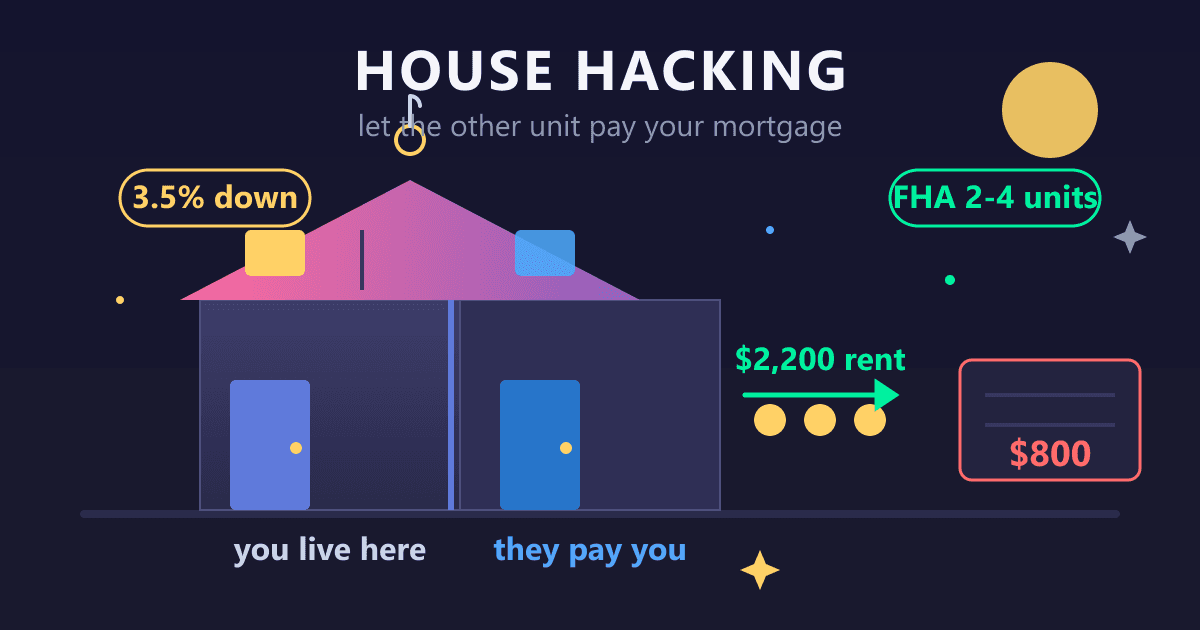
House hacking is a real estate strategy where you live in a property while renting out part of it to offset your housing costs. A typical house hack can reduce your effective mortgage payment by 50-100%, allowing you to build equity while paying less than renting.
For example, a $3,000 monthly mortgage on a duplex with $2,200 in rental income from the other unit means you effectively pay only $800 per month to live there—while building equity in a property you own.
Try House Hacking Calculator — free, no sign-up, and it runs entirely in your browser.
With median home prices at $419,000 and mortgage rates near 6.2%, over half of millennials and Gen Z homebuyers are now considering house hacking as their entry point into real estate. The strategy works particularly well with FHA loans, which allow just 3.5% down on properties up to four units.
This guide explains how house hacking works, the numbers you need to analyze, and whether the strategy makes sense for your situation.
→ Run your numbers with our free House Hacking Calculator.
What Is House Hacking?
House hacking is a real estate strategy where you live in a property while renting out portions of it to generate income that offsets your housing costs. The rental income from housemates or tenants reduces—or in the best cases, eliminates—your effective housing payment.
Several variations exist. The classic approach involves purchasing a small multifamily property (duplex, triplex, or fourplex), living in one unit, and renting the others. A single-family variation involves renting spare bedrooms to housemates. ADU (accessory dwelling unit) strategies convert garages or build backyard cottages to create rental income from single-family properties.
The key advantage is financing. Owner-occupied properties qualify for residential mortgages with lower down payments and better rates than investment properties. An FHA loan requires only 3.5% down for properties up to four units, as long as you live in one unit. This makes house hacking one of the lowest-capital-requirement paths into real estate investing.
What Are the Different Types of House Hacking?
| House Hack Type | Description | Best For |
|---|---|---|
| Duplex/Triplex/Fourplex | Live in one unit, rent the others | Maximum rental income with separate living spaces |
| Rent-by-the-Room | Rent individual bedrooms in a single-family home | Higher per-square-foot income, lower purchase price |
| ADU Strategy | Add or convert a separate unit (garage, basement, backyard) | Existing homeowners, single-family neighborhoods |
| Short-Term Rental | Rent units/rooms on Airbnb while living there | Higher income potential, more management required |
Duplex, triplex, or fourplex ownership is the traditional house hack. You occupy one unit and rent the others. A fourplex generates three rental income streams while you live in the fourth unit. Properties with four or fewer units qualify for residential financing with owner-occupancy.
Rent-by-the-room in a single-family home can generate more per-square-foot income than renting a whole unit but involves shared living space. Many house hackers generate $1,500-$3,000 monthly renting 2-3 bedrooms.
ADU strategy involves building or converting a separate dwelling unit—garage conversions, basement apartments, or detached backyard units. Recent zoning changes have made ADU construction significantly easier in most states.
Short-term rental on platforms like Airbnb can generate 20-50% more income than long-term rentals but involves more work and regulatory considerations.
Is House Hacking Worth It in 2026?
Yes, house hacking remains one of the best wealth-building strategies in 2026, though the math is tighter than in lower-rate environments. In current conditions, covering 75% of your mortgage with rental income is considered a strong outcome.
Current market conditions create both challenges and opportunities:
- Mortgage rates around 6.2% are higher than pandemic lows but below the historical average. Fannie Mae projects rates declining toward 5.9-6.1% by late 2026.
- Average landlord gross profit runs approximately $8,552 annually across all rental properties. House hackers often do better by eliminating property management fees.
- Rents continue rising—nearly 78% of property owners plan increases in 2026, meaning your rental income should grow while fixed-rate mortgage payments stay constant.
The key metric: compare your net housing cost (mortgage minus rental income) to what you would pay renting. If house hacking costs you $800/month while a comparable rental costs $1,500, you are saving $700/month while building equity.
How Do You Finance a House Hack in 2026?
FHA loans are the most popular financing option for house hacking, requiring only 3.5% down on properties up to four units. This makes house hacking accessible to buyers without substantial savings.
2025 FHA Loan Limits for House Hacking
| Property Type | 2025 FHA Limit (High-Cost Areas) | Minimum Down (3.5%) |
|---|---|---|
| Single-Family | $1,209,750 | $42,341 |
| Duplex | $1,549,500 | $54,232 |
| Triplex | $1,872,275 | $65,530 |
| Fourplex | $2,326,875 | $81,441 |
Note: Floor limits (minimum) start at $524,225 for single-family. Local limits vary by county.
FHA House Hack Requirements
- Credit score: 580 minimum for 3.5% down (500-579 requires 10% down)
- Debt-to-income ratio: Typically under 43%
- Occupancy: Must be your primary residence for at least one year
- Property type: 1-4 units qualifies for residential financing
VA loans offer even better terms for eligible veterans—zero down payment and no private mortgage insurance on properties up to four units with owner occupancy.
ADU Regulatory Changes Opening New Opportunities
Accessory dwelling unit regulations have loosened dramatically in recent years, creating new house hacking opportunities for single-family homeowners.
-
California continues leading ADU reform. AB 2533 (effective January 2025) creates a pathway to legalize unpermitted ADUs built before 2020. SB 1211 allows up to 8 detached ADUs on multifamily lots. AB 1033 enables ADUs to be sold separately as condominiums. CalHFA offers grants up to $40,000 for predevelopment costs.
-
Massachusetts now allows ADUs up to 900 square feet by-right in single-family zones, effective February 2, 2025. This eliminates the need for special permits or zoning variances in most situations.
-
Colorado prevents local jurisdictions from prohibiting ADU construction where zoning otherwise allows residential development, effective June 30, 2024.
Similar reforms are spreading nationally. These changes mean single-family homeowners can increasingly add rental units to their properties, creating house hacking opportunities from properties that previously couldn't support the strategy.
See if house hacking works for you. Our House Hacking Calculator shows exactly how much of your mortgage rental income can cover and compares the result to renting.
How Do You Analyze a House Hack Property?
The four key metrics for evaluating any house hack are: net monthly housing cost, mortgage coverage percentage, comparison to renting, and cash-on-cash return. Use our House Hacking Calculator to run these numbers instantly.
House Hack Analysis Metrics
| Metric | What It Measures | Target |
|---|---|---|
| Net monthly cost | Mortgage minus rental income | Lower than renting equivalent |
| Mortgage coverage | % of mortgage covered by rent | 75%+ is strong in 2026 |
| Cash-on-cash return | Annual savings / total cash invested | 10%+ is good; 20%+ is excellent |
| Comparison to rent | House hack cost vs. renting | Savings while building equity |
Example analysis for a $400,000 duplex:
- Monthly mortgage (PITI): $3,000
- Rental income from other unit: $2,200
- Net monthly cost: $800
- Mortgage coverage: 73%
- If renting equivalent space costs $1,500: saving $700/month ($8,400/year)
- On $20,000 invested (down payment + closing): 42% cash-on-cash return
Critical reserves to budget: 5-8% of rental income for vacancy and 5-10% for maintenance. These costs will occur—excluding them makes projections unrealistically optimistic.
What Are the Biggest House Hacking Mistakes?
The six most common house hacking mistakes can turn a wealth-building strategy into a financial and lifestyle burden:
-
Choosing location based on price alone. A cheap property in an undesirable area will struggle to attract quality tenants and may have poor appreciation. Balance purchase price against rental demand, tenant quality, and neighborhood trajectory.
-
Ignoring local ordinances. Some areas restrict short-term rentals, have occupancy limits, or require landlord licensing. Research local regulations before purchasing—violations can mean fines of $1,000+ per day or forced eviction of tenants.
-
Inadequate tenant screening. Living near your tenants makes tenant quality particularly important. Run credit checks, verify income (should be 3x rent), check references, and conduct background checks. One problem tenant can make your living situation miserable.
-
Underestimating expenses. Maintenance, repairs, vacancy, and capital expenditures add up to 15-25% of rental income. Build realistic expense assumptions into your analysis—optimistic projections lead to cash flow surprises.
-
Not establishing boundaries. When you live near tenants, maintaining landlord-tenant professionalism becomes harder but more important. Set clear expectations upfront about maintenance requests, noise, shared spaces, and payment deadlines.
-
Insufficient emergency fund. Major repairs, extended vacancy, or tenant non-payment can strain finances. Maintain reserves of 3-6 months of total property costs before starting—typically $10,000-$20,000 minimum.
Frequently Asked Questions
How long do I have to live in a house hack property? For FHA and most owner-occupied loans, you must live in the property as your primary residence for at least one year. After that, you can move out and convert it to a pure investment property, then potentially house hack a new property with another owner-occupied loan.
Is house hacking worth it with current interest rates? Yes, though the math is tighter than in lower-rate environments. Focus on properties where rental income covers 75%+ of your mortgage rather than expecting full coverage. The combination of reduced housing expense, equity building, and real estate appreciation still creates significant wealth over time—especially compared to renting.
Can I house hack with no money down? VA loans allow zero down payment for eligible veterans on properties up to four units. Some state and local programs offer down payment assistance. Otherwise, you need at least 3.5% down for FHA ($14,000 on a $400,000 property) or 5% for conventional loans, plus closing costs and reserves.
How do I find tenants for a house hack? List on platforms like Zillow, Apartments.com, Facebook Marketplace, and Craigslist. For room rentals, sites like Roomies and SpareRoom specialize in finding housemates. Local Facebook groups and word-of-mouth referrals can also be effective. Screen all applicants thoroughly—verify income is 3x rent, run credit checks, and check references.
What are the tax benefits of house hacking? You can deduct expenses proportional to the rented portion: mortgage interest, property taxes, insurance, maintenance, and depreciation on the rental percentage. On a duplex, that is typically 50% of all deductible expenses. When you eventually sell, Section 121 exclusion may let you exclude gains on the portion you occupied as your primary residence.
What if I want to move after house hacking? After the one-year occupancy requirement, you can convert the property to a full rental, sell it, or continue house hacking while purchasing another property. Many house hackers build portfolios by repeating the strategy—buy, live in it for a year, move to a new house hack, and keep the previous property as a rental.
How much can I make from house hacking? Returns vary widely by market and property type. A typical duplex house hack saves $500-$1,000/month compared to renting, plus builds equity. Rent-by-the-room can generate $1,500-$3,000/month in gross rental income. The best house hacks achieve 20-50%+ cash-on-cash returns when comparing to renting.
What is the best property type for house hacking? Duplexes offer the best balance of rental income and separate living spaces—you have your own unit while collecting rent from the other. Fourplexes maximize income (three rental units) but cost more. Rent-by-the-room has the lowest entry cost but involves shared living space. Choose based on your budget and lifestyle preferences.
Run the Numbers on Your House Hack
House hacking works best when you enter with realistic expectations and solid analysis. The strategy won't make you rich overnight, but it can dramatically reduce your housing costs, help you build equity, and provide a hands-on education in real estate investing.
The right property in the right location with the right financing can set you up for long-term wealth building. The wrong property—or unrealistic projections—can become a financial and lifestyle burden.
Use our free House Hacking Calculator to analyze potential properties. Enter your purchase price, financing terms, and expected rental income to see your net housing cost, mortgage coverage percentage, and how the numbers compare to renting. Make decisions based on real projections, not hope.