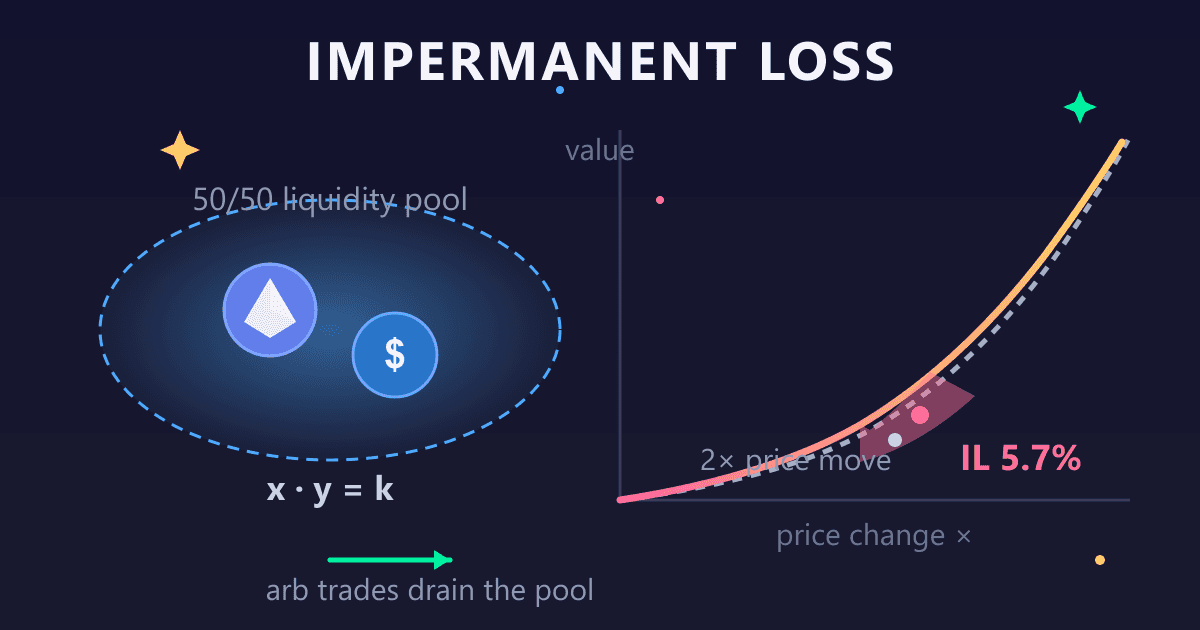
Impermanent loss is the difference in value between holding tokens in a liquidity pool versus simply holding them in your wallet. When token prices change, LPs lose value compared to holding—a 2x price change causes approximately 5.7% impermanent loss, while a 5x change causes 25.5% loss.
Research shows over 51% of Uniswap V3 liquidity providers have been unprofitable, with $260 million lost to impermanent loss in the protocol's first months alone. Understanding this risk is essential before providing liquidity to any DeFi protocol.
Try Impermanent Loss Calculator — free, no sign-up, and it runs entirely in your browser.
With DeFi total value locked reaching $214 billion and DEX volume hitting $462 billion in December 2024, millions of new liquidity providers are entering the market—many without understanding the hidden cost they are taking on.
This guide explains exactly how impermanent loss works, the math behind it, and how to calculate whether your LP position is actually profitable.
→ Check your position now with our free Impermanent Loss Calculator.
What Is Impermanent Loss?
Impermanent loss occurs when the price ratio of tokens in a liquidity pool changes after you deposit them. The loss represents the difference between holding tokens in a pool versus simply holding the same tokens in your wallet.
The "impermanent" label refers to the fact that the loss only becomes permanent when you withdraw liquidity. If prices return to their original ratio before withdrawal, the loss disappears. In practice, prices rarely return to exactly the original ratio, making "impermanent" something of a misnomer—critics prefer "divergence loss."
Impermanent Loss Example
Starting position: You deposit 1 ETH and 1,000 USDC into a 50/50 pool when ETH trades at $1,000. Total value: $2,000.
After ETH doubles to $2,000: The pool automatically rebalances. When you withdraw, you receive approximately 0.707 ETH and 1,414 USDC, worth $2,828.
If you had just held: Your original 1 ETH + 1,000 USDC would be worth $3,000.
Impermanent loss: $3,000 - $2,828 = $172, or approximately 5.7% of what you could have had.
Why Does Impermanent Loss Happen?
Impermanent loss happens because AMMs (automated market makers) use mathematical formulas to maintain token ratios, and arbitrageurs extract value when prices diverge from external markets.
Unlike traditional order book exchanges where buyers and sellers set prices, AMMs use the constant product formula:
x * y = k
Here, x and y represent the quantities of each token in the pool, and k is a constant. When someone trades token A for token B, they add A to the pool and remove B, maintaining the constant product.
When the external market price of an asset changes, arbitrageurs profit by trading with the pool until its prices match the market. Each arbitrage trade extracts value from liquidity providers—and that extracted value is impermanent loss.
How Much Is Impermanent Loss at Different Price Changes?
The relationship between price change and impermanent loss follows a predictable curve. The formula is: IL = 2 * sqrt(price_ratio) / (1 + price_ratio) - 1
| Price Change | Impermanent Loss | Example ($10,000 position) |
|---|---|---|
| 1.25x (25% up or 20% down) | 0.6% | $60 loss vs. holding |
| 1.5x (50% up or 33% down) | 2.0% | $200 loss vs. holding |
| 2x (100% up or 50% down) | 5.7% | $570 loss vs. holding |
| 3x (200% up or 67% down) | 13.4% | $1,340 loss vs. holding |
| 4x (300% up or 75% down) | 20.0% | $2,000 loss vs. holding |
| 5x (400% up or 80% down) | 25.5% | $2,550 loss vs. holding |
Key insight: Impermanent loss is symmetrical. A 50% price decrease causes the same IL as a 100% price increase—both represent a 2x change in price ratio. The direction does not matter; only the magnitude of the change.
How Does Uniswap V3 Concentrated Liquidity Affect Impermanent Loss?
Concentrated liquidity amplifies both fees and impermanent loss. A position with 10x capital efficiency earns 10x more fees but experiences approximately 4x higher impermanent loss compared to a full-range position.
Uniswap V3 allows LPs to provide liquidity within specific price ranges rather than across all possible prices. This capital efficiency is powerful—but comes with significantly higher IL risk.
The critical risk: If the price moves outside your range entirely, you end up with 100% of the less valuable token:
- An ETH/USDC position with a $1,500-$2,000 range becomes 100% USDC if ETH drops below $1,500
- The same position becomes 100% ETH if price rises above $2,000
This represents maximum impermanent loss within your chosen range.
The V3 profitability data is sobering: Research found that 49.5% of Uniswap V3 positions had negative returns even after accounting for trading fees. The increased fee income from concentrated positions often fails to compensate for amplified IL in volatile markets.
Do Trading Fees Cover Impermanent Loss?
Often no. The Bancor study found that 51%+ of Uniswap V3 LPs were unprofitable even after fee income. Whether fees exceed IL depends on four key factors:
| Factor | Best Case | Worst Case |
|---|---|---|
| Volume-to-TVL ratio | High volume, lower liquidity | Low volume, high liquidity |
| Fee tier | Matches volatility (0.3-1% for volatile pairs) | Too low for the pair's volatility |
| Price action | Sideways with high volume | Strong directional trend |
| Time horizon | Short positions during high volume | Long positions during trending markets |
The ideal scenario: Sideways price action with high trading volume generates lots of fees with minimal IL.
The worst scenario: Strong directional moves accumulate IL while potentially generating low volume during the trend.
Key insight: Profitability is not guaranteed and requires active management. A position might be profitable after one week due to high fees but unprofitable after one month if price divergence outpaces fee accumulation.
Know your true returns. Use our Impermanent Loss Calculator to see exactly how price changes affect your LP position and whether fees are covering your losses.
How Can You Minimize Impermanent Loss?
Five strategies for reducing impermanent loss risk:
-
Provide liquidity for correlated assets. Stablecoin pairs (USDC/DAI, USDT/USDC) experience minimal IL because their prices move together. Similarly, pairs like stETH/ETH or wBTC/BTC have reduced IL risk. Tradeoff: lower fee income since these pairs use low fee tiers.
-
Choose appropriate range width (V3). Wider ranges reduce IL amplification but earn fewer fees. Narrower ranges increase both fee income and IL risk. Match your range to expected volatility and your ability to actively manage.
-
Monitor and rebalance actively. Adjust ranges as price moves and exit when IL exceeds fee income. Gas costs on Ethereum mainnet make frequent rebalancing expensive—Layer 2 solutions enable more active management.
-
Time your entries carefully. Entering LP positions after large price moves may reduce IL if prices mean-revert. Avoid entering before major announcements or obviously volatile periods.
-
Consider single-sided liquidity. Some protocols let you deposit only one token, shifting some IL risk to the protocol. Tradeoff: typically lower yields.
Tax Implications of Impermanent Loss
DeFi taxation remains complex and somewhat uncertain, but some principles apply in most jurisdictions. When you deposit tokens into a liquidity pool, you may trigger a taxable event if the deposit is treated as disposing of your original assets. When you withdraw different proportions of tokens than you deposited, the difference in value could create capital gains or losses.
Trading fees earned from LP positions are generally treated as ordinary income in the United States, taxable at your regular income tax rate. This creates a tax obligation even if the overall position is unprofitable due to impermanent loss.
The tax treatment of impermanent loss itself is unclear. It may be deductible as a capital loss when you close the position, but guidance is limited. Keeping detailed records of deposits, withdrawals, and fee accruals is essential for accurate tax reporting.
A significant regulatory development occurred in April 2025 when legislation overturning DeFi broker reporting rules was signed. This eliminated the requirement for DeFi protocols to issue 1099 forms, though individual tax obligations remain unchanged.
What Are Common Impermanent Loss Myths?
Four dangerous misconceptions about impermanent loss:
Myth 1: "IL only happens when prices go down." False. Impermanent loss occurs from any directional price change—up or down. A 2x price increase causes the same 5.7% IL as a 50% decrease. Only the magnitude of ratio change matters.
Myth 2: "Trading fees always cover impermanent loss." False. Over 51% of Uniswap V3 LPs were unprofitable even with fee income. Whether fees exceed IL depends on volume, volatility, and time in position—it is far from guaranteed.
Myth 3: "Stablecoin pools have zero impermanent loss." Mostly true, but not always. Stablecoins can depeg—UST's collapse in 2022 caused massive IL in UST-related pools. Even small depegs of major stablecoins create IL, though typically minor.
Myth 4: "APR displayed on pools includes impermanent loss." Generally false. Most DeFi dashboards show fee APR without accounting for IL. The displayed APR is a best-case scenario assuming zero price divergence. Real returns are often significantly lower.
Frequently Asked Questions
How do I calculate impermanent loss? For a 50/50 pool, the formula is: IL = 2 * sqrt(price_ratio) / (1 + price_ratio) - 1. If one token doubles relative to the other (price_ratio = 2), impermanent loss is approximately 5.7%. Use our Impermanent Loss Calculator to run the math automatically.
Is impermanent loss permanent? It becomes permanent when you withdraw liquidity. Until then, it fluctuates with price changes. If prices return to the exact ratio when you deposited, IL would be zero. In practice, prices rarely return precisely, so some IL typically becomes permanent upon withdrawal.
Why is it called "impermanent" if it usually becomes permanent? The term reflects the technical possibility of IL reversing if prices revert. Critics argue "divergence loss" would be more accurate since the loss stems from price divergence between assets and usually does not fully reverse.
Should I provide liquidity if impermanent loss is so common? LP can still be profitable with the right strategy: choose correlated pairs or stablecoins for lower IL risk, focus on high-volume pools where fees are substantial, and actively manage positions rather than set and forget. Understand that you are betting on fees exceeding IL—and over 50% of LPs lose that bet.
How does impermanent loss differ between Uniswap V2 and V3? V2 positions provide liquidity across all prices, experiencing standard IL from any price change. V3 concentrated positions experience amplified IL within their range (potentially 4x higher) but earn higher fees. V3 positions that move outside their range experience maximum IL and stop earning fees entirely.
Can impermanent loss exceed 100%? No. Maximum IL approaches but never reaches 100%, occurring only as price ratio approaches infinity or zero. Even a 100x price change causes about 81% IL. However, combined with general market decline, your total dollar losses could exceed your initial investment.
What is the best pool for avoiding impermanent loss? Stablecoin-to-stablecoin pools (USDC/DAI, USDT/USDC) have near-zero IL because both assets maintain the same value. Correlated asset pools (stETH/ETH, wBTC/BTC) also have minimal IL. Tradeoff: these pools typically have lower fee tiers and generate less income.
How much impermanent loss is acceptable? Depends on your fee income. If you are earning 20% APR in fees and experiencing 5% IL, you are still profitable. Use our calculator to compare fee income against IL. Generally, if IL exceeds accumulated fees, consider exiting the position.
Calculate Your Impermanent Loss
Impermanent loss is the hidden cost of providing liquidity in DeFi. While the promise of trading fees is attractive, understanding the true economics of your LP positions requires accounting for the value lost to price divergence.
Many LPs do not realize they are losing money until they withdraw and compare the result to what they would have earned by simply holding. Running the numbers beforehand and monitoring positions actively helps you make informed decisions about whether LP makes sense for your situation.
Use our free Impermanent Loss Calculator to model how price changes affect your LP position. Enter your deposit amounts and current prices to see your impermanent loss, compare to holding, and understand whether trading fees are actually making your position profitable.