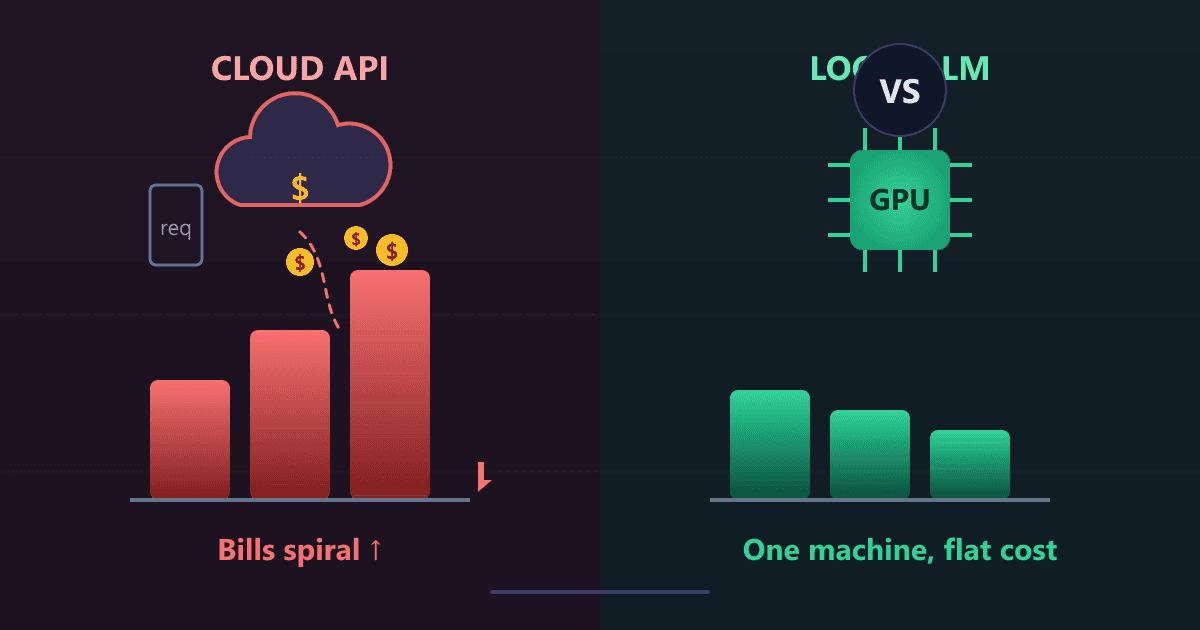
Quick Answer: For small teams spending over $400/month on AI APIs, local LLMs typically cost 70-85% less over three years. A $1,500 hardware investment can pay for itself in 6-8 weeks for teams with moderate usage. Local LLMs eliminate per-token charges entirely, replacing variable costs with fixed electricity costs of $20-40/month. The break-even formula is: Hardware Cost / (Monthly API Cost - Monthly Operating Cost) = months to recoup investment.
Six months ago, our agency's OpenAI bill hit $847. For a team of eight people. In one month.
Try Random Team Generator — free, no sign-up, and it runs entirely in your browser.
I sat in a budget meeting trying to explain why our "experimental AI initiative" was hemorrhaging money faster than we'd anticipated. The CFO wanted answers. The creative director wanted to keep using the tools that tripled her team's output. I wanted to understand how a few team members asking ChatGPT to write email drafts escalated into a four-figure monthly expense.
That conversation pushed me to research alternatives. Not to eliminate AI from our workflow—the productivity gains were undeniable—but to find a sustainable economic model. Cloud APIs charge per token. Local models require upfront investment. Which approach actually costs less for a small team over a realistic timeframe?
I spent the next two months building detailed financial models, testing hardware configurations, and calculating total cost of ownership. This article presents what I learned: the real numbers, the hidden costs, the break-even analysis, and the decision framework I wish I'd had before that budget meeting.
How Do AI API Costs Spiral Out of Control for Small Teams?
Our agency started with good intentions. Three months earlier, we'd signed up for OpenAI's $20/user plan, calculating a maximum monthly cost of $160 for eight team members. Everyone could use ChatGPT for reasonable productivity enhancement. Simple.
Within weeks, patterns emerged that I should have anticipated but didn't:
Usage grew organically. Writers discovered AI-assisted research. Developers used it for code review. Account managers drafted client communications. Each person found legitimate uses that genuinely improved their work. Nobody was wasteful or excessive. They were productive.
Heavy users emerged. Two team members accounted for 60% of our usage. One writer used AI extensively for content drafts and research synthesis. One developer used it for code documentation and problem-solving. Their output quality improved measurably. I couldn't ask them to cut back.
The $20 plan limits bit hard. Several team members hit their message caps mid-month. They either stopped using the tool when they needed it most or switched to pay-as-you-go API access at higher per-token rates.
We escalated to API access. I built a simple internal tool using the OpenAI API so team members wouldn't hit arbitrary message limits. Everyone could work without constraints. I set up monitoring to track costs.
That monitoring revealed uncomfortable truths. API calls that felt instantaneous and weightless carried real costs. One team member's "quick brainstorming session" might burn through 50,000 tokens. A developer asking the API to review a large code file consumed hundreds of thousands of tokens. The bills added up faster than expected.
The February invoice showed $847. Broken down:
- Base subscriptions: $160 (eight users at $20)
- API usage: $687 (approximately 12 million tokens across input and output)
The CFO asked a reasonable question: "Will this keep growing? What's our monthly AI budget next quarter? Next year?"
I had no good answer. Usage was still climbing as more team members discovered effective workflows. If we reached steady-state at $850/month, we'd spend over $10,000 annually on AI APIs. That's real money for an agency our size.
That's when I started researching local alternatives.
What Are the True Costs of Running Local LLMs?
The promise of local AI is simple: buy hardware once, pay only for electricity after that. No per-token charges. No usage limits. No surprise bills.
The reality is more nuanced. Local deployment has costs that aren't obvious until you detail them out.
Hardware costs between $800 and $3,000 depending on requirements. An RTX 4070 12GB in a basic workstation runs about $1,500 total. That's a significant upfront investment, but it's a one-time expense rather than recurring costs.
Electricity costs $20-40 per month for typical AI workloads. A GPU running eight hours daily at 250W consumes roughly 60 kWh monthly. At $0.12 per kWh (national average), that's $7.20. Factor in the system's other components and realistic usage patterns, and $25/month is a reasonable estimate.
Setup and maintenance require time. Someone needs to install hardware, configure software, manage updates, and troubleshoot issues. For our team, I estimated 16 hours initial setup and 2-4 hours monthly maintenance. At my hourly rate, that's real cost.
Opportunity cost of capital. Money spent on hardware can't be invested elsewhere. For a proper financial comparison, I needed to account for this.
But local deployment also has benefits that don't appear on an invoice:
Unlimited usage. Team members can use AI without cost anxiety. Brainstorming sessions don't accrue charges. Experimentation doesn't inflate bills.
Privacy and confidentiality. Client data stays on our infrastructure. No third-party servers. No data processing agreements. No wondering what happens to uploaded information.
Independence from providers. We control the infrastructure. API pricing changes don't affect us. Service outages don't halt our work. Rate limits don't constrain usage.
Predictable budgeting. Fixed costs are easier to plan than variable consumption-based pricing. The CFO appreciates predictability.
So which approach actually costs less? That depends on usage patterns and time horizons.
How Much Can You Save With Local LLMs in Year One?
I built detailed models comparing API costs to local deployment over three years. Here's what the numbers revealed for our actual usage pattern.
Our baseline usage (what we were actually consuming):
- 8 team members
- ~12 million tokens per month (mixed input/output)
- 70% basic models (GPT-4o-mini, ~$0.40 per million tokens blended)
- 30% advanced models (GPT-4o, ~$6.25 per million tokens blended)
- Blended cost: ~$687 per month plus $160 in base subscriptions
API Costs Projection (Year 1):
- Months 1-3: $850/month (current usage)
- Months 4-9: $950/month (25% growth as adoption spreads)
- Months 10-12: $1,050/month (usage stabilizes)
- Year 1 Total: $11,250
Local Deployment Costs (Year 1):
- Hardware: $1,500 (RTX 4070 12GB workstation)
- Electricity: $300 ($25/month × 12 months)
- Setup labor: $800 (16 hours at $50/hour blended rate)
- Ongoing maintenance: $200 (4 hours/month × 6 months at $50/hour)
- Year 1 Total: $2,800
Year 1 Savings: $8,450
The math wasn't close. Even accounting for setup time, maintenance, and conservative assumptions, local deployment would save our team over $8,000 in the first year alone.
But Year 1 analysis can be misleading. What happens over longer time horizons?
What Is the Three-Year ROI of Local LLMs vs Cloud APIs?
Short-term analysis favors whatever has low upfront costs. For sustainable infrastructure decisions, you need to look at longer timeframes.
API Costs (Three Year Projection):
- Year 1: $11,250 (as calculated above)
- Year 2: $13,500 (continued modest growth, 20% year-over-year)
- Year 3: $15,000 (stabilized usage, 11% growth)
- Three Year Total: $39,750
Local Deployment Costs (Three Years):
- Hardware: $1,500 (one-time, assuming 3+ year lifespan)
- Electricity: $900 ($25/month × 36 months)
- Initial setup: $800 (one-time)
- Ongoing maintenance: $600 ($200/year × 3 years)
- Three Year Total: $3,800
Three Year Savings: $35,950
Over three years, local deployment would save nearly $36,000. That's not a rounding error. That's a junior developer salary. That's marketing budget. That's profit.
The break-even analysis made the decision obvious: we'd recover our entire hardware investment in the first six weeks of operation. Everything after that was pure savings.
What Hidden Variables Affect the Local LLM vs API Cost Comparison?
The straightforward math favored local deployment for our usage pattern. But several variables can shift the economics dramatically:
Usage intensity matters enormously. Our 12 million tokens per month put us in the "moderate to heavy" usage category. If you're only using 1-2 million tokens monthly, API costs might be $150-200/month. At that usage level, the payback period extends to 12-18 months, making the decision less clear-cut.
Team size changes the equation. We have eight people, but only two account for 60% of usage. If you have 15 people with distributed usage, you might need multiple local systems or more powerful hardware. Conversely, a three-person team might need less capable hardware.
Growth trajectory affects ROI. If your usage is stable or declining, API costs remain predictable. If you're early in AI adoption and usage is doubling every few months, API costs accelerate while local costs remain fixed.
Hardware capability requirements vary. Our workflows run fine on 7-8B parameter models. If you need cutting-edge reasoning from frontier models (GPT-4 Turbo, Claude Opus), local alternatives may not match quality yet, making this comparison academic.
Technical capability influences true costs. I can set up and maintain AI infrastructure without difficulty. If you'd need to hire consultants for setup ($2,000-5,000) and ongoing management, those costs shift the break-even point significantly.
Data sensitivity may make the decision for you. We handle client confidential information regularly. The privacy benefits of local deployment aren't reflected in cost analysis but were actually the deciding factor. Sometimes compliance or confidentiality requirements eliminate cost considerations entirely.
How Do You Decide Between Local LLMs and Cloud APIs?
After analyzing our situation thoroughly, I created a framework to help evaluate this decision systematically. Here's how to use it:
Step 1: Calculate Your Current API Spending
Look at actual bills for the last three months. Calculate your average monthly cost. If you're using the tools in professional work, assume 20-30% growth from current levels as usage matures.
- Under $200/month: APIs likely cheaper long-term
- $200-500/month: Depends on growth trajectory and other factors
- Over $500/month: Local likely cheaper within one year
Step 2: Assess Your Usage Pattern
Intensity: How many tokens do you consume monthly?
- Light (<2M tokens): APIs probably fine
- Moderate (2-10M tokens): Local worth considering
- Heavy (>10M tokens): Local likely wins
Distribution: How concentrated is usage?
- One or two power users: Single local system sufficient
- Distributed across team: May need multiple systems or shared infrastructure
- Occasional bursts: APIs handle variability better
Growth: How is usage trending?
- Stable: Current costs predict future well
- Growing: API costs compound; local costs stay fixed
- Declining: Maybe reconsider AI strategy overall
Step 3: Evaluate Non-Financial Factors
Data sensitivity:
- Handling confidential information: Local required
- Public or non-sensitive content: Either works
- Compliance requirements: May mandate local
Technical capability:
- Team has technical members: Local feasible
- No technical capability: APIs simpler
- Willing to learn: Local achievable with effort
Operational needs:
- Need cutting-edge capabilities: APIs currently better
- Standard tasks sufficient: Local matches quality
- Mix of both: Hybrid approach possible
Step 4: Run Your Own Numbers
Use this formula for break-even analysis:
Break-even months = Hardware Cost ÷ (Monthly API Cost - Monthly Local Operating Cost)
For our situation:
$1,500 ÷ ($850 - $25) = 1.8 months
If your break-even is under six months, local is a clear win. Six to eighteen months, it's situational. Over eighteen months, APIs might be simpler.
Step 5: Consider The Hybrid Approach
You don't have to choose exclusively. We ultimately implemented a hybrid:
80% of queries run on local infrastructure. Daily work, drafts, research, coding assistance all happen locally. No cost per query. No usage anxiety. Privacy guaranteed.
20% of queries use API access. When we need cutting-edge reasoning, multimodal capabilities, or specialty models not available locally, we use APIs selectively. Our API bill dropped to $180/month while maintaining access to advanced capabilities.
This hybrid approach captured most of the cost savings (85% reduction) while maintaining flexibility for edge cases.
What Hardware and Software Do You Need for Local LLMs?
After all the analysis, here's what we built:
Hardware: One workstation with an RTX 4070 12GB, shared across the team via network access. Total hardware cost: $1,540.
Software stack: Ollama for model hosting, a simple FastAPI wrapper for team access, and a Slack bot interface so team members don't need to learn new tools.
Models deployed:
- Llama 3.1 8B for general writing and research
- Qwen 2.5 14B for technical content and code
- Mistral 7B for quick drafts and brainstorming
Access pattern: Team members use a /ai command in Slack that routes queries to the local system. Response times are 2-5 seconds depending on query complexity. Fast enough that nobody complains.
Fallback to APIs: For specialized needs, team members can use GPT-4o directly. This happens rarely (15-20 times per month across the entire team).
Setup time: Took me about 12 hours total to configure everything and get the team trained.
First month results:
- OpenAI bill: $187 (down from $847)
- Local electricity: ~$25
- Total AI costs: $212
- Savings: $635 (75% reduction)
The savings compounded. Over the three months since implementation, we've saved over $1,900. We'll hit our break-even point this month and start generating pure savings.
What Are the Non-Financial Benefits of Local LLMs?
The cost savings justified the project, but unexpected benefits emerged:
Team members use AI more freely. Without per-query cost anxiety, people experiment more, iterate more, and find more valuable use cases. Our writer uses AI for 10-15 drafts of headlines instead of 2-3. Better output results.
Privacy is actually liberating. Client information flows through our AI workflows without concern. We analyze contracts, process proposals, and research competitors knowing the data stays internal.
Response times are often faster. Local inference is quick. No API round-trip latency. No rate limiting. No waiting in queue during high-traffic periods.
We control our stack. When Ollama releases an improved model, we upgrade on our schedule. When OpenAI changes pricing, it doesn't affect 80% of our usage.
Budgeting became simple. Fixed costs are easier to plan than variable consumption. The CFO is happy. I'm happy.
The quality difference is minimal for our workflows. Llama 3.1 8B produces writing that's indistinguishable from GPT-4o-mini in blind tests. For the 20% of cases where we need frontier model capability, we still have API access.
When Should You Choose Local LLMs vs Cloud APIs?
Based on our experience and analysis, here's my recommendation framework:
Choose APIs if:
- Monthly usage is under $200 and growing slowly
- You have zero technical capability and no interest in learning
- You need cutting-edge capabilities for most queries
- Usage is highly variable or seasonal
- You're still experimenting with AI use cases
Choose Local if:
- Monthly usage exceeds $400-500
- You handle sensitive or confidential information
- You have basic technical capability on your team
- Usage is steady and growing
- You want predictable costs
Choose Hybrid if:
- You need both cost control and frontier capabilities
- Usage varies between routine and specialized tasks
- You want to test local deployment without full commitment
- Budget matters but cutting-edge access is sometimes critical
For most small teams with moderate-to-heavy AI usage and even basic technical capability, local deployment offers compelling economics. The break-even period is measured in weeks or months, not years.
Why Does Data Privacy Make Local LLMs Essential for Some Teams?
I've focused on costs because that's what triggered this analysis. But honestly, privacy is why we'll never go back to API-only usage.
We're a marketing agency. We handle client confidential information daily: unannounced products, strategic plans, market research, competitive intelligence. Sending that data to external APIs, even with business associate agreements and assurances, always felt risky.
Local AI eliminates that risk structurally. Client data processes on our hardware. Nothing goes to external servers. Nothing is logged by third parties. Nothing can leak through a vendor's security incident.
This peace of mind is difficult to value financially, but it's real. Our clients trust us with sensitive information. We take that seriously. Local AI lets us use cutting-edge tools without compromising that trust.
The local file conversion tools on Practical Web Tools demonstrate the same principle. Convert PDFs, images, documents entirely in your browser. No uploads. No server processing. Complete privacy. Same architecture philosophy we use for AI.
How Do You Get Started With Local LLMs for Your Team?
If you're convinced local deployment makes sense for your situation, here's a practical getting-started guide:
Week 1: Baseline Assessment
- Document your current API spending (last 3 months)
- Identify your heaviest users and their use cases
- Estimate growth trajectory based on team adoption
- Calculate your break-even point using the formula above
Week 2: Technical Planning
- Determine hardware requirements based on usage
- Decide between dedicated workstation or shared server
- Choose deployment location (office, cloud instance, etc.)
- Budget for total costs including setup labor
Week 3: Procurement and Setup
- Order hardware (or repurpose existing system)
- Install Ollama and test with sample models
- Deploy initial models (start with Llama 3.1 8B)
- Test performance with real workloads
Week 4: Team Integration
- Build or deploy interface layer (API, Slack bot, etc.)
- Train team on new tools and workflows
- Run parallel with APIs to verify quality
- Gather feedback and iterate
Ongoing: Optimization
- Monitor usage patterns and quality
- Adjust model selection based on actual needs
- Fine-tune hardware if bottlenecks emerge
- Gradually reduce API dependency
The AI chat feature on our site runs entirely locally in your browser using Ollama. Try it to see how local AI performs before committing to infrastructure investment.
The Bottom Line
Six months ago, I sat in a budget meeting trying to justify an $847 AI bill. Today, our monthly AI costs are under $220, we're using AI more extensively than before, and every team member can experiment freely without cost anxiety.
The upfront investment of $1,500 paid for itself in six weeks. Over three years, we'll save $36,000 compared to API-only usage. Those savings fund other initiatives, or become profit, or both.
The quality trade-off is minimal for most tasks. The privacy benefit is substantial. The predictable costs are easier to budget. The break-even period is measured in weeks.
If you're spending over $400/month on AI APIs, running moderate-to-heavy workloads, and handling any sensitive information, local deployment probably makes economic sense. Run your own numbers with the formula above. Calculate your break-even point. Make a decision based on data instead of assumptions.
For our team, switching to local AI was one of the best technical decisions we made this year. The math was clear. The implementation was straightforward. The results exceeded expectations.
Your situation will differ, but the framework for analyzing it remains the same: calculate actual costs, project realistically, factor in non-financial benefits, and make an informed decision.
The era of assuming APIs are always cheaper is over. For many use cases, local AI is not just viable but economically superior. The question isn't whether local AI can compete on cost. The question is whether your usage pattern and requirements justify the approach that's been obvious for months.
Do the math. You might be surprised by what you find.
Frequently Asked Questions
How much does it cost to run local LLMs compared to cloud APIs?
Local LLMs cost $1,500-$4,000 for hardware upfront plus $20-40/month in electricity. Cloud APIs cost $0.40-$75 per million tokens depending on the model. For teams spending over $400/month on APIs, local deployment typically saves 70-85% over three years. A team spending $850/month on cloud APIs would save approximately $36,000 over three years with local deployment.
What hardware do I need to run local LLMs for a small team?
An RTX 4070 12GB GPU ($500), 32GB RAM, and 500GB NVMe storage provide excellent performance for teams of 5-10 people. This configuration runs 7-8B parameter models like Llama 3.1 8B at 20-40 tokens per second. Total hardware cost is approximately $1,500-$2,000 for a complete workstation.
How long does it take for local LLMs to pay for themselves?
The break-even formula is: Hardware Cost / (Monthly API Cost - Monthly Operating Cost). For a team spending $850/month on APIs with $1,500 hardware investment and $25/month electricity, break-even occurs in approximately 1.8 months. Teams spending $400-500/month typically break even within 4-6 months.
Are local LLMs as good as GPT-4 or Claude?
For 80-90% of typical business tasks, modern local models like Llama 3.1 8B deliver comparable results. In blind tests, users often cannot distinguish between outputs from local models and GPT-4o-mini. For cutting-edge reasoning or multimodal tasks, cloud APIs still have an edge. A hybrid approach (80% local, 20% cloud) captures most savings while maintaining access to frontier capabilities.
Can local LLMs handle multiple users at once?
Yes. A single RTX 4070 workstation can serve 5-10 concurrent users for typical business queries. Response times range from 2-5 seconds per query. For larger teams, consider an RTX 4090 or multiple GPUs. Shared access is typically configured through a simple API endpoint or Slack bot integration.
What are the privacy benefits of local LLMs?
Local LLMs process data entirely on your hardware. Sensitive information never leaves your network. This eliminates concerns about data transmission, third-party storage, vendor employee access, government data requests, and policy changes. For organizations handling confidential client data, regulated information, or competitive intelligence, local deployment often becomes essential regardless of cost considerations.
How difficult is it to set up local LLMs?
Using tools like Ollama, basic setup takes 2-4 hours for someone with moderate technical ability. Running a model is as simple as ollama run llama3.1. Team integration (API endpoints, Slack bots) requires 8-16 additional hours. Ongoing maintenance averages 2-4 hours per month for updates and troubleshooting.
Which local LLM models are best for business use?
Llama 3.1 8B provides the best balance of quality and speed for general business tasks. Qwen 2.5 14B excels at technical content and code. Mistral 7B is ideal for quick drafts and brainstorming. For maximum quality when hardware allows, Llama 3.3 70B approaches cloud model capabilities.
Cost analysis based on January 2026 pricing. API costs change frequently. Hardware prices fluctuate. Run current numbers before making decisions. ROI calculations assume standard usage patterns; your results may vary.