Blackjack Pair Splitting Calculator: When to Split (2026)
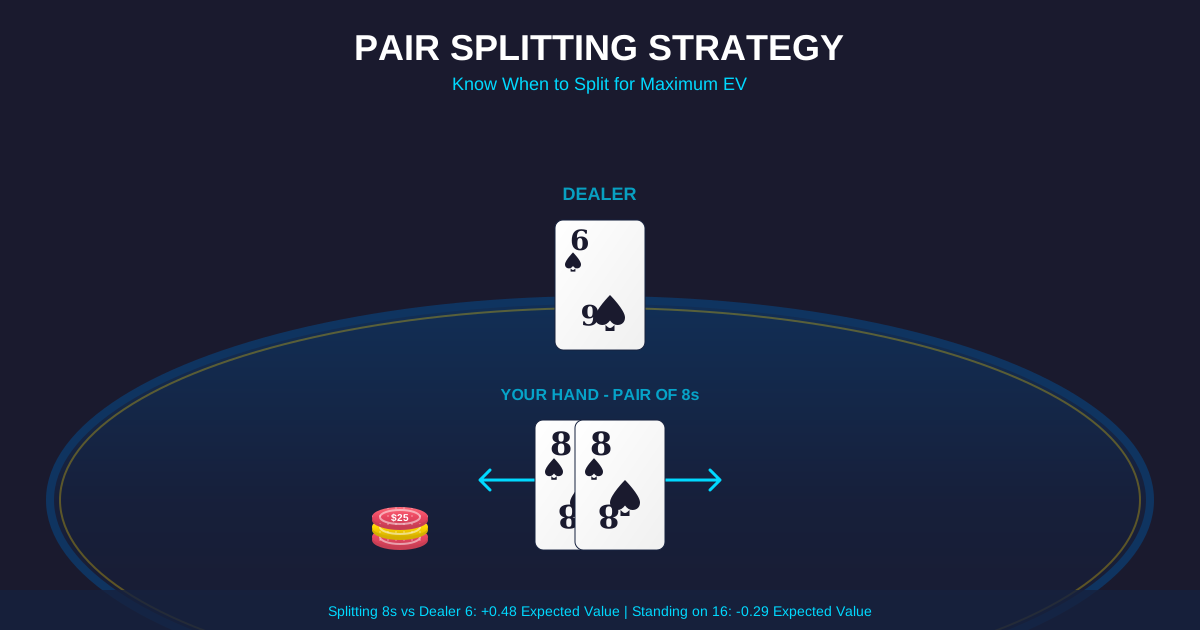
Blackjack Pair Splitting Calculator: Double Your Opportunities
Splitting pairs creates two separate hands from one, doubling your action and sometimes your expected value. Our calculator shows optimal splitting decisions for every pair, factoring in dealer upcard, DAS rules, and resplit options.
What Is Pair Splitting?
When dealt two cards of the same rank, you can split them into two separate hands, each receiving a new card. You must place an equal bet on the second hand. Some pairs should always split; others should never split; many depend on the dealer's upcard.
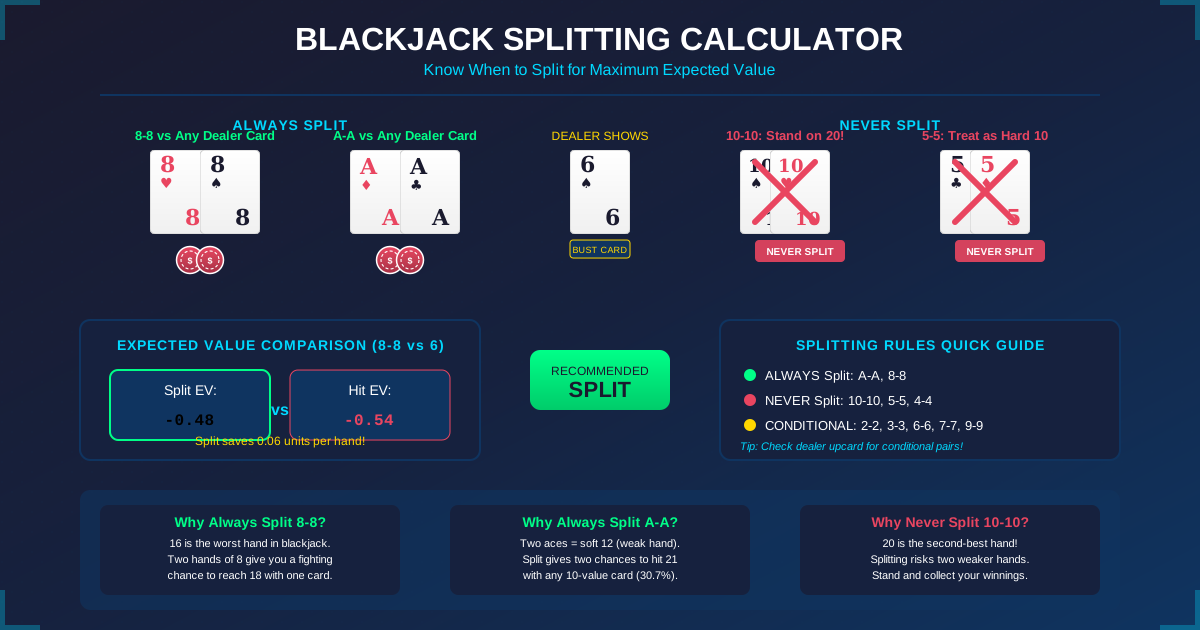
Quick Answer: Always split: Aces and 8s. Never split: 10s and 5s. Variable splits: 2s, 3s, 4s, 6s, 7s, 9s depend on dealer upcard. DAS (Double After Split) allows more aggressive splitting. Splitting creates two chances against a weak dealer. The goal isn't to "rescue" a pair—it's to maximize expected value.
How to Use Our Calculator
Use the Pair Splitting Calculator →
Enter your pair and dealer upcard for optimal strategy.
Step-by-Step Instructions
-
Enter Your Pair: Which pair you have
-
Input Dealer Upcard: Their showing card
-
Select DAS Rule: Double after split allowed?
-
View Recommendation: Split or don't split
-
See Expected Values: Compare options
Input Fields Explained
| Field | Description | Example |
|---|---|---|
| Your Pair | Both cards | 8-8 |
| Dealer Shows | Upcard | 6 |
| DAS Allowed | Double after split | Yes |
| Recommendation | Optimal play | Split |
| Split EV | Expected value | +0.24 |
| Stand EV | Expected value | -0.12 |
| Hit EV | Expected value | -0.21 |
The Always Split Pairs
Always Split Aces
Why split aces:
- Starting with 11 is excellent
- A + 10 = 21 (but often pays 1:1)
- Two chances at strong hands

Restrictions often apply:
- Only one card per ace
- Cannot double after ace split
- Cannot resplit aces (usually)

Still split despite restrictions!
AA vs any upcard: SPLIT
Always Split 8s
Why split 8s:
- 16 is worst hand (too high to hit safely)
- 8 is good starting point
- Dealer bust doesn't save 16 often enough

Even vs dealer 10 or A:
Split 8-8 is better than hitting 16
Both options are bad, splitting less bad

8-8 vs any upcard: SPLIT
The Never Split Pairs
Never Split 10s
Why not split 10s:
- 20 is excellent hand (wins ~85%)
- Starting with 10 is just "good"
- Breaking 20 is greedy

Even vs dealer 6:
20 stands, wins big
Two 10s just compete
Don't fix what isn't broken

10-10 vs any upcard: STAND
Never Split 5s
Why not split 5s:
- 5 is bad starting card
- 10 is great for doubling
- Creates two weak hands

Better strategy:
Double down on 10 (if appropriate)
Or just hit

5-5 is really "hard 10"
5-5 vs any upcard: HIT/DOUBLE (never split)
Context-Dependent Pairs
2s and 3s
DAS allowed:
Split vs 2-7

No DAS:
Split vs 4-7 only

Reasoning:
With DAS, can double good totals after split
Without DAS, less aggressive splitting
4s
DAS allowed:
Split vs 5-6 only

No DAS:
Never split 4s

Reasoning:
8 is decent starting point
4 is poor starting point
Only split vs very weak dealer with DAS
6s
DAS allowed:
Split vs 2-6

No DAS:
Split vs 3-6 only

Reasoning:
12 is bad (hit and bust often)
6 is bad starting point
Only split vs weak dealer
7s
Standard rule:
Split vs 2-7

Against 8+:
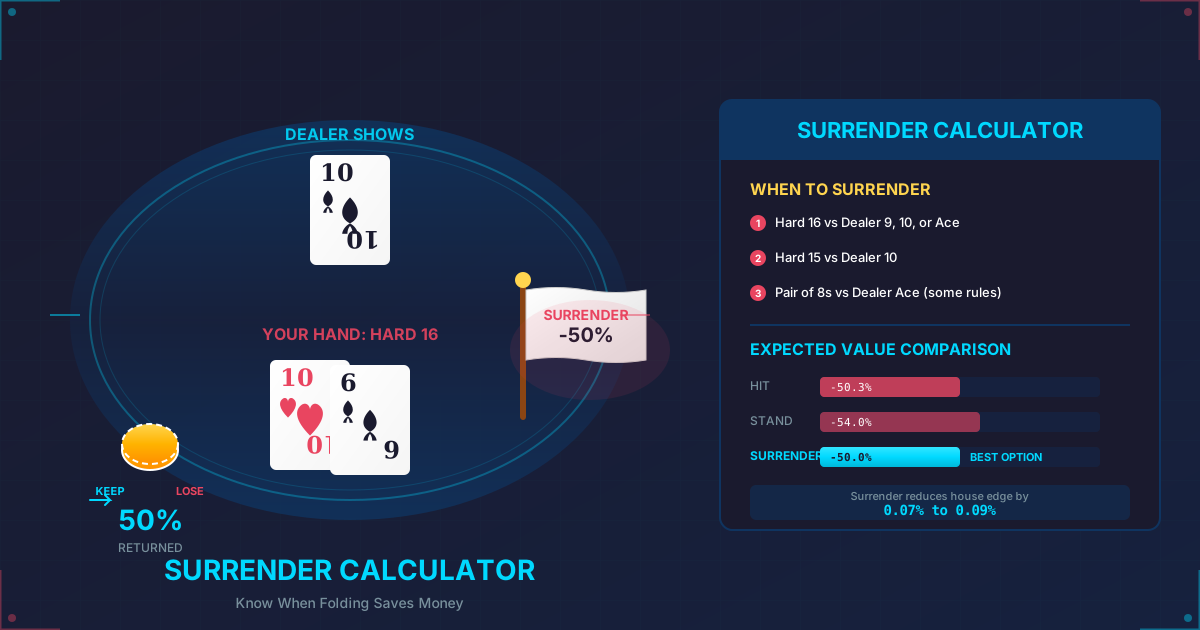
Hit (or surrender if available)

Reasoning:
14 is okay, 7 is okay
Against weak dealer, split to press
Against strong dealer, minimize damage
9s
Split vs 2-6, 8-9
Stand vs 7, 10, A

Reasoning:
18 is strong vs 7 (dealer likely makes 17)
18 is weak vs 10/A (dealer likely beats it)
Splitting vs mid-cards presses advantage
DAS Impact on Strategy
What Is DAS?
DAS = Double After Split

Example:
Split 3-3, receive 8 = 11
With DAS: Can double
Without DAS: Can only hit

DAS adds value to splitting
More aggressive splits with DAS
Strategy Differences
With DAS, also split:
- 2-2 vs 2-3
- 3-3 vs 2-3
- 4-4 vs 5-6
- 6-6 vs 2

Without DAS:
These pairs should hit instead
DAS rule matters!
Real-World Examples
Example 1: Classic Split Decision
Hand: 8-8 vs dealer 10
Analysis:
Option 1: Stand on 16
EV = -0.54 (lose 54% of bet average)

Option 2: Hit 16
EV = -0.54 (same terrible result)

Option 3: Split
EV = -0.48 (lose 48% average)

Split is least bad option
Always split 8s, even vs 10
Example 2: DAS Decision
Hand: 4-4 vs dealer 5, DAS allowed
Analysis:
Without DAS consideration:
8 is good, hit/double 8 vs 5

With DAS:
Split 4-4, if you get 6 or 7 = 10 or 11
Can double those strong totals

EV comparison:
Hit 8: +0.15
Split with DAS: +0.18

Small edge to splitting with DAS
Example 3: The Tempting 10s
Hand: 10-10 vs dealer 6
Analysis:
Stand on 20:
Win rate: ~85%
EV = +0.70

Split 10s:
Each 10 against 6: EV ~+0.29
Combined: +0.58

Standing is significantly better!
Never split 10s, even vs 6
Example 4: 9s Strategy
Hand: 9-9 vs dealer 7
Analysis:
Standing on 18:
Dealer likely makes 17 with 7
18 beats 17
EV = +0.40

Splitting 9s:
Two hands starting with 9
EV = +0.38

Stand is slightly better vs 7
This is why 9s stand vs 7
Complete Splitting Chart
With DAS Allowed
| Pair | 2 | 3 | 4 | 5 | 6 | 7 | 8 | 9 | 10 | A |
|---|---|---|---|---|---|---|---|---|---|---|
| A-A | Y | Y | Y | Y | Y | Y | Y | Y | Y | Y |
| 10-10 | N | N | N | N | N | N | N | N | N | N |
| 9-9 | Y | Y | Y | Y | Y | N | Y | Y | N | N |
| 8-8 | Y | Y | Y | Y | Y | Y | Y | Y | Y | Y |
| 7-7 | Y | Y | Y | Y | Y | Y | N | N | N | N |
| 6-6 | Y | Y | Y | Y | Y | N | N | N | N | N |
| 5-5 | N | N | N | N | N | N | N | N | N | N |
| 4-4 | N | N | N | Y | Y | N | N | N | N | N |
| 3-3 | Y | Y | Y | Y | Y | Y | N | N | N | N |
| 2-2 | Y | Y | Y | Y | Y | Y | N | N | N | N |
Y = Split, N = Don't Split
Common Mistakes
1. Splitting 10s for "More Action"
Mistake: Split 10s vs weak dealer Problem: Breaking winning hand Fix: Stand on 20, always
2. Not Splitting 8s vs Strong Dealer
Mistake: Hit 16 vs dealer 10 instead of splitting Problem: 16 is terrible either way Fix: Split 8s vs everything
3. Ignoring DAS Rules
Mistake: Same splitting regardless of DAS Problem: Missing optimal plays Fix: Know when DAS changes strategy
4. Splitting for "Luck"
Mistake: Split based on feeling Problem: Ignoring math Fix: Follow optimal strategy
Frequently Asked Questions
Should I always split aces?
Yes. Even with restrictions (one card only), split aces. Two chances starting with 11 beat one 12 or 2.
Is splitting 8s really better than hitting 16?
Yes, mathematically. Both options are bad vs strong dealers, but splitting loses slightly less long-term.
Why never split 5s?
Because 10 is a great doubling hand. Splitting creates two weak 5-start hands instead of one strong 10.
What if I can't afford to split?
Then you shouldn't have bet more than half your current stack. Budget for splits on any pair.
Does resplit change strategy?
Slightly. If you can resplit (split again if you get another pair), some marginal splits become better.
Should I split 4s?
Only vs 5-6 with DAS allowed. Otherwise, 8 is a better starting point than two 4s.
Pro Tips
-
Memorize aces and 8s: Always split, no exceptions
-
Memorize 10s and 5s: Never split, no exceptions
-
Know DAS rule: Changes several decisions
-
Budget for splits: Have double your bet available
-
Ignore "feelings": Math doesn't change with hunches
Related Calculators
- Blackjack Basic Strategy Calculator - Full strategy
- Blackjack Odds Calculator - Probability analysis
- Blackjack Doubling Calculator - Double down strategy
- Blackjack Expected Value Calculator - EV by hand
- Blackjack Insurance Calculator - Insurance analysis
Conclusion
Pair splitting transforms one hand into two—doubling opportunity when the math favors it. Our calculator shows exactly when splitting increases expected value, when it destroys a good hand, and how DAS rules change optimal play.
Calculate Splitting Strategy Now →
The rules are simple: always aces and 8s, never 10s and 5s, and learn the contexts for everything else. Our calculator provides the mathematical foundation for every splitting decision you'll face.