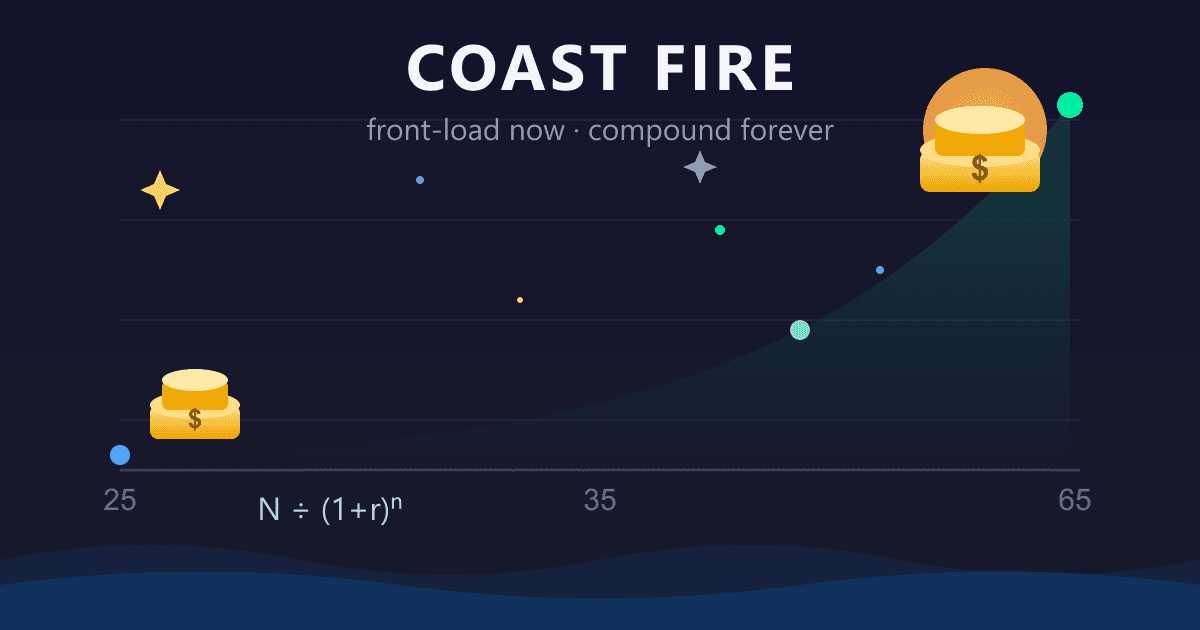
Quick Answer: Coast FIRE is a retirement strategy where you save aggressively early in your career until your investments can grow to your target retirement amount through compound interest alone—without any additional contributions. A typical Coast FIRE number ranges from $150,000 to $400,000 depending on your age and retirement goals. The formula is: Coast FIRE Number = Target Retirement Amount ÷ (1 + expected return)^years until retirement. Once you hit this number, you only need to earn enough to cover current expenses while your investments "coast" to your retirement goal.
The traditional FIRE movement has a burnout problem. Saving 50-75% of your income for a decade straight while watching your friends travel, buy homes, and actually enjoy their twenties sounds noble in theory. In practice, it's a recipe for resentment, deprivation fatigue, and Reddit threads full of people asking if they've made a terrible mistake.
Try Coast FIRE Calculator — free, no sign-up, and it runs entirely in your browser.
Enter Coast FIRE—the financial independence strategy for people who want security without the monastic sacrifice. The concept has exploded in popularity, with the r/CoastFIRE subreddit growing to over 51,000 members and financial planners increasingly recommending it as a realistic middle path between aggressive early retirement and the traditional "work until 65" grind.
Here's what makes Coast FIRE different: instead of racing to accumulate millions so you can quit working entirely by 35, you front-load your savings until compound interest can carry the load. Then you stop saving for retirement completely. You still work—but only to cover current living expenses. No more maxing out 401(k)s. No more guilt about buying concert tickets. Your future is mathematically secured, and your present becomes yours again.
What Is Coast FIRE and How Does It Work?
Coast FIRE is a financial independence milestone where you've invested enough money that, even without additional contributions, compound growth will build your portfolio to your target retirement amount by a traditional retirement age (typically 60-67). The term "coast" refers to the ability to ease off aggressive saving and let time and market returns do the heavy lifting.
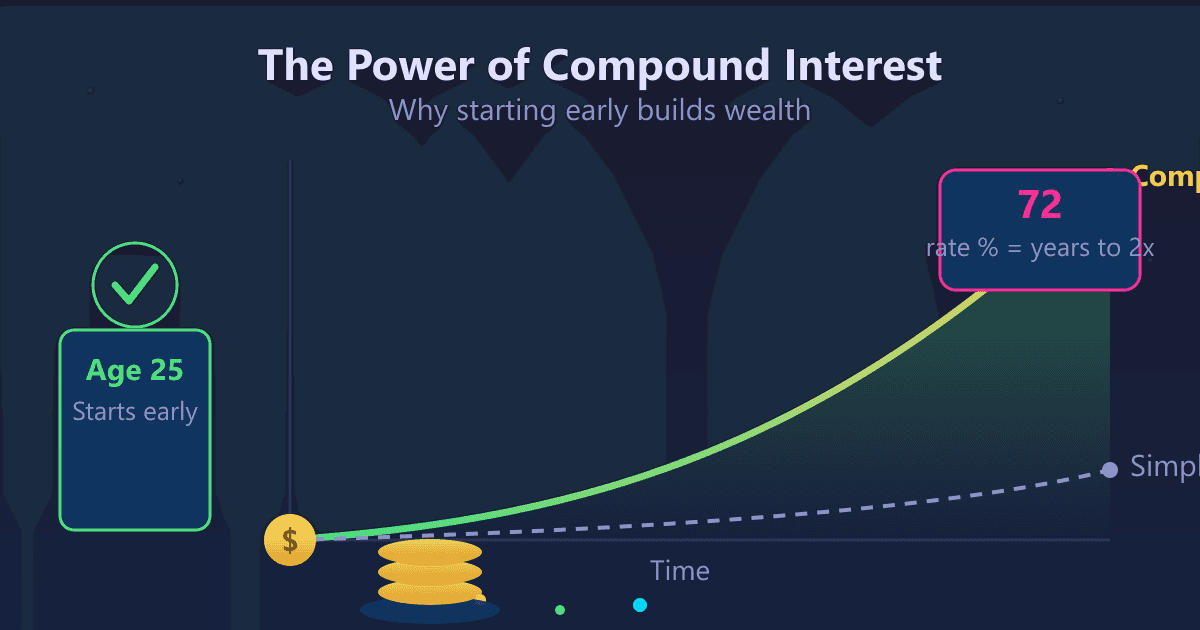
The strategy hinges on one of the most powerful forces in personal finance: compound interest. Albert Einstein supposedly called it the eighth wonder of the world, and whether or not he actually said that, the math is undeniable. Money invested early has decades to multiply. A dollar invested at 25 does far more work than a dollar invested at 45.
Consider this: $100,000 invested at age 30 with a 7% inflation-adjusted annual return grows to approximately $761,000 by age 65—without adding another cent. That same $100,000 invested at age 45 only reaches about $295,000 by 65. Time isn't just money. Time is a multiplier.
The Coast FIRE approach exploits this reality by concentrating savings in your highest-earning, lowest-expense years (typically your twenties and early thirties before mortgages, kids, and lifestyle inflation kick in), then transitioning to a maintenance mode where you earn just enough to live on.
How to Calculate Your Coast FIRE Number
Your Coast FIRE number is the amount you need invested today for compound growth to reach your target retirement portfolio by your chosen retirement age. The formula looks intimidating but is actually straightforward:
Coast FIRE Number = Target Retirement Portfolio ÷ (1 + R)^n
Where:
- Target Retirement Portfolio = Your FIRE number (typically 25× your expected annual retirement spending, based on the 4% withdrawal rule)
- R = Expected annual real return (commonly 5-7% after inflation)
- n = Years until your target retirement age
Let's run through a real example. Say you're 30 years old, plan to retire at 60, and expect to spend $60,000 annually in retirement.
First, calculate your target retirement portfolio: $60,000 × 25 = $1,500,000
Then apply the formula with a 6% expected real return over 30 years: $1,500,000 ÷ (1.06)^30 = $1,500,000 ÷ 5.74 = $261,000
That's your Coast FIRE number. If you have $261,000 invested at age 30, you can theoretically stop all retirement contributions and still hit $1.5 million by 60 through compound growth alone.
The numbers shift dramatically based on age and assumptions. A 25-year-old with the same goals needs only about $195,000. A 40-year-old needs closer to $470,000. This is why Coast FIRE advocates emphasize starting early—every year of delay significantly increases the hurdle.
What's a Realistic Coast FIRE Target by Age?
The specific number varies based on your retirement spending goals and risk tolerance, but here are rough benchmarks assuming a $60,000 annual retirement budget, 6% real returns, and retirement at 65:
- Age 25: ~$175,000
- Age 30: ~$235,000
- Age 35: ~$315,000
- Age 40: ~$420,000
- Age 45: ~$560,000
These figures assume you want a traditional 4% safe withdrawal rate. More conservative planners suggest targeting 3.5% withdrawals, which would require a larger portfolio and thus a higher Coast FIRE number.
Financial Samurai's Sam Dogen suggests $300,000 as a minimum threshold before declaring yourself Coast FIRE, regardless of the math. His reasoning: at that level, annual investment returns in a good year can exceed what most people could realistically save anyway, creating psychological breathing room and genuine optionality. Below that threshold, market volatility can feel too precarious.
Is Coast FIRE Actually Safe? The Risks You Need to Know
Coast FIRE sounds almost too good to be true, and critics raise legitimate concerns. The strategy makes several assumptions that may not hold:
Market returns aren't guaranteed. The historical 7% inflation-adjusted return of the S&P 500 is an average, not a promise. The "lost decade" from 2000-2009 saw essentially zero real returns. Someone who hit their Coast FIRE number in 1999 and stopped contributing would have watched their portfolio stagnate for a decade while life got more expensive.
Inflation can spike unexpectedly. The 2022-2023 inflation surge reminded everyone that 2-3% annual inflation isn't a law of physics. If inflation runs hot for extended periods, your future purchasing power erodes faster than projected, and your "enough" becomes "not quite enough."
Life changes. The person you are at 30 may want different things than the person you become at 45. Health issues, family obligations, career pivots, divorce, economic shifts—Coast FIRE calculations assume a stable trajectory that real life rarely provides.
You're still working. Unlike traditional FIRE, Coast FIRE doesn't free you from employment. You're trading the stress of aggressive saving for the requirement of continued income. If you lose your job or burn out on work entirely, you don't have the portfolio to fall back on.
Sequence of returns risk on the back end. Even if average returns meet expectations, a market crash in your late 50s can devastate a portfolio you've been counting on. Without ongoing contributions to dollar-cost average through downturns, you're fully exposed to timing luck.
The honest assessment: Coast FIRE is significantly safer than Lean FIRE (retiring extremely early on a minimal portfolio) but riskier than continuing to save throughout your career. It's a calculated bet that time in the market will compensate for years of zero contributions.
Coast FIRE vs. Traditional FIRE: Which Strategy Is Right for You?
Traditional FIRE demands extreme sacrifice for total freedom. Coast FIRE offers moderate sacrifice for partial freedom. Neither is objectively better—they serve different personalities and life situations.
Choose Traditional FIRE if:
- You genuinely hate your job and want to escape employment entirely
- You're naturally frugal and don't feel deprived living on 25-50% of your income
- You have high income that makes aggressive saving feasible
- You're willing to accept a more austere retirement lifestyle
Choose Coast FIRE if:
- You don't mind working, just want less financial pressure
- You want to enjoy your twenties and thirties without constant sacrifice
- You're interested in career flexibility—lower-paying but more fulfilling work, part-time schedules, or entrepreneurial risk
- You'd rather retire at 60 comfortably than at 40 anxiously
The psychological difference matters enormously. Traditional FIRE adherents often report burnout, social isolation, and a strained relationship with money even after reaching their number. Coast FIRE practitioners describe a sense of freedom and security without the deprivation hangover.
Calculate your Coast FIRE number with our free Coast FIRE Calculator.
How Much Do You Need to Save to Reach Coast FIRE?
The savings rate required depends entirely on your income, expenses, and timeline. But rough math helps set expectations.
Assuming you start at 22 with no savings, earn the median millennial income of around $60,000, and want to hit a Coast FIRE number of $250,000 by age 32:
You'd need to save approximately $2,100 per month for 10 years, assuming 7% returns. That's a 42% savings rate—aggressive but not impossible, especially if you avoid lifestyle inflation as your income grows.
The math gets easier with higher incomes or longer timelines. Someone earning $100,000 who can save $3,000 monthly might hit Coast FIRE in 6-7 years. Someone starting at 25 instead of 22 and targeting 35 has more time for compounding to help.
The critical insight: Coast FIRE front-loads the pain. You sacrifice harder for 8-12 years, then coast for 25-35 years. Traditional careers back-load the pain—moderate sacrifice for 40 years with no guaranteed payoff.
Can You Achieve Coast FIRE on an Average Salary?
Yes, but it requires more intentional choices. The median American household income of roughly $75,000 makes a 50% savings rate nearly impossible when accounting for taxes, housing, and basic living expenses. However, a 30-35% savings rate is achievable with discipline.
The keys for average earners:
- Geographic arbitrage: Living in lower-cost areas dramatically accelerates saving
- Housing hacking: House hacking, roommates, or living with family during accumulation years
- Transportation: Avoiding car payments and choosing reliable used vehicles
- Income growth: Focusing on career advancement and salary negotiation during the accumulation phase
- Side income: Using evenings and weekends for additional earnings that go directly to investments
Someone earning $55,000 who manages a 30% savings rate ($1,375/month) starting at 25 could reasonably hit a Coast FIRE number of $200,000 by age 35, assuming 7% returns. It's not easy. But it's more achievable than the traditional FIRE requirement of saving 50-70% for 10+ years.
Try our Coast FIRE Calculator to see how your savings rate affects your timeline.
What Do You Do After Reaching Coast FIRE?
Hitting your Coast FIRE number isn't retirement—it's a transition. You still need income for current expenses. But the nature of that income changes fundamentally.
Career pivots become possible. That lower-paying nonprofit job you've always wanted? Now viable. Starting a business that might take years to profit? Less terrifying. Going back to school? Financially realistic.
Part-time work becomes sufficient. If your annual expenses are $40,000, you don't need a $100,000 job to cover them. Twenty hours a week at decent pay might be enough.
Entrepreneurial risk becomes manageable. Knowing your retirement is secured lets you take swings you'd never attempt otherwise. The consulting business that might fail. The creative project that might not pay. The startup that's a long shot.
Geographic freedom opens up. Without the need to maximize salary, you can choose where to live based on quality of life rather than job market strength.
The most common post-Coast FIRE paths: transitioning to part-time work in the same field, switching to passion-driven lower-paying work, starting location-independent businesses, or "downshifting" to less stressful roles within the same industry.
Should You Count on Social Security in Your Coast FIRE Plan?
The conservative approach: don't. Build your Coast FIRE plan as if Social Security won't exist, then treat any benefits as a bonus.
The realistic assessment: Social Security probably won't disappear entirely, but benefits may be reduced for future retirees. Current projections suggest the trust fund could face shortfalls by the mid-2030s, potentially requiring benefit cuts of 20-25% unless Congress acts.
The average Social Security retirement benefit in 2025 is approximately $1,976 per month, or about $23,700 annually. For someone whose Coast FIRE plan targets $60,000 in annual retirement spending, that's nearly 40% of expenses potentially covered—a significant buffer.
A moderate approach: calculate your Coast FIRE number assuming zero Social Security, but recognize that some benefit probably will exist. This builds in a margin of safety while not requiring excessive accumulation.
Use our Coast FIRE Calculator to model different scenarios with and without Social Security.
The Best Accounts for Coast FIRE Savings
Where you save matters almost as much as how much you save. The optimal Coast FIRE accumulation strategy prioritizes tax-advantaged accounts:
401(k) or 403(b): Max these first, especially if your employer matches contributions. The 2025 limit is $23,500, with catch-up contributions available at 50+. Pre-tax contributions reduce your current tax burden during high-earning accumulation years.
Roth IRA: The $7,000 annual limit (2025) is modest, but Roth accounts offer tax-free growth and withdrawals—valuable for retirement flexibility.
HSA (if eligible): The "stealth IRA." Contributions are tax-deductible, growth is tax-free, and withdrawals for medical expenses are never taxed. After 65, withdrawals for any purpose are taxed as regular income (like a traditional IRA). Max it if you have a high-deductible health plan.
Taxable brokerage: After maxing tax-advantaged space, additional savings go here. Less tax-efficient but fully liquid—important because early withdrawals from retirement accounts carry penalties.
The Coast FIRE accumulation phase typically means maxing all available tax-advantaged space, then any excess goes to taxable accounts. The post-Coast phase might see reduced 401(k) contributions since you're no longer prioritizing retirement savings.
Getting Started with Coast FIRE: A Practical Roadmap
If Coast FIRE resonates, here's how to begin:
Step 1: Calculate your number. Use the formula above or a Coast FIRE calculator. Be honest about retirement spending expectations—underestimating leads to shortfalls.
Step 2: Assess your current position. How much do you have invested? What's the gap between current holdings and your Coast FIRE number?
Step 3: Determine your savings rate. Given your income and expenses, what percentage can you realistically direct toward investments? If it's under 20%, identify expenses to cut or income to increase.
Step 4: Set a target date. When do you want to hit Coast FIRE? This creates accountability and allows progress tracking.
Step 5: Automate everything. Set up automatic transfers to investment accounts on payday. Remove the temptation to spend what you intend to save.
Step 6: Track quarterly, not daily. Obsessing over daily portfolio swings leads to anxiety and poor decisions. Check in every few months to ensure you're on track.
Step 7: Plan your "after." What does post-Coast FIRE life look like? Having a vision for how you'll spend your time and earn income during the coasting phase prevents aimlessness after hitting the number.
The Bottom Line on Coast FIRE
Coast FIRE won't make you a millionaire by 35. It won't let you quit your job and travel the world indefinitely in your thirties. What it offers is arguably more valuable for most people: the psychological freedom of knowing your retirement is handled, combined with the financial flexibility to design a career around meaning rather than money.
In a world where 54% of American households have no dedicated retirement savings at all and the median retirement account balance sits at just $87,000, reaching any Coast FIRE milestone puts you ahead of the vast majority. More importantly, it gives you options—the ability to say no to soul-crushing jobs, to take risks on passion projects, to prioritize time with family without sacrificing your financial future.
The FIRE movement got something fundamentally right: the conventional path of working maximum hours for 40+ years and hoping you saved enough isn't a great plan. Coast FIRE takes that insight and makes it sustainable. You sacrifice hard for a defined period, then you get your life back—not someday when you're 65, but in your thirties or forties, while you're still young enough to enjoy the freedom.
The math is simple. The execution is hard. But the payoff—decades of financial security without decades of deprivation—might be the most reasonable retirement strategy nobody told you about.
Ready to find your number? Use our free Coast FIRE Calculator to see exactly how much you need invested today.