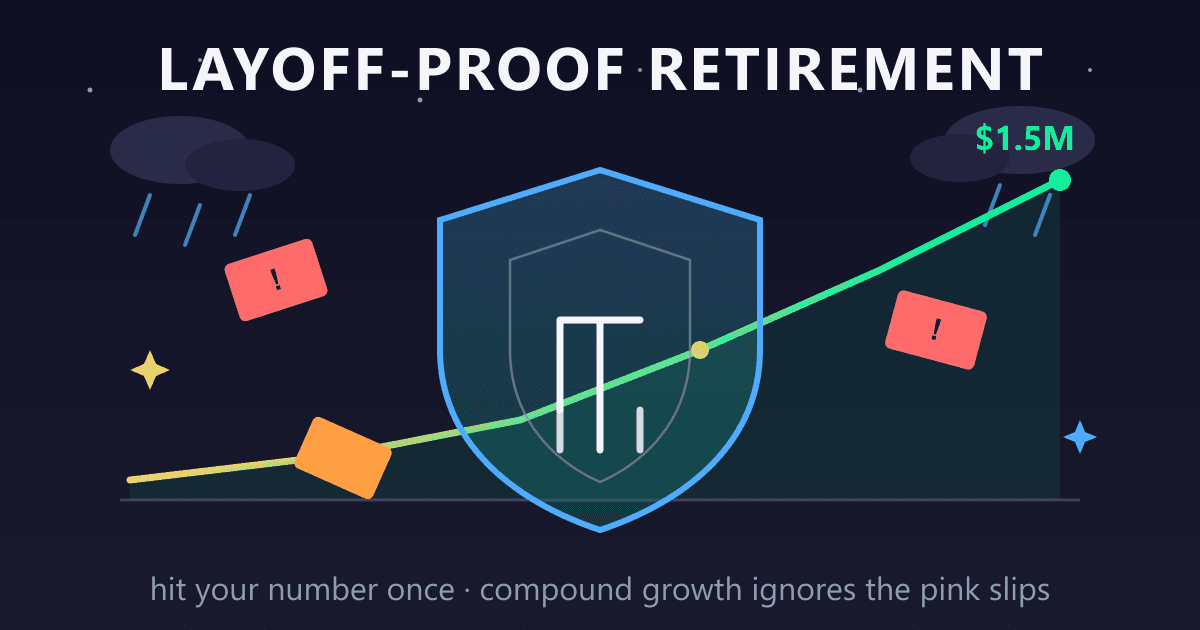
Coast FIRE is a retirement strategy where you save enough early that compound interest alone grows your portfolio to your retirement goal—without any additional contributions. Once you hit your Coast FIRE number (typically $150,000-$350,000 for workers under 40), your retirement stays on track whether you are employed or not.
With over 1.1 million layoffs announced in 2026 and 80% of Americans experiencing financial anxiety, Coast FIRE has emerged as the retirement strategy people actually trust—because it does not require your employer to keep you around.
Try Barista FIRE Calculator — free, no sign-up, and it runs entirely in your browser.
Traditional retirement planning assumes 30 years of steady paychecks. That assumption looks increasingly naive when tech workers get pink slips without warning, government employees find themselves job hunting, and average unemployment duration has stretched to 24.5 weeks.
Coast FIRE sidesteps this vulnerability: reach your number, and your retirement compounds whether you are employed or not.
→ Find out if you've already hit your Coast FIRE number with our free Coast FIRE Calculator.
Why Is Coast FIRE So Popular in 2026?
Coast FIRE is exploding in popularity because it offers security in an insecure job market. When 80% of Americans report financial anxiety and the majority cannot cover a $1,000 emergency from savings, a retirement strategy that does not depend on continuous employment becomes compelling.
2025 Job Market Statistics
| Statistic | 2025 Data |
|---|---|
| Total layoffs announced | 1.1+ million |
| Tech sector layoffs | 126,000+ |
| Average unemployment duration | 24.5 weeks |
| Long-term unemployment (27+ weeks) | 1.8 million |
| Unemployment rate | 4.4% (highest since Sept 2021) |
The 2025 layoff wave hit demographics that felt secure. Tech workers, government employees, healthcare professionals—people who thought they were doing everything right. Many had saved diligently but had not reached traditional FIRE numbers. Some, without realizing it, had already hit Coast FIRE.
The key difference: Traditional FIRE requires 25-30x annual expenses (often $1.5M+) before you can stop working. Coast FIRE requires only enough invested today that compound growth reaches your target—typically 10-25% of the final number. Once you cross the threshold, interruptions to income do not derail retirement. A layoff becomes a speed bump rather than a catastrophe.
How Do You Calculate Your Coast FIRE Number?
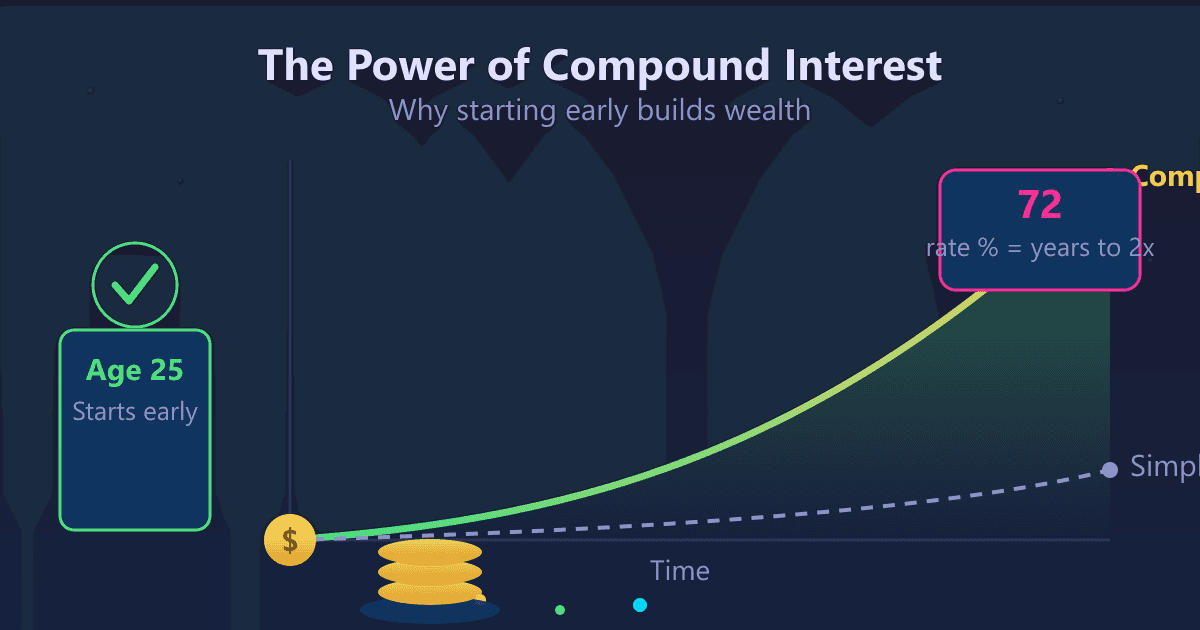
Coast FIRE works because compound interest does not care about your employment status. A 35-year-old with $261,397 invested today, assuming a 6% real return, will have $1.5 million at 65—no additional contributions required.
The Coast FIRE formula:
Coast FIRE Number = Target Retirement Portfolio / (1 + Real Return Rate)^Years Until Retirement
Example: You want $1.2 million at age 65, you are currently 40, and you assume a 6% real return after inflation:
$1,200,000 / (1.06)^25 = $279,578
If you have $279,578 invested in diversified index funds today, you have hit Coast FIRE. You could contribute nothing else for 25 years and still retire with $1.2 million in today's dollars.
Why this matters in 2026: You do not need to maintain a high savings rate for three decades. You need to hit a specific number, and then you are free—free to take risks, accept lower-paying work you enjoy, or weather layoffs without panicking about retirement.
Coast FIRE Numbers by Age (Targeting $1.5M at 65)
| Current Age | Years to 65 | Coast FIRE Target (6% return) | Coast FIRE Target (7% return) |
|---|---|---|---|
| 25 | 40 | $145,888 | $111,949 |
| 30 | 35 | $195,232 | $157,820 |
| 35 | 30 | $261,397 | $222,451 |
| 40 | 25 | $349,848 | $313,588 |
| 45 | 20 | $468,177 | $442,099 |
| 50 | 15 | $626,506 | $623,261 |
A 25-year-old needs roughly $146,000 to coast to $1.5 million—less than a tenth of the final target. Even at 35, the Coast FIRE number is under $300,000. These aren't small amounts, but they're achievable for disciplined savers in ways that accumulating $1.5 million outright never feels.
The catch, of course, is that return assumption. Using 7% instead of 6% drops your required number significantly. Using 5% raises it. The difference between optimistic and conservative assumptions can mean $50,000 or more in your Coast FIRE target. Choose your assumption carefully—being wrong in the optimistic direction means running out of money.
Check where you stand with our free Coast FIRE Calculator—you might be closer than you think.
Why Does the 2026 Job Market Make Coast FIRE Urgent?
Traditional retirement planning assumes continuous employment. The 2025 job market proves that assumption is dangerous.
Consider what happens to a traditional retirement plan when you lose your job at 45:
- You stop contributing to your 401(k)
- You might withdraw from it to cover expenses during a prolonged job search
- Your carefully constructed projections fall apart
- The retirement you planned for 65 might need to wait until 70 or later
Coast FIRE offers resilience. Once you have crossed the threshold:
- A six-month job search becomes an inconvenience rather than a retirement-derailing crisis
- A career change to a lower-paying field becomes a lifestyle choice
- Taking a year off to care for aging parents or recover from burnout does not mean sacrificing your future
The strategy acknowledges a reality that traditional financial planning ignores: careers are no longer linear. The forty-year climb up the corporate ladder, retiring with a pension and a gold watch, exists primarily in nostalgia. Modern careers involve pivots, layoffs, industry disruptions, and periods of unemployment that would have been unthinkable a generation ago.
Coast FIRE is retirement planning for the world that actually exists.
What Can You Do After Reaching Coast FIRE?
Reaching Coast FIRE does not mean you stop working. It means you stop worrying about retirement while you work. The psychological shift matters more than most people expect.
When your retirement is mathematically secured through compound growth alone, employment becomes about today rather than tomorrow. You work to cover current expenses—housing, food, healthcare—not to fund a retirement that is already handled.
How Coast FIRE Changes Your Relationship with Work
| Before Coast FIRE | After Coast FIRE |
|---|---|
| Fear of losing job = fear of losing retirement | Job loss is a speed bump, not a catastrophe |
| Must tolerate toxic work environments | Can walk away without panicking |
| Salary is primary consideration | Lifestyle and fulfillment matter more |
| High savings rate required indefinitely | Only need to cover current expenses |
What Coast FIRE enables:
-
Reduce hours or negotiate flexibility. The salary cut that would have been unthinkable when retirement depended on maximum contributions becomes manageable when you only need to cover current expenses.
-
Switch to lower-stress roles. A $200,000 consulting job requiring 70-hour weeks becomes less attractive than a $90,000 position with reasonable hours when retirement is already funded.
-
Start businesses or pursue freelance work. The risk calculus changes completely when your retirement does not depend on the venture succeeding.
-
Take extended breaks between jobs. A six-month sabbatical to travel, recover from burnout, or figure out what is next becomes financially viable.
The common thread: choice. Coast FIRE converts retirement from a distant obligation into present-tense freedom. You are not working to fund a future you might not live to see. You are working to live the life you want right now.
What Is the Hidden Risk of Coast FIRE?
The biggest Coast FIRE risk is sequence of returns risk at the front end. If you hit your number at a market peak and immediately stop contributing, a 30% correction could push you back below the threshold.
The Buffer Solution
| Without Buffer | With 15% Buffer |
|---|---|
| Hit $300,000 Coast FIRE target | Hit $345,000 (15% above target) |
| 30% market drop = $210,000 | 30% market drop = $241,500 |
| Back below threshold | Still above original target |
| Psychological stress returns | Cushion absorbs volatility |
This is not theoretical. Markets dropped over 30% in early 2020 and fell significantly in 2022. Anyone who hit their Coast FIRE number in late 2021 and stopped contributing watched their portfolio shrink below the threshold within months.
Mathematically, this should not matter over a 30-year time horizon—markets recover. Psychologically, it matters enormously. Watching your "retirement is secured" number become your "retirement is no longer secured" number is demoralizing in ways pure math cannot capture.
The solution: Continue contributing until you are 10-20% above your calculated Coast FIRE target. That cushion absorbs market volatility and ensures a bad year does not reset your timeline.
How Does Healthcare Work with Coast FIRE?
Coast FIRE addresses retirement savings, not current expenses. If you leave a full-time job with benefits before Medicare eligibility at 65, you still need income to cover health insurance.
2025 Healthcare Costs for Early Coast FIRE Practitioners
| Situation | Monthly Cost | Annual Cost |
|---|---|---|
| Individual, age 40 | $500-$800 | $6,000-$9,600 |
| Individual, age 55 | $800-$1,500 | $9,600-$18,000 |
| Couple, 50s | $2,000-$3,000 | $24,000-$36,000 |
ACA subsidies help if your income qualifies, but this creates complications—you must manage income carefully to stay within subsidy ranges.
Why Coast FIRE often pairs with continued employment:
- Part-time work covering living expenses and healthcare while investments grow untouched
- Lower-paying jobs you enjoy that provide benefits
- Freelance income supplemented by ACA marketplace coverage
The Starbucks strategy: Some Coast FIRE adherents target jobs specifically for benefits rather than salary. Starbucks offers health insurance to employees working 20+ hours per week; other employers have similar arrangements.
Key insight: Coast FIRE is not a path to early retirement—it is a path to freedom from retirement anxiety while you continue working in some capacity. The work changes character (about today's bills, not tomorrow's security), but it does not disappear.
Should I Include Social Security in Coast FIRE Calculations?
The safest approach: assume zero Social Security income. Calculate your Coast FIRE number without it. If benefits remain intact, that is a bonus. If they get cut, your retirement still works.
Social Security Outlook
| Year | Projected Status |
|---|---|
| 2025 | Trust fund depletion date moved up by 1 year |
| 2033 | Projected trust fund depletion |
| 2035+ | Potential 23% automatic benefit cuts if Congress does not act |
How Much Social Security to Include by Age
| Your Age | Include in Calculations |
|---|---|
| Under 40 | 0% (exclude entirely) |
| 40-55 | 50-70% of projected benefits |
| Within 15 years of claiming | Full projected benefits |
Why this pessimism is prudent: For anyone under 50, building a retirement plan that depends on full Social Security benefits is optimistic at best. The program will likely exist, but benefits you receive may be substantially less than current retirees collect.
The upside of being wrong: If Social Security remains fully intact, you will have more money in retirement than planned. That is a problem most people would love to have.
What Return Rate Should I Use for Coast FIRE?
The return rate you assume is the single most important decision in your Coast FIRE calculation. Get this wrong and your entire plan falls apart.
How Return Assumptions Affect Your Coast FIRE Number (35-year-old targeting $1.5M at 65)
| Return Rate | Coast FIRE Number | Difference |
|---|---|---|
| 5% (conservative) | $347,161 | Baseline |
| 6% (moderate) | $261,397 | -$85,764 |
| 7% (optimistic) | $222,451 | -$124,710 |
That is a $125,000 spread based entirely on return assumptions. Choose optimistically and you might declare Coast FIRE prematurely. Choose conservatively and you might work longer than necessary.
Recommended Approach
- Use 6% for your primary calculation - balances realism and achievability
- Check your numbers against 5% - see how much cushion you have
- If the 5% target is achievable without massive sacrifice, aim for that - the extra security is worth the additional saving
Critical warning: Avoid using historical nominal returns of 10%+ without adjusting for inflation. A million dollars in 30 years will not buy what a million dollars buys today. Real returns—after inflation—are what matter.
Run your numbers with our free Coast FIRE Calculator and see how different return assumptions affect your timeline.
Should I Keep Contributing to My 401(k) After Coast FIRE?
The purist answer is no—you have crossed the threshold and compound growth handles the rest. The practical answer is more nuanced.
Reasons to Continue Contributing (at Least to the Match)
| Benefit | Why It Matters |
|---|---|
| Employer matching | 50% match = immediate 50% return (no investment beats this) |
| Tax benefits | Pre-tax contributions reduce current taxable income |
| Buffer growth | Every dollar adds cushion against market volatility |
| Psychological safety | Insurance against Coast FIRE math not working perfectly |
The Practical Compromise
Most Coast FIRE adherents reduce contributions to the employer match level rather than stopping entirely. You capture the free money and tax benefits while freeing up cash flow for current life enjoyment.
Example: If your employer matches 50% up to 6% of salary, continuing to contribute that 6% gets you an immediate 50% return on those dollars. No investment in history consistently beats that.
Frequently Asked Questions
How do I know if I've already reached Coast FIRE? Take your target retirement portfolio, divide by (1 + expected real return rate) raised to the power of years until your planned retirement age. If your current invested assets exceed that number, you've reached Coast FIRE. Use our calculator to run the math instantly.
What return rate should I use for Coast FIRE calculations? Most financial planners recommend 5-7% real returns (after inflation) for long-term projections. Using 6% provides a reasonable middle ground—optimistic enough to be achievable, conservative enough to build in margin for error. Avoid using 10%+ nominal returns without adjusting for inflation.
Should I stop contributing to my 401(k) after reaching Coast FIRE? Not necessarily. Even after hitting your Coast FIRE number, 401(k) contributions offer tax benefits and employer matching. Many people reduce contributions to capture the full employer match rather than stopping entirely. Free money is free money, and the tax advantages remain valuable.
Does Coast FIRE work during a recession? Yes, with caveats. If you reached your number before a market downturn, compound growth continues working for you over the long term—you just have a bumpier ride. If you're approaching your number during a downturn, you might actually benefit from lower entry points. The bigger risk is reaching your number at a market peak and then watching it drop below the threshold.
Can I reach Coast FIRE if I started saving late? Yes, but the numbers get larger. Someone starting at 45 with 20 years until retirement needs significantly more invested today to coast to the same target. The math works at any age—it just becomes less dramatic as you approach retirement. A 50-year-old needs over $600,000 to coast to $1.5 million, compared to under $150,000 for a 25-year-old.
What's the difference between Coast FIRE and Barista FIRE? Coast FIRE means your retirement savings compound without additional contributions. Barista FIRE typically means working part-time primarily for current expenses and benefits while investments grow. Many people who reach Coast FIRE effectively practice Barista FIRE afterward—the terms overlap significantly in practice.
Does Coast FIRE account for inflation? Yes, if you use real returns rather than nominal returns. A 6% real return means 6% above inflation. Your target portfolio should be expressed in today's dollars—what $1.5 million buys now, not what the number on your statement says. Using real returns automatically adjusts for purchasing power.
What if I have a pension? Calculate your Coast FIRE number for the gap between your pension income and total retirement spending needs, rather than your full retirement budget. If your pension provides $30,000 annually and you need $60,000 to live, you only need investments to cover the $30,000 difference.
The Bottom Line
Traditional retirement planning assumes stability that 2025 has demonstrated doesn't exist. Coast FIRE offers an alternative—a concrete milestone where compound growth handles your future, freeing you from dependence on continuous high-income employment.
The math isn't complicated. The implications are profound. Knowing your retirement is secured regardless of your employment status changes how you think about work, risk, and what you're willing to tolerate. It transforms employment from an obligation that controls your future into a choice that funds your present.
With layoffs continuing, financial anxiety at record levels, and job security increasingly illusory, Coast FIRE represents something rare in personal finance: a finish line that actually means something. Not a finish line where you stop working entirely—that's traditional FIRE, and it requires far more savings. A finish line where you stop worrying. Where compound interest takes over the job of funding your retirement, and you're free to work for different reasons.
That freedom is worth more than most people realize until they experience it. The ability to weather career disruptions, make unconventional choices, and sleep soundly regardless of what your employer decides—these aren't small things. In an economy where layoffs happen without warning and careers rarely follow predictable paths, they might be the most valuable things of all.
Use our free Coast FIRE Calculator to find your number. Enter your current savings, age, and retirement goals to see whether you've already crossed the threshold—or how close you might be.