DFS Ownership Leverage Calculator: GPP Strategy Guide (2026)
DFS Ownership Leverage Calculator: Gain Edge Through Contrarianism
Ownership leverage is the key to GPP success—being right when few others agree creates massive tournament equity. Our calculator analyzes projected ownership to identify leverage spots where you can differentiate while maintaining upside.
What Is DFS Ownership Leverage?
Ownership leverage measures the advantage gained by rostering players at different rates than the field. Positive leverage comes from correct fades and underowned hits; negative leverage comes from wrong contrarian plays.
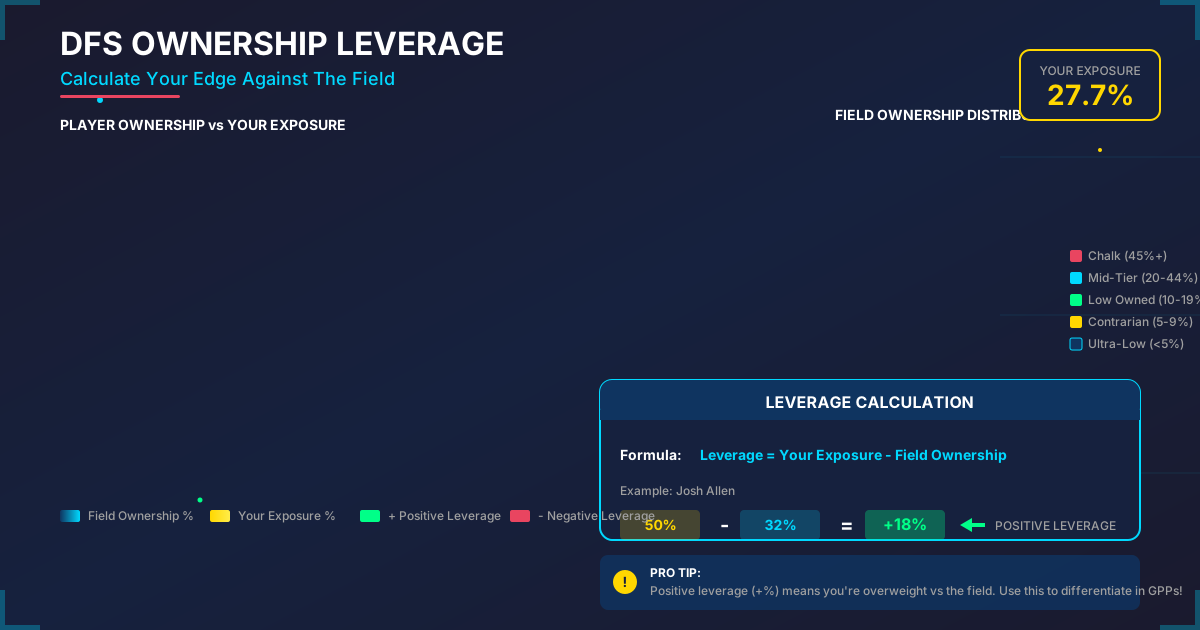
Quick Answer: Leverage = Your ownership minus field ownership. If a player is 30% owned but you roster them 50% of lineups, you have +20% leverage. If they hit, you gain ground on 30% of the field. The goal: positive leverage on players who exceed expectations, negative leverage on busts. Low-owned players who hit provide more equity than high-owned hits.
How to Use Our Leverage Calculator
Use the DFS Ownership Leverage Calculator →
Enter projected ownership and your exposure to calculate leverage and equity impact.
Step-by-Step Instructions
-
Enter Player: Name and salary
-
Input Projected Ownership: Field consensus
-
Enter Your Exposure: Lineup percentage
-
View Leverage: Differential analysis
-
See Equity Impact: Outcome scenarios
Input Fields Explained
| Field | Description | Example |
|---|---|---|
| Player | Selection | Josh Allen |
| Projected Ownership | Field % | 28% |
| Your Exposure | Your lineup % | 40% |
| Leverage | Differential | +12% |
| Hit Equity | If player exceeds | +3.4% |
| Miss Equity | If player busts | -1.2% |
Understanding Leverage Math
Basic Leverage Formula
Leverage = Your Exposure - Field Ownership

Positive leverage: You're overweight vs field
Negative leverage: You're underweight (fading)
Equity Impact Calculation
Hit Equity = Leverage × (1 - Field Ownership)
Miss Equity = -Leverage × Field Ownership

Example: +20% leverage on 25% owned player
Hit: +20% × 75% = +15% relative gain
Miss: -20% × 25% = -5% relative loss
Ownership Tiers
High Ownership (Chalk)
| Ownership | Strategy | Risk |
|---|---|---|
| 40%+ | Fade or match | Very chalky |
| 30-40% | Consider fading | Chalk |
| 20-30% | Selective | Moderate |
Low Ownership (Contrarian)
| Ownership | Strategy | Upside |
|---|---|---|
| 10-20% | Strong leverage | Good |
| 5-10% | High leverage | Great |
| <5% | Maximum leverage | Highest |
Leverage Scenarios
Scenario 1: Chalky Play Hits
Player: 35% owned, you have 35% Outcome: Hits ceiling
Equity Impact:
- You move up with 65% of field
- But so does 35% of field
- Net: No leverage gain
Scenario 2: Contrarian Hit
Player: 8% owned, you have 25% Outcome: Hits ceiling
Equity Impact:
- You move up with 92% of field
- Only 8% of field had them
- Leverage gain: +17% × 92% = +15.6%
Scenario 3: Chalk Fade Works
Player: 40% owned, you have 0% Outcome: Busts
Equity Impact:
- You stay steady
- 40% of field drops
- Leverage gain: +40% relative
Scenario 4: Contrarian Miss
Player: 5% owned, you have 20% Outcome: Busts
Equity Impact:
- You drop with 5% of field
- 95% of field unaffected
- Leverage loss: -15% × 5% = -0.75%
Optimal Leverage Strategy
GPP Guidelines
| Player Type | Leverage Target |
|---|---|
| Core plays | +5 to +15% |
| Differentiators | +10 to +25% |
| Game stacks | Correlated leverage |
| One-offs | Maximum leverage |
Cash vs GPP Approach
| Game Type | Leverage Strategy |
|---|---|
| Cash | Near-zero leverage |
| Single-entry GPP | Moderate leverage |
| 3-max GPP | Higher leverage |
| 20-max GPP | Maximum leverage |
Correlation and Leverage
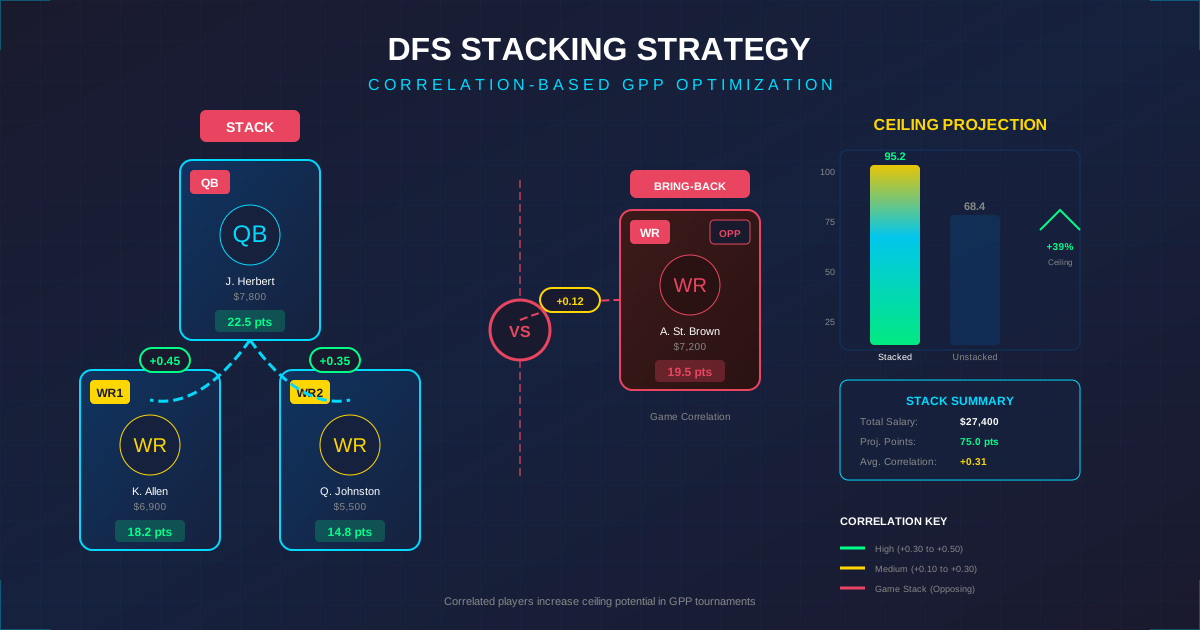
Stacking Leverage
| Stack Type | Ownership Impact |
|---|---|
| QB-WR1 stack | High combined ownership |
| QB-WR2/3 stack | Better leverage |
| Bring-back | Reduces leverage, adds ceiling |
Game Stack Example
Popular game: KC @ BUF
- Mahomes: 28% owned
- Kelce: 24% owned
- Combined: ~40% have Mahomes-Kelce
Leverage play:
- Allen: 18% owned
- Kincaid: 12% owned
- Combined: ~8% have Allen-Kincaid
Leverage differential: +32% if game hits
Building Leverage Lineups
Step 1: Identify Chalk
| Position | Chalk Threshold |
|---|---|
| QB | >20% |
| RB | >25% |
| WR | >20% |
| TE | >20% |
| FLEX | >15% |
Step 2: Find Alternatives
For each chalk play, identify:
- Similar ceiling projection
- Lower ownership
- Positive game environment
Step 3: Calculate Total Leverage
Lineup Leverage = Σ(Player Leverage)

Target: +50 to +100% total leverage for GPPs
Real-World Examples
Example 1: NFL Main Slate
Chalk lineup leverage:
| Position | Player | Own% | Your% | Leverage |
|---|---|---|---|---|
| QB | Mahomes | 25% | 25% | 0% |
| RB1 | McCaffrey | 30% | 30% | 0% |
| WR1 | Hill | 28% | 28% | 0% |
| Total | 0% |
Leveraged lineup:
| Position | Player | Own% | Your% | Leverage |
|---|---|---|---|---|
| QB | Allen | 18% | 30% | +12% |
| RB1 | Pacheco | 12% | 25% | +13% |
| WR1 | DeVonta | 15% | 35% | +20% |
| Total | +45% |
Example 2: NBA Showdown
Captain leverage is key:
| Captain | Own% | Leverage Play |
|---|---|---|
| Star PG | 35% | Fade in 50% of lineups |
| Secondary | 8% | +27% leverage |
Ownership Projection Sources
Data Quality
| Source | Accuracy | Availability |
|---|---|---|
| Paid projections | ±2-5% | Subscription |
| Aggregate sites | ±5-10% | Free/paid |
| Your estimate | ±10-15% | Free |
Adjusting Projections
| Factor | Adjustment |
|---|---|
| Late news | Ownership shifts |
| Weather | Fades/pivots |
| Primetime | Higher ownership |
| Early slate | Different patterns |
Common Leverage Mistakes
1. Leverage for Leverage's Sake
Mistake: Rostering bad players because low owned Problem: Negative EV, even with leverage Fix: Leverage only on quality plays
2. Ignoring Correlation
Mistake: Individual leverage without stack consideration Problem: Game environments move together Fix: Leverage at stack/game level
3. Over-Fading Chalk
Mistake: Zero exposure to top plays Problem: Missing when chalk hits Fix: Reduce, don't eliminate entirely
4. Same Leverage as Pros
Mistake: Matching sharp ownership Problem: Sharps are the new chalk Fix: Consider secondary contrarian
Frequently Asked Questions
How important is ownership leverage?
Critical for GPPs. Even optimal projections need leverage to overcome rake and reach top payouts. Cash games: irrelevant.
Should I always fade chalk?
No. Fade chalk when you have comparable alternative with similar ceiling. Don't fade for bad players.
What's optimal total lineup leverage?
Single-entry: +30 to +60%. Multi-entry: +50 to +100% across portfolio. Balance uniqueness with quality.
How do I estimate ownership?
Use aggregate projections, adjust for news, consider slate dynamics. Ownership moves significantly from early week to lock.
Does leverage matter in cash games?
No. Cash games pay ~50% of field—you need floor, not differentiation. Match or exceed consensus.
Can leverage be too high?
Yes. 100%+ leverage on poor plays is negative EV. Quality first, leverage second.
Advanced Leverage Concepts
Expected Leverage Value
ELV = (Hit Prob × Hit Equity) + (Miss Prob × Miss Equity)

Only roster players with positive ELV
Multi-Entry Leverage
| Entry # | Leverage Target |
|---|---|
| 1-5 | Moderate (balanced) |
| 6-10 | High (contrarian) |
| 11-20 | Maximum (unique) |
Leverage Correlation Matrix
Track how your leverage plays correlate:
- Correlated leverage: Boom or bust
- Uncorrelated leverage: Smoother outcomes
Pro Tips
-
Quality before leverage: Never sacrifice EV for uniqueness
-
Stack-level thinking: Leverage at game/stack level, not individuals
-
Adjust live: Ownership shifts dramatically before lock
-
Track results: Was your leverage profitable?
-
Tournament size matters: Larger fields need more leverage
Related Calculators
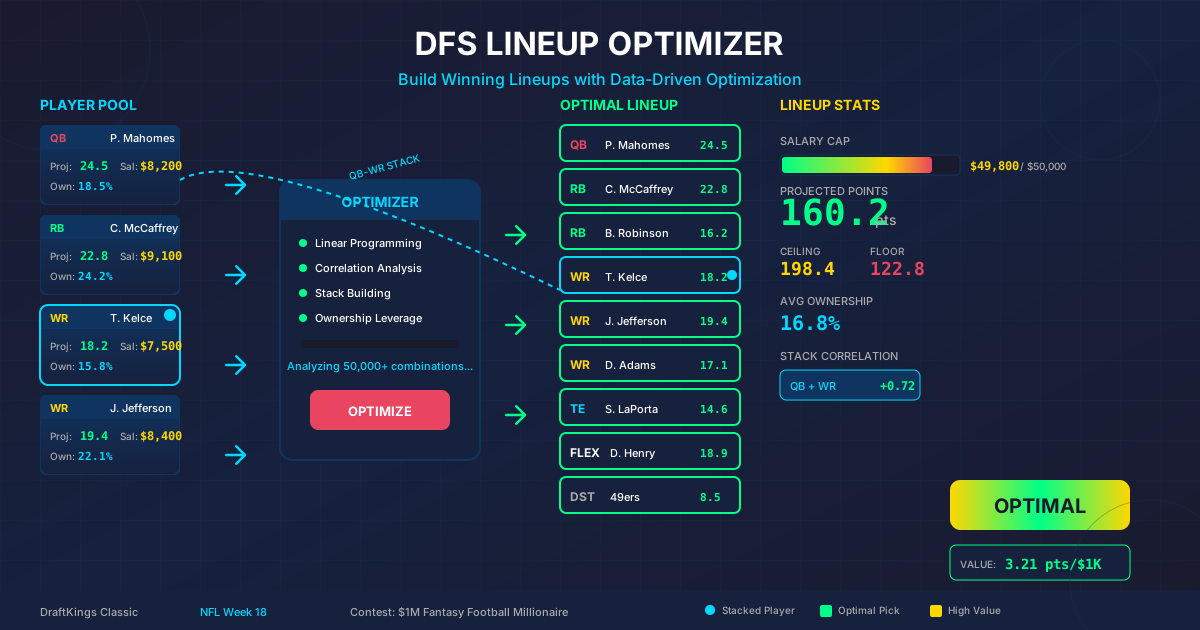
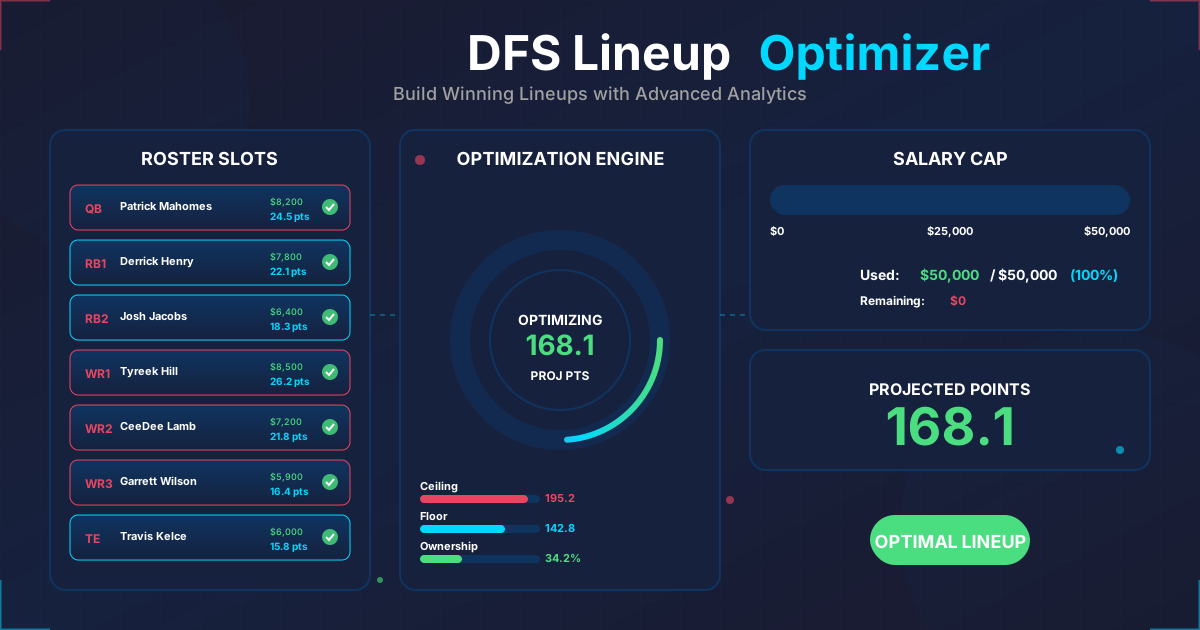
- DFS Lineup Optimizer - Build lineups
- DFS GPP vs Cash EV Calculator - Game selection
- DFS Ceiling/Floor Calculator - Player analysis
- DFS Value Calculator - Value plays
- DFS ROI Calculator - Performance tracking
Conclusion
Ownership leverage separates GPP winners from the field. Our calculator helps you identify optimal leverage spots where contrarian plays maintain quality while providing differentiation. The goal isn't being different—it's being different and right. Balance leverage with player quality, think at the stack level, and adjust as ownership solidifies before lock.
Calculate Your Ownership Leverage Now →
In GPPs, being right isn't enough—you need to be right when others are wrong. Ownership leverage provides the mathematical framework for contrarian DFS strategy. Use our calculator to find spots where your correct reads generate maximum tournament equity.