DFS in 2026: Is Daily Fantasy Sports Still Profitable? Strategy, Trends, and Tools
Daily fantasy sports in 2026 is a fundamentally different game than it was five years ago. The fish have mostly left. The tools are more sophisticated. The fields are sharper. And yet, the opportunity for profit still exists -- if you understand the math, use the right tools, and approach DFS like the investment vehicle it actually is rather than the entertainment product it markets itself as.
The DFS industry generates over $4 billion in annual entry fees across platforms like DraftKings and FanDuel. But here is the uncomfortable truth: the top 1-2% of players take home the vast majority of the prize pool. If you are playing DFS without a systematic approach to lineup optimization, ownership leverage, stacking strategy, and bankroll management, you are subsidizing the profits of those who do.
This guide covers everything you need to compete in the 2026 DFS landscape: the current state of the industry, the fundamental differences between cash game and GPP strategy, how to build optimized lineups, how ownership leverage creates edge in tournaments, when and how to stack, proper bankroll management, and realistic expectations for what you can actually earn.
Start building optimized lineups with our free DFS Lineup Optimizer.
The DFS Landscape in 2026
Industry Overview
| Metric | 2020 | 2023 | 2026 |
|---|---|---|---|
| Annual entry fees | $2.5B | $3.5B | $4.2B+ |
| Active players | 9M | 12M | 15M+ |
| Avg. field sharpness | Medium | Medium-High | High |
| Top player win rate | 55-65% | 52-60% | 50-58% |
| States legal | 42 | 44 | 45+ |
| Major platforms | 2 | 2 | 2+ |
What Has Changed
Sharper fields: Recreational players make up a smaller percentage of the player pool. More players use optimization tools, projection sources, and advanced analytics.
Better data: Player-tracking data, real-time injury updates, and weather models have all improved, making projections more accurate across the field.
Platform adjustments: DraftKings and FanDuel have implemented features like beginner-only contests, entry limits, and experience badges to protect recreational players. This is good for the ecosystem's sustainability but means the unlimited GPPs are predominantly sharp.
Sports betting integration: Many former DFS players have moved to sports betting (legal in 38+ states). This has reduced the overall DFS player pool but also removed some recreational money.
Evaluate your DFS performance with our DFS ROI Calculator.
Cash Games vs. GPP Tournaments: Choosing Your Battlefield
Cash Games (50/50s, Double-Ups, Head-to-Heads)
Cash games pay out roughly the top 50% of entries. Your goal is simple: beat approximately half the field with consistent, high-floor lineups.
Cash Game Strategy Principles:
| Principle | Description | Example |
|---|---|---|
| Maximize floor | Choose safe, high-usage players | Star QB with 25+ attempts |
| Minimize bust risk | Avoid volatile low-floor plays | Skip boom-or-bust WR3 |
| Prioritize correlations | Stack QB + pass-catcher | Mahomes + Kelce |
| Pay for studs | Pay up at premium positions | Top-5 RB worth the salary |
| Use chalk wisely | Do not fight consensus when correct | Popular plays are popular for a reason |
Cash Game ROI Expectations:
- Breakeven players: 48-52% win rate
- Solid players: 53-58% win rate
- Elite players: 58-65% win rate
At a 55% win rate in double-ups, your ROI is approximately +5% before rake. After rake (typically 10-15% of entry fees), net ROI is approximately -5% to 0% for median players and +3-8% for strong players.
GPP Tournaments (Guaranteed Prize Pools)
GPPs are top-heavy payout structures where the top 15-25% of entries cash, but the majority of the prize pool goes to the top 1%. These require fundamentally different strategy than cash games.
GPP Strategy Principles:
| Principle | Description | Example |
|---|---|---|
| Maximize ceiling | Choose players with boom potential | Leverage boom-bust profiles |
| Differentiate lineups | Low-ownership, high-upside picks | Under-owned value play at 5% |
| Ownership leverage | Fade chalk, create unique lineups | Skip 35% owned player |
| Stack aggressively | QB + 2-3 pass-catchers | Full game stack |
| Accept variance | Most lineups will lose | 70-80% of entries will bust |
GPP ROI Expectations:
- Breakeven players: Top 15-20% finishes consistently
- Solid players: 5-15% ROI (volatile, requires high volume)
- Elite players: 15-30% ROI (large sample required)
Calculate your DFS value plays with our DFS Value Calculator.
Lineup Optimization: The Math Behind Winning Lineups
The Optimization Problem
DFS lineup optimization is a constrained optimization problem:
Objective: Maximize total projected fantasy points Subject to:
- Total salary <= salary cap ($50,000 on DraftKings)
- Roster size = required positions filled
- Position constraints met (1 QB, 2 RB, 3 WR, 1 TE, 1 FLEX, 1 DST for DK NFL)
Points Per Dollar: The Core Value Metric
Value = Projected Points / (Salary / $1,000)
| Player | Salary | Projection | Value (pts/$1K) |
|---|---|---|---|
| Player A | $8,200 | 22.5 | 2.74 |
| Player B | $5,400 | 16.8 | 3.11 |
| Player C | $4,100 | 11.5 | 2.80 |
| Player D | $3,800 | 12.2 | 3.21 |
Player D offers the best value at 3.21 points per $1,000, while Player A offers the worst despite having the highest raw projection.
The key insight: You do not need every player to be the highest-scoring option at their position. You need the combination of players that produces the highest total score while staying under the salary cap.
Optimize your lineup mathematically with our DFS Lineup Optimizer.
Projection Sources and Quality
Your projections are the single most important input. Better projections beat better optimization every time.
Sources of projection alpha:
- Consensus projections -- The average of multiple sources eliminates individual bias
- Proprietary models -- If you can build or purchase a model that outperforms consensus, this is the biggest edge available
- Late-breaking information -- Injury news, weather changes, and lineup confirmations that arrive after projections are set
- Matchup-specific adjustments -- Defensive rankings, pace of play, and scheme considerations
Salary Efficiency
The salary cap forces tradeoffs. Every dollar you spend on one player is a dollar unavailable for another.
Optimal salary distribution (NFL DraftKings $50K):
| Strategy | QB | RB1 | RB2 | WR1 | WR2 | WR3 | TE | FLEX | DST |
|---|---|---|---|---|---|---|---|---|---|
| Stars & Scrubs | $7.5K | $8K | $4.5K | $7K | $5K | $4K | $3.5K | $7.5K | $3K |
| Balanced | $6.5K | $7K | $5.5K | $6.5K | $5.5K | $5K | $5K | $5.5K | $3.5K |
| Pay-down QB | $5.5K | $8K | $6.5K | $7.5K | $6K | $5K | $4.5K | $4K | $3K |
There is no single "correct" salary distribution. The optimal approach depends on the slate-specific value at each position.
Ownership Leverage: The Hidden Edge in GPPs
What Is Ownership Leverage?
Ownership leverage is the practice of building lineups that differ from the field's most popular construction. In GPPs, being different is as important as being right.
Why Ownership Matters
The math of ownership leverage:
If Player A is owned by 35% of the field and Player B (similar projection) is owned by 8%, and both score 25 fantasy points:
- 35% of your opponents also have Player A (no differentiation)
- Only 8% have Player B (massive differentiation)
If Player B outscores Player A, you gain on 92% of the field. Even if Player A outscores Player B, you only lose to the 35% who had him -- and you gain on them at other positions where you are differentiated.
Ownership Leverage Framework
| Ownership Level | Strategy | Risk/Reward |
|---|---|---|
| 30%+ (Heavy chalk) | Fade in GPPs, play in cash | Low ceiling, high floor |
| 15-30% (Popular) | Selective use, do not over-expose | Moderate |
| 5-15% (Low owned) | Strong GPP plays if projections support | High ceiling potential |
| Under 5% (Contrarian) | Maximum leverage if correct | Highest risk/reward |
The ideal GPP lineup has a mix: 1-2 popular plays (you cannot be different everywhere) and 3-4 low-ownership plays that provide leverage.
Analyze ownership percentages with our DFS Ownership Leverage Calculator.
Real-World Ownership Example
NFL Sunday Main Slate GPP:
| Player | Salary | Projection | Ownership | Your Decision |
|---|---|---|---|---|
| Patrick Mahomes | $8,400 | 24.5 | 32% | Fade (popular, but game script is a concern) |
| Josh Allen | $8,200 | 23.8 | 18% | Play (similar projection, half the ownership) |
| Lamar Jackson | $7,600 | 22.0 | 8% | Strong GPP play (rushing upside at low ownership) |
By choosing Jackson over Mahomes, you save $800 in salary (to spend elsewhere) and gain leverage on 32% of the field. If Jackson outperforms, you leap past nearly a third of your competitors.
Stacking Strategy: Correlation Is King
What Is Stacking?
Stacking means rostering multiple players from the same game, typically a quarterback with his pass-catchers. Stacking exploits positive correlation -- when a QB throws a touchdown, both the QB and the receiver score.
Types of Stacks
| Stack Type | Composition | Best For | Example |
|---|---|---|---|
| Primary stack | QB + 1-2 pass-catchers | All formats | Mahomes + Kelce + Rice |
| Bring-back | Primary stack + opposing pass-catcher | GPPs | Mahomes + Kelce + Opposing WR |
| Game stack | Primary + bring-back (4+ players) | GPPs | Full game environment play |
| Run-back | RB + opposing pass-catchers | GPPs (less common) | Leverage high-total games |
| Mini-stack | 2 skill players same team (no QB) | Cash/GPP | RB + WR from run-heavy team |
Why Stacking Works
Without correlation (independent events):
- Probability both players score 25+ pts: 0.20 x 0.20 = 4%
With positive correlation (QB + WR):
- Probability both score 25+ pts: 0.20 x 0.50 (conditional) = 10%
Stacking increases your lineup's variance in a favorable direction. Your ceiling is much higher when correlated players simultaneously hit.
Plan your stacking strategy with our DFS Stacking Strategy Calculator.
Game Environment Selection
The best stacks come from the best game environments:
| Factor | Favorable for Stacking | Unfavorable |
|---|---|---|
| Over/Under | 50+ (NFL) | Under 40 |
| Spread | Close game (within 6 pts) | Blowout expected |
| Pace | Fast-pace teams | Slow, run-heavy |
| Weather | Dome or clear | Heavy wind/rain |
| Defensive ranking | Weak pass defense | Top-5 pass defense |
Analyze game environments with our Expected Value Calculator.
Bankroll Management for DFS
Why Bankroll Management Matters More in DFS
DFS has inherently high variance, especially in GPPs where you might cash only 15-25% of the time. Without proper bankroll management, even a skilled player can go broke during inevitable cold stretches.
Bankroll Allocation by Contest Type
| Contest Type | Max % of Bankroll per Entry | Reasoning |
|---|---|---|
| Head-to-head | 5-10% | Lower variance, higher win rate |
| Double-up/50-50 | 3-5% | Moderate variance |
| Single-entry GPP | 1-3% | High variance, need volume |
| Multi-entry GPP | 0.5-1% per entry | Highest variance, need diversification |
| High-stakes | 0.5-2% | Risk management is critical |
Example: $1,000 DFS Bankroll
| Contest Type | Max Entry | Entries per Week | Weekly Investment |
|---|---|---|---|
| $5 double-ups | $50 total | 10 | $50 |
| $3 GPPs | $30 total | 10 | $30 |
| $20 single-entry GPP | $20 | 1 | $20 |
| Total weekly | $100 (10% of bankroll) |
At 10% weekly deployment, you can withstand 10+ consecutive losing weeks before depleting your bankroll -- enough to weather virtually any downswing for a skilled player.
Calculate your optimal DFS bankroll with our DFS Bankroll Calculator.
The Kelly Criterion for DFS
The Kelly Criterion can be adapted for DFS:
Kelly % = (Edge x Probability of Cashing) / (Entry Fee / Average Cash)
For a GPP with 20% cash rate and 3x average cash:
- Edge estimate: 5%
- Kelly % = (0.05 x 0.20) / (1/3) = 0.01 / 0.333 = 3%
This suggests allocating 3% of your bankroll to this contest. Most professionals use fractional Kelly (25-50%) for additional safety.
Calculate optimal allocation with our Kelly Criterion Calculator.
Realistic Profit Expectations
The Rake Problem
DFS platforms take 10-15% of every entry fee as rake. This means:
- In a $100 contest with $10 rake, only $90 goes to the prize pool
- To break even after rake, you need to outperform 55-60% of the field
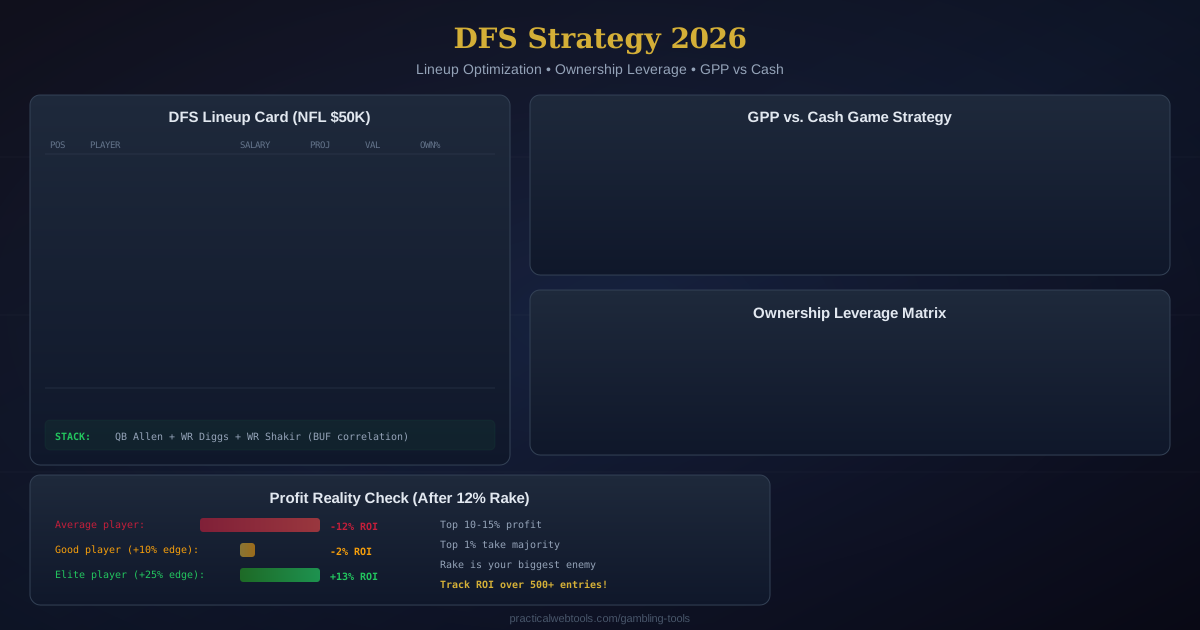
- A 5% edge over the field translates to approximately -5% to 0% ROI after rake
- Only players with 10%+ edge over the field achieve meaningful positive ROI
ROI by Skill Level
| Skill Level | Edge over Field | ROI (before rake) | ROI (after 12% rake) | Monthly P/L ($500/wk) |
|---|---|---|---|---|
| Below average | -10% | -10% | -22% | -$440 |
| Average | 0% | 0% | -12% | -$240 |
| Above average | +5% | +5% | -7% | -$140 |
| Good | +10% | +10% | -2% | -$40 |
| Very good | +15% | +15% | +3% | +$60 |
| Elite | +25% | +25% | +13% | +$260 |
| Top 0.1% | +40% | +40% | +28% | +$560 |
The harsh reality: The majority of DFS players lose money after rake. Only the top 10-15% of players consistently profit. The top 1% take home the majority of the money.
Track your actual ROI over time with our DFS ROI Calculator.
Advanced DFS Strategy
Late Swap Optimization
Late swap (updating your lineup after some games have started) is one of the most underutilized edges in DFS:
- Swap out inactive players before their game starts
- React to early-game developments in late-afternoon/evening games
- Adjust based on first-half performance (less reliable but sometimes valuable)
Slate Selection
Not all slates are created equal. Smaller slates (3-5 games) have higher variance and less room for differentiation. Larger slates (10+ games) allow for more unique lineup construction.
| Slate Size | Games | Best For | Field Sharpness |
|---|---|---|---|
| Main slate | 10-13 | All strategies | Highest |
| Sunday-Monday | 2-3 | Showdown/Captain | Very high |
| Afternoon | 6-8 | Balanced | Medium-high |
| Primetime | 1-2 | Showdown only | Medium |
Multi-Entry Strategy
In multi-entry GPPs, you can submit multiple lineups. The goal is portfolio diversification:
- Build a core: 3-5 players you strongly believe in
- Vary around the core: Different combinations of supporting players
- Include contrarian lineups: 1-2 lineups with very low overall ownership
- Avoid duplication: Each lineup should have a unique construction
- Target different game stacks: Diversify across game environments
DFS as Investment: Variance and Sample Size
DFS is high-variance. A profitable player can easily lose money over a 10-week sample. Minimum sample sizes for meaningful conclusions:
| Contest Type | Minimum Entries | Ideal Entries |
|---|---|---|
| Cash games | 200+ | 500+ |
| Single-entry GPP | 300+ | 1,000+ |
| Multi-entry GPP | 500+ | 2,000+ |
Understand your variance exposure with our Poker Variance Calculator (the math applies to DFS too).
Real-World DFS Examples
Example 1: Cash Game Grinder
Profile: Sarah plays $10 double-ups on DraftKings NFL
- Weekly entry: $100 (10 entries)
- Win rate: 57%
- Average cash: $18.18 (from $10 entry)
- Weekly results: 5.7 cashes x $18.18 = $103.63, minus $100 = +$3.63
- Monthly profit: approximately +$58 (2.9% ROI)
- Annual profit: approximately $700
Sarah is a winning player but her profit is modest. The edge in cash games is thin.
Example 2: GPP Tournament Player
Profile: Mike plays $5 GPPs on FanDuel NFL (20 entries/week)
- Weekly entry: $100
- Cash rate: 22%
- Average cash: $35 (skewed by occasional big finishes)
- Weekly results: 4.4 cashes x $35 = $154, minus $100 = +$54
- Monthly profit: approximately $864 (43% ROI, heavily variance-dependent)
- But: His biggest single week was +$2,400, his worst was -$100
Mike's higher ROI comes from GPP top-heavy payouts, but his results are extremely volatile.
Example 3: Multi-Sport Pro
Profile: Lisa plays NFL, NBA, and MLB DFS year-round
- Monthly entry: $2,000
- Blended ROI: 8% after rake
- Monthly profit: $160
- Annual profit: approximately $1,920
- Effective hourly rate: $8-12/hour (including research time)
Lisa is profitable but the time investment makes it comparable to a low-wage side hustle rather than a lucrative activity.
Example 4: The Losing Player Who Thinks They Are Winning
Profile: Tom plays $20 NFL GPPs casually
- Weekly entry: $60 (3 entries)
- Remembers his $500 win vividly
- Forgets his 15 losing weeks
- Actual results over 20 weeks: $1,200 entered, $800 returned
- Actual ROI: -33%
Tom's experience illustrates why tracking matters. Without data, his perception (profitable) differs enormously from his reality (significant loser).
Using Our Tools for DFS Success
Step-by-Step DFS Workflow
Step 1: Build Projections Start with consensus projections and adjust based on your research. Focus on matchups, game environments, and late-breaking news.
Step 2: Identify Value Use our DFS Value Calculator to find players whose projected points per dollar exceed the field average at their position.
Step 3: Check Ownership Use our DFS Ownership Leverage Calculator to identify which popular plays to fade and which low-owned players offer leverage.
Step 4: Plan Stacks Use our DFS Stacking Strategy Calculator to identify optimal game stacks based on game totals, spreads, and correlation data.
Step 5: Optimize Lineups Run your projections through our DFS Lineup Optimizer to generate mathematically optimal lineups under salary constraints.
Step 6: Manage Bankroll Use our DFS Bankroll Calculator to determine how much to allocate to each contest type.
Step 7: Track Results Use our DFS ROI Calculator to track your actual ROI over time and determine if your approach is profitable.
Understanding Bankroll Volatility
DFS bankrolls can experience significant swings even for winning players. Understanding expected volatility prevents you from making poor decisions during downswings.
Monitor your swings with our Bankroll Volatility Tracker.
Determine proper bankroll requirements with our Poker Bankroll Requirements (the math applies to any form of edge-based gambling including DFS).
Comparing DFS to Sports Betting ROI
Many DFS players also engage in sports betting. How do the two compare?
| Factor | DFS | Sports Betting |
|---|---|---|
| Rake/Vig | 10-15% | 2-5% (standard juice) |
| Skill ceiling | Very high | High |
| Time investment | High (research + lineup building) | Moderate |
| Variance | Very high (GPPs) | Moderate |
| Scalability | Limited (entry caps, field size) | Moderate (bet limits) |
| ROI potential | 5-15% (elite) | 2-5% (elite) |
| Legal status | 45+ states | 38+ states |
Compare your performance across activities with our Poker ROI Calculator (works for any gambling ROI calculation).
Implied Probability and DFS Pricing
Understanding implied probability helps identify which game environments DFS pricing is undervaluing:
If a total is set at 52.5 and the market implies a close game, the DFS pricing should favor pass-catchers in that game. If it does not, you have found value.
Calculate implied probabilities with our Implied Probability Calculator.
Understand the hold on betting lines that inform your DFS research with our Hold/Vig Calculator.
Frequently Asked Questions
Is DFS still profitable in 2026?
Yes, but only for a shrinking percentage of players. The average field is significantly sharper than it was 5 years ago. To be profitable, you need quality projections, an optimization tool, ownership awareness, proper bankroll management, and substantial volume. The top 10-15% of players extract profit; everyone else subsidizes them.
How much money do I need to start playing DFS seriously?
A minimum of $500-$1,000 is recommended for a serious approach. This allows you to properly diversify across contest types and survive the variance inherent in GPPs. With less capital, stick to low-stakes cash games to build your bankroll gradually.
Should I play cash games or GPPs?
It depends on your edge and risk tolerance. If you are a consistent, solid player, cash games offer steadier returns with lower variance. If you have strong ownership leverage skills and higher risk tolerance, GPPs offer greater upside but with more variance. Most successful players mix both.
How important are projections vs. optimization?
Projections are far more important. A simple lineup with superior projections will outperform an optimized lineup with poor projections every time. Think of it as 70% projections, 20% ownership/game theory, 10% optimization.
Can I make a living playing DFS?
Very few people make a full-time living from DFS alone. The typical elite player earns $10,000-$50,000 annually after accounting for time investment. Given the 20-30+ hours per week required for research and lineup construction, the effective hourly rate is often below minimum wage. DFS is best treated as a profitable hobby or supplementary income.
What is the best sport for DFS profitability?
NFL offers the most prize pools and liquidity. NBA offers more frequent slates with higher volume opportunities. MLB has the most predictable variance and highest correlation benefit from stacking. The "best" sport depends on your specific knowledge edge and available time.
How do I know if I am a winning DFS player?
Track every entry, contest type, and result for at minimum 3-6 months (500+ entries in cash, 1,000+ in GPPs). Calculate your ROI after rake. If your ROI is positive over this sample, you have evidence of skill. Use our DFS ROI Calculator to track systematically.
How does stacking affect my variance?
Stacking increases both your upside and downside variance. Correlated lineups have higher ceilings (when the stack hits) and lower floors (when it busts). This is desirable in GPPs where you need to finish at the very top to earn meaningful prizes, but less desirable in cash games where consistency is paramount.
Related Tools
Optimize your DFS strategy with these free calculators:
- DFS Lineup Optimizer -- Build mathematically optimal lineups
- DFS Value Calculator -- Find value plays by points per dollar
- DFS Ownership Leverage -- Analyze ownership percentages
- DFS ROI Calculator -- Track your DFS profitability
- DFS Bankroll Calculator -- Determine optimal bankroll allocation
- DFS Stacking Strategy -- Plan correlated stacks
- Expected Value Calculator -- Calculate EV for any decision
- Bankroll Volatility Tracker -- Monitor bankroll swings
- Kelly Criterion Calculator -- Optimize bet/entry sizing
- Hold/Vig Calculator -- Understand market pricing
- Implied Probability Calculator -- Convert odds to probabilities
- Odds Converter -- Compare odds formats
- Poker ROI Calculator -- Calculate ROI across activities
- Poker Variance Calculator -- Understand variance mathematics
- Poker Bankroll Requirements -- Bankroll sizing fundamentals
Conclusion
DFS in 2026 remains a viable path to profit for disciplined, analytical players who treat it as a skill-based investment rather than casual entertainment. The fields are tougher, the edges are thinner, and the time commitment is significant. But for those willing to put in the work, the mathematics still reward the prepared.
Start with our DFS Lineup Optimizer to build your first optimized lineup. Use our DFS Value Calculator to find the best value plays on every slate. Leverage our DFS Ownership Leverage Calculator to build differentiated GPP lineups. And track everything with our DFS ROI Calculator so you know -- with mathematical certainty -- whether you are actually winning.
The prize pools are still massive. The tools are free. The question is whether you are willing to approach DFS with the analytical rigor it demands.
Gambling involves risk. This content is for educational and informational purposes only. Always gamble responsibly, set limits you can afford, and seek help if gambling becomes a problem. Visit the National Council on Problem Gambling or call 1-800-522-4700 for support.