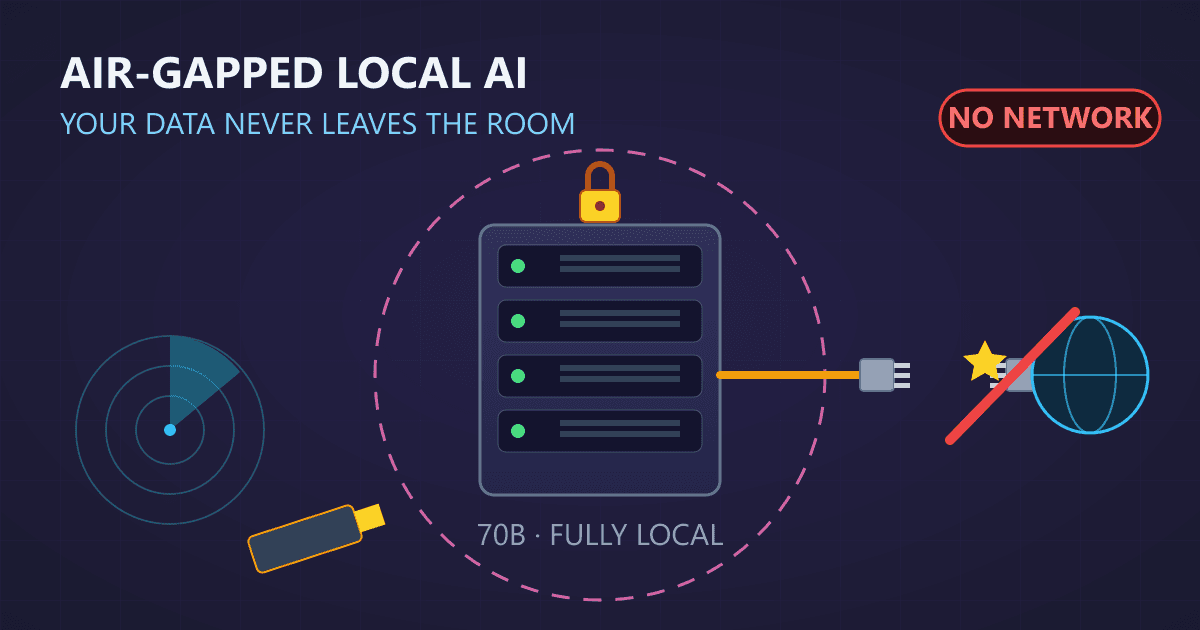
Quick Answer: Air-gapped AI deployment uses open-weight language models like Llama 3.3 70B running entirely on local hardware with no network connection. Entry-level deployment costs $5,000-$8,000 for single-user workstations; production deployments supporting multiple users range from $50,000-$200,000. The software stack (Ollama, llama.cpp, or vLLM) is free and open-source. Typical ROI payback is 6 months through productivity gains of 2-3x for document analysis, coding assistance, and research tasks.
A defense contractor called me last year with an unusual problem. Their analysts were spending hours summarizing intelligence reports, their engineers were writing code without modern AI assistance, and their researchers were drowning in documents they couldn't process efficiently.
Try AI Chat — free, no sign-up, and it runs entirely in your browser.
The problem wasn't budget or technology. The problem was that their most valuable data lived on networks with no internet connection by design.
Air-gapped systems exist precisely because some information is too sensitive to risk any external exposure. These physically isolated networks protect classified government data, medical records, financial trading algorithms, and industrial control systems. The air gap is the ultimate firewall: you cannot hack what you cannot reach.
But this isolation creates a productivity gap. Knowledge workers on air-gapped networks watch their counterparts on regular networks use AI tools that dramatically accelerate their work. The pressure to match that productivity leads some to dangerous workarounds: copying sensitive data to personal devices, using unauthorized cloud services, or simply accepting reduced efficiency.
The good news is that modern AI no longer requires cloud connectivity. Open-weight large language models can run entirely on local hardware, bringing powerful AI capabilities to networks that will never see the internet.
Why Can't Air-Gapped Systems Use Cloud AI Services?
The fundamental problem with cloud AI services is in the name: cloud. ChatGPT, Claude, and similar services require sending your data to external servers for processing.
For many use cases, this is fine. Asking a cloud AI to help write a birthday message or explain a programming concept poses minimal risk.
But consider the data that lives on air-gapped systems:
- Classified intelligence reports and threat assessments
- Military system specifications and capabilities
- Patient medical records protected by HIPAA
- Financial trading strategies worth billions
- Industrial control system configurations
- Legal case materials under attorney-client privilege
None of this can be uploaded to an external service, regardless of the service's security practices. The regulations, contracts, and common sense that govern this data simply prohibit external transmission.
This isn't about distrusting any particular company. It's about the fundamental incompatibility between data that must stay isolated and services that require data transmission.
What Does Local AI Mean for Air-Gapped Environments?
Local AI means running the entire AI system, including the large language model that generates responses, on hardware you physically control.
Modern open-weight models like Meta's Llama, Mistral AI's models, and various community-developed options can be downloaded as files and run on standard server or workstation hardware. The model weights (the billions of parameters that encode the model's knowledge) live on your local storage. The computation happens on your local processors. No network connection is required after initial model download.
This isn't a thin client connecting to a remote brain. The entire neural network runs locally. You could literally unplug the network cable after setup and the AI would continue functioning indefinitely.
The models are remarkably capable. Llama 3.3 70B, for example, performs sophisticated reasoning, writes and analyzes code, summarizes documents, answers questions, and handles most tasks you'd ask of cloud AI services.
What Hardware Do You Need for Air-Gapped AI?
Running large language models requires significant computational resources, but not exotic hardware.
Entry-Level Deployment (Single User)
A high-end workstation with a modern NVIDIA GPU can run capable models for individual use:
- NVIDIA RTX 4090 (24GB VRAM)
- 64GB system RAM
- 2TB NVMe storage
- Modern CPU (AMD Ryzen 9 or Intel Core i9)
This configuration runs models up to about 30 billion parameters at interactive speeds. Expect 20-40 tokens per second depending on the model and prompt complexity.
Cost: $5,000-$8,000 for the complete workstation
Production Deployment (Multiple Users)
Supporting multiple concurrent users requires more capable hardware:
- Multiple NVIDIA A100 or H100 GPUs
- 256GB+ system RAM
- Redundant storage arrays
- Server-class CPUs
This configuration can run the largest open models (70B+ parameters) and serve multiple users simultaneously.
Cost: $50,000-$200,000 depending on GPU configuration
CPU-Only Deployment (Where GPUs Are Prohibited)
Some secure environments prohibit GPUs due to concern about covert channels or simply procurement restrictions. CPU-only deployment is possible but significantly slower:
- High core count server CPU (AMD EPYC or Intel Xeon)
- 256GB+ RAM (model runs in system memory)
- Fast NVMe storage
This configuration runs at 1-5 tokens per second, suitable for batch processing but frustrating for interactive use.
What Software Do You Need to Run AI on Air-Gapped Systems?
The software for local AI deployment is mature and well-documented:
Ollama provides the simplest deployment path. It manages model downloads, optimization, and serving through a clean command-line interface and API. Running a model is as simple as ollama run llama3.3:70b.
llama.cpp offers lower-level control for users who need to optimize every aspect of deployment. It's the foundation that Ollama builds upon.
vLLM provides high-performance serving for multi-user deployments with sophisticated batching and memory management.
All of these are open source, free to use, and designed for on-premise deployment.
How Do You Deploy AI on an Air-Gapped Network?
Deploying AI on an air-gapped network requires careful planning because you can't download anything after the system is operational.
Step 1: External Preparation
On an internet-connected system (outside your secure environment):
- Download the AI software (Ollama, llama.cpp, or vLLM)
- Download model weight files for the models you want to deploy
- Download any dependencies
- Verify file checksums against published values
- Create installation media (USB drives, DVDs, or approved transfer media)
Step 2: Media Transfer
Follow your organization's procedures for bringing media across the air gap. This typically involves:
- Security scan of all files
- Documentation of all files being transferred
- Approval from information security personnel
- Physical transfer using approved media types
Step 3: Installation
On your air-gapped system:
- Install the AI runtime software
- Copy model weight files to local storage
- Configure the software for your environment
- Test functionality with sample prompts
Step 4: Integration
Connect the AI system to your users and workflows:
- Configure network access for authorized users
- Set up any web interface for interactive use
- Integrate API access for applications that need AI capabilities
- Establish user access controls and logging
What Can You Do With AI on Air-Gapped Networks?
Document Summarization and Analysis
Large language models excel at distilling lengthy documents into actionable summaries. An analyst can paste a 50-page report into the AI and receive a summary of key findings, identified entities, and notable patterns in seconds.
Code Assistance
Developers on isolated networks can get code suggestions, explanations, and debugging help. The AI doesn't have access to external resources but can draw on its training knowledge of programming languages, algorithms, and common patterns.
Translation
While not replacing human translators for authoritative work, local AI can provide working translations that help analysts triage foreign-language documents and identify priorities for formal translation.
Research Assistance
The AI can help researchers explore topics, identify connections, and draft initial documents. It serves as an intelligent starting point for research rather than a replacement for domain expertise.
Administrative Tasks
Routine communications, meeting summaries, and documentation can be drafted by AI and refined by humans, reducing time spent on administrative overhead.
What Security Considerations Apply to Air-Gapped AI?
Deploying AI on secure networks introduces considerations beyond traditional software:
Model Provenance
Where did the model come from? Who created it? What was it trained on? For secure environments, sticking with models from reputable sources (Meta, Mistral, Google) with documented provenance is prudent.
Prompt Injection
If the AI processes adversary-controlled content (captured documents, intercepted communications), adversaries might attempt to manipulate AI behavior through crafted inputs. Train users to treat AI output as suggestions requiring human validation.
Output Classification
AI-generated content based on classified inputs should be treated at the same classification level. The AI doesn't declassify anything.
Access Controls
Implement appropriate access controls for AI systems. Not everyone who can access the network should necessarily have AI access.
Logging
Log AI interactions for audit purposes. Who used the AI, when, and for what purposes should be auditable.
How Does Air-Gapped AI Meet Compliance Requirements?
For environments subject to regulatory frameworks, AI deployment must satisfy relevant requirements:
NIST 800-171 / CMMC for defense contractors handling Controlled Unclassified Information requires access controls, audit logging, and configuration management for AI systems.
HIPAA for healthcare requires ensuring AI systems processing patient data meet privacy and security requirements.
ICD 503 for intelligence community systems requires integration with existing security architecture and approval from authorizing officials.
In each case, local AI deployment is generally easier to authorize than cloud services because it doesn't involve data transmission to external parties.
What Results Can Organizations Expect From Air-Gapped AI?
Local AI on air-gapped networks isn't theoretical. Organizations are deploying these systems now.
A defense contractor I work with deployed Llama 70B on a dedicated server in their secure facility. Their analysts now process documents at roughly triple their previous speed. Developers get code suggestions that, while not as capable as cloud AI with internet access, still meaningfully accelerate development.
The system cost about $60,000 including hardware, configuration, and authorization documentation. It paid for itself in productivity gains within six months.
Another organization in the healthcare sector deployed local AI for analyzing research documents. HIPAA concerns had completely blocked cloud AI use. Local deployment gave their researchers AI capabilities they couldn't access any other way.
How Do You Get Started With Air-Gapped AI?
If you're considering local AI for an air-gapped environment:
Assess your use cases: What would your users do with AI capabilities? Document specific workflows and expected benefits.
Engage security stakeholders early: Your ISSO/ISSM needs to understand what you're proposing. Present local AI as a capability that doesn't involve external data transmission.
Start small: Begin with a single workstation deployment for evaluation. Demonstrate value before proposing enterprise deployment.
Plan for model updates: How will you update models as better versions release? Build this into your transfer procedures.
Document everything: Authorization requires comprehensive documentation. Start building your security narrative from day one.
Conclusion
The air gap exists for good reason. Some data genuinely cannot risk any external exposure. But the air gap shouldn't mean accepting permanent productivity disadvantages.
Local AI deployment brings meaningful capabilities to environments where cloud services are impossible. The technology is mature, the costs are reasonable, and the path to deployment is well-documented.
For organizations handling sensitive data on isolated networks, local AI isn't just an option. It's increasingly becoming necessary to remain competitive while maintaining the security posture that sensitive work requires.
Frequently Asked Questions
What is an air-gapped AI system?
An air-gapped AI system runs language models entirely on hardware physically isolated from external networks. The AI software and model weights are transferred via approved media (USB drives, DVDs) and never connect to the internet. All processing happens locally, ensuring sensitive data cannot be exposed through network transmission.
How much does air-gapped AI deployment cost?
Entry-level single-user deployments cost $5,000-$8,000 for hardware (RTX 4090, 64GB RAM, NVMe storage). Production deployments supporting multiple concurrent users range from $50,000-$200,000 depending on GPU configuration. Software (Ollama, llama.cpp, vLLM) is free and open-source. Total cost including deployment, testing, and documentation typically runs $60,000-$100,000 for enterprise implementations.
What AI models work best on air-gapped systems?
Llama 3.3 70B provides the best balance of capability and hardware requirements for most use cases. For single-user workstations with limited GPU memory, Llama 3.2 8B or Mistral 7B deliver good results at faster speeds. Qwen 2.5 72B excels at multilingual tasks. All are open-weight models that can be downloaded, verified, and deployed without licensing concerns.
Can air-gapped AI match cloud AI performance?
For most document processing, coding assistance, and research tasks, local models deliver 80-90% of cloud AI quality. Processing speed depends on hardware: 20-40 tokens per second on RTX 4090, up to 100+ tokens per second on A100 GPUs. The primary limitation is context window size, though modern models support 8K-32K tokens, sufficient for most documents.
How do you update AI models on air-gapped systems?
New model versions are downloaded on internet-connected systems, verified against published checksums, transferred to approved media, security-scanned per organizational procedures, and installed on air-gapped hardware. Organizations typically establish quarterly update cycles to balance security with capability improvements.
What compliance frameworks does air-gapped AI satisfy?
Air-gapped AI deployment simplifies compliance with NIST 800-171, CMMC (defense contractors), HIPAA (healthcare), ICD 503 (intelligence community), and SOX (financial services). Because data never leaves the controlled environment, third-party data processing agreements, vendor security assessments, and external audit requirements are eliminated.
How long does it take to deploy air-gapped AI?
Initial proof-of-concept deployment takes 1-2 weeks including hardware setup, software installation, and testing. Full production deployment with documentation, user training, and security authorization typically requires 2-3 months. Ongoing maintenance averages 4-8 hours monthly for monitoring, updates, and user support.
What productivity gains can organizations expect?
Defense contractors report 2-3x speed improvements for document summarization and analysis. Developer productivity increases 20-40% for code-related tasks. Healthcare research organizations process document volumes 3x faster. Typical ROI payback occurs within 6 months based on time savings alone.
For less sensitive work that doesn't require air-gapped networks, our browser-based tools provide private file conversion without uploading files to any server. Different security requirement, same privacy principle.