Stone to Pounds: A Complete Guide to British Weight Units

Your Guide to British Weight: From Stone to Pounds and Back
Have you ever been watching a British television show and heard a character announce they've lost "half a stone"? Or perhaps you've read a UK-based health article that lists weight recommendations in this enigmatic unit. For many outside the United Kingdom and Ireland, the 'stone' is a confusing and unfamiliar measurement. While most of the world has adopted the metric system of grams and kilograms, the UK amusingly clings to a mix of imperial units, with the stone being a prime example in everyday life.
This guide is here to demystify this historical unit of weight. We'll dive into what a stone is, its origins, and most importantly, how to confidently convert it to pounds (lbs) and even kilograms (kg). By the end of this article, you'll be able to navigate British weight measurements like a local and understand the simple math behind the conversions.
What Exactly is a Stone? A Historical Perspective
The term 'stone' sounds quaintly archaic for a reason—it is. The origin of the unit is exactly what it sounds like: a physical stone. For centuries, before the advent of standardized weights, stones of a generally agreed-upon size were used as counterweights on balance scales in markets across Europe. The stone was a convenient and readily available tool for trade.
However, this led to significant regional variations. A stone of wool in one English county might weigh differently from a stone of spices in another. The weight of a 'stone' could range anywhere from 5 to 40 pounds depending on the commodity and the location.
It wasn't until the 14th century that the English crown began to standardize the unit, primarily for the wool trade, a cornerstone of the medieval English economy. The official weight was set at 14 pounds. This standard, formalized over centuries by various Weights and Measures Acts, is the one that survives today.
While the stone is no longer an official unit for trade, its use for measuring human body weight is deeply ingrained in British and Irish culture. It's the standard on bathroom scales, at the doctor's office, and in fitness communities like Weight Watchers (now WW).
The Core Conversion: Stone to Pounds
Let's get straight to the most crucial piece of information. The relationship between stone and pounds is fixed and straightforward.
1 stone = 14 pounds
That's it. This is the golden rule for all conversions. If you can remember this single fact, you can solve any conversion problem.
To make it even easier, here is a quick reference table for the first 10 stone:
| Stone (st) | Pounds (lbs) |
|---|---|
| 1 st | 14 lbs |
| 2 st | 28 lbs |
| 3 st | 42 lbs |
| 4 st | 56 lbs |
| 5 st | 70 lbs |
| 6 st | 84 lbs |
| 7 st | 98 lbs |
| 8 st | 112 lbs |
| 9 st | 126 lbs |
| 10 st | 140 lbs |
How to Calculate a Full Weight Reading
In the UK, body weight is typically expressed in a combination of stone and pounds (e.g., "11 stone 4 pounds"). To convert this to a single pound value, you simply convert the stone part and add the rest.
Formula: Total Pounds = (Number of Stone × 14) + Remaining Pounds
Let's walk through an example:
Convert 12 stone 6 pounds to total pounds.
- Convert the stone component: Multiply the number of stone by 14.
12 st × 14 lbs/st = 168 lbs - Add the remaining pounds: Add the extra pounds to your result from step 1.
168 lbs + 6 lbs = 174 lbs
So, 12 stone 6 pounds is equal to 174 pounds.
Converting Pounds to Stone: The Reverse Calculation
What if you have a weight in pounds and want to see what it is in the traditional British format? This calculation involves a little division.
Convert 180 pounds into stone and pounds.
- Divide by 14: Take the total number of pounds and divide it by 14 to find out how many full stone there are.
180 lbs ÷ 14 = 12.857... - Identify the stone value: The whole number from this calculation is your stone value. In this case, it's 12 stone.
- Calculate the remaining pounds: To find the leftover pounds, you have two simple methods:
- Method A (Multiplication): Multiply the stone value (12) by 14 to see how many pounds that accounts for (
12 × 14 = 168 lbs). Then, subtract this from your original total (180 lbs - 168 lbs = 12 lbs). - Method B (Decimal): Take the decimal part from your division in step 1 (
0.857...) and multiply it by 14 (0.857... × 14 ≈ 12 lbs).
- Method A (Multiplication): Multiply the stone value (12) by 14 to see how many pounds that accounts for (
Both methods give you the same result. The remaining weight is 12 pounds.
So, 180 pounds is equal to 12 stone 12 pounds.
Stone vs. Pounds vs. Kilograms: A Global Comparison
For a more complete picture, it's useful to know how the imperial units of stone and pounds compare to the metric kilogram (kg), which is the standard for science and most countries worldwide.
Here are the key conversion factors:
- 1 stone = 6.35029 kilograms
- 1 pound = 0.453592 kilograms
- 1 kilogram = 2.20462 pounds
To help you visualize these differences, here's a comparison chart for common body weights:
| Stone (st) & Pounds (lbs) | Total Pounds (lbs) | Kilograms (kg) (Approx.) |
|---|---|---|
| 8 st 0 lbs | 112 lbs | 50.8 kg |
| 9 st 6 lbs | 132 lbs | 59.9 kg |
| 10 st 0 lbs | 140 lbs | 63.5 kg |
| 11 st 10 lbs | 164 lbs | 74.4 kg |
| 12 st 12 lbs | 180 lbs | 81.6 kg |
| 14 st 4 lbs | 200 lbs | 90.7 kg |
| 15 st 10 lbs | 220 lbs | 99.8 kg |
From Physical Weight to Digital 'Weight'
Understanding different units of measurement, whether it's stone for body weight or gallons for fuel, is about navigating different systems and standards. The same principle applies in the digital world, where we constantly manage the 'weight' of our data.
Instead of pounds or kilograms, we measure digital files in kilobytes (KB), megabytes (MB), and gigabytes (GB). A large, high-resolution photo or a lengthy video document can be digitally 'heavy', making it difficult to email, upload, or store. Just as you might want to shed a few pounds, you often need to reduce the weight of your digital files.
This is where file compression comes in. If you have a folder of documents that's too large to send, you can use a tool to Compress Files into a single, smaller ZIP archive. This makes the data lighter and more portable.
Different systems also use different standards for compressed files, much like the UK uses stone while the US uses pounds. You might receive a .RAR archive from a colleague, but your computer might prefer the more universal .ZIP format. In that case, a simple online converter like our RAR to ZIP tool can instantly bridge that gap, without requiring you to download any new software.
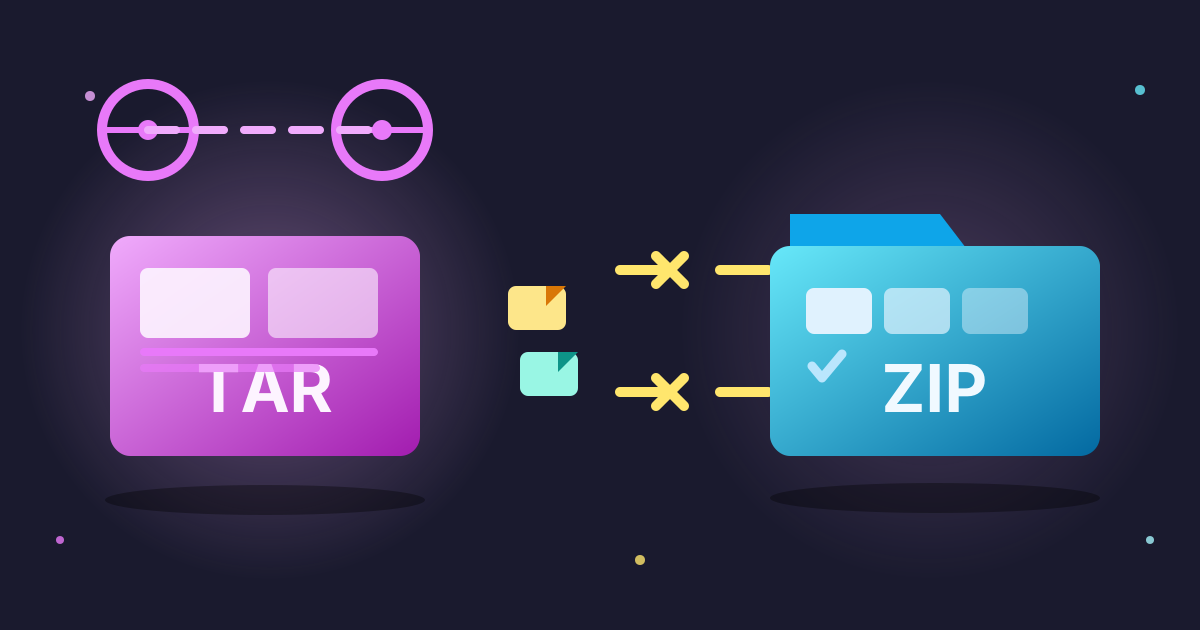
This need for conversion is common for developers and tech-savvy users, too. For instance, moving a project from a Windows environment (which often uses ZIP) to a Linux server often requires a different archive format like TAR. A handy ZIP to TAR tool streamlines this process, ensuring your digital packages are in the right format for their destination.
Why is the Stone Still So Common in the UK?
Despite an official policy of 'metrification' that began in the 20th century, the cultural inertia of the imperial system is strong. Here's why the stone persists:
- Cultural Habit: Generations have grown up thinking about their weight in stone. It's the language they use with their family, friends, and doctors. A weight of "12 stone" is more immediately understandable and relatable to many Brits than "76 kilograms."
- Healthcare System: While medical records increasingly use kilograms for precision, doctors often communicate with patients in stone and pounds to be easily understood.
- Existing Infrastructure: Millions of bathroom scales in the UK are calibrated in stone and pounds. This daily reinforcement keeps the unit alive.
- Media and Fitness: Newspapers, magazines, and popular weight-loss programs in the UK and Ireland still primarily refer to weight loss goals and results in stone.
Conclusion: Your Go-To Guide for Weight Conversions
Navigating the quirks of the British imperial system doesn't have to be a challenge. The key takeaway is simple: one stone is equal to 14 pounds. With that knowledge and the conversion methods we've outlined, you can easily translate any weight measurement you encounter.
Whether you're managing physical weight in stone and pounds or digital weight in megabytes and gigabytes, having the right knowledge and tools is essential. Understanding these systems allows you to operate confidently in any environment, from a British doctor's office to a global digital workspace.
Ready to simplify your digital life? Explore the full suite of over 455 free, privacy-focused online tools at Practical Web Tools to handle all your file conversion, editing, and management needs with ease.