Master Percentages: Quick Tricks for Daily Math Problems

From a 25% off sale at your favorite store to calculating a 15% tip at a restaurant, percentages are woven into the fabric of our daily lives. Yet for many, the mere mention of percentage calculations can trigger a wave of anxiety, bringing back memories of complex math classes. What if you could handle these calculations with confidence and speed, often without even needing a calculator?
This comprehensive guide will demystify percentages for good. We'll break down the basics, reveal powerful mental math tricks, and walk through real-world scenarios. You'll learn how to quickly figure out discounts, understand statistics, and even apply these skills to practical digital tasks like measuring file size reduction. Get ready to turn percentage problems into simple, everyday solutions.
The Three Pillars of Percentage Problems
Before diving into the tricks, it's essential to understand what a percentage really is. The word "percent" comes from the Latin per centum, meaning "per hundred." So, a percentage is simply a fraction of 100. When you say "50%," you're really saying 50 out of 100, or ½.
Nearly every percentage problem you'll encounter is a variation of one of three basic types. Understanding these will give you a solid foundation.
1. Finding the Part: What is X% of Y?
This is the most common type of percentage problem. You're given a total amount and a percentage, and you need to find the value of that percentage.
- Formula:
Part = (Percentage / 100) * Whole - Example: What is 30% of 200?
- Solution:
(30 / 100) * 200 = 0.30 * 200 = 60
2. Finding the Percentage: X is what percent of Y?
Here, you know the part and the whole, and you need to figure out the percentage that the part represents.
- Formula:
Percentage = (Part / Whole) * 100 - Example: 45 is what percent of 150?
- Solution:
(45 / 150) * 100 = 0.3 * 100 = 30%
3. Finding the Whole: X is Y% of what number?
In this scenario, you know the part and the percentage it represents, but you need to find the original total amount.
- Formula:
Whole = Part / (Percentage / 100) - Example: 50 is 25% of what number?
- Solution:
50 / (25 / 100) = 50 / 0.25 = 200
Mental Math Magic: The 10% Rule
While the formulas are reliable, the real key to everyday mastery lies in mental math. The most powerful trick is the "10% Rule." It's incredibly simple and forms the basis for many other quick calculations.
To find 10% of any number, just move the decimal point one place to the left.
- 10% of 500 is 50.0
- 10% of 85 is 8.5
- 10% of 1,234 is 123.4
- 10% of 9.99 is 0.999
Once you've mastered this, you can easily find other percentages by building on it.
Building Blocks Based on 10%
Here’s how to use the 10% rule as your starting point for other common percentages:
-
Find 20%: Calculate 10% and double it.
- Example: To find 20% of 180, first find 10% (which is 18). Then, double it: 18 * 2 = 36.
-
Find 30%, 40%, etc.: Calculate 10% and multiply it by 3, 4, etc.
- Example: To find 40% of 90, first find 10% (which is 9). Then, multiply by 4: 9 * 4 = 36.
-
Find 5%: Calculate 10% and take half of it.
- Example: To find 5% of 220, first find 10% (which is 22). Then, halve it: 22 / 2 = 11.
-
Find 15%: Calculate 10% and add half of that amount (which is 5%).
- Example: To find 15% of 80, first find 10% (which is 8). Then find 5% (half of 8, which is 4). Add them together: 8 + 4 = 12. This is a fantastic trick for calculating tips!
Other Foundational Mental Tricks
Beyond the 10% rule, a few other base percentages are easy to calculate:
-
Find 50%: Simply divide the number by 2.
- Example: 50% of 150 is 75.
-
Find 25%: Simply divide the number by 4 (or find 50% and halve it again).
- Example: 25% of 88 is 22.
-
Find 1%: Move the decimal point two places to the left.
- Example: 1% of 450 is 4.50.
-
Find 75%: Find 50% and 25% and add them together.
- Example: To find 75% of 120, find 50% (60) and 25% (30). Add them: 60 + 30 = 90.
Putting It All Together: Percentages in the Wild
Let's apply these tricks to situations you encounter every day.
Scenario 1: Shopping and Discounts
You see a pair of jeans for $80, and they're 30% off. What's the sale price?
- Find the discount amount: You need to calculate 30% of $80.
- Mental Math: 10% of $80 is $8. Since you need 30%, multiply that by 3: $8 * 3 = $24.
- Calculate the final price: Subtract the discount from the original price.
- Calculation: $80 - $24 = $56.
Scenario 2: Tipping at a Restaurant
Your dinner bill is $54, and you want to leave a good tip, around 18%.
This looks tricky, but you can approximate it easily.
- Calculate 10%: 10% of $54 is $5.40.
- Calculate 20%: Double the 10% amount: $5.40 * 2 = $10.80.
- Estimate 18%: You know 18% is slightly less than 20%. A tip of $10 would be perfectly acceptable and easy to calculate.
- For an exact amount: Calculate 1% by moving the decimal two places: $0.54. Calculate 2% by doubling that: $1.08. Subtract that from your 20% amount: $10.80 - $1.08 = $9.72. The quick estimate of $10 was close and much faster!
Advanced Skills: Percentage Change and Reverse Percentages
Once you're comfortable with the basics, you can tackle two slightly more complex but incredibly useful concepts: calculating percentage change and finding the original number after a change.
Calculating Percentage Increase and Decrease
This is used to determine how much a value has changed relative to its original value. It's crucial for tracking investments, analyzing data, or even for digital tasks.
- The Formula:
Percentage Change = ((New Value - Old Value) / Old Value) * 100
A positive result indicates a percentage increase, while a negative result indicates a decrease.
Practical Digital Example: File Compression Savings
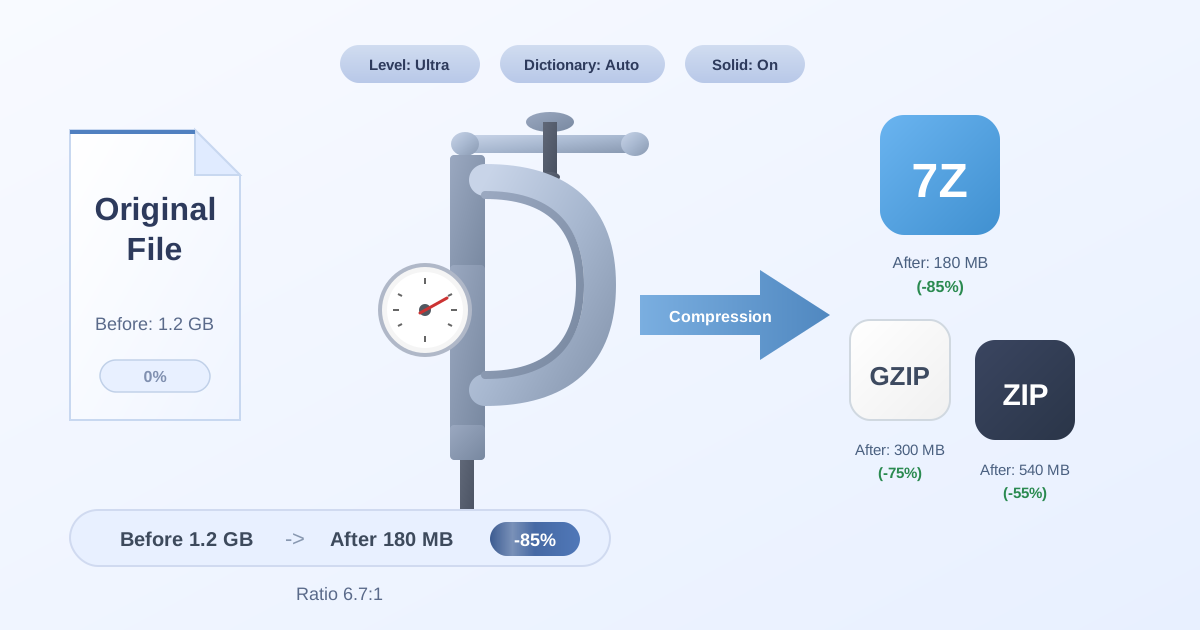
Let's see how this applies to managing digital files. Suppose you have a large 80MB presentation folder that you need to email. To make it smaller, you use a tool to Compress Files into a single ZIP archive. After compression, the new file size is 24MB. What was the percentage decrease in file size?
-
Identify your values:
- Old Value: 80 MB
- New Value: 24 MB
-
Apply the formula:
((24 - 80) / 80) * 100(-56 / 80) * 100-0.7 * 100 = -70%
You achieved a 70% reduction in file size! This calculation is extremely useful when comparing different compression formats. For instance, you could compare the savings from a standard ZIP file versus converting that ZIP to 7Z, as 7Z often provides a higher percentage of compression.
When you or the recipient needs the original files, a simple tool to Decompress Files restores them to their original state, making this a powerful and reversible process for saving space.
The Trick of Reverse Percentages
This is a common trap in retail math. Imagine an item is advertised for $120, which is "after a 25% discount." What was the original price?
Most people's first instinct is to calculate 25% of $120 ($30) and add it back, getting $150. This is incorrect.
The mistake is that the 25% discount was taken from the original, unknown price, not the final price.
Here’s how to solve it correctly:
- Think about what's left: If there was a 25% discount, the price you're paying ($120) represents 100% - 25% = 75% of the original price.
- Set up the problem: $120 = 75% of the original price.
- Use the "Finding the Whole" formula:
Whole = Part / (Percentage / 100) - Calculate:
Original Price = 120 / (75 / 100) = 120 / 0.75 = 160
The original price was actually $160.
When to Use a Calculator
Mental math is empowering for everyday estimates and simple numbers. However, for complex figures, ensuring accuracy in financial documents, or when you're short on time, an online percentage calculator is your best friend. These tools eliminate human error and provide instant, precise answers for any of the problem types we've discussed.
- Use a calculator when:
- Numbers involve multiple decimal places (e.g., calculating 17.5% of 8,342.91).
- Accuracy is critical (e.g., financial reporting, engineering specifications).
- You need to perform many calculations quickly.
Conclusion: You Are Now a Percentage Pro
Percentages are not a mathematical monster to be feared. By understanding the three core problem types and mastering a few simple mental tricks—especially the versatile 10% rule—you can gain the confidence to handle any everyday calculation thrown your way.
From snagging the best deal at a sale to understanding data in a news report, these skills are practical tools for navigating a world driven by numbers. The next time you're faced with a percentage, take a moment, apply these tricks, and solve it with ease.
Ready to put your newfound knowledge of percentage savings to the test? See how much digital space you can save by exploring the powerful file management tools at Practical Web Tools. Start by trying our free Compress Files utility and calculate your own percentage reduction!