Everyday Math Made Easy: Top Percentage Calculator Tricks

Introduction: Demystifying the Dreaded Percent Sign
Walk into any store, browse a website, or look at a restaurant bill, and you'll see it: the percent sign (%). For many, this simple symbol triggers a moment of panic. How much is 30% off? Is a 15% or 20% tip appropriate? What does it mean when your phone storage is 95% full? Percentages are woven into the fabric of our daily lives, yet they remain a common source of mathematical anxiety.
But what if you could calculate percentages in your head, faster than you can pull out your phone's calculator? What if you had a few simple tricks up your sleeve that made these calculations not just easy, but second nature?
This guide is here to do just that. We're going to break down the barriers and show you the simple, powerful tricks that turn percentage problems into simple arithmetic. From mastering shopping sales to understanding the numbers behind your digital life, get ready to make percentages your new superpower.
The Foundation: What Exactly is a Percentage?
Before we dive into the tricks, let's go back to basics for a moment. The word "percent" comes from the Latin per centum, which literally means "per one hundred."
A percentage is simply a fraction where the denominator (the bottom number) is always 100. So, 25% is just another way of saying 25 out of 100, or 25/100. 50% is 50 out of 100, and 100% is 100 out of 100—the whole thing.
Thinking of percentages this way is the first step to mastering them. When you see "40% off," you can think, "For every $100 of the price, I save $40."
The classic formula you learned in school is:
(Part / Whole) × 100 = Percentage
While this formula is correct, it's not always practical for quick mental calculations. That's where the tricks come in.
Your Mental Math Superpower: The 10% Trick
If you learn only one trick from this entire guide, make it this one. The ability to quickly find 10% of any number is the key that unlocks almost every other mental percentage calculation.
How to Find 10% of Any Number: Simply move the decimal point one place to the left.
That's it. It's that simple.
Step-by-Step Guide to the 10% Trick
- Identify your number. Let's say you want to find 10% of $85.00.
- Locate the decimal point. In $85.00, it's right before the zeros.
- Move it one place to the left. Moving the decimal in 85.00 one spot to the left gives you 8.500.
So, 10% of $85.00 is $8.50.
Let's try a few more examples:
- 10% of 60 is 6.0
- 10% of 230 is 23.0
- 10% of 1,450 is 145.0
- 10% of $42.50 is $4.25
- 10% of 7 is 0.7
Practice this until it becomes automatic. Grab a receipt and find 10% of the total. Look at the price of a gallon of gas and find 10%. Once this is effortless, you can build upon it to find almost any other percentage.
Building on the 10% Trick for Everyday Calculations
Now that you've mastered the 10% trick, you can use it as a building block for other common percentages, like those you see while shopping or tipping.
Finding 20%: The Double
To find 20% of a number, simply find 10% and double it.
- Scenario: You want to leave a 20% tip on a $60 restaurant bill.
- Step 1: Find 10% of $60. (Move the decimal) -> $6.
- Step 2: Double it. $6 × 2 = $12.
- Your 20% tip is $12.
Finding 5%: The Half
To find 5% of a number, find 10% and take half of it.
- Scenario: A product costs $120 and has a 5% sales tax.
- Step 1: Find 10% of $120. -> $12.
- Step 2: Take half of that. $12 / 2 = $6.
- The sales tax is $6.
Finding 15%: The Tip Master
To find 15% (a very common tip amount), combine the previous two tricks. Find 10%, find 5%, and add them together.
- Scenario: Your taxi fare is $40, and you want to leave a 15% tip.
- Step 1: Find 10% of $40. -> $4.
- Step 2: Find 5% of $40 (half of 10%). -> $2.
- Step 3: Add them together. $4 + $2 = $6.
- Your 15% tip is $6.
Quick Reference Table
Here is a handy table summarizing how to use the 10% trick as a base for other calculations. Let's use an example of a $120 item.
| Desired Percentage | Calculation Method | Example (on $120) | Result |
|---|---|---|---|
| 1% | Move decimal left twice | 1.20 | $1.20 |
| 5% | Find 10%, then halve it | $12.00 / 2 | $6.00 |
| 10% | Move decimal left once | 12.00 | $12.00 |
| 15% | Find 10% + 5% | $12.00 + $6.00 | $18.00 |
| 20% | Find 10%, then double it | $12.00 × 2 | $24.00 |
| 30% | Find 10%, then triple it | $12.00 × 3 | $36.00 |
| 50% | Halve the number | $120 / 2 | $60.00 |
The Commutative Trick: A Genius Shortcut
Here’s a trick that feels like a magic trick. The commutative property of multiplication means that order doesn't matter (A × B = B × A). This applies to percentages, too!
X% of Y is the same as Y% of X.
This seems simple, but it's incredibly powerful.
- Scenario: You need to calculate 18% of 50.
Your brain might freeze up trying to figure that out. But what if we flip it?
- The Trick: Calculate 50% of 18 instead.
50% of 18 is just half of 18, which is 9. It's that easy. Since 50% of 18 is 9, then 18% of 50 is also 9.
More examples where this is useful:
- 4% of 75: Hard. -> 75% of 4: Easy! 75% is 3/4. 3/4 of 4 is 3.
- 32% of 25: Hard. -> 25% of 32: Easy! 25% is 1/4. 1/4 of 32 is 8.
- 12% of 75: Hard. -> 75% of 12: Easy! 3/4 of 12 is 9.
Working Backwards: How to Calculate the Original Price
Retailers love to advertise big discounts, but sometimes you want to know the original price of an item. A common mistake is to calculate the discount amount and add it back to the sale price. This will always give you the wrong answer.
- The Mistake: An item is $80 after a 20% discount. 20% of $80 is $16. You add it back: $80 + $16 = $96. This is incorrect.
The discount was calculated from a higher, original price. Here’s how to find it correctly.
The Reverse Percentage Method
- Think about what percentage you paid. If you got a 20% discount, you paid 80% of the original price (100% - 20% = 80%). If you got a 30% discount, you paid 70%.
- Convert this percentage to a decimal. 80% = 0.80. 70% = 0.70.
- Divide the sale price by that decimal.
- Scenario: Your jacket cost $80 after a 20% discount. What was the original price?
- Step 1: You paid 100% - 20% = 80% of the price.
- Step 2: Convert 80% to a decimal: 0.80.
- Step 3: Divide the sale price by the decimal: $80 / 0.80 = $100.
- The original price was $100.
Percentages in the Digital World: File Sizes and Data
Percentages aren't just for shopping and finance; they are fundamental to how we understand our digital world. From storage space to download speeds, they provide crucial context.
The Power of Percentage Reduction in File Compression
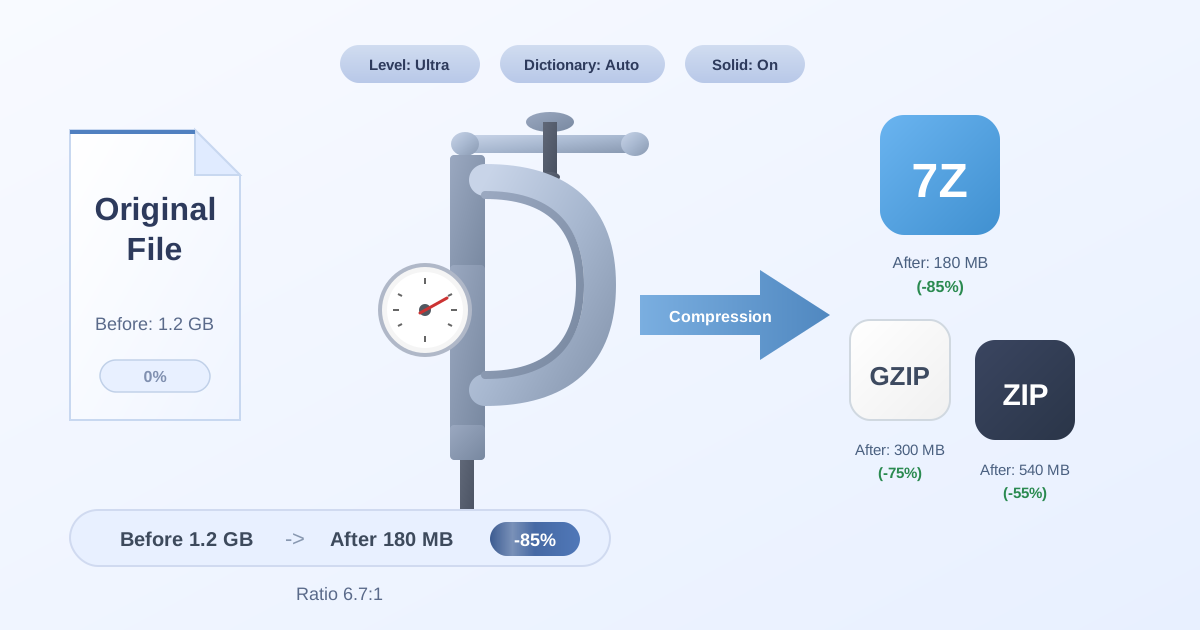
When you work with digital files, especially large documents, photos, or videos, file size matters. Compressing files is a common practice to save disk space or make them easier to send over the internet. The effectiveness of this compression is almost always measured as a percentage.
Let's say you have a folder of high-resolution images that totals 50 MB. To email it, you need to make it smaller.
Using a tool to Compress Files, you can package them into a single ZIP archive. After compression, the new file size is only 15 MB.
So, what was the percentage reduction in size? We can use the percentage change formula:
((New Value - Old Value) / Old Value) × 100
((15 MB - 50 MB) / 50 MB) × 100(-35 MB / 50 MB) × 100-0.7 × 100 = -70%
The file size was reduced by 70%, a significant saving!
Understanding this percentage helps you manage your digital life. If your cloud storage is 98% full, finding large folders that can be compressed by 70% or more is a quick and effective way to free up space.
Sometimes, managing these compressed files means converting them. For instance, the 7Z format often offers a higher compression percentage than ZIP. If a colleague sends you a .7z file, you might need to convert 7Z to ZIP for better compatibility with your system's built-in tools. Conversely, once you've received any compressed file, you'll need a simple way to Decompress Files to access their contents.
Progress Bars and Storage Space
Other digital examples include:
- Download Progress: A download bar at 40% means 40 out of 100 parts of the file have been transferred.
- Battery Life: Your phone's battery at 25% means it has a quarter of its total potential energy remaining.
- Hard Drive Space: A report that your drive is "85% full" is a simple calculation: (Used Space / Total Space) × 100.
Conclusion: You're Now a Percentage Pro
Percentages don't have to be intimidating. By moving away from rigid formulas and embracing these flexible mental math tricks, you can gain confidence in your daily calculations.
We've covered:
- The 10% Trick: Your foundational tool for finding almost any percentage by moving the decimal.
- Building Blocks: Using the 10% rule to quickly find 5%, 15%, 20%, and more.
- The Commutative Trick: Flipping the problem (X% of Y = Y% of X) to simplify complex math.
- Reverse Percentages: Finding the original price after a discount.
- Digital Percentages: Applying these concepts to understand file compression and data storage.
Mastering these techniques isn't just about saving a few dollars during a sale; it's about building numerical literacy and being more comfortable in a world driven by data. The more you practice, the more these tricks will become an intuitive part of your thinking.
Now that you're armed with these percentage hacks, put them to use! And while you're optimizing your everyday math, don't forget to optimize your digital life. Explore the full suite of over 455 free, privacy-focused online tools at Practical Web Tools to make your digital tasks even easier.