Age Calculator: Find Your Exact Age in Years, Months & Days

Your Precise Age: More Than Just a Number
"How old are you?" It seems like a simple question. Most of us answer with a single number, the number of candles on our last birthday cake. But what if you needed to know your exact age, right down to the very day? This is your chronological age—a precise measurement of time from your birth date to the current date, expressed in years, months, and days.
While it might seem like a trivial detail, knowing your exact age is crucial for countless official, legal, and even personal reasons. From filling out government forms and calculating insurance premiums to tracking developmental milestones and planning for retirement, precision matters. The complexity arises from the nuances of our calendar system: months with varying lengths and the ever-present leap year.
This comprehensive guide will demystify the process of age calculation. We'll explore why it's so important, break down the manual calculation method step-by-step, and show you how modern online tools provide the easiest and most accurate solution. Get ready to discover your age in a way you never have before.
Why Calculating Your Exact Age Matters
Knowing your age in years is standard, but the need for a more granular calculation in years, months, and days appears in many important aspects of life. It’s a detail that can have significant real-world implications.
Legal and Administrative Requirements
Many official documents and applications require your age to be stated with precision. Consider these scenarios:
- Passports and Visas: Immigration and travel documents often have strict age-related rules, especially for minors.
- Retirement and Pension Forms: Eligibility for benefits can be tied to a specific age, and calculations need to be exact to determine the start date.
- Legal Contracts: Age verification is fundamental in contracts, from signing a lease to entering into a legal agreement.
- Government Benefits: Applications for social security, disability, or other government programs often rely on precise age calculations.
Medical and Health Assessments
In the medical field, chronological age is a critical data point. For pediatricians, tracking a child's age in years, months, and even weeks is essential for monitoring developmental milestones, scheduling vaccinations, and assessing growth charts. For adults, it's a key factor in risk assessment for various health conditions.
Financial Planning and Insurance
Your exact age can directly impact your finances. Insurance companies use your precise age to calculate life insurance and health insurance premiums. A difference of even a few days can sometimes place you in a different risk bracket, affecting your rates. Similarly, financial advisors use your age to create long-term investment and retirement plans.
Genealogical and Historical Research
For those tracing their family tree or conducting historical research, calculating the exact age of an individual at a specific historical event can provide crucial context. It helps build a more accurate and vivid timeline of a person's life.
How to Calculate Your Age Manually: A Step-by-Step Guide
While online calculators are faster, understanding the manual process helps appreciate the logic involved. It's a simple subtraction problem complicated by the fact that we need to "borrow" from units of different sizes (e.g., a month can be 28, 29, 30, or 31 days).
Here’s the most common method, broken down for clarity. For this example, let's calculate the age of someone born on August 25, 1992, as of the date June 12, 2024.
Step 1: Set Up the Calculation
Write the current date (or the date you're calculating to) on top and the birth date below it, in Year/Month/Day format.
| Year | Month | Day | |
|---|---|---|---|
| Current Date | 2024 | 06 | 12 |
| Birth Date | 1992 | 08 | 25 |
Step 2: Calculate the Days
Start with the 'Day' column. You can't subtract 25 from 12. So, you need to borrow from the 'Month' column. When you borrow 1 month, you add its equivalent in days to the 'Day' column. The key is to use the number of days in the previous month (Month 5, May, which has 31 days).
- New Days = 12 + 31 = 43
- New Months = 06 - 1 = 05
Now subtract the days: 43 - 25 = 18 days.
Our calculation now looks like this:
| Year | Month | Day | |
|---|---|---|---|
| Current Date | 2024 | 05 | 43 |
| Birth Date | 1992 | 08 | 25 |
| Result | 18 |
Step 3: Calculate the Months
Next, look at the 'Month' column. You can't subtract 8 from 5. So, you need to borrow from the 'Year' column. When you borrow 1 year, you add 12 to the 'Month' column.
- New Months = 5 + 12 = 17
- New Years = 2024 - 1 = 2023
Now subtract the months: 17 - 8 = 9 months.
Our calculation now looks like this:
| Year | Month | Day | |
|---|---|---|---|
| Current Date | 2023 | 17 | 43 |
| Birth Date | 1992 | 08 | 25 |
| Result | 09 | 18 |
Step 4: Calculate the Years
Finally, subtract the years: 2023 - 1992 = 31 years.
Final Result: The person's exact age is 31 years, 9 months, and 18 days.
As you can see, the process is logical but has several steps where errors can occur, especially when remembering the number of days in each month and handling the borrowing correctly.
The Best Alternative: Using an Online Age Calculator
For speed, accuracy, and convenience, nothing beats a good online age calculator. These tools eliminate the risk of manual errors and provide instant results. At Practical Web Tools, we champion tools that are not only effective but also privacy-focused. A high-quality online age calculator should be:
- Accurate: It automatically handles leap years and the varying lengths of months.
- Fast: It delivers results in a fraction of a second.
- User-Friendly: It requires a simple input of two dates.
- Private: It performs calculations in your browser without uploading your personal data (like your date of birth) to a server.
How Online Calculators Provide More Detail
Beyond just years, months, and days, many online tools offer a more detailed breakdown of your age in different units, which can be fascinating:
- Total Months: e.g., 381 months
- Total Weeks: e.g., 1,659 weeks
- Total Days: e.g., 11,613 days
- Total Hours: e.g., 278,712 hours
- Upcoming Birthday: It can even tell you how many months and days are left until your next birthday.
This level of detail is perfect for fun facts, milestone celebrations, or any situation where you need to express an age in a different unit of time.
Managing Your Important Date-Related Documents
The need to calculate your exact age often goes hand-in-hand with managing the documents that prove it, such as birth certificates, passports, driver's licenses, and other forms of identification. In our digital world, having secure digital copies of these documents is essential for easy access and backup.
When you scan these documents, you might end up with several image files (JPEGs, PNGs) or PDFs. To keep them organized and secure, it's a great practice to bundle them together.
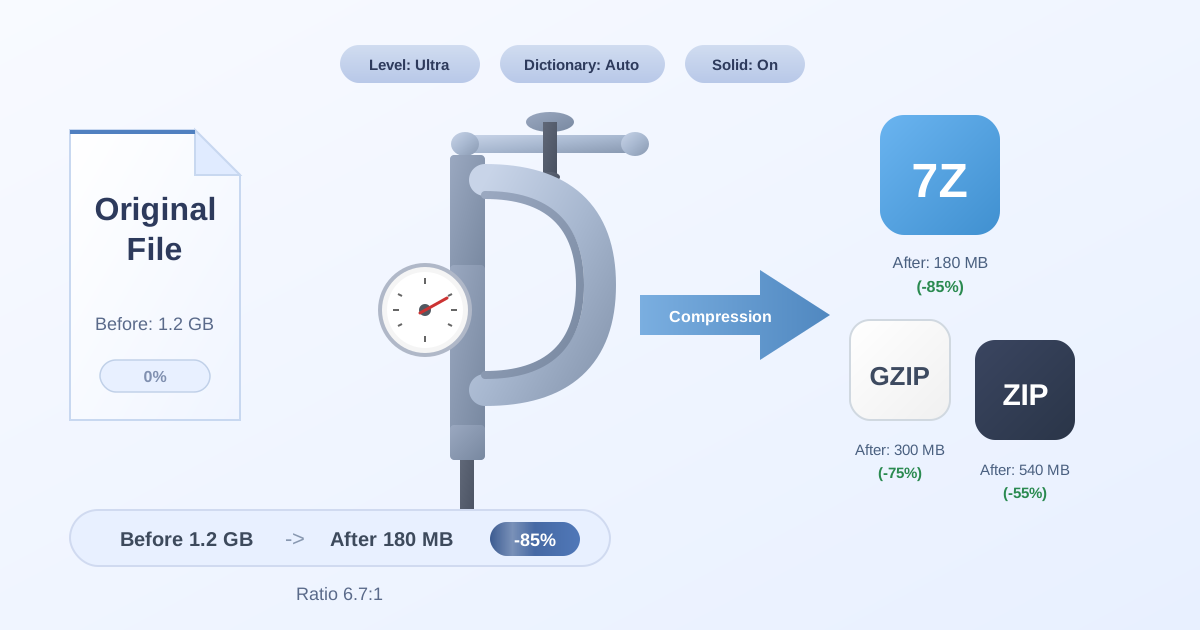
For instance, if you're preparing for a visa application, you might have a scanned copy of your birth certificate, passport photo, and application form. To send these to your lawyer or keep them in a single, organized unit, you can use a tool to Compress Files. This bundles all the documents into a single ZIP archive, which is smaller in size and easier to manage, upload, or email.
When the recipient needs to view them, they can use a corresponding tool to Decompress Files to extract the original documents. Using browser-based tools like those on Practical Web Tools ensures that your sensitive, personal documents are processed on your own computer, offering a critical layer of privacy.
Frequently Asked Questions (FAQ)
What is a chronological age calculator?
A chronological age calculator is a tool that determines the precise amount of time that has passed between a person's date of birth and a specified end date (usually the current date). The result is typically displayed in a combination of years, months, and days.
How accurate is an online age calculator?
A well-programmed online age calculator is extremely accurate. It's designed to account for all the complexities of the Gregorian calendar, including the exact number of days in each month and the rules for leap years (an extra day in February every four years, except for years divisible by 100 but not by 400).
Can I calculate my age as of a future date?
Yes, most online age calculators allow you to set both the start date (your birthday) and the end date. You can set the end date to a future date to find out how old you will be on that day, which is useful for planning around retirement, anniversaries, or other milestones.
How does the calculator handle a leap day birthday (February 29th)?
In non-leap years, people born on February 29th typically celebrate their birthday on either February 28th or March 1st. For calculation purposes, an age calculator will accurately count the total number of days passed. Their age will increment by a full year on March 1st of a common year.
Conclusion: Precision at Your Fingertips
Understanding your exact age in years, months, and days is more than a novelty; it's a practical necessity for many of life's most important moments. While the manual calculation is a valuable exercise in logic, the complexity of our calendar makes it prone to human error.
Online age calculators offer a superior solution—they are fast, precise, and effortlessly handle all the tricky rules, like leap years. They provide the confidence you need when filling out sensitive applications or planning for the future. This move towards digital efficiency mirrors the way we now manage other tasks, from editing a PDF to compressing important files for secure storage.
To continue simplifying your digital life with secure, free, and easy-to-use utilities, explore the full suite of over 455 tools available right here at Practical Web Tools.