Calorie Calculator Guide: Find Your Daily Needs for Weight Loss

Your Ultimate Guide to Calculating Daily Calorie Needs
Ever feel like you're lost in a sea of conflicting diet advice? "Eat this, not that." "Cut carbs." "Go keto." The noise can be overwhelming, but what if you could silence it with a single, powerful number tailored specifically to you? That's the promise of understanding your daily calorie needs. This isn't about a restrictive diet; it's about empowerment through knowledge.
Calculating your caloric needs is the bedrock of any successful nutrition plan, whether your goal is to lose fat, build muscle, or simply maintain a healthy weight. It transforms guesswork into a clear, actionable strategy. In this comprehensive guide, we'll break down the science behind calorie calculation, demystify acronyms like BMR and TDEE, and provide you with a step-by-step framework to determine exactly how much energy your unique body requires.
Think of it as the instruction manual for your metabolism. By the end of this article, you'll not only understand the numbers but also how to use them to finally take control of your health and fitness journey.
The Building Block of Energy: What Exactly is a Calorie?
Before we dive into the calculations, let's start with the basics. A calorie is simply a unit of energy. It's the amount of energy required to raise the temperature of one gram of water by one degree Celsius. For our purposes, think of calories as the fuel your body uses to perform every single function, from breathing and blinking to running a marathon.
Your body gets this fuel from the macronutrients in food: proteins, carbohydrates, and fats. Each provides a different amount of energy:
- Protein: 4 calories per gram
- Carbohydrates: 4 calories per gram
- Fats: 9 calories per gram
At its core, weight management comes down to the principle of energy balance:
- Caloric Surplus: You consume more calories than you burn, leading to weight gain.
- Caloric Deficit: You consume fewer calories than you burn, leading to weight loss.
- Energy Balance: You consume the same amount of calories you burn, leading to weight maintenance.
The goal of a calorie calculator is to determine that crucial 'maintenance' number, which we can then adjust based on your personal goals.
The Foundation: Calculating Your Basal Metabolic Rate (BMR)
Imagine you spent an entire day lying in bed, completely still but awake. The number of calories your body would burn just to keep your vital organs functioning—heart beating, lungs breathing, brain thinking—is your Basal Metabolic Rate, or BMR.
Your BMR is the largest chunk of your daily energy expenditure, often accounting for 60-75% of the total calories you burn. It's the baseline, the absolute minimum energy your body needs to survive. Several factors influence your BMR:
- Weight & Height: Larger bodies require more energy to function.
- Age: Metabolism naturally slows as we age.
- Sex: Men typically have more muscle mass and less body fat than women, resulting in a higher BMR.
- Body Composition: Muscle tissue is more metabolically active than fat tissue. A more muscular person will have a higher BMR than a person of the same weight with more body fat.
How to Calculate Your BMR
While the most accurate way to measure BMR is in a lab, we can get a very reliable estimate using established formulas. The most widely used and respected is the Mifflin-St Jeor equation:
- For Men: BMR = (10 × weight in kg) + (6.25 × height in cm) - (5 × age in years) + 5
- For Women: BMR = (10 × weight in kg) + (6.25 × height in cm) - (5 × age in years) - 161
Let's walk through an example:
Meet Sarah: A 35-year-old woman who is 168 cm (5'6") tall and weighs 70 kg (154 lbs).
- Weight Calculation: 10 × 70 kg = 700
- Height Calculation: 6.25 × 168 cm = 1050
- Age Calculation: 5 × 35 years = 175
- Final Formula: (700 + 1050) - 175 - 161 = 1414 calories
Sarah's BMR is approximately 1,414 calories. This is the energy she needs just to exist, before even getting out of bed.
From BMR to TDEE: Factoring in Your Lifestyle
Of course, most of us don't spend our days in bed. We walk, work, exercise, and even fidget. All of this activity burns additional calories. To get a complete picture of your daily energy needs, we must calculate your Total Daily Energy Expenditure (TDEE).
TDEE = BMR + Calories burned from physical activity and digestion.
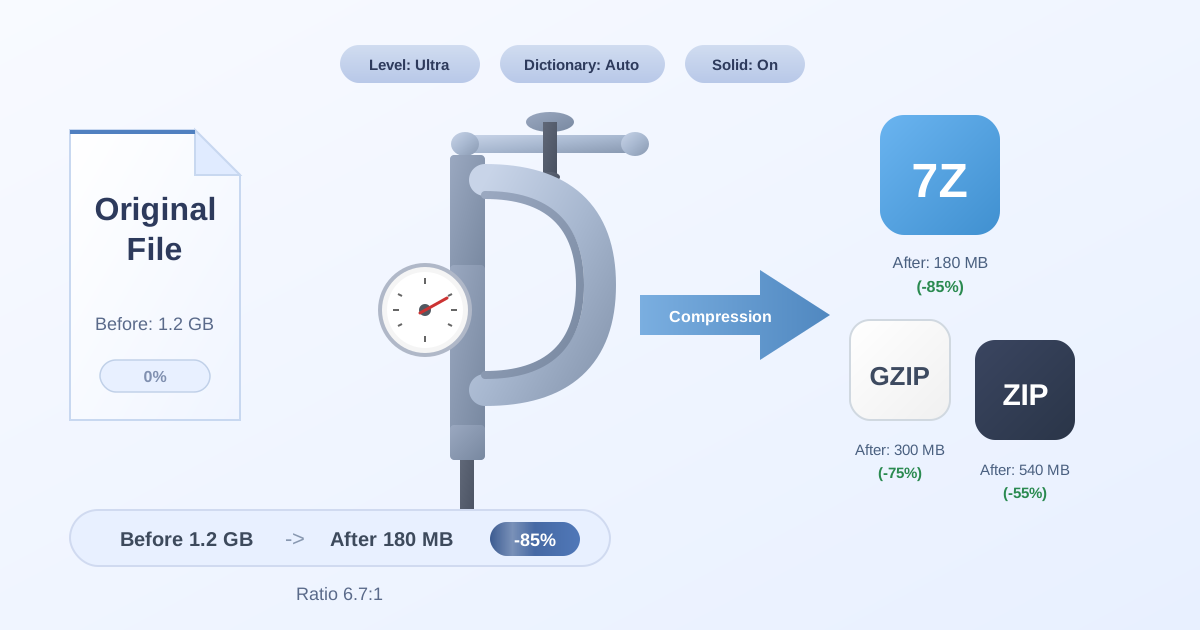
To calculate TDEE, we take your BMR and multiply it by an activity multiplier. This is where honesty is crucial for an accurate result. Think of this process like data management. You're taking complex information about your lifestyle and using a formula to get a single, useful output. It’s similar to how you might need to Compress Files to bundle many documents into one smaller, manageable package for emailing.
Activity Level Multipliers
Choose the category that best describes your typical week:
| Activity Level | Description | Multiplier |
|---|---|---|
| Sedentary | Little to no exercise, desk job | 1.2 |
| Lightly Active | Light exercise/sports 1-3 days per week | 1.375 |
| Moderately Active | Moderate exercise/sports 3-5 days per week | 1.55 |
| Very Active | Hard exercise/sports 6-7 days a week | 1.725 |
| Extra Active | Very hard exercise & physical job or 2x training | 1.9 |
Calculating TDEE: Putting It All Together
Let's continue with our example of Sarah, whose BMR is 1,414 calories. Sarah works a desk job but makes sure to get to the gym for a moderate workout 4 days a week. This puts her in the Moderately Active category.
- TDEE Calculation: BMR × Activity Multiplier
- Sarah's TDEE: 1414 × 1.55 = 2192 calories
This number, 2,192, is Sarah's maintenance calorie level. If she consistently eats around this many calories per day, her weight should remain stable.
Setting Your Goals: Customizing Your Calorie Target
Now that you have your TDEE, you can adjust it to match your specific goals. This is where the magic happens.
For Weight Loss (Caloric Deficit)
To lose weight, you must consume fewer calories than your TDEE. A safe, sustainable, and effective rate of weight loss is 1-2 pounds per week. Since one pound of fat is roughly equivalent to 3,500 calories, creating a daily deficit of 500 calories will result in about one pound of weight loss per week (500 calories/day × 7 days = 3,500 calories/week).
- Goal: Lose 1 lb per week.
- Calculation: TDEE - 500 calories
- Sarah's Weight Loss Calories: 2192 - 500 = 1692 calories per day
Important: It's generally not recommended for women to eat below 1,200 calories or men below 1,500 calories per day without medical supervision, as it can be difficult to get essential nutrients.
For Weight Maintenance
This one is simple! If your goal is to maintain your current weight, your target is your TDEE. For Sarah, this would be 2192 calories per day. This is a great goal if you've reached your target weight or are happy with your current physique and want to focus on performance and health.
When you're working with a trainer on a maintenance or performance plan, they might send you a package of resources like workout videos, meal plans, and tracking sheets. Sometimes these are bundled together in a compressed format. If you receive one, our free Decompress Files tool lets you easily extract everything you need to get started, right in your browser.
For Muscle Gain (Caloric Surplus)
To build muscle tissue, your body needs extra energy and resources, specifically protein. This requires a caloric surplus. However, a massive surplus will lead to excessive fat gain. A small, controlled surplus is key.
A good starting point is to add 250-500 calories to your TDEE.
- Goal: Lean muscle gain.
- Calculation: TDEE + 300 calories
- Sarah's Muscle Gain Calories: 2192 + 300 = 2492 calories per day
For this goal, it's crucial to pair the caloric surplus with a progressive resistance training program and adequate protein intake (typically 1.6-2.2 grams of protein per kg of body weight).
Beyond the Numbers: Important Nuances for Success
Calorie calculators are fantastic tools, but they provide an estimate—a starting point. True success comes from listening to your body and making adjustments.
Food Quality Matters
1,800 calories from lean proteins, whole grains, fruits, and vegetables will have a vastly different effect on your health, energy levels, and body composition than 1,800 calories from processed foods, sugar, and unhealthy fats. Focus on nutrient-dense foods first.
The Power of Protein
Protein is the most satiating macronutrient, meaning it helps you feel fuller for longer, which is incredibly helpful when in a caloric deficit. It's also essential for preserving muscle mass during weight loss.
Adjust as You Go
Your TDEE is not static. As you lose weight, your TDEE will decrease because a smaller body requires less energy. It's important to recalculate your BMR and TDEE every 10-15 pounds of weight loss or every few months to ensure your targets remain accurate.
Sometimes, managing your health journey involves handling different types of digital information. You might download a nutrition guide as a 7Z archive but prefer to use ZIP files. In those cases, a simple converter like our 7Z to ZIP tool can streamline your digital life, letting you focus on your health goals.
Use Calculators as a Compass, Not a GPS
An online calorie calculator gives you a direction to head in. It's a scientifically-backed starting point. However, your real-world results are the ultimate feedback. If you've been eating in what should be a 500-calorie deficit for two weeks and the scale hasn't moved, you may need to slightly decrease your intake or increase your activity level. The plan must be adaptable.
Conclusion: Your Path to Nutritional Empowerment
Understanding your daily calorie needs is one of the most empowering steps you can take on your health journey. It removes the guesswork and provides a clear, data-driven path toward your goals. By calculating your BMR, determining your TDEE based on your unique lifestyle, and adjusting that number for weight loss, maintenance, or muscle gain, you create a personalized roadmap for success.
Remember the key steps:
- Calculate Your BMR: The energy your body needs at rest.
- Determine Your TDEE: Your BMR multiplied by your activity level.
- Adjust for Your Goal: Create a deficit for loss, a surplus for gain, or eat at maintenance.
- Monitor and Adapt: Use this number as your starting point and adjust based on your real-world progress.
This knowledge is your tool for building a healthier, stronger body. Use it wisely, be consistent, and stay patient with the process. For more helpful guides and free tools to make your digital life easier, be sure to explore the rest of the Practical Web Tools blog.