Capsule Volume Calculator: The Ultimate Medicine & Supplement Guide
Your Guide to Accurate Dosing: The Capsule Volume Calculator
Have you ever stood before a selection of empty gelatin capsules, wondering which size is right for your supplements or herbs? Or perhaps you've tried filling your own capsules, only to find that the dosage is inconsistent and unreliable. It's a common challenge for DIY supplement enthusiasts, small-scale producers, and even compounding pharmacists. The world of capsule sizes, volumes, and fill weights can seem needlessly complex, but getting it right is crucial for safety, effectiveness, and consistency.
This is where understanding capsule volume calculation becomes not just helpful, but essential. It’s the key to transforming your raw ingredients into precise, reliable doses. This comprehensive guide will demystify the entire process. We'll break down capsule sizes, explain the critical role of powder density, and provide you with a step-by-step method to calculate exactly how much of a substance you can fit into any given capsule. Get ready to take the guesswork out of your health regimen.
Why Accurate Capsule Volume Matters More Than You Think
Before we dive into the 'how,' let's establish the 'why.' Meticulously calculating your capsule's capacity isn't just about being neat; it has significant implications for several key areas.
Safety and Efficacy
This is the most important reason. For potent herbs, nootropics, or medicinal compounds, the difference between a therapeutic dose and an ineffective (or even harmful) one can be a matter of milligrams. Relying on guesswork or 'eyeballing' the amount is a risky practice. Accurate calculations ensure that each capsule contains the intended dose, providing predictable and safe results.
Consistency in Dosing
If you take a supplement daily, you want the same effect every time. Inconsistent fill weights lead to fluctuating dosages. One day you might get 300mg, the next 450mg. This variability can undermine the benefits of the supplement and make it impossible to track its true effects. Proper calculation ensures every single capsule you produce is a clone of the last.
Cost-Effectiveness
High-quality supplements and raw ingredients can be expensive. Overfilling capsules, even by a small margin, adds up over time, leading to significant product waste. Conversely, underfilling means you aren't getting the full value of the capsule's capacity. Precision saves money by ensuring you use exactly the amount of product you need—no more, no less.
Understanding the Basics: Capsule Sizes Explained
The first step in our journey is to understand the standardized sizing system for two-piece hard capsules (the kind you typically fill yourself). The system is somewhat counterintuitive: the smaller the number, the larger the capsule.
The most common sizes range from 000 (the largest) down to 5 (the smallest).
Capsule Size and Volume Chart
To help you visualize the differences, here is a standard chart that details the specifications for common capsule sizes. This table is a foundational reference point for any calculation you'll perform.
| Capsule Size | Volume (mL) | Locked Length (mm) | External Diameter (mm) |
|---|---|---|---|
| 000 | 1.37 mL | 26.1 mm | 9.9 mm |
| 00 | 0.95 mL | 23.3 mm | 8.5 mm |
| 0 | 0.68 mL | 21.7 mm | 7.6 mm |
| 1 | 0.50 mL | 19.4 mm | 6.9 mm |
| 2 | 0.37 mL | 18.0 mm | 6.4 mm |
| 3 | 0.30 mL | 15.9 mm | 5.8 mm |
| 4 | 0.21 mL | 14.3 mm | 5.3 mm |
| 5 | 0.13 mL | 11.1 mm | 4.9 mm |
Note: These values are approximate and can vary slightly between manufacturers. Always use this chart as a starting point.
The Critical Difference: Volume vs. Weight
Looking at the chart above, you might think, "Great, a size 0 capsule holds 0.68 mL, so I just need to weigh out my powder based on that." This is the single biggest mistake people make. The chart tells you the volume of the capsule, not the weight it can hold.
Think of it like this: a cup (a measure of volume) of lead pellets will weigh far more than a cup of feathers. The same principle applies to powders. A capsule filled with dense Creatine Monohydrate will weigh much more than the same capsule filled with a light, fluffy herb like Marshmallow Root.
Introducing Powder Density: The Game Changer
The property that governs how much weight fits into a given volume is density. The density of your specific powder is the most important variable you need to determine. It's often expressed in grams per milliliter (g/mL) or milligrams per milliliter (mg/mL).
There are two types of density to consider:
- Loose Bulk Density: The density of the powder when it's gently scooped or poured into a container without being compressed.
- Tapped Density: The density of the powder after it has been packed or 'tapped' down to remove air pockets. This is generally the more relevant metric for capsule filling, as you'll likely be tamping the powder to fit more in.
How to Calculate Capsule Fill Weight: A Step-by-Step Guide
Now we get to the practical part. Follow these steps to accurately calculate the fill weight for any powder and any capsule size.
Step 1: Identify Your Capsule Volume
Look at the chart above and find the volume (in mL) for the capsule size you are using. Let's say we're using a Size 0 capsule, which has a volume of 0.68 mL.
Step 2: Determine Your Powder's Density
You'll need a few simple tools for this: an accurate milligram scale and a small graduated cylinder (e.g., 10 mL or 25 mL).
- Weigh the Empty Cylinder: Place your empty graduated cylinder on the milligram scale and 'tare' or 'zero' it.
- Add Powder: Gently add your powder to the cylinder up to a known volume mark. Let's say you add it up to the 10 mL mark. Try not to compress it yet.
- Weigh the Powder: Place the cylinder with the powder back on the scale. The weight displayed is the mass of your powder. Let's say it weighs 6,000 mg (or 6 g).
- Calculate Loose Density:
- Formula: Density = Mass / Volume
- Calculation: 6,000 mg / 10 mL = 600 mg/mL. This is your loose bulk density.
- Determine Tapped Density (Optional but Recommended): Gently tap the bottom of the graduated cylinder on a countertop for about a minute. You'll see the powder level drop as it compacts. Let's say it settles to the 8 mL mark.
- Calculate Tapped Density:
- Formula: Density = Mass / New Volume
- Calculation: 6,000 mg / 8 mL = 750 mg/mL. This is your tapped density.
For capsule filling, the tapped density is usually a more accurate predictor of your final fill weight.
Step 3: Apply the Magic Formula
Now you have the two pieces of information you need: the capsule volume and the powder density. The formula is simple:
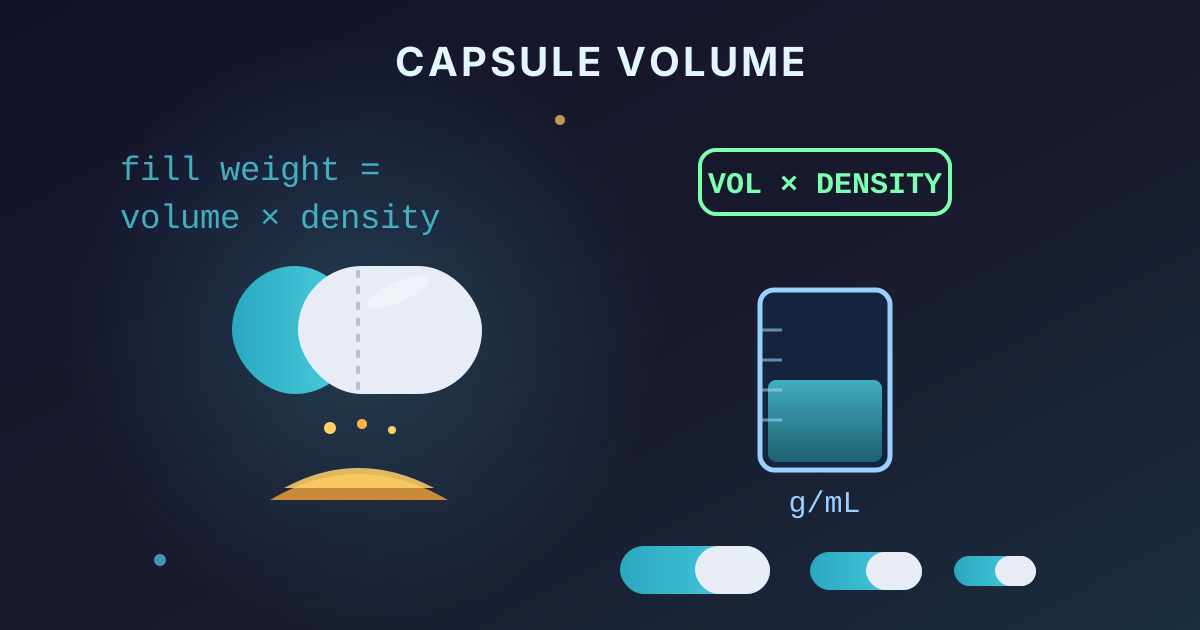
Fill Weight (mg) = Capsule Volume (mL) × Powder Density (mg/mL)
A Practical Example
Let's put it all together. We want to fill a Size 0 capsule (0.68 mL volume) with our powder that has a tapped density of 750 mg/mL.
- Calculation: 0.68 mL × 750 mg/mL = 510 mg
So, you can expect to fit approximately 510 mg of this specific powder into each Size 0 capsule when it is well-tamped.
Common Mistakes in Capsule Filling (And How to Avoid Them)
- Assuming All Powders Are Equal: Never assume a fill weight you used for one supplement applies to another. Always calculate density for each new powder.
- Ignoring Excipients: If you're mixing your active ingredient with fillers (like rice flour or microcrystalline cellulose), you must calculate the density of the final blend, not the individual components.
- Inconsistent Tamping: If you calculate based on tapped density, you must use a consistent tamping method when filling your capsules to achieve that density. A capsule-filling machine can help with this.
- Forgetting to Tare the Scale: A simple but common error. Always zero out your scale with the weighing container on it before adding your powder.
Managing Your Formulation Data for Success
Once you begin creating different supplement blends and calculating their properties, you'll start generating a lot of valuable data. You'll have records of powder densities, blend ratios, batch numbers, and fill weights. Keeping this information organized and secure is crucial for consistency and future reference.
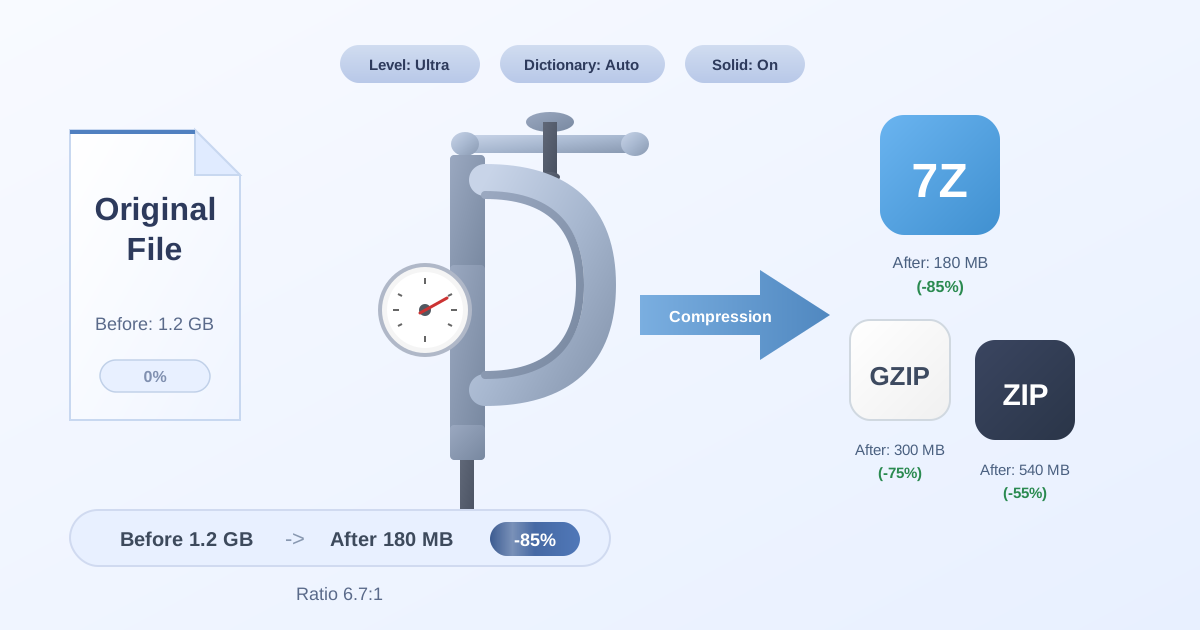
As your formulation library grows, you might find yourself with numerous spreadsheets, text files, and research notes. To keep this information organized and easy to share or archive, it's essential to manage your digital files effectively. A simple way to bundle all the data for a specific project is to Compress Files into a single, smaller package like a ZIP archive. This makes storage and email sharing much more manageable.
Collaboration is also key in formulation. If you're working with a partner or a lab that uses different systems, file compatibility can become an issue. For instance, you might need to convert your archive into a more efficient format. Using a tool to convert a ZIP to 7Z can improve compression rates, saving even more space. And when you receive data from others in a compressed format you're not familiar with, there's no need to install special software. You can simply use a browser-based tool to Decompress Files and access the information instantly and privately.
Conclusion: Take Control of Your Dosing
Calculating capsule volume and fill weight is a skill that empowers you to take full control over your supplement regimen. By moving beyond guesswork and embracing a scientific approach, you ensure every capsule you create is safe, consistent, and effective.
Remember the core principles: start with the standard capsule volume, always determine the unique density of your powder, and then apply the simple formula to find your true fill weight. This knowledge transforms you from a casual DIYer into a precise and confident formulator.
Now that you've mastered the physical side of supplement creation, don't forget to manage the digital side. Explore the full suite of free, privacy-focused utilities at Practical Web Tools to handle all your file management and conversion needs.