Convert FLAC to MP3: A Comprehensive Guide & Analysis
Have you ever downloaded a pristine, high-quality album in FLAC format, only to find you can't play it on your phone or in your car? It's a common frustration for music lovers. You have the best possible version of your favorite song, but it's locked in a format that prioritizes quality over compatibility. This is where the magic of converting FLAC to MP3 comes in.
While it might sound like a downgrade, this conversion is often a necessary and intelligent step to make your music library truly portable. It's about striking the perfect balance between audiophile-grade sound and real-world practicality. In this comprehensive guide, we'll demystify the entire process. We'll explore the core differences between these two formats, explain exactly when and why you should convert, and provide a step-by-step tutorial on how to do it effectively without losing noticeable audio quality.
Understanding the Formats: FLAC vs. MP3
Before we dive into the conversion process, it's crucial to understand what you're working with. FLAC and MP3 are two of the most popular audio formats in the world, but they serve fundamentally different purposes.
What is FLAC? The Lossless Champion
FLAC stands for Free Lossless Audio Codec. The key word here is "lossless." Think of a FLAC file like a ZIP archive for audio. It compresses the original audio data to save space—typically 30-60% smaller than an uncompressed WAV or AIFF file—but does so without discarding a single bit of information. When you play a FLAC file, it's uncompressed on the fly to produce a perfect, bit-for-bit copy of the original studio master.
Pros of FLAC:
- Perfect Sound Quality: It is an exact replica of the original source audio.
- Archival Grade: It's the best format for storing a digital music collection you want to preserve for the future.
- Metadata Support: It has robust support for tagging, including album art, track numbers, artist info, and more.
Cons of FLAC:
- Large File Sizes: A typical 3-minute song in FLAC can be 20-40 MB, compared to 3-8 MB for an MP3.
- Limited Compatibility: While support is growing, many older devices, car stereos, and basic music players do not support FLAC playback.
What is MP3? The Universal Standard
MP3, or MPEG-1 Audio Layer III, is the format that revolutionized digital music. Its defining feature is "lossy" compression. To achieve incredibly small file sizes, the MP3 encoding algorithm cleverly removes parts of the audio data that the human ear is least likely to notice. This includes sounds at very high or very low frequencies and sounds that are masked by louder ones.
Pros of MP3:
- Small File Sizes: This makes it ideal for streaming, downloading, and storing thousands of songs on devices with limited space.
- Universal Compatibility: From smartphones and laptops to smart speakers and car stereos, virtually every device made in the last 20 years can play an MP3 file.
Cons of MP3:
- Quality Loss: By definition, some audio data is permanently discarded. While a high-bitrate MP3 can sound excellent, it will never be a perfect copy of the original.
FLAC vs. MP3: A Head-to-Head Comparison
To make the differences crystal clear, here’s a simple table breaking down the key characteristics of each format.
| Feature | FLAC (Free Lossless Audio Codec) | MP3 (MPEG-1 Audio Layer III) |
|---|---|---|
| Compression Type | Lossless | Lossy |
| Sound Quality | Perfect, bit-for-bit copy of the original | Very good to excellent, but technically degraded |
| Typical File Size | Large (e.g., 20-40 MB per song) | Small (e.g., 3-8 MB per song) |
| Compatibility | Moderate; not supported by all devices | Universal; plays on virtually everything |
| Primary Use Case | Archiving music, critical listening at home | Portability, streaming, everyday listening |
The Top Reasons to Convert FLAC to MP3
You have a library of beautiful FLAC files. Why would you ever want to convert them to a "lesser" format? The reasons are entirely practical.
-
To Save Precious Space: This is the biggest driver. A 1TB hard drive can hold around 25,000 FLAC tracks. That same drive can hold over 125,000 high-quality MP3 tracks. The difference is even more critical on a smartphone, where storage is at a premium.
-
For Universal Compatibility: Want to play your music library in your car via a USB stick? Need to load up an older digital audio player for the gym? Creating an MP3 version of your library ensures your music plays anywhere, on any device, without a second thought.
-
For Faster Streaming & Sharing: Uploading a 1GB FLAC album to a cloud service can take a long time. Sharing that same album as a 150 MB MP3 zip file is significantly faster. Smaller files are simply easier to manage and move around the internet.
-
To Create a "Portable" Library: Many audiophiles adopt a two-library system. They keep their master FLAC files safely stored on a home computer or network drive for high-fidelity listening. Then, they create a parallel MP3 copy of the library to sync with their mobile devices for on-the-go listening.
How to Convert FLAC to MP3: A Step-by-Step Guide
Converting your files doesn't require complex software or technical genius. With modern web tools, the process is straightforward and secure.
Using an Online Converter (The Easy Way)
For converting one or a few files at a time, an online tool like Practical Web Tools' FLAC to MP3 Converter is the fastest and most convenient method. It's free, privacy-focused (your files are not stored), and requires no software installation.
Step 1: Open the Converter Navigate to the free FLAC to MP3 converter tool on Practical Web Tools.
Step 2: Upload Your FLAC File Click the "Choose File" button and select the FLAC file from your computer. The tool will immediately begin uploading it.
Step 3: Select Your Audio Quality (Bitrate) This is the most important step for determining the final quality and file size of your MP3. You'll typically see a dropdown menu with options like 128 kbps, 192 kbps, 256 kbps, and 320 kbps. We'll discuss what these mean in the next section, but for now, we recommend choosing 320 kbps for the best quality.
Step 4: Convert and Download Click the "Convert" button. The tool will process your file in seconds and provide a download link for your newly created MP3. It's that simple!
Understanding MP3 Bitrate: The Key to Quality
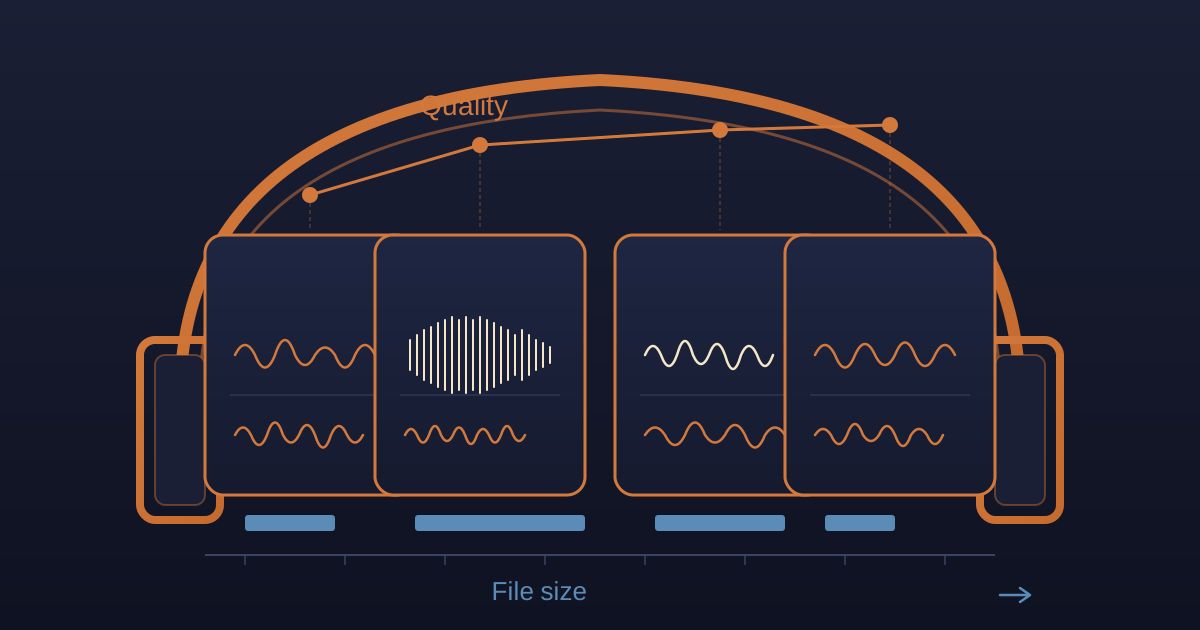
When you convert to MP3, the "bitrate" setting is your control knob for the trade-off between quality and file size. Bitrate is measured in kilobits per second (kbps).
- Higher Bitrate = Higher Quality = Larger File Size
- Lower Bitrate = Lower Quality = Smaller File Size
Here's a quick guide to help you choose:
- 320 kbps: This is the highest quality standard for MP3s. For most people, on most audio systems, a 320 kbps MP3 is sonically indistinguishable from the original FLAC file. This is the recommended setting for almost all conversions.
- 256 kbps: Still considered high quality. You get a slightly smaller file size with a minimal, often imperceptible, drop in audio fidelity. A great all-around choice.
- 192 kbps: This is a common standard for many online music services. The quality is good, and the file size savings become more significant. You might start to notice a slight loss of detail on a good sound system.
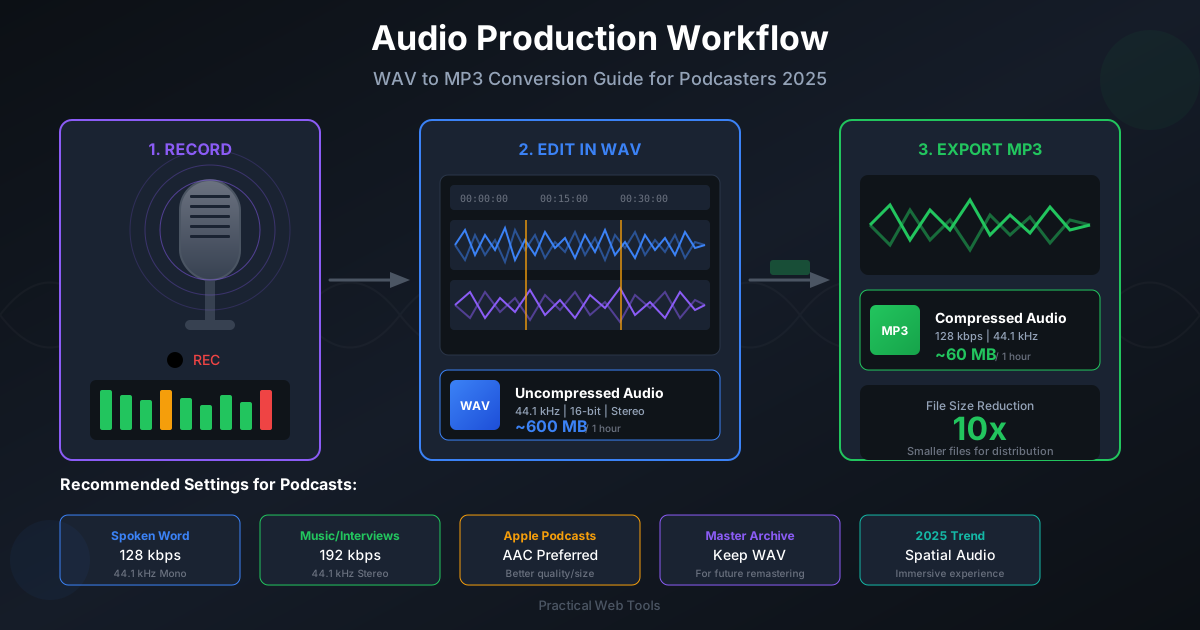
- 128 kbps: This was the standard in the early days of digital music. Today, it's considered acceptable for podcasts or spoken word content, but for music, the loss in quality (especially in the high frequencies) can be noticeable.
Advanced Topics and Best Practices
To become a true audio conversion pro, keep these principles in mind.
The Golden Rule of Audio Conversion
Always work from the highest quality source possible. When you convert FLAC (lossless) to MP3 (lossy), you are discarding data. This process is irreversible.
This leads to the golden rule: Never convert a lossy format to another lossy or lossless format with the expectation of gaining quality.
For example, converting an MP3 back into a FLAC file will not magically restore the audio data that was lost in the initial compression. Our MP3 to FLAC tool is useful if a specific program requires a FLAC file, but it won't improve the sound. The damage from the MP3 compression is already done. The same is true for converting a 128 kbps MP3 to a 320 kbps MP3—you'll just get a bigger file with the same 128 kbps quality.
Managing Your Music Library: The Best of Both Worlds
For the serious music collector, the best strategy is a hybrid approach:
- Archive in FLAC: Keep your original, high-quality FLAC files stored safely on a large hard drive or Network Attached Storage (NAS) device. This is your permanent, master archive.
- Portability in MP3: Use a FLAC to MP3 converter to create a second, parallel library of your music in high-quality (320 kbps) MP3 format. This is the library you'll sync with your phone, tablet, and other portable devices.
This method gives you pristine quality for listening at home on a high-end system and maximum convenience for listening on the go.
Beyond FLAC and MP3: Exploring Other Formats
While FLAC and MP3 cover most use cases, it's helpful to know about other formats you might encounter and how they fit into the audio ecosystem.
-
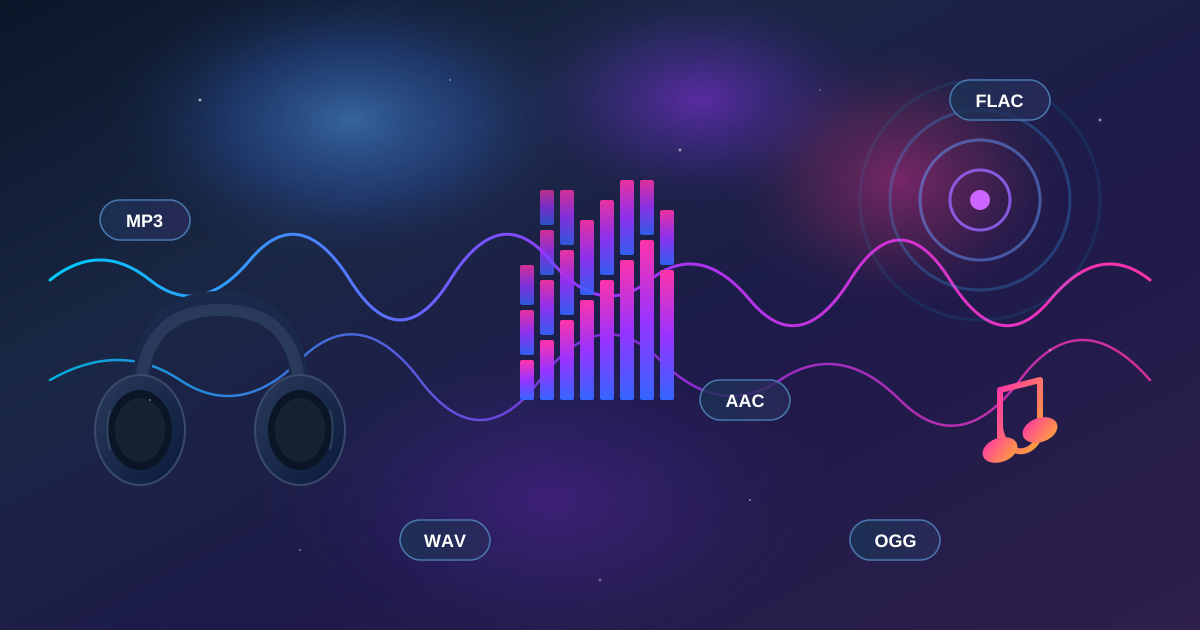
WAV (Waveform Audio File Format): This is the standard for uncompressed audio on Windows systems. The quality is identical to FLAC's source, but the files are much larger because there's no compression at all. It's primarily used for professional audio editing and recording. You can easily convert other formats to it using an MP3 to WAV tool if needed for a project.
-
AAC (Advanced Audio Coding): Often found in an M4A container, AAC is Apple's preferred lossy format. It's generally considered more efficient than MP3, meaning it can provide slightly better sound quality at the same bitrate. It's the standard for iTunes, Apple Music, and YouTube.
-
OGG Vorbis: This is a popular open-source, patent-free alternative to MP3 and AAC. It's known for its high quality at mid-range bitrates and is famously used by Spotify for its streaming service. If you're an avid Spotify user, you're already listening to OGG files. You can also create them yourself with an MP3 to OGG converter.
Your Go-To Solution for FLAC to MP3 Conversion
Navigating the world of audio formats doesn't have to be complicated. Understanding the fundamental trade-off between FLAC's archival quality and MP3's universal convenience is the key. For nearly every practical, day-to-day listening scenario—from your daily commute to your workout playlist—a high-bitrate MP3 created from a FLAC source provides the perfect blend of fidelity and functionality.
By following the steps and best practices outlined in this guide, you can confidently manage your digital music library, ensuring your favorite tracks are always accessible, no matter the device.
Ready to make your high-quality audio library universally compatible? Try our free, secure, and incredibly fast FLAC to MP3 converter today and experience the perfect balance of quality and convenience!