CSV to JSON: A Comprehensive Guide for Developers

In the world of software development, data is the currency that fuels our applications. We're constantly moving it, transforming it, and reshaping it to fit different needs. Two of the most common formats you'll encounter are CSV and JSON. While CSV (Comma-Separated Values) is the stalwart of spreadsheets and tabular data, JSON (JavaScript Object Notation) is the undisputed language of the modern web API.
As a developer, you'll inevitably face the task of bridging the gap between these two formats. Perhaps you're migrating data from a legacy system, processing user-uploaded spreadsheets, or feeding a front-end application with data from a report. Whatever the reason, knowing how to efficiently and reliably convert CSV to JSON is a fundamental skill.
This comprehensive guide goes beyond a simple one-liner script. We'll dive deep into why this conversion is so critical, explore various methods from command-line tools to robust programming scripts in Python and Node.js, and tackle the complex edge cases that can trip up even experienced developers. Get ready to master your data workflow.
Why Convert CSV to JSON? The Developer's Perspective
At first glance, both CSV and JSON store data. So why bother converting? The reasons are rooted in the fundamental differences in their structure and the ecosystems they serve. For a developer, choosing JSON is often a strategic decision that unlocks greater flexibility and compatibility.
| Feature | CSV (Comma-Separated Values) | JSON (JavaScript Object Notation) |
|---|---|---|
| Structure | Flat, tabular (rows and columns) | Hierarchical (key-value pairs, nested objects, arrays) |
| Data Types | Everything is a string | Supports strings, numbers, booleans, arrays, objects, null |
| Web APIs | Rarely used for APIs | The de facto standard for REST and GraphQL APIs |
| Web Dev | Requires parsing libraries | Natively supported in JavaScript (JSON.parse()) |
| Flexibility | Rigid schema defined by columns | Highly flexible, schema can vary between objects |
| Readability | Easy for tabular data | Easy for complex, nested data |
Here’s a deeper look at the key advantages:
- API Integration: Modern web services overwhelmingly consume and produce JSON. If you're building or interacting with a RESTful API, you'll be working with JSON. It's the common language that allows your application to talk to countless third-party services.
- Hierarchical Data Representation: The real world is not flat. A user has an address, an order has a list of line items, and a blog post has a list of comments. JSON's ability to nest objects and arrays allows you to model these complex, real-world relationships intuitively. A CSV file would require awkward workarounds like duplicating rows or using complex column naming conventions.
- Native JavaScript/Web Compatibility: Since JSON is a subset of JavaScript's object syntax, it's incredibly easy to work with in web development. A single line of code (
JSON.parse(data)) can turn a JSON string into a usable JavaScript object, no external libraries needed. This makes it perfect for front-end frameworks like React, Vue, and Angular. - NoSQL Database Synergy: Databases like MongoDB, CouchDB, and DynamoDB are designed around JSON-like document models. Storing your data as JSON objects from the start makes interacting with these databases seamless.
Methods for CSV to JSON Conversion: A Practical Guide
Now that we understand the 'why', let's dive into the 'how'. The best method depends on your specific context: Is it a one-time conversion? A recurring task in an automated pipeline? Is the file massive? We'll cover the spectrum.
Method 1: Using Online Conversion Tools
For a quick, one-off conversion, you don't always need to write code. Numerous online tools allow you to upload a CSV file and download the JSON equivalent. They are fast, convenient, and require no setup.
When to use them:
- Quickly converting a small file for testing or inspection.
- You're not a developer and need a one-time conversion.
- The data is not sensitive (always be mindful of privacy with online tools).
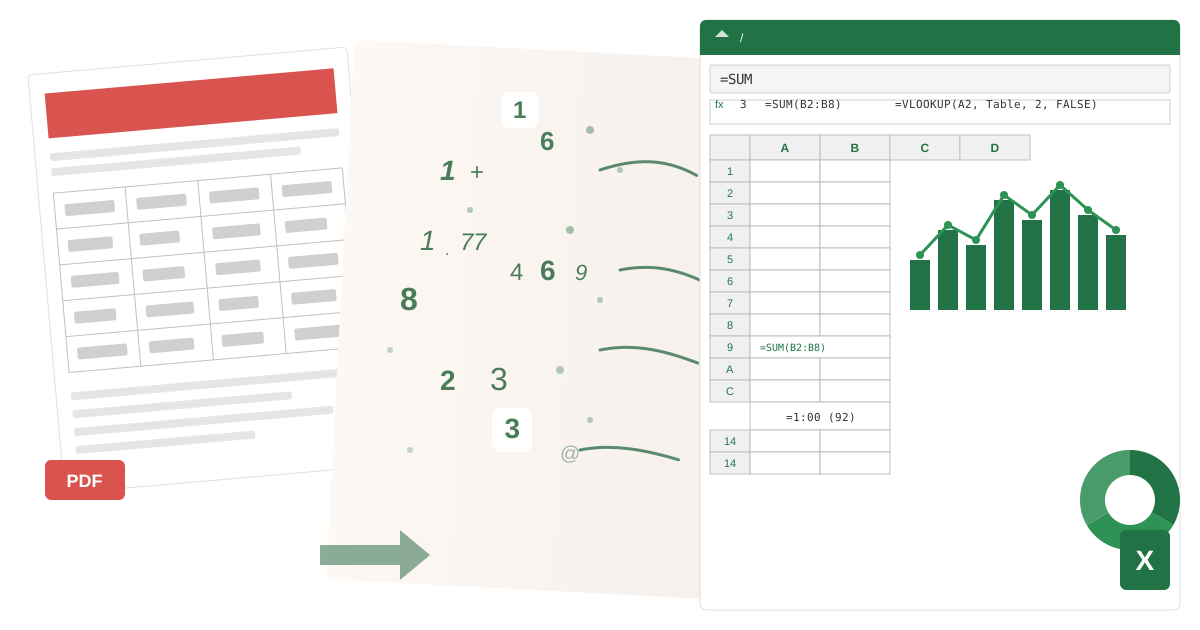
At Practical Web Tools, we believe in creating simple, powerful, and privacy-focused utilities. While we don't have a CSV-to-JSON converter yet, this philosophy guides all our tools. Often, the first step is getting your data out of a restrictive format. For example, if your tabular data is trapped inside a document, our PDF to Excel tool can extract it into a spreadsheet, which you can then easily save as a CSV and convert using the methods below.
Method 2: Scripting with Python
Python is a powerhouse for data manipulation, making it a top choice for programmatic conversions. Its rich standard library and extensive third-party packages can handle almost any scenario.
Using the Standard csv and json Libraries
For most use cases, Python's built-in modules are all you need. This approach is lightweight and available in any standard Python installation.
Step-by-step example:
-
Create a sample CSV file named
users.csv:id,name,email 1,Alice,[email protected] 2,Bob,[email protected] 3,Charlie,[email protected] -
Write the Python script
convert.py:import csv import json def csv_to_json(csv_file_path, json_file_path): """Converts a CSV file to a JSON file.""" data = [] try: with open(csv_file_path, mode='r', encoding='utf-8') as csv_file: # DictReader reads each row as a dictionary csv_reader = csv.DictReader(csv_file) for row in csv_reader: data.append(row) with open(json_file_path, mode='w', encoding='utf-8') as json_file: # Use indent for pretty-printing the JSON json.dump(data, json_file, indent=4) print(f'Successfully converted {csv_file_path} to {json_file_path}') except FileNotFoundError: print(f'Error: The file {csv_file_path} was not found.') except Exception as e: print(f'An error occurred: {e}') # --- Usage --- csv_path = 'users.csv' json_path = 'users.json' csv_to_json(csv_path, json_path) -
Run the script from your terminal:
python convert.py -
Check the output in
users.json:[ { "id": "1", "name": "Alice", "email": "[email protected]" }, { "id": "2", "name": "Bob", "email": "[email protected]" }, { "id": "3", "name": "Charlie", "email": "[email protected]" } ]
Using the pandas Library
For larger datasets or when you need to perform data cleaning and transformation before converting, the pandas library is the industry standard.
import pandas as pd

def csv_to_json_pandas(csv_file_path, json_file_path):
    """Converts CSV to JSON using the pandas library."""
    try:
        df = pd.read_csv(csv_file_path)
        # 'records' orientation creates a list of dictionaries, just like our manual example
        df.to_json(json_file_path, orient='records', indent=4)
        print(f'Successfully converted {csv_file_path} to {json_file_path} using pandas')
    except Exception as e:
        print(f'An error occurred: {e}')

# --- Usage ---
csv_path = 'users.csv'
json_path_pandas = 'users_pandas.json'
csv_to_json_pandas(csv_path, json_path_pandas)
Method 3: Scripting with Node.js
For developers in the JavaScript ecosystem, Node.js provides excellent tools for this task. A key advantage is its non-blocking, stream-based nature, which is ideal for handling large files without consuming excessive memory.
We'll use the popular csv-parser library.
Step-by-step example:
-
Set up your project:
npm init -y npm install csv-parser -
Use the same
users.csvfile as in the Python example. -
Write the Node.js script
convert.js:const fs = require('fs'); const path = require('path'); const csv = require('csv-parser'); function convertCsvToJson(csvFilePath, jsonFilePath) { const results = []; fs.createReadStream(csvFilePath) .pipe(csv()) .on('data', (data) => results.push(data)) .on('end', () => { try { fs.writeFileSync(jsonFilePath, JSON.stringify(results, null, 4)); console.log(`Successfully converted ${csvFilePath} to ${jsonFilePath}`); } catch (err) { console.error('Error writing JSON file:', err); } }) .on('error', (err) => { console.error('Error reading CSV file:', err); }); } // --- Usage --- const csvPath = path.join(__dirname, 'users.csv'); const jsonPath = path.join(__dirname, 'users.json'); convertCsvToJson(csvPath, jsonPath); -
Run the script:
node convert.js. The output will be identical to the Python example.
This streaming approach reads the CSV file line by line, processes it, and adds it to the results array. This is far more memory-efficient for large files than reading the entire file at once.
Handling Complex Scenarios and Edge Cases
Real-world data is rarely as clean as our simple users.csv example. Here’s how to tackle common complexities.
Creating Nested JSON
What if you want to group your data? Imagine a CSV of product sales by region and want to nest the products under each region.
Input sales.csv:
region,product_id,product_name,sales
North,101,Widget A,500
North,102,Widget B,350
South,101,Widget A,700
South,103,Widget C,900
Desired sales.json (nested):
{
    "North": [
        {
            "product_id": "101",
            "product_name": "Widget A",
            "sales": "500"
        },
        {
            "product_id": "102",
            "product_name": "Widget B",
            "sales": "350"
        }
    ],
    "South": [
        {
            "product_id": "101",
            "product_name": "Widget A",
            "sales": "700"
        },
        {
            "product_id": "103",
            "product_name": "Widget C",
            "sales": "900"
        }
    ]
}
Python solution:
import csv
import json
from collections import defaultdict

nested_data = defaultdict(list)

with open('sales.csv', mode='r', encoding='utf-8') as csv_file:
    csv_reader = csv.DictReader(csv_file)
    for row in csv_reader:
        region = row.pop('region') # Get the region and remove it from the row dict
        nested_data[region].append(row)

with open('sales.json', mode='w', encoding='utf-8') as json_file:
    json.dump(nested_data, json_file, indent=4)
Data Type Conversion
By default, all values read from a CSV are strings. You often need to convert them to appropriate types like numbers or booleans.
# Inside your CSV reading loop
for row in csv_reader:
    # Manually convert types
    row['id'] = int(row['id'])
    # Example for a hypothetical 'is_active' column
    # row['is_active'] = row['is_active'].lower() in ('true', '1', 't')
    data.append(row)
Libraries like pandas are excellent at automatically inferring data types (pd.read_csv(file, infer_datetime_format=True)), which can save a lot of manual effort.
Dealing with Messy Data
Handling messy data sources is a constant challenge for developers. It's a problem that often begins before you even have a CSV file. For instance, if you're pulling data from a report, you might first need to extract it from a PDF. A tool like our PDF to Text converter is an essential first step in that data pipeline, getting you the raw information you need to parse and clean.
Other common CSV issues include:
- Different Delimiters: Some files use semicolons (
;) or tabs (\t).csv.DictReadercan handle this with thedelimiterargument:csv.DictReader(file, delimiter=';'). - No Header Row: If the file lacks a header, you can supply your own column names:
csv.reader(file)and process it manually, or if using pandas:pd.read_csv(file, header=None, names=['id', 'name', 'email']). - Quoting and Escaping: CSVs with text containing commas should have that text enclosed in quotes. Most libraries handle this automatically, but it's a common source of errors with manual parsing.
Conclusion
Converting CSV to JSON is more than just a file format change; it's about transforming data into a structure that's more powerful, flexible, and compatible with the modern development landscape. We've seen that you have a range of options, from quick online tools to powerful, memory-efficient scripts in Python and Node.js.
The key takeaway is to choose the right tool for the job:
- For a quick, one-off task, an online converter is fine.
- For repeatable, robust workflows, a Python or Node.js script is the professional choice.
- For large files and complex transformations, leverage powerful libraries like
pandasor stream-based parsers in Node.js.
By mastering these techniques, you can ensure your data flows smoothly between systems, enabling you to build more powerful and sophisticated applications. At Practical Web Tools, we're dedicated to giving you the tools you need to manage your data and documents effectively. Whether you're combining reports using our Merge PDFs tool or converting data formats as shown here, our goal is to streamline your workflow.
Explore our full suite of over 455 free and privacy-focused tools to see how we can help simplify your next project.