CSV to JSON: The Ultimate Developer's Guide to Conversion

In the world of web development, data is the currency that flows between applications, APIs, and databases. Two formats have long dominated this exchange: CSV and JSON. While CSV (Comma-Separated Values) offers simplicity and tabular structure, JSON (JavaScript Object Notation) provides the hierarchical flexibility demanded by modern web services. As a developer, the task of converting CSV to JSON isn't just common—it's essential.
Whether you're migrating legacy data, integrating with a third-party API, or feeding data into a front-end framework, a robust understanding of this conversion process is crucial. This guide provides a comprehensive deep-dive into CSV to JSON conversion, covering everything from fundamental concepts and practical code examples in multiple languages to advanced techniques and best practices. Let's get started.
Understanding the Formats: CSV vs. JSON
Before diving into the conversion process, it's vital to understand the core characteristics, strengths, and weaknesses of each format.
What is CSV (Comma-Separated Values)?
CSV is a plain text format that stores tabular data. Each line in the file represents a data record, and each record consists of one or more fields, separated by commas. It's the digital equivalent of a simple spreadsheet.
- Structure: Flat, two-dimensional, and row-based.
- Pros:
- Human-Readable: Easy to open and understand in any text editor or spreadsheet program.
- Compact: For simple tabular data, it has a very low overhead.
- Widely Supported: Virtually every data-centric application can import or export CSV files.
- Cons:
- No Data Types: Every value is inherently a string.
123,"true", and"hello"are all just text. - No Hierarchy: It's impossible to represent nested data structures natively.
- Parsing Ambiguity: Issues can arise from commas within data fields, different delimiters (tabs, semicolons), and inconsistent quoting.
- No Data Types: Every value is inherently a string.
What is JSON (JavaScript Object Notation)?
JSON is a lightweight data-interchange format inspired by JavaScript object literal syntax. It uses human-readable text to represent data objects consisting of attribute-value pairs and array data types.
- Structure: Hierarchical, based on key-value pairs and ordered lists (arrays).
- Pros:
- Supports Data Types: Natively handles strings, numbers, booleans, arrays, and objects (including
null). - Hierarchical: Can represent complex, nested data relationships, making it perfect for modern applications.
- Easy to Parse: Its structure is rigid and well-defined, making it simple for machines to parse and generate.
- Supports Data Types: Natively handles strings, numbers, booleans, arrays, and objects (including
- Cons:
- More Verbose: The use of keys and structural characters (
{,},[,]) makes it larger than CSV for the same flat data. - Less Readable for Tabular Data: A large table can be harder to scan in JSON format compared to a spreadsheet view.
- More Verbose: The use of keys and structural characters (
Why Convert CSV to JSON?
Developers frequently convert CSV to JSON for several key reasons, primarily driven by the requirements of modern web technologies:
- Web APIs: Most RESTful and GraphQL APIs consume and produce JSON. It's the de facto standard for client-server communication.
- Front-End Frameworks: Libraries like React, Vue, and Angular work seamlessly with JSON objects to manage state and render UIs.
- NoSQL Databases: Databases like MongoDB and CouchDB store data in JSON-like BSON documents, making JSON a natural fit.
- Configuration Files: JSON's hierarchical structure is ideal for application configuration files (e.g.,
package.json). - Representing Complex Relationships: When flat CSV data needs to be transformed into a structured model with nested objects, JSON is the target format.
Methods for Converting CSV to JSON
There are numerous ways to tackle this conversion, from writing your own scripts to using command-line utilities. We'll explore the most popular developer-centric approaches.
Method 1: Using Python
Python's extensive standard library includes the csv and json modules, making this conversion straightforward without external dependencies.
Step-by-Step Python Conversion
- Read the CSV File: Use the
csv.DictReaderto read the CSV rows as dictionaries. This automatically uses the header row for the dictionary keys. - Append to a List: Iterate over the
DictReaderobject and append each dictionary to a list. - Write to a JSON File: Use the
json.dump()function to serialize the list of dictionaries into a JSON string and write it to a file.
Here's a sample script:
import csv
import json

def csv_to_json(csv_file_path, json_file_path):
    """Converts a CSV file to a JSON file."""
    data = []
    try:
        with open(csv_file_path, mode='r', encoding='utf-8') as csv_file:
            # Use DictReader to read CSV rows as dictionaries
            csv_reader = csv.DictReader(csv_file)
            for row in csv_reader:
                data.append(row)

        with open(json_file_path, mode='w', encoding='utf-8') as json_file:
            # Use json.dump to write the list of dicts to a JSON file
            # indent=4 makes the output pretty and readable
            json.dump(data, json_file, indent=4)
        print(f"Successfully converted {csv_file_path} to {json_file_path}")

    except FileNotFoundError:
        print(f"Error: The file {csv_file_path} was not found.")
    except Exception as e:
        print(f"An error occurred: {e}")

# --- Usage ---
csv_input = 'users.csv'
json_output = 'users.json'

# Create a dummy CSV for the example
with open(csv_input, 'w', newline='') as f:
    writer = csv.writer(f)
    writer.writerow(['id', 'name', 'email'])
    writer.writerow(['1', 'Alice', '[email protected]'])
    writer.writerow(['2', 'Bob', '[email protected]'])

csv_to_json(csv_input, json_output)
Input (users.csv):
id,name,email
1,Alice,[email protected]
2,Bob,[email protected]
Output (users.json):
[
    {
        "id": "1",
        "name": "Alice",
        "email": "[email protected]"
    },
    {
        "id": "2",
        "name": "Bob",
        "email": "[email protected]"
    }
]
For more complex data manipulation, the Pandas library is a powerful alternative: pd.read_csv('users.csv').to_json('users.json', orient='records').
Method 2: Using JavaScript (Node.js)
In the Node.js ecosystem, you can use powerful stream-based libraries to handle large CSV files efficiently without consuming too much memory.
Step-by-Step Node.js Conversion
We'll use the csv-parser library, which is a popular choice for this task.
- Install the Library:
npm install csv-parser - Read and Parse: Create a read stream for the CSV file and pipe it through the
csv()parser. - Collect Data: Listen for
dataevents to collect each parsed row andendevents to know when the process is complete. - Write JSON: Once all data is collected, use the
fsmodule to write the resulting array to a JSON file.
Here is a complete script:
const fs = require('fs');
const csv = require('csv-parser');

function convertCsvToJson(csvFilePath, jsonFilePath) {
    const results = [];

    fs.createReadStream(csvFilePath)
        .pipe(csv())
        .on('data', (data) => results.push(data))
        .on('end', () => {
            fs.writeFile(jsonFilePath, JSON.stringify(results, null, 4), (err) => {
                if (err) {
                    return console.error('Error writing JSON file:', err);
                }
                console.log(`Successfully converted ${csvFilePath} to ${jsonFilePath}`);
            });
        })
        .on('error', (error) => {
            console.error('Error reading or parsing CSV:', error);
        });
}

// --- Usage ---
const csvInput = 'products.csv';
const jsonOutput = 'products.json';

// Create a dummy CSV for the example
const csvContent = 'productId,productName,price\n101,Laptop,1200\n102,Mouse,25';
fs.writeFileSync(csvInput, csvContent);

convertCsvToJson(csvInput, jsonOutput);
Output (products.json):
[
    {
        "productId": "101",
        "productName": "Laptop",
        "price": "1200"
    },
    {
        "productId": "102",
        "productName": "Mouse",
        "price": "25"
    }
]
Handling Complex CSV to JSON Conversions
A simple array of objects is often not enough. Real-world data frequently requires more complex, nested JSON structures and proper data typing.
Creating Nested JSON
Imagine a CSV that represents nested data using dot notation in its headers, like user.id and user.name. Your goal is to convert this flat structure into a nested JSON object.
Input CSV (orders.csv):
orderId,orderDate,user.id,user.name,user.email
901,2023-10-27,1,Alice,[email protected]
902,2023-10-27,2,Bob,[email protected]
Here's a Python snippet to handle this transformation:
import csv
import json

def convert_to_nested_json(csv_path, json_path):
    nested_data = []
    with open(csv_path, mode='r', encoding='utf-8') as csv_file:
        csv_reader = csv.DictReader(csv_file)
        for row in csv_reader:
            structured_object = {}
            for key, value in row.items():
                # Split keys by dot and build nested structure
                keys = key.split('.')
                d = structured_object
                for k in keys[:-1]:
                    d = d.setdefault(k, {})
                d[keys[-1]] = value
            nested_data.append(structured_object)

    with open(json_path, 'w', encoding='utf-8') as json_file:
        json.dump(nested_data, json_file, indent=4)

convert_to_nested_json('orders.csv', 'orders_nested.json')
Output (orders_nested.json):
[
    {
        "orderId": "901",
        "orderDate": "2023-10-27",
        "user": {
            "id": "1",
            "name": "Alice",
            "email": "[email protected]"
        }
    },
    {
        "orderId": "902",
        "orderDate": "2023-10-27",
        "user": {
            "id": "2",
            "name": "Bob",
            "email": "[email protected]"
        }
    }
]
Managing Data Type Conversion
As mentioned, CSV treats all data as strings. You need to apply logic during conversion to cast values to their correct types (numbers, booleans).
Here's an enhanced Python function that attempts to convert types automatically:
def type_caster(value):
    # Try to convert to integer
    try:
        return int(value)
    except (ValueError, TypeError):
        pass
    # Try to convert to float
    try:
        return float(value)
    except (ValueError, TypeError):
        pass
    # Handle booleans
    if value.lower() in ['true', 't', 'yes', 'y']:
        return True
    if value.lower() in ['false', 'f', 'no', 'n']:
        return False
    return value # Return as string if all else fails

# You would then apply this function to each value in your conversion loop
# for row in csv_reader:
#    typed_row = {key: type_caster(value) for key, value in row.items()}
#    data.append(typed_row)
Best Practices for CSV to JSON Conversion
Following best practices ensures your conversions are reliable, efficient, and maintainable.
-
Validate Your CSV First: Before processing, ensure your CSV is well-formed. Check for consistent delimiters, proper quoting, and a uniform number of columns per row. This prevents parsing errors downstream.
-
Define Your Target JSON Schema: Don't convert blindly. Have a clear idea of the desired output JSON structure, including nesting and data types. This makes your conversion logic purposeful.
-
Handle Errors Gracefully: Your script should not crash on a single malformed row. Implement try-except blocks or error-handling callbacks to log problematic rows and continue processing the rest of the file.
-
Stream Large Files: For CSV files that are gigabytes in size, avoid reading the entire file into memory. Use streaming parsers, as shown in the Node.js example, to process the file chunk by chunk, ensuring low memory usage.
-
Automate Your Workflow: If conversion is a recurring task, automate it with scripts and command-line tools. Just like you'd automate document workflows by using a tool to Merge PDFs instead of doing it manually, automating data conversion saves time and prevents human error.
-
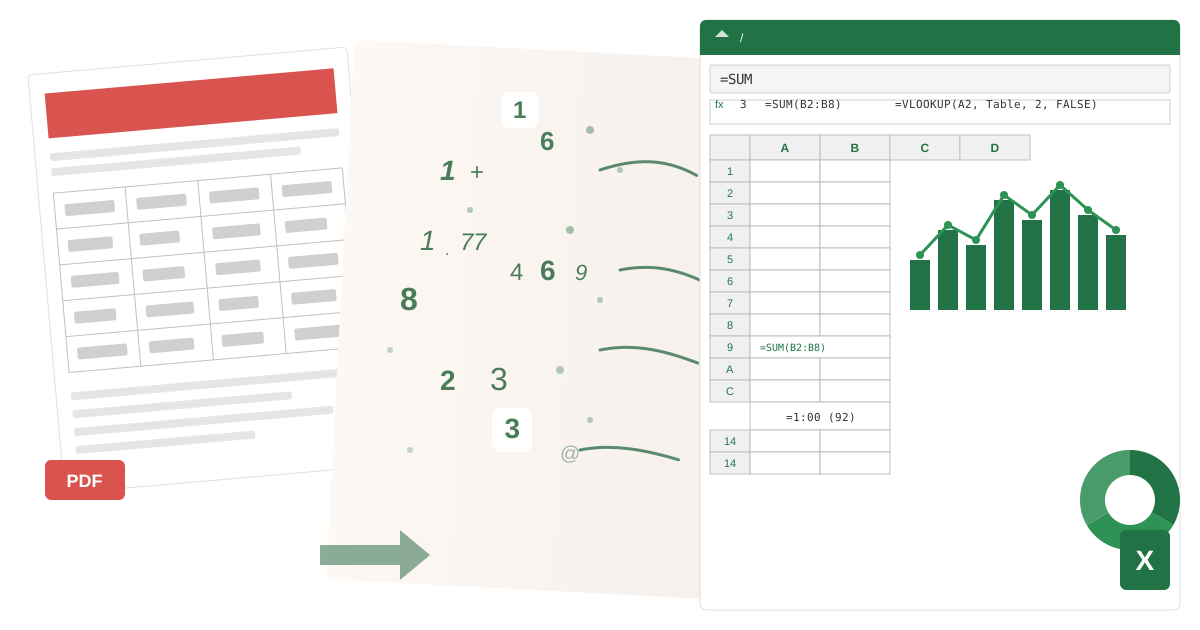
Consider the Data Source: The source of your data matters. Sometimes data is trapped in other formats. For instance, if you need to extract a table from a report, you might first use a PDF to Excel converter to get the data into a tabular format, which can then be saved as CSV for your conversion script.
Conclusion
Converting CSV to JSON is a fundamental skill for any developer working with data. While the basic process is simple, mastering the nuances of data structuring, type casting, and error handling is what separates a quick-and-dirty script from a robust, production-ready solution. By understanding the strengths of each format and leveraging the powerful tools available in languages like Python and JavaScript, you can build reliable data pipelines that power your applications.
As you continue to streamline your development workflows, remember that having the right tools for the job is essential. From data conversion to document management, efficiency is key. If you ever need to manage digital paperwork, check out our free suite of privacy-focused tools, like our popular Sign PDF utility that makes signing contracts a breeze. Explore all the tools Practical Web Tools has to offer today!