Master HTML to Markdown Conversion: A Writer's Guide
In the world of digital writing, the tools you use are as important as the words you write. You’ve likely spent countless hours in WYSIWYG (What You See Is What You Get) editors like those in WordPress, Google Docs, or Microsoft Word. They seem simple at first, but have you ever tried to copy content from one platform to another? The result is often a chaotic mess of broken formatting, strange <span> tags, and inline styles that take forever to clean up. This is where a simpler, more powerful language comes in: Markdown.
For many writers, the idea of moving away from a visual editor can be daunting. But what if we told you there’s a way to write faster, maintain complete control over your formatting, and make your content universally portable? Converting your work from HTML to Markdown is the key. This comprehensive guide will walk you through why this conversion is a game-changer for writers and how you can master it to create clean, future-proof content with ease.
What is Markdown? A Quick Refresher
Created in 2004 by John Gruber, Markdown is a lightweight markup language designed for one purpose: to be as readable as possible in its plain-text form. It allows you to add formatting elements (like headings, bold text, and lists) to a plain text document without the clutter of traditional HTML tags.
For example, instead of writing this in HTML:
<h1>My Awesome Article</h1>
<p>This is the <strong>first</strong> paragraph.</p>
You would write this in Markdown:
# My Awesome Article
This is the **first** paragraph.
The Markdown version is cleaner, easier to read, and faster to type. When processed by a Markdown application, it converts back to perfectly structured HTML. It’s the best of both worlds: simplicity during the writing process and semantic correctness in the final output.
Why Convert HTML to Markdown? The Core Benefits for Writers
If you're starting a new article, it's often best to write in Markdown from the beginning. However, you'll frequently encounter existing content in HTML format—whether it's an old blog post you want to repurpose or content you've scraped from a website. Converting this HTML to Markdown offers significant advantages.
1. Enhanced Readability and Focus
Raw HTML is noisy. It’s filled with opening and closing tags, attributes, and nested elements that can make it difficult to focus on the actual content. When you convert HTML to Markdown, you strip away this noise, leaving only your text and a few intuitive formatting characters. This clean environment makes proofreading and editing a much more pleasant and efficient experience.
2. Ultimate Portability and Future-Proofing
Markdown is, at its core, just plain text. This makes it incredibly portable. A Markdown file (.md) can be opened and edited on any device with any text editor. You are no longer locked into a specific platform or proprietary format. Want to move your blog from WordPress to Ghost, or to a static site generator like Hugo or Jekyll? With your content in Markdown, the process is trivial. Your content remains yours, independent of the platform that displays it.
3. Simplified Version Control
If you collaborate with other writers or use a version control system like Git to track changes, Markdown is a clear winner. Tracking changes in an HTML file can be a nightmare; a small text edit might result in a huge, confusing change log (a "diff") because of shifting lines and tags. In Markdown, changes are clean and precise. You see only the text that was added or removed, making collaboration and reviewing history incredibly straightforward.
4. Cleaner, More Semantic Code
HTML generated by WYSIWYG editors is often messy. It can be filled with unnecessary tags, inline styling, and non-semantic <div> elements. When you convert this "dirty" HTML to Markdown, you force a cleanup. The conversion process strips out the junk, preserving only the structural elements (headings, lists, bold text). When you later convert this Markdown back to HTML for publishing, the output is clean, semantic, and standardized.
Understanding the Conversion: HTML Tags to Markdown Syntax
At its heart, the conversion process is a translation from one set of rules to another. Most standard HTML formatting tags have a direct equivalent in Markdown. Understanding this mapping is the first step to mastering the process. Here’s a quick reference table for the most common elements:
| HTML Tag | Markdown Equivalent | Notes |
|---|---|---|
<h1> to <h6> |
# to ###### |
The number of # corresponds to the heading level. |
<p> |
A blank line between text blocks | Markdown creates paragraphs from adjacent lines. |
<strong> or <b> |
**Bold Text** or __Bold Text__ |
Double asterisks or underscores. |
<em> or <i> |
*Italic Text* or _Italic Text_ |
Single asterisks or underscores. |
<a href="URL">Link Text</a> |
[Link Text](URL) |
Simple and clean link syntax. |
<img src="URL" alt="Alt"> |
 |
The ! at the beginning signifies an image. |
<ul><li>Item</li></ul> |
* Item or - Item |
Asterisks, pluses, or hyphens can be used. |
<ol><li>Item</li></ol> |
1. Item |
Numbers are used for ordered lists. |
<blockquote> |
> Quoted Text |
A > character at the start of the line. |
<code> |
`Inline Code` |
Text is enclosed in backticks. |
<hr> |
--- or *** |
Three or more hyphens, asterisks, or underscores. |
How to Convert HTML to Markdown: Your Toolkit
There are several ways to perform the conversion, each suited to different needs and technical comfort levels. Let's explore the most popular methods.
Method 1: Online Converters (The Quick and Easy Way)
For quick, one-off conversions, online tools are your best friend. A simple search for "HTML to Markdown converter" will yield dozens of web-based tools. The process is typically the same:
- Copy your source HTML code.
- Paste it into the input box on the website.
- Copy the automatically generated Markdown from the output box.
- Pros: Fast, no installation required, free to use, great for beginners.
- Cons: Not suitable for sensitive information (privacy concerns), may have file size limits, can be cumbersome for batch conversions.
Method 2: Code Editors and Plugins (The Power User's Choice)
If you do a lot of writing, using a modern code editor like Visual Studio Code (VS Code), Sublime Text, or Atom is highly recommended. These editors have powerful extensions (or plugins) that can handle conversions and offer a fantastic Markdown writing experience.
Example: Using VS Code for Conversion
- Install VS Code: It's free and available for Windows, macOS, and Linux.
- Install an Extension: Open the Extensions view (Ctrl+Shift+X) and search for a Markdown converter. A popular choice is
turndownor other HTML-to-Markdown packages. - Perform the Conversion: Once installed, these extensions typically add a command to the Command Palette (Ctrl+Shift+P). You can open an HTML file, run a command like "Convert HTML to Markdown," and it will transform the file for you.
This method gives you more control and allows you to work entirely within one application, which is great for a streamlined workflow.
Method 3: Command-Line Tools (For Automation and Bulk Conversion)
For technical writers, developers, or anyone needing to convert many files at once, command-line tools are the most powerful option. The undisputed king in this category is Pandoc, the "universal document converter."
Pandoc can convert between dozens of file formats. To convert an HTML file to Markdown, you would open your terminal or command prompt and use a simple command:
pandoc -f html -t markdown yourfile.html -o newfile.md
-f html: Specifies the from format (HTML).-t markdown: Specifies the to format (Markdown).yourfile.html: The name of your input file.-o newfile.md: The-oflag specifies the name of the output file.
This method is incredibly powerful for automating your workflow and ensuring consistency across large batches of content.
Common Challenges in Conversion (And How to Fix Them)
While conversion tools are smart, they aren't perfect. You may encounter a few common issues, especially when dealing with complex or poorly formatted HTML.
- Complex Tables: Basic Markdown tables are simple, but they don't support merged cells (
colspanorrowspan). If your HTML contains a complex table, most converters will either simplify it or embed the original HTML table directly into the Markdown file. Often, the best solution is to rethink the table's structure to be simpler. - Inline Styles and Classes: Markdown is about structure, not presentation. Therefore, inline CSS (
<p style="color:red;">) and custom CSS classes (<p class="special-intro">) will be stripped out during conversion. This is usually a good thing, as it separates content from design. - Embedded Content:
<iframe>elements (for videos or maps) and<script>tags have no Markdown equivalent. These will almost always need to be manually re-inserted into your final document or template after conversion. - "Dirty" HTML: HTML copied from programs like Microsoft Word or Google Docs is notoriously messy. It can contain a huge amount of non-standard tags and inline styles. The garbage-in, garbage-out principle applies here. Always review the Markdown output carefully and be prepared to do some manual cleanup.
A Writer's Workflow: Integrating Conversion into Your Process
To be an effective digital writer, you need a flexible workflow that can handle content from various sources. Your process might involve more than just a single HTML file.
Often, source material comes in different formats. A client might send you a project brief, research materials, or existing content as a PDF. Before you can even think about HTML or Markdown, you need to get the core text out. This is where having a reliable tool is essential. For instance, our free PDF to Text converter can instantly extract all the text from a PDF, giving you a clean base to work from. You can then easily structure this raw text using Markdown.
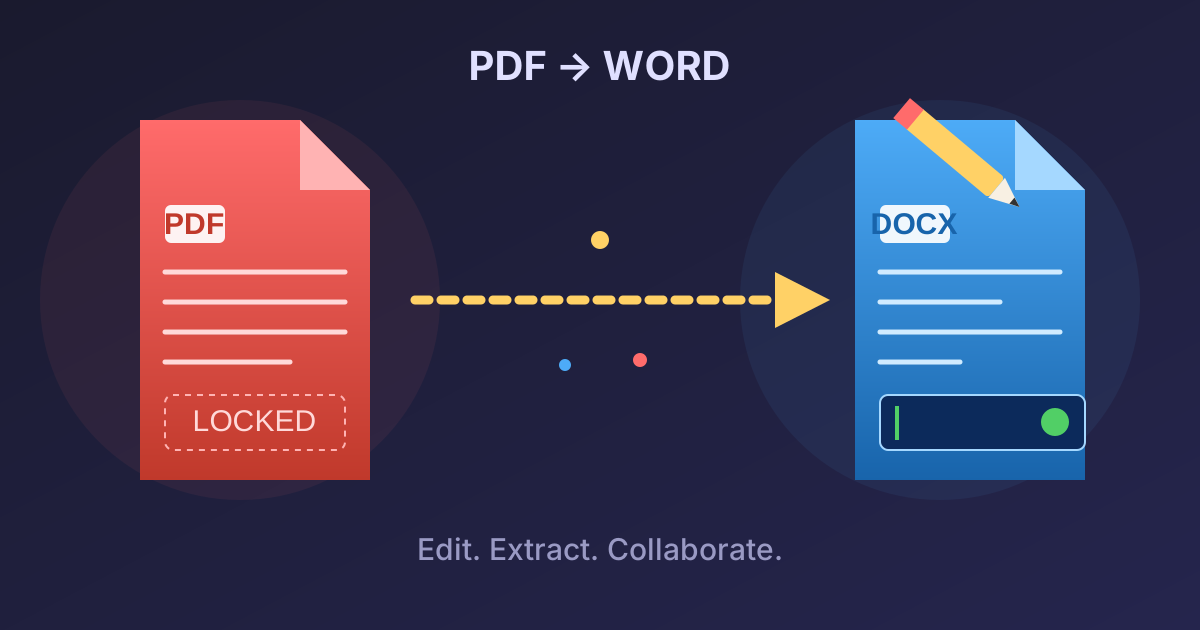
For more complex PDFs that contain important layouts, tables, or images, a direct text extraction might not be enough. In these cases, using a tool like our PDF to Word converter can be a useful intermediate step. This preserves more of the original structure. From Word, you can then export to HTML and finally convert that HTML to clean Markdown, giving you a well-structured starting point for your edits.
Conclusion: Embrace the Future of Writing
Learning to convert HTML to Markdown is more than just a technical skill; it's an investment in the longevity and flexibility of your content. By embracing a Markdown-first workflow, you free yourself from platform lock-in, streamline your editing process, and ensure your work remains clean and portable for years to come.
The initial learning curve is small, but the benefits are immense. You'll write faster, collaborate more easily, and spend less time fighting with formatting and more time focusing on what truly matters: your words.
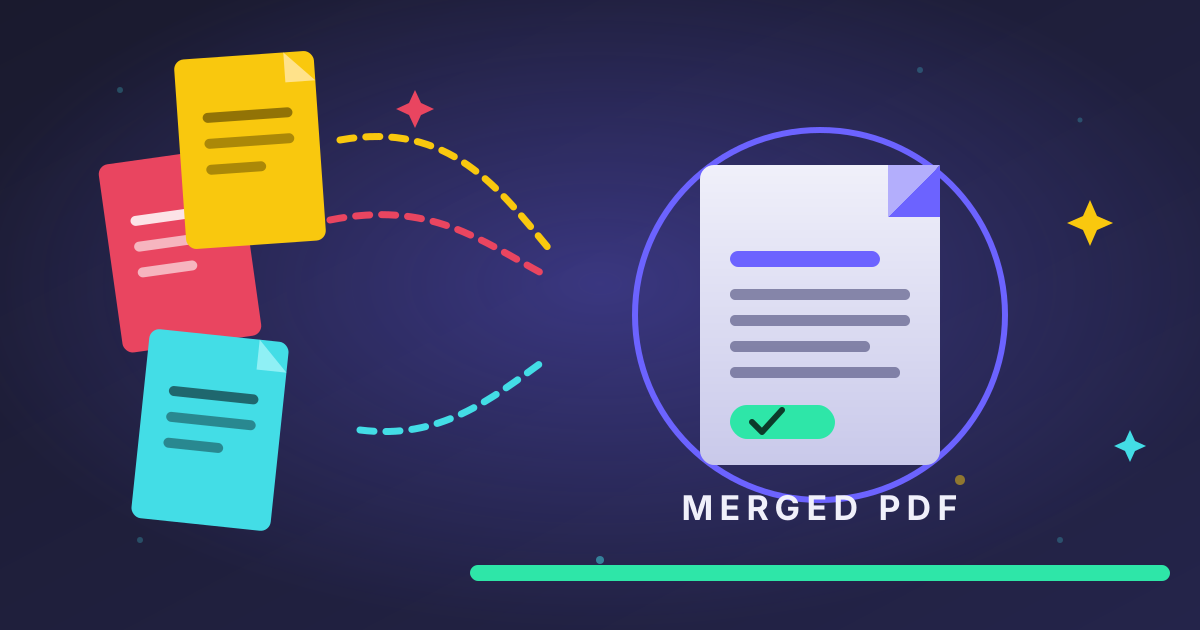
Ready to streamline more of your document management tasks? Explore the full suite of free tools at Practical Web Tools. From combining research documents with our Merge PDFs tool to converting data for analysis, we have you covered.