Calories Burned Calculator: The Ultimate Exercise Guide

Your Fitness Journey and the Power of Data
Have you ever finished a tough workout, drenched in sweat, and thought, "I wonder how many calories I actually burned?" It's a universal question for anyone on a fitness journey. We use calories as a metric for energy, and understanding how much we expend is a key piece of the puzzle, whether your goal is weight loss, muscle gain, or simply maintaining a healthy lifestyle. This is where a calories burned calculator comes in—a simple tool that promises to translate your effort into a tangible number.
But how accurate are these calculators? What's the science behind them? And how can you use that information to make smarter decisions about your workouts and nutrition? This comprehensive guide will demystify the process. We'll dive into the mechanics of how your body burns energy, explore the key factors that make your calorie burn unique, and provide actionable tips to go beyond the numbers. By the end, you'll not only know how to use a calories burned calculator but also how to interpret its results to fuel your personal fitness journey effectively.
What Are Calories Burned Calculators and How Do They Work?
At its core, a calories burned calculator is a digital tool that estimates your total energy expenditure (TEE) during a specific activity. It's not a magic box; it's an algorithm that uses established scientific principles and formulas to provide a reasonable approximation of the energy you've used.
Most online calculators rely on a few key user inputs: your body weight, the specific exercise you performed, and the duration of that activity. The calculation happening behind the scenes is typically based on two crucial scientific concepts: Basal Metabolic Rate (BMR) and Metabolic Equivalent of Task (METs).
The Science Behind the Numbers: METs and BMR
Understanding these two terms is the first step to appreciating how these calculators function.
1. Basal Metabolic Rate (BMR): Your BMR is the number of calories your body needs to perform its most basic, life-sustaining functions while at complete rest. Think of it as the energy required to keep your heart beating, lungs breathing, and body temperature stable if you were to lie in bed all day. Factors like age, sex, weight, height, and body composition all play a significant role in determining your BMR. While a calories burned calculator for a specific exercise doesn't always ask for all these details, the underlying formulas often account for them in a generalized way, primarily using weight.
2. Metabolic Equivalent of Task (METs): This is the real star of the show. A MET is a standardized measure of the energy cost of a physical activity. It's a ratio of your working metabolic rate relative to your resting metabolic rate. Here’s a simple breakdown:
- 1 MET: The energy you expend while sitting quietly at rest.
- 3 METs: An activity that requires three times the energy of sitting at rest (e.g., walking at a moderate pace).
- 8 METs: An activity that requires eight times the energy of sitting at rest (e.g., jogging or running).
The Compendium of Physical Activities is a standardized list that assigns MET values to hundreds of activities, from washing dishes to competitive cycling. Calories burned calculators use these established MET values as a core component of their formula.
The simplified formula often looks something like this:
Total Calories Burned = Duration (in minutes) * (MET Value * 3.5 * Body Weight in kg) / 200
You don't need to memorize this, but seeing it helps illustrate how your weight, the activity's intensity (MET), and the duration are all multiplied together to produce the final estimate.
Key Factors That Influence Your Calorie Burn
A calculator provides a great baseline, but the actual number of calories you burn is highly individual. Several personal factors can cause your results to differ from a standard estimate.
Body Weight and Composition
This is the most significant factor. A heavier person will burn more calories than a lighter person doing the same activity for the same amount of time because it takes more energy to move more mass. Furthermore, muscle tissue is more metabolically active than fat tissue. Someone with a higher percentage of muscle mass will burn more calories, even at rest.
Exercise Intensity and Duration
The relationship here is straightforward: the harder and longer you work, the more calories you'll burn. A 30-minute high-intensity run will burn significantly more calories than a 30-minute leisurely walk.
Age and Gender
Metabolism naturally tends to slow down with age due to a gradual loss of muscle mass. Men also generally have a higher BMR than women, primarily because they tend to have more muscle mass and less body fat on average.
Fitness Level
Your body is an amazing machine that adapts to stress. As you become more fit, your body becomes more efficient at performing a particular exercise. This means a seasoned runner will burn slightly fewer calories on a 5k run than a beginner running at the same pace, as the beginner's body is working much harder to keep up.
The "Afterburn" Effect (EPOC)
EPOC, or Excess Post-exercise Oxygen Consumption, is the number of calories your body continues to burn after a workout is over. Your body uses this energy to repair muscle cells, replenish fuel stores, and return to its resting state. High-intensity workouts, especially HIIT and heavy strength training, result in a much greater EPOC effect than low-intensity, steady-state cardio.
Common Exercises and Their Estimated Calorie Burn
To give you a practical idea, here is a table of common activities with their MET values and an estimated calorie burn per hour for a 155-pound (70 kg) person. Remember, these are just estimates!
| Activity (Moderate Effort) | MET Value | Estimated Calories Burned / Hour (155 lb person) |
|---|---|---|
| Running (6 mph / 10 min mile) | 9.8 | ~686 kcal |
| Cycling (12-14 mph) | 8.0 | ~560 kcal |
| Swimming (Freestyle, general) | 7.0 | ~490 kcal |
| HIIT (High-Intensity) | 8.0 | ~560 kcal |
| Weightlifting (Vigorous) | 6.0 | ~420 kcal |
| Walking (3.5 mph) | 3.8 | ~266 kcal |
| Yoga (Hatha) | 2.5 | ~175 kcal |
| Jumping Rope | 10.0 | ~700 kcal |
Tracking Your Progress: The Importance of Data Management
Using a calories burned calculator is just one part of tracking your fitness. A holistic approach involves logging your workouts, monitoring your nutrition, taking progress photos, and noting how you feel. Over time, this generates a significant amount of valuable personal data.
Managing this data effectively is crucial for long-term success. You might have spreadsheets for workout logs, folders of meal plans, and countless progress photos. Keeping this information organized and accessible helps you spot trends, stay motivated, and share your progress with a coach or trainer.
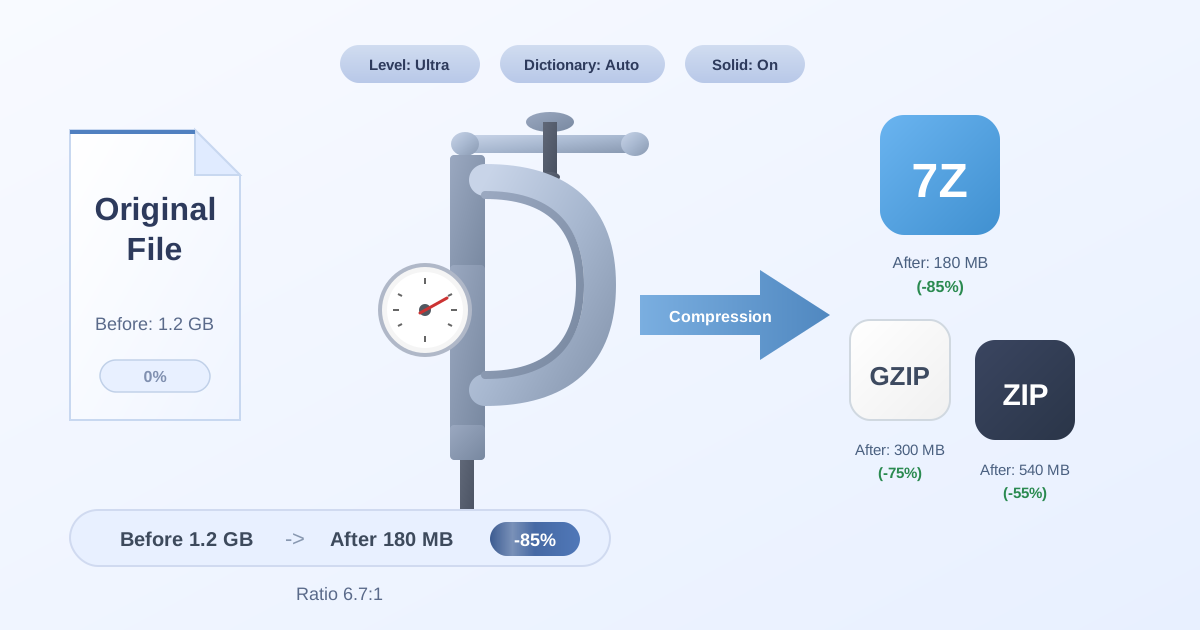
To keep your digital fitness journal organized and portable, you might want to bundle all your weekly logs, meal plans, and progress photos into a single archive. Using a tool to Compress Files can shrink this package, making it perfect for cloud backup or sending to a coach without worrying about large file sizes.
Conversely, if your online trainer sends you a comprehensive fitness plan, it might arrive as a compressed package to save space. You can quickly access the contents using a simple online tool to Decompress Files, getting you to your workout faster without installing any special software.
Compatibility can also be an issue. If your coach uses a less common format like 7Z, and you need a standard ZIP file for your own records, a quick conversion using a 7Z to ZIP tool solves the problem in seconds. It’s all about making your digital fitness data work for you, not against you.
Beyond the Calculator: Maximizing Your Results
A calculator is a great tool for awareness, but true progress comes from applying knowledge. Here are actionable strategies to enhance your fitness results.
Incorporate High-Intensity Interval Training (HIIT)
HIIT involves short bursts of all-out effort followed by brief recovery periods. This method is incredibly efficient for burning calories in a short amount of time and significantly boosts the afterburn effect (EPOC).
Focus on Compound Exercises
Compound movements like squats, deadlifts, push-ups, and pull-ups engage multiple muscle groups simultaneously. They burn more calories than isolation exercises (like bicep curls) and are more effective for building overall strength.
Don't Skip Strength Training
While cardio might burn more calories during the session, building muscle through strength training increases your resting metabolic rate. This means you'll burn more calories throughout the day, even when you're not exercising.
Stay Consistent and Progressively Overload
Consistency is the single most important factor for success. Aim for regular workouts and gradually increase the challenge over time—a principle known as progressive overload. This could mean lifting heavier weights, running a little faster, or reducing your rest times. This continued adaptation is what prevents plateaus.
Common Pitfalls and Misconceptions
As you integrate calorie tracking into your routine, be mindful of these common errors:
- Obsessing Over Exact Numbers: Remember that calculators are estimates. Don't get discouraged if your results don't perfectly match a device or online tool. Focus on the trends and overall effort.
- "Eating Back" Your Exercise Calories: Many people overestimate their calorie burn from exercise and use it as a license to overeat. This can easily negate the calorie deficit needed for weight loss.
- Ignoring Nutrition: Exercise is only one part of the equation. You cannot out-train a poor diet. A balanced intake of protein, healthy fats, and complex carbohydrates is essential for fueling your body and achieving your goals.
- Relying Solely on Cardio: While excellent for heart health, a fitness plan that only includes cardio is incomplete. Strength training is vital for building a strong, resilient, and metabolically active body.
Conclusion: Your Fitness Journey is More Than a Number
A calories burned calculator is an excellent educational tool. It provides valuable insight into the energy demands of different activities and can help you make more informed decisions. It can motivate you to push a little harder or try a new activity with a high MET value.
However, it's crucial to see it for what it is: one piece of a much larger, more beautiful puzzle. Your fitness journey is also measured in your increasing strength, your improved endurance, your mental clarity, and your overall well-being. Listen to your body, celebrate non-scale victories, and focus on building sustainable habits.
Use the data, but don't be defined by it. Combine the knowledge from these tools with consistent effort and a balanced lifestyle, and you'll be well on your way to achieving your goals.
Ready to take control of your fitness data and more? Explore our full suite of 455+ free, privacy-focused online tools at Practical Web Tools to streamline every aspect of your digital life!