Metric to Imperial Conversion Cheatsheet: The Ultimate Guide

The Universal Language Barrier: Metric vs. Imperial
Ever tried to follow a recipe from an American cookbook in Europe? Or perhaps you've ordered a part for a DIY project from the UK, only to find your metric tools are useless. You've just encountered the great divide in measurement: the metric system versus the imperial system. It’s a common frustration in our increasingly globalized world. One system relies on logical, decimal-based units, while the other uses a more traditional, and sometimes seemingly random, set of measurements.
Navigating between these two systems can feel like translating a language without a dictionary. A simple task can become a complex mathematical problem, prone to errors that could ruin your dinner, your project, or even misrepresent important data. But what if you had a universal translator? A single, reliable reference you could turn to anytime you're faced with a stubborn pint, a confusing centimeter, or a baffling pound.
This comprehensive guide is your ultimate metric to imperial conversion cheatsheet. We’ll break down the most common conversions for length, weight, volume, and temperature into easy-to-read tables. Forget frantically searching online for a one-off converter every time. Bookmark this page, and you'll have all the essential information right at your fingertips.
Why Two Systems? A Brief History
Before we dive into the numbers, it’s helpful to understand why we have these two competing systems in the first place.
The Imperial System
The Imperial System of units has ancient roots, evolving from old English units that were themselves based on Roman and Anglo-Saxon measurements. These units were often based on relatable, if inconsistent, things. An 'inch' was the width of a thumb, and a 'foot' was, well, the length of a foot. In 1824, the British Weights and Measures Act standardized these units, creating the British Imperial System we know today. It’s primarily used in the United States, with the United Kingdom using a mix of both imperial and metric.
The Metric System
The metric system, now known as the International System of Units (SI), was born from the French Revolution's desire for rationality and logic. Created in the 1790s, it’s based on the meter for length and the kilogram for mass. Its key advantage is its base-10 structure. Every unit is a multiple of ten of the unit below it (10 millimeters in a centimeter, 100 centimeters in a meter), which makes calculations incredibly straightforward. Today, it is the official system of measurement for almost every country in the world.
The Ultimate Conversion Cheatsheet
Here is the core of our guide: a series of clear, concise tables for the most common conversions. We've included both metric-to-imperial and imperial-to-metric for your convenience.
Length and Distance
Whether you're measuring a person's height, a room's dimensions, or the distance of a road trip, length conversions are among the most frequently needed.
Metric to Imperial Length
| Metric Unit | Imperial Equivalent | Conversion Factor | Example |
|---|---|---|---|
| 1 Millimeter (mm) | 0.03937 Inches (in) | mm * 0.03937 = in | 10 mm is about 0.39 inches. |
| 1 Centimeter (cm) | 0.3937 Inches (in) | cm * 0.3937 = in | A 30 cm ruler is about 11.8 inches. |
| 1 Meter (m) | 3.28084 Feet (ft) | m * 3.28084 = ft | A 5-meter-long room is 16.4 feet long. |
| 1 Meter (m) | 1.09361 Yards (yd) | m * 1.09361 = yd | A 100-meter dash is 109.36 yards. |
| 1 Kilometer (km) | 0.62137 Miles (mi) | km * 0.62137 = mi | A 10 km run is about 6.2 miles. |
Imperial to Metric Length
| Imperial Unit | Metric Equivalent | Conversion Factor | Example |
|---|---|---|---|
| 1 Inch (in) | 2.54 Centimeters (cm) | in * 2.54 = cm | A 12-inch ruler is 30.48 cm long. |
| 1 Foot (ft) | 0.3048 Meters (m) | ft * 0.3048 = m | A 6-foot-tall person is 1.83 meters tall. |
| 1 Yard (yd) | 0.9144 Meters (m) | yd * 0.9144 = m | A 50-yard football field is 45.72 meters. |
| 1 Mile (mi) | 1.60934 Kilometers (km) | mi * 1.60934 = km | A marathon (26.2 miles) is 42.16 km. |
Weight and Mass
From kitchen ingredients to shipping weights, converting mass is essential for accuracy in cooking, commerce, and science.
Metric to Imperial Weight
| Metric Unit | Imperial Equivalent | Conversion Factor | Example |
|---|---|---|---|
| 1 Gram (g) | 0.03527 Ounces (oz) | g * 0.03527 = oz | 100 grams of flour is about 3.5 ounces. |
| 1 Kilogram (kg) | 2.20462 Pounds (lb) | kg * 2.20462 = lb | A 70 kg person weighs about 154 pounds. |
| 1 Tonne (t) | 1.10231 Short Tons (US ton) | t * 1.10231 = US ton | A 10-tonne truck weighs 11 US tons. |
Imperial to Metric Weight
| Imperial Unit | Metric Equivalent | Conversion Factor | Example |
|---|---|---|---|
| 1 Ounce (oz) | 28.3495 Grams (g) | oz * 28.3495 = g | A 1-ounce chocolate bar is about 28 grams. |
| 1 Pound (lb) | 0.45359 Kilograms (kg) | lb * 0.45359 = kg | A 5-pound bag of sugar is 2.27 kg. |
| 1 Short Ton (US ton) | 0.90718 Tonnes (t) | US ton * 0.90718 = t | A 2-ton vehicle weighs about 1.81 tonnes. |
Volume and Capacity
Volume conversions are critical in the kitchen for liquids and in many industrial applications. Note that US and UK imperial volumes (like gallons) can differ. These tables use US standard units.
Metric to Imperial Volume
| Metric Unit | Imperial Equivalent (US) | Conversion Factor | Example |
|---|---|---|---|
| 1 Milliliter (ml) | 0.03381 Fluid Ounces (fl oz) | ml * 0.03381 = fl oz | A 355 ml can of soda is 12 fl oz. |
| 1 Liter (L) | 2.11338 Pints (pt) | L * 2.11338 = pt | A 2-liter bottle is about 4.2 pints. |
| 1 Liter (L) | 1.05669 Quarts (qt) | L * 1.05669 = qt | A 1-liter carton of milk is just over a quart. |
| 1 Liter (L) | 0.26417 Gallons (gal) | L * 0.26417 = gal | A car's 50-liter fuel tank holds 13.2 gallons. |
Imperial to Metric Volume
| Imperial Unit (US) | Metric Equivalent | Conversion Factor | Example |
|---|---|---|---|
| 1 Fluid Ounce (fl oz) | 29.5735 Milliliters (ml) | fl oz * 29.5735 = ml | A shot glass (1.5 fl oz) is about 44 ml. |
| 1 Cup (cup) | 236.588 Milliliters (ml) | cup * 236.588 = ml | A standard US cup is about 237 ml. |
| 1 Pint (pt) | 0.47318 Liters (L) | pt * 0.47318 = L | A pint of beer is about 0.47 liters. |
| 1 Quart (qt) | 0.94635 Liters (L) | qt * 0.94635 = L | A quart of oil is just under a liter. |
| 1 Gallon (gal) | 3.78541 Liters (L) | gal * 3.78541 = L | A gallon of paint is about 3.79 liters. |
Temperature
Unlike other units, temperature conversion isn't a simple multiplication. It requires a formula to convert between Celsius (°C) and Fahrenheit (°F).
Celsius to Fahrenheit
Formula: (°C * 9/5) + 32 = °F
| Celsius (°C) | Fahrenheit (°F) | Description |
|---|---|---|
| 0°C | 32°F | Freezing point of water |
| 10°C | 50°F | A cool spring day |
| 20°C | 68°F | Room temperature |
| 30°C | 86°F | A hot summer day |
| 37°C | 98.6°F | Normal body temperature |
| 100°C | 212°F | Boiling point of water |
Fahrenheit to Celsius
Formula: (°F - 32) * 5/9 = °C
| Fahrenheit (°F) | Celsius (°C) | Description |
|---|---|---|
| 32°F | 0°C | Freezing point of water |
| 50°F | 10°C | A cool day |
| 72°F | 22°C | Pleasant indoor temperature |
| 90°F | 32°C | Very hot weather |
| 100°F | 38°C | Heatwave conditions |
| 212°F | 100°C | Boiling point of water |
Practical Applications & Managing Conversion Data
This cheatsheet is invaluable, but its application often involves handling data and files, especially in a professional context. Imagine you receive a large dataset from an international research partner. The file contains thousands of data points—measurements, weights, and temperatures—all in metric units that you need to convert to imperial for your analysis.
Before you even begin the conversion process, you face a more immediate challenge: file management. The raw data file is several gigabytes, far too large to email or upload to a shared drive.
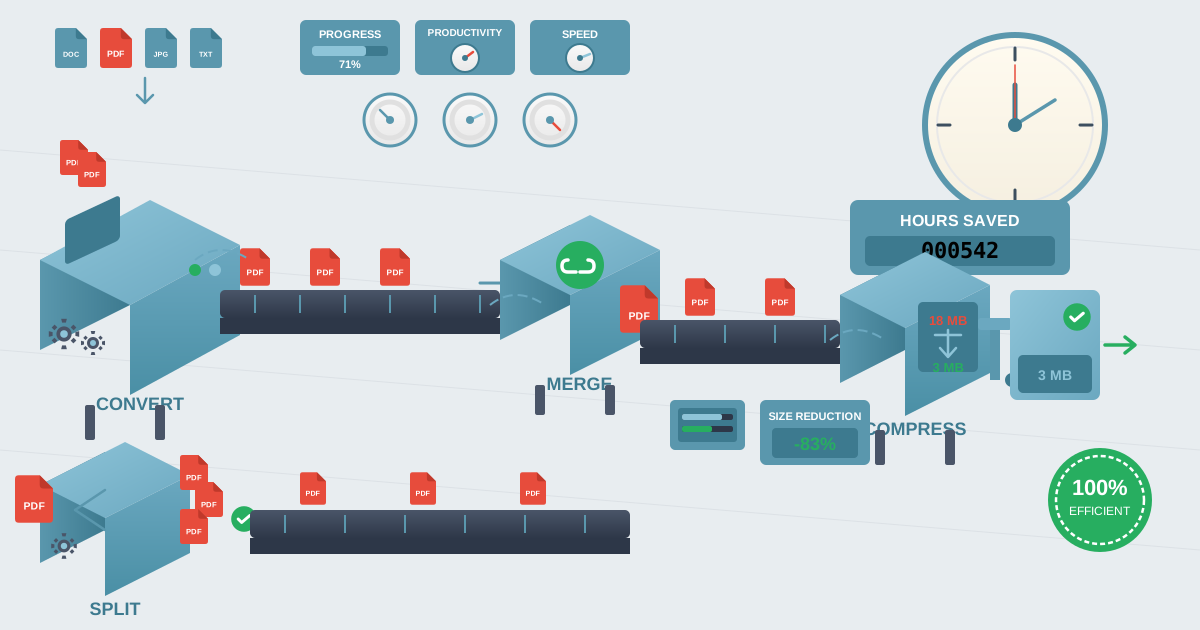
This is where understanding file logistics becomes as important as understanding unit conversion. Your first step is to make the file transferrable. Using a tool to Compress Files can shrink the dataset into a much smaller ZIP or 7Z archive, making it easy to share. Once your collaborator receives it, they can use a privacy-focused online tool to Decompress Files without needing to install any software, ensuring the data is accessible and secure.
Compatibility can also be an issue. Perhaps your systems are standardized on the TAR archive format, but your partner sent a ZIP file. Instead of going back and forth, a simple online converter can solve the problem instantly. Tools like our ZIP to TAR converter streamline this process, allowing you to access your data and get to the important work of converting those units from metric to imperial.
Common Pitfalls and How to Avoid Them
While a cheatsheet is powerful, there are common mistakes people make during conversion.
- US vs. UK Imperial Units: Be aware that some imperial units are not the same across the pond. The most famous example is the gallon. A US gallon is 3.785 liters, while a UK (or Imperial) gallon is 4.546 liters. Always confirm which system is being used.
- Ounces vs. Fluid Ounces: These are not interchangeable. An ounce (oz) is a unit of weight/mass, while a fluid ounce (fl oz) is a unit of volume. Make sure you're converting the correct type of measurement.
- Rounding Errors: For casual conversions, rounding is fine (e.g., 1 kg is about 2.2 lbs). For scientific, engineering, or medical purposes, precision is paramount. Use the full conversion factor and adhere to rules about significant figures to avoid potentially dangerous errors.
- Over-Reliance on Memory: Don't try to memorize complex conversion factors. It's easy to transpose numbers or make a mistake. That's what this cheatsheet is for! Bookmark it and refer to it whenever you're in doubt.
Your Go-To Resource for a Globalized World
Understanding how to navigate between the metric and imperial systems is no longer a niche skill—it's a daily necessity for professionals, hobbyists, travelers, and home cooks alike. It fosters better communication, ensures greater accuracy in your work, and removes a common barrier in our interconnected world.
This guide provides the foundation you need, with clear charts and practical advice to make unit conversion a seamless part of your workflow. By keeping this cheatsheet handy, you empower yourself to tackle any measurement system with confidence.
We encourage you to bookmark this page for future reference. And while you're here, explore the hundreds of other free, privacy-focused utilities at Practical Web Tools. From file management to data conversion, our tools are designed to make your digital life simpler and more efficient.