Artificial intelligence is here, and it's reshaping the global labor market at an unprecedented pace. The headlines often paint a dire picture: AI taking jobs, mass unemployment, and a future where human work is obsolete. While it's true that AI will displace millions of roles, this perspective is only half the story.
This comprehensive guide dives into the intricate relationship between AI and employment, moving beyond the fear to explore the profound opportunities for augmentation, new job creation, and the significant wage premiums awaiting those who proactively adapt. We'll analyze key economic forecasts, identify the most vulnerable and resilient professions, and—most importantly—provide actionable strategies and tools to empower you to thrive in this AI-integrated future. For professionals and solopreneurs alike, understanding this shift isn't just about survival; it's about unlocking immense new potential.
Try AI Chat — free, no sign-up, and it runs entirely in your browser.
The AI Labor Tsunami: Macroeconomic Projections
The integration of artificial intelligence into every facet of the commercial and industrial sectors has initiated a period of profound labor market transformation. Economic models and global employment surveys indicate that the proliferation of large language models (LLMs), machine learning algorithms, and autonomous physical systems will fundamentally alter the traditional structures of employment, productivity, and gross domestic product (GDP) generation.
The Baseline Estimates of Exposure and Displacement
Prominent financial institutions and global economic forums have attempted to quantify the impending shift. According to an extensive analysis conducted by Goldman Sachs Research, approximately 300 million full-time jobs globally are exposed to some form of automation via generative AI [cite: 1, 2]. Furthermore, up to two-thirds of occupations within the United States involve tasks that could be at least partially automated, with AI possessing the technical capability to handle up to half of the workload within those specific roles [cite: 1, 3].
It's crucial to distinguish between “exposure” and “displacement.” Occupational exposure refers to the technical feasibility of an AI system executing tasks currently performed by humans. Displacement, conversely, represents the actual economic reality of job elimination. High exposure does not unequivocally guarantee displacement; in many high-skill sectors, it results in task augmentation, thereby increasing baseline productivity.
The transition period for wide-scale AI adoption by firms is estimated to occur over a ten-year horizon. During this period, Goldman Sachs projects that 6% to 7% of workers in the U.S. will face direct displacement [cite: 3, 4]. This displacement, while seemingly modest as a percentage, equates to roughly 11 million American workers [cite: 5]. The macroeconomic ripple effect of this automation is profound; organizations stand to realize significant cost savings and productivity enhancements, potentially driving a 7% increase in annual global GDP over the next decade [cite: 2, 6].
Job Creation Versus Job Loss: A Net Positive Outlook
Despite the alarming raw exposure figures, the broader consensus among labor economists suggests that AI will act as an engine for net job creation. The World Economic Forum's (WEF) Future of Jobs Report 2025 forecasts that the current decade will witness the displacement of approximately 92 million positions globally due to technological changes. However, this loss is projected to be aggressively offset by the creation of 170 million new jobs, resulting in a net structural increase of 78 million jobs by 2030 [cite: 7, 8].
This net-positive outlook relies heavily on historical precedents. Historically, every major technological revolution—from the industrial mechanization of textiles to the advent of the internet—has ultimately reallocated labor rather than permanently destroying it [cite: 1, 9, 10]. Projections indicate that the emergence of AI will generate entirely new industries focused on data architecture, AI governance, autonomous systems management, and physical computing infrastructure [cite: 3, 11].
The Pace of Integration and Productivity Gains
The rate at which AI impacts the economy is tethered to actual corporate adoption. While early experimental usage of AI is widespread, reaching true "AI maturity" remains a bottleneck. For instance, Gartner research reported that despite nine out of ten organizations using AI, only 9% have reached true AI maturity [cite: 12]. Similarly, the Federal Reserve notes that while surveys of firms show a wide spread of adoption rates ranging from 5% to 40%, the actual deep integration into production processes is still in its infancy [cite: 13].
Where integration has occurred, the productivity gains are staggering. The World Economic Forum notes that data-rich industries are experiencing adoption rates of 60% to 70%, while data-poor sectors (such as construction and certain healthcare administrations) struggle with rates below 25% due to infrastructural friction and privacy constraints [cite: 14]. In sectors heavily exposed to AI, productivity has surged nearly fourfold since 2022, with revenue per employee rising at three times the standard rate between 2018 and 2024 [cite: 7]. A study from McKinsey further corroborates this, finding that companies actively leveraging AI technologies can improve organizational productivity by up to 40% [cite: 15].
Global AI Labor Impact Overview:
- Global Jobs Exposed to Automation: 300 Million [cite: 2, 3]
- Projected Global Job Displacement (2030): 85 - 92 Million [cite: 8, 16]
- Projected Global Job Creation (2030): 97 - 170 Million [cite: 8, 16]
- Net Global Job Gain (2030): ~78 Million [cite: 7, 8]
- Estimated U.S. Workforce Displacement: 6% - 7% (11 Million) [cite: 3, 5]
- Potential Global GDP Increase: +7% [cite: 2, 6]
Who's at Risk? The Anatomy of AI Job Displacement
The traditional paradigm of automation dictated that physical, routine, and blue-collar tasks were the primary targets for mechanization. The advent of generative artificial intelligence has fundamentally inverted this paradigm. Today, the most acutely vulnerable professions are those rooted in cognitive, analytical, and linguistic capabilities.
The White-Collar Vulnerability Paradigm
Unlike previous technological revolutions, the current wave of generative AI disproportionately impacts white-collar, knowledge-based, and creative professions. According to research from Anthropic, jobs that consist primarily of information processing, data synthesis, and text generation exhibit the highest "exposure" scores. Anthropic’s internal studies, which track the capabilities of large language models against standardized occupational tasks, identify computer programmers as having an exposure rate of 75%, followed closely by customer service representatives (70%), data entry keyers (67%), and medical record specialists (67%) [cite: 17, 18].
Similarly, researchers at Tufts University introduced the American AI Jobs Risk Index, estimating that occupations with high vulnerability to AI-driven displacement account for $757 billion in annual U.S. income, representing roughly 7.5% of total labor income [cite: 19]. Among the highest-risk sectors are Information (18%), Finance and Insurance (17%), and Professional, Scientific, and Technical Services (16%). The occupations bearing the highest potential income loss include software developers, management analysts, and market research specialists—reflecting both the sheer volume of workers and their relatively high salaries [cite: 19].
Complementarity vs. Replaceability: The Key Distinction
To understand why some white-collar roles are augmented while others are displaced, one must examine the concept of "complementarity." Research based on Statistics Canada data suggests that approximately 60% of Canadian employees are exposed to AI-related job transformation. However, within this highly exposed cohort, about half possess jobs that are highly complementary with AI [cite: 20].
- High Exposure, High Complementarity: Roles such as senior financial analysts, specialized attorneys, and executive managers fall into this category. AI handles their routine data processing, allowing these professionals to focus on high-level strategic reasoning, client relationship management, and complex problem-solving. This results in wage premiums and increased job security [cite: 1, 20].
- High Exposure, Low Complementarity: Occupations like routine computer programming, entry-level data analysis, clerical administration, and basic copywriting fall into this quadrant. Because the core function of these jobs overlaps almost entirely with AI's inherent capabilities, these roles face severe displacement risks rather than augmentation [cite: 20, 21].
Demographic and Socioeconomic Impacts
The socioeconomic distribution of AI exposure reveals alarming demographic disparities. Research indicates that the negative effects of automation will not be borne equally. According to findings highlighted by the Washington Post, women make up approximately 86% of the workers most vulnerable to AI displacement. This disproportionate impact is largely due to the high concentration of female workers in administrative, clerical, and customer support roles—fields that are highly exposed and offer low adaptability for rapid lateral career transitions [cite: 21].
Furthermore, younger workers are experiencing acute friction as they enter the workforce. The hiring rates for entry-level workers in highly AI-exposed occupations—particularly recent college graduates aged 22-25—have declined sharply. Big tech companies reduced new graduate hiring by 25% from 2023 to 2024, and employment for young software developers has dropped nearly 20% since its peak in late 2022 [cite: 22]. As generative AI absorbs routine "starter tasks," the traditional entry-level stepping stones that young professionals use to gain industry experience are vanishing, leading to what some analysts describe as a hollowing out of the junior talent pipeline [cite: 8, 23].
Conversely, lower-wage manual labor jobs are somewhat paradoxically shielded. A Tufts University analysis noted that 38% of American workers are effectively "AI-proof," yet this safety zone heavily overlaps with America's lowest-paid jobs, leading to the stark conclusion that "the safe zone is the near-poverty zone" [cite: 19].
Occupations: High Exposure vs. Low Exposure
| High Exposure / Vulnerability (Risk of Displacement) | Low Exposure / High Resistance (Safer Roles) |
|---|---|
| Computer Programmers / Software Developers (75% exposed) [cite: 17] | Healthcare Providers (Nurses, Physicians, Therapists) [cite: 29, 30] |
| Customer Service Representatives (70% exposed) [cite: 17] | Skilled Tradespeople (Plumbers, Electricians, HVAC) [cite: 29, 30] |
| Data Entry Keyers / Clerks (67% exposed) [cite: 17] | Educators and Teachers (Early Childhood, Special Ed) [cite: 29, 30] |
| Writers, Authors, and Translators (57% exposed) [cite: 19] | Social Workers & Mental Health Professionals [cite: 30] |
| Market Research Analysts (65% exposed) [cite: 17] | Physical Security and Emergency Responders [cite: 31] |
| Financial and Investment Analysts (57% exposed) [cite: 17] | Creative Strategy & Brand Management Leaders [cite: 29, 31] |
Beyond the Hype: Doomsday Warnings vs. Measured Reality
The discourse surrounding AI job displacement is polarized, characterized by extreme forecasts from industry insiders on one end, and measured, empirical labor data on the other.
The "Adolescence of Technology" and Catastrophic Predictions
Among the most vocal proponents of imminent, massive disruption is Dario Amodei, CEO of Anthropic. In interviews and extensive essays published in 2025 and 2026, Amodei issued stark warnings that AI could wipe out 50% of all entry-level white-collar jobs within a one-to-five-year timeframe, potentially causing unemployment to spike to between 10% and 20% [cite: 24, 25]. He argues that governments and tech companies are "sugarcoating" the reality of AI’s capabilities, predicting the arrival of systems smarter than Nobel laureates by 2027 and assessing a 25% chance of catastrophic societal and existential risks stemming from unchecked AI development [cite: 26, 27].
Amodei's warnings have resonated with the anxieties of the general workforce. Polling indicates that 40% of employees now fear losing their jobs to AI, a significant jump from 28% in 2024 [cite: 26]. The International Monetary Fund (IMF) has echoed these concerns, with Managing Director Kristalina Georgieva stating that AI is "hitting the labor market like a tsunami" [cite: 26].
The Reality of Corporate Adoption and Internal Contradictions
Despite these dire predictions, the actual data regarding measurable job loss directly attributable to AI paints a much slower transition. Outplacement firm Challenger, Gray & Christmas tracked only about 12,700 job losses directly attributed to AI in 2024, and independent analyses estimate total U.S. AI-attributable displacement in 2025 at 200,000 to 300,000 positions—a mere 0.13% to 0.20% of total nonfarm employment [cite: 5].
Furthermore, a glaring contradiction exists within the AI industry itself. Despite Amodei's warnings of mass tech layoffs, Anthropic's own Head of Growth recently stated that the company is "desperate" for product managers (PMs) and designers [cite: 28]. While AI coding tools like Claude Code have dramatically increased engineering output, the human oversight required to direct, manage, and refine this output has become an immense bottleneck. As one insider noted, the fact that the company warning of mass job elimination cannot fill traditional tech management roles "says more about where AI disruption actually stands than any forecast" [cite: 28].
This dynamic highlights the reality of the AI transition: deployment is the limiting factor, not capability [cite: 5]. Bureaucratic inertia, regulatory compliance, data privacy laws, and the sheer complexity of integrating novel technologies into legacy corporate structures are slowing the "tsunami" to a highly manageable, albeit disruptive, current.
The AI Skills Gold Rush: Your Wage Premium Opportunity
The narrative of widespread job destruction is incomplete without analyzing the intense demand for AI-literate talent. As organizations pivot to leverage machine learning, the economic value of workers who possess AI skills has skyrocketed, leading to substantial structural shifts in compensation models.
Quantifying the AI Wage Premium
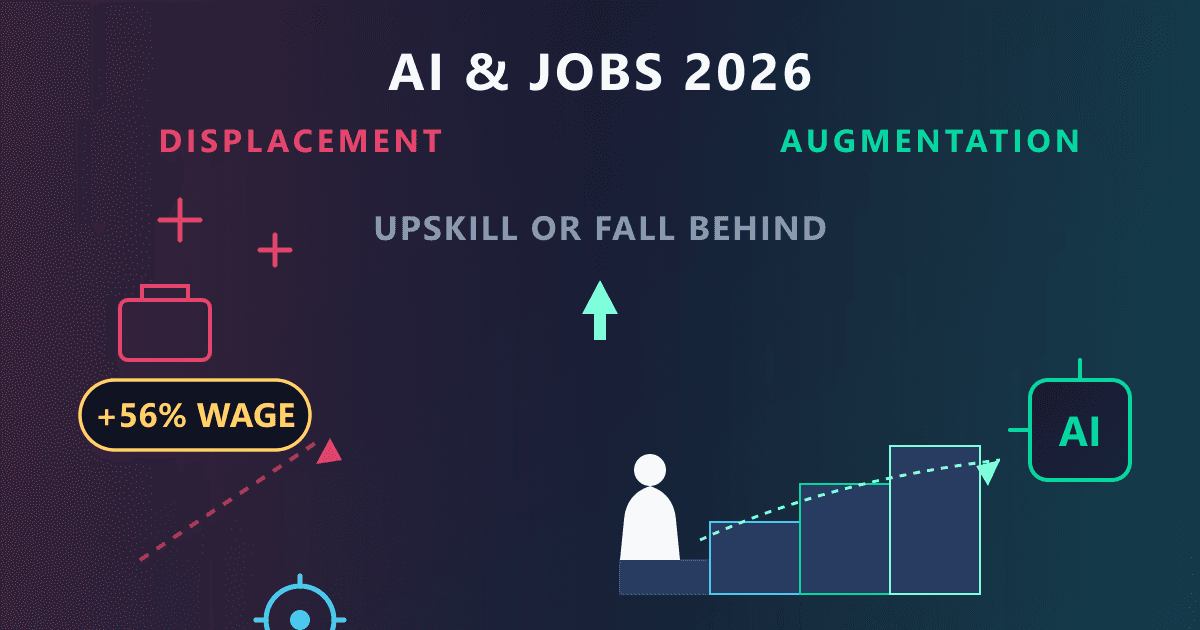
A landmark 2025 study by PwC—the Global AI Jobs Barometer—analyzed nearly one billion job advertisements across 15 countries and 80 sectors. The findings definitively prove that AI proficiency is the most lucrative skill in the modern economy. In 2025, workers demonstrating specialized AI skills commanded a staggering 56% wage premium compared to their non-skilled peers, more than doubling the 25% premium recorded just two years prior in 2023 [cite: 12, 32].
This wage premium applies across virtually all knowledge-based industries. A separate analysis highlighted that employers are willing to pay, on average, 47% more for IT workers with AI capabilities, 43% more for sales and marketing professionals, 42% more for finance roles, and 35% more for human resources staff [cite: 32]. The premium is driven by the stark reality of productivity: sectors highly exposed to AI are experiencing labor productivity growth that is 4.8 times higher than less exposed sectors [cite: 33]. Consequently, companies are fiercely competing for individuals who can translate raw AI potential into tangible business outcomes.
The Decline of the Traditional Degree
A profound secondary effect of the AI revolution is the accelerated shift toward skills-based hiring over traditional credentialism. As the pace of technological change outstrips the ability of universities to update their curricula, employers are dropping degree requirements in favor of demonstrated AI competencies.
Research from the Oxford Internet Institute focusing on the UK labor market revealed that between 2018 and 2023, while demand for AI roles grew by 21%, mentions of university education requirements in those job postings fell by 15% [cite: 34]. Strikingly, possessing specialized AI skills yielded a 23% wage premium, a financial benefit that outpaced the value of a master's degree (13% premium) and was only surpassed by possessing a Ph.D. (33% premium) [cite: 34].
Similarly, PwC noted that the percentage of AI-augmented jobs requiring a degree fell from 66% in 2019 to 59% in 2024 [cite: 12]. The traditional trajectory of university education acting as the default pathway to higher compensation is fracturing. Instead, the market is aggressively rewarding continuous learners, self-taught technologists, and professionals who maintain agility in adopting new digital tools [cite: 34, 35].
Upskilling Imperative: How Organizations (and You) Can Adapt
Given the clear financial incentives and existential business threats posed by AI, upskilling and reskilling the existing workforce has become a paramount C-suite priority. Current trends suggest that proactive upskilling, systemic reskilling initiatives, and the integration of specialized digital tools are critical variables that will determine whether workers face displacement or structural augmentation. According to the World Economic Forum, while AI displacement is inevitable, the net outcome for an organization hinges entirely on its proactive reskilling framework [cite: 7].
The Architecture of Effective Reskilling
Organizations that successfully navigate the AI transition do not simply distribute software licenses; they fundamentally restructure their corporate learning environments. Expert consensus from institutions like Deloitte, BCG, and standard HR practices reveal a unified framework for effective AI enablement:
- Conducting Rigorous Skills Gap Analyses: Before training begins, companies must map current employee roles against future AI-augmented tasks. Utilizing AI-based assessment tools allows human resources departments to identify specific vulnerabilities and tailor tiered learning paths [cite: 36, 37].
- Implementing Just-in-Time Learning: Traditional, lengthy classroom sessions are largely ineffective for fast-evolving software. Best practices involve "Just-in-Time Learning"—providing access to resources, micro-credentials, and conversational tutorials precisely when an employee needs them to complete a task [cite: 38].
- Fostering a Culture of Experimentation: Employees often resist AI due to fear of incompetence or job loss. It is critical for leadership to destigmatize the learning curve. Providing safe, low-stakes environments (sandbox platforms) where employees can experiment with prompt engineering and automation without fear of reprimand accelerates organic adoption [cite: 37, 39].
- Reserving Time for Intensive Immersion: While micro-learning is beneficial, complex technical skills require deep cognitive focus. Organizations must establish dedicated "time blocks" where employees are relieved from their standard operational duties to engage in immersive AI upskilling scenarios [cite: 38, 39].
Case Study: Internal Generative Assistants
A prime example of structural upskilling is the deployment of bespoke internal AI tools. PwC, for instance, invested heavily in a proprietary generative AI tool called "ChatPwC." Tailored specifically for their workforce, this conversational assistant was trained securely on internal tax guidelines and regulatory frameworks [cite: 40]. By rolling this out to their employees, PwC not only improved immediate operational efficiency but inherently raised the baseline AI literacy of their entire firm. Employees organically learned the nuances of prompt engineering, hallucination identification, and query structuring in a safe, relevant environment, effectively upskilling 65,000 workers through daily immersion rather than theoretical seminars [cite: 40].
The Rise of the "Company of One": AI and the Solopreneur
As artificial intelligence flattens organizational hierarchies and hollows out middle management—traditionally the domain of those who manage information flow and coordinate entry-level output—a new labor dynamic is emerging: the hyper-productive freelancer, or the "Company of One" [cite: 6].
By leveraging a suite of AI tools, an individual entrepreneur can now execute the workload of an entire marketing, research, and administrative department. AI allows these solo operators to spot market gaps, draft comprehensive marketing copy, generate code, handle customer service routing, and manage financial projections simultaneously. Because the core components of these tasks—original thinking, strategy formulation, and emotional resonance—remain distinctly human, the AI acts not as a replacement but as a vast, high-speed cognitive exoskeleton [cite: 29, 31].
This shift toward hyper-augmented freelancing is particularly prominent in the creator economy, where individuals are bypassing traditional gatekeepers entirely to monetize their expertise and creativity.
Practical Practicum I: Leveraging Generative AI for Daily Productivity
To survive and thrive in an economy actively being reshaped by artificial intelligence, theoretical knowledge is insufficient; workers must develop hands-on technical fluency. One of the most immediate and accessible ways to build this fluency—and capture the documented wage premium—is by integrating foundational AI conversational models into your daily workflow.
Tool Focus: AI Chat by Practical Web Tools.
This privacy-focused platform provides an ideal sandbox for professionals to develop the critical skill of prompt engineering without exposing sensitive corporate data to public training models.
Step-by-Step Implementation for Professionals
Phase 1: Automating Routine Communications and Administration A significant portion of a modern professional's day is consumed by administrative friction—drafting emails, summarizing meetings, and organizing schedules.
- The Method: Instead of staring at a blank screen, utilize the AI Chat tool to generate foundational drafts. Input a bulleted list of the key points you need to convey.
- Effective Prompting: "Act as an executive communications director. Take these three bullet points regarding project delays and draft a professional, empathetic, yet firm email to our client explaining the revised timeline. Maintain a tone of proactive problem-solving."
- The Benefit: This process reduces cognitive load, saving approximately 30-45 minutes per day, allowing you to reallocate that mental energy toward complex strategic decision-making.
Phase 2: Data Synthesis and Research Augmentation In knowledge-heavy roles (market research, financial analysis, consulting), synthesizing vast amounts of text is an acute bottleneck.
- The Method: When confronted with lengthy industry reports or dense academic papers, extract the raw text and utilize the AI to distill the core arguments.
- Effective Prompting: "Analyze the following text regarding the 2025 Q3 market trends. Extract the top five quantitative data points, summarize the primary risk factors mentioned, and format the output as a high-level executive briefing table."
- The Benefit: You transform a multi-hour reading task into a five-minute review process. You are now acting as an editor and strategist rather than a basic data parser, directly elevating your value within your organization.
Phase 3: Ideation and Collaborative Problem Solving AI's greatest asset is its ability to act as a tireless brainstorming partner, helping to overcome writer's block and tunnel vision.
- The Method: When developing a new product feature, marketing campaign, or operational strategy, use the AI Chat to generate divergent perspectives.
- Effective Prompting: "I am launching a new B2B SaaS product aimed at mid-sized logistics companies. Generate ten unconventional marketing angles that highlight our software's ability to reduce supply chain friction. Play devil's advocate and outline three reasons why a logistics manager might reject this software."
- The Benefit: By asking the AI to adopt adversarial or unconventional personas, you stress-test your strategies and generate novel concepts that a solitary human mind might overlook due to inherent cognitive biases.
Practical Practicum II: The AI Creator Economy and Passive Income
Beyond augmenting traditional corporate roles, artificial intelligence has democratized the creation of digital assets, enabling individuals to establish independent revenue streams. One of the fastest-growing sectors in the side-hustle economy of 2025/2026 is the rapid authoring and self-publishing of niche eBooks [cite: 41, 42, 43].
Tool Focus: AI eBook Writer by Practical Web Tools.
Historically, producing an eBook required weeks of drafting, or hiring a ghostwriter at a cost of $2,000 to $10,000 per manuscript [cite: 41]. Today, dedicated AI text generators have reduced the friction to near-zero, allowing subject matter experts to monetize their knowledge rapidly.
A Comprehensive Guide to AI-Assisted Self-Publishing
Step 1: Niche Identification and Market Viability The key to success in self-publishing is not writing a general masterpiece, but solving a highly specific problem for a targeted audience.
- Action: Use an AI Chat tool (like the one linked above) to analyze current market trends on platforms like Amazon Kindle Direct Publishing (KDP) or Gumroad. Identify gaps where demand exists but comprehensive guides are lacking (e.g., "Meal Prepping for Shift Workers," "Advanced Excel Macros for Real Estate Agents").
Step 2: Structuring the Manuscript A coherent structure is the difference between a high-value eBook and a disorganized collection of thoughts.
- Action: Input your chosen topic into the AI eBook Writer. Prompt the tool to generate a comprehensive Table of Contents.
- Refinement: Review the generated outline critically. Inject your personal expertise by adding specific chapters or case studies that only a human with lived experience could provide. AI provides the scaffolding; you provide the soul.
Step 3: Iterative Content Generation Do not ask the AI to write the entire book in a single prompt. The result will be generic and repetitive. Instead, generate the book chapter by chapter.
- Action: Feed the AI eBook Writer specific prompts for each subsection. For example: "Write a 1,500-word chapter on 'The Psychology of Habit Formation.' Include a brief historical overview of behavioral psychology, followed by three actionable steps the reader can take today. Maintain an encouraging, authoritative tone."
- The Human Touch: As the AI generates the text, actively edit. Rewrite anecdotes in your own voice, verify factual claims, and ensure the logical flow connects seamlessly to the preceding chapters [cite: 43].
Step 4: Formatting and Distribution Once the text is refined, it must be packaged professionally.
- Action: Utilize the formatting capabilities within the AI tools or export the document to specialized design software to create an attractive layout and cover.
- Monetization: Publish the finalized PDF or EPUB file to platforms like Amazon KDP, Etsy, or Gumroad. Because the cost of production was negligible (save for your editorial time), profit margins are exceptionally high [cite: 41, 43]. Over 4 million eBooks were self-published on KDP in 2025 alone, proving the viability of this business model for those willing to harness AI [cite: 41].
Conclusion: Navigating the Tsunami with Intent
The assertion that "AI is taking all the human jobs" is a simplistic reduction of a highly complex macroeconomic transition. The data definitively shows that artificial intelligence will irrevocably alter the landscape of global employment, displacing millions of roles—particularly in routine cognitive, administrative, and junior coding sectors. However, the concurrent creation of new industries, the massive productivity gains, and the emergence of entirely new job categories suggest a future defined not by human obsolescence, but by human augmentation.
The determining factor in whether an individual or an organization becomes a casualty of this transition or a beneficiary is adaptability. The 56% wage premium for AI skills serves as an undeniable market signal: the global economy is actively rewarding those who learn to wield these new cognitive tools.
By rejecting fear and embracing continuous, targeted upskilling—leveraging accessible, privacy-focused platforms like Practical Web Tools' AI Chat and AI eBook Writer—professionals can insulate themselves against displacement. The future of work will not belong to the AI systems themselves, but to the humans who master them. Start your journey today by exploring the practical AI tools at Practical Web Tools and transform your career for the augmented age.
Sources
- medium.com
- forbes.com
- goldmansachs.com
- reddit.com
- almcorp.com
- peripateticperch.com
- genesishumanexperience.com
- weforum.org
- journeycounts.com
- shrm.org
- weforum.org
- gloat.com
- federalreserve.gov
- weforum.org
- umu.com
- click-vision.com
- cbsnews.com
- builtin.com
- tufts.edu
- statcan.gc.ca
- washingtonpost.com
- novoresume.com
- brookings.edu
- techgig.com
- axios.com
- forbes.com
- censinet.com
- indiatimes.com
- careerminds.com
- livecareer.co.uk
- tripleten.com
- forbes.com
- hcamag.com
- hrdive.com
- mckinsey.com
- bcg.com
- newhorizons.com
- shiftelearning.com
- theadaptavistgroup.com
- ciodive.com
- inkfluenceai.com
- medium.com
- medium.com