Every November, millions of workers click through their company open enrollment portal in ten minutes, pick the same health plan they had last year, and leave their 401(k) percentage untouched. Then the first paycheck of January lands. If you maxed out your retirement and health accounts using last year's numbers, leaving your payroll elections on autopilot means you will quietly undersave by $1,000 to $1,750 in 2027 and pay hundreds of dollars in unnecessary federal, state, and payroll taxes.
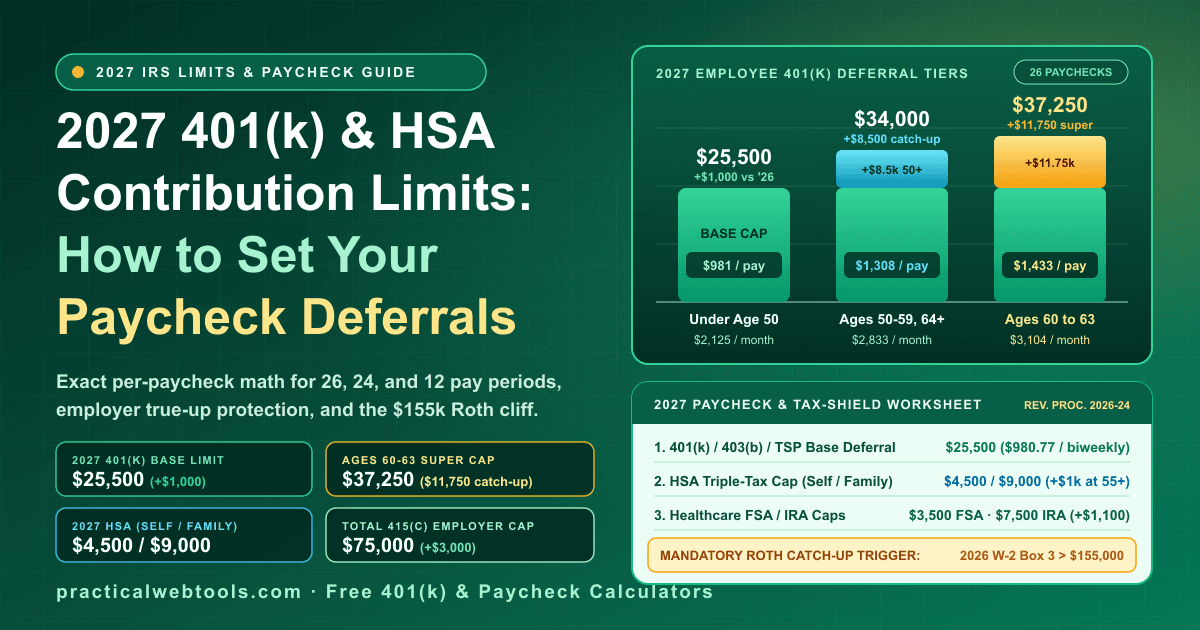
For 2027, the inflation adjustments under Internal Revenue Code Section 415(d) and IRS Revenue Procedure 2026-24 move nearly every major workplace ceiling higher. The standard employee deferral limit for 401(k), 403(b), most 457(b) plans, and the federal Thrift Savings Plan (TSP) rises by $1,000 to $25,500. The age 50 and older catch-up limit rises by $500 to $8,500 (for a $34,000 total), while workers aged 60, 61, 62, or 63 get a higher SECURE 2.0 "super catch-up" of $11,750 (pushing their personal deferral ceiling to $37,250). At the same time, official 2027 Health Savings Account (HSA) limits climb to $4,500 for self-only coverage and $9,000 for family coverage.
Try Full Moon Calendar 2027: free, no sign-up.
Whether you want to max out your accounts to the exact penny on your final December paycheck or simply capture every dollar of your employer match without starving your monthly cash flow, this step-by-step guide walks through the exact 2027 per-paycheck math. You can run your own salary and match numbers live in our free browser-based 401(k) Calculator and check your net paycheck impact with the Take-Home Pay Calculator, with zero sign-up and no financial data ever leaving your device.
The Complete 2026 vs. 2027 IRS Contribution Limits Master Table
Before you open Workday, ADP, Fidelity NetBenefits, or FSAFEDS, here is the side-by-side comparison of every workplace retirement, IRA, HSA, and FSA threshold for 2026 and 2027. The HSA figures are official per IRS Revenue Procedure 2026-24; the retirement plan figures reflect the statutory IRC Section 415(d) formulas calculated from the September 2026 Consumer Price Index release.
| Account or Threshold | 2026 Limit | 2027 Limit | Year-Over-Year Change |
|---|---|---|---|
| 401(k), 403(b), 457(b), TSP Base Employee Deferral | $24,500 | $25,500 | +$1,000 (+4.1%) |
| 401(k) Catch-Up (Ages 50 to 59, and Age 64+) | $8,000 | $8,500 | +$500 (+6.3%) |
| Total 401(k) Employee Deferral (Ages 50 to 59, 64+) | $32,500 | $34,000 | +$1,500 (+4.6%) |
| 401(k) Super Catch-Up (Ages 60, 61, 62, and 63) | $11,250 | $11,750 | +$500 (+4.4%) |
| Total 401(k) Employee Deferral (Ages 60 to 63) | $35,750 | $37,250 | +$1,500 (+4.2%) |
| Section 415(c) Total Annual Additions (Under Age 50) | $72,000 | $75,000 | +$3,000 (+4.2%) |
| Section 415(c) Total Annual Additions (Ages 50 to 59, 64+) | $80,000 | $83,500 | +$3,500 (+4.4%) |
| Section 415(c) Total Annual Additions (Ages 60 to 63) | $83,250 | $86,750 | +$3,500 (+4.2%) |
| Mandatory Roth Catch-Up Prior-Year FICA Wage Threshold | $150,000 (2025 W-2) | $155,000 (2026 W-2) | +$5,000 |
| HSA Contribution Limit (Self-Only HDHP) | $4,400 | $4,500 | +$100 (+2.3%) |
| HSA Contribution Limit (Family HDHP) | $8,750 | $9,000 | +$250 (+2.9%) |
| HSA Catch-Up Contribution (Age 55+) | $1,000 | $1,000 | Unchanged (fixed by statute) |
| HDHP Minimum Deductible (Self-Only / Family) | $1,700 / $3,400 | $1,750 / $3,500 | +$50 / +$100 |
| HDHP Out-of-Pocket Maximum (Self-Only / Family) | $8,500 / $17,000 | $8,700 / $17,400 | +$200 / +$400 |
| Healthcare FSA Employee Contribution Limit | $3,400 | $3,500 | +$100 (+2.9%) |
| SIMPLE IRA / SIMPLE 401(k) Standard Deferral | $17,000 | $17,500 | +$500 (+2.9%) |
| SIMPLE Plan Enhanced Deferral (Small Employers <=25) | $18,100 | $19,100 | +$1,000 (+5.5%) |
| Traditional & Roth IRA Base Contribution Limit | $7,500 | $7,500 | Unchanged |
| Traditional & Roth IRA Catch-Up (Age 50+) | $1,100 | $1,100 | Unchanged ($8,600 total) |
| Roth IRA MAGI Phase-Out Range (Single Filers) | $153,000 to $168,000 | $158,000 to $173,000 | +$5,000 |
| Roth IRA MAGI Phase-Out Range (Married Filing Jointly) | $242,000 to $252,000 | $250,000 to $260,000 | +$8,000 |
Two structural rules in this table catch people off guard every year:
- Your employer match does NOT count toward your $25,500 employee deferral limit. The $25,500 cap (plus any $8,500 or $11,750 catch-up) applies strictly to money deducted from your own paycheck. Employer matching dollars, employer profit-sharing contributions, and voluntary after-tax (non-Roth) employee contributions fall under the much larger Section 415(c) Annual Additions ceiling of $75,000 (or $83,500 for ages 50 to 59 and 64+, and $86,750 for ages 60 to 63).
- However, employer HSA seed money DOES count toward your $4,500 or $9,000 HSA limit. If you enroll in a family High-Deductible Health Plan (HDHP) for 2027 and your company deposits $1,000 into your HSA in January, your maximum personal payroll deduction for the year is $8,000 ($9,000 minus the $1,000 employer seed), not $9,000. Exceeding the combined HSA cap triggers a 6 percent excise tax every year the excess remains in the account.
Step 1: Calculate Your Exact 2027 Per-Paycheck Dollar Deferral
If your payroll system lets you enter a flat dollar amount per paycheck, setting up your 2027 election is straightforward division. Divide your target annual limit by the number of pay dates your company has in the 2027 calendar year.
Use the table below to find your exact per-paycheck deduction for weekly (52), biweekly (26), semi-monthly (24), and monthly (12) pay schedules across every 2027 age tier.
2027 Per-Paycheck Dollar Deferral Cheat Sheet
| Account & Age Tier (Age on Dec 31, 2027) | 2027 Annual Max | Weekly (52 Pays) | Biweekly (26 Pays) | Semi-Monthly (24 Pays) | Monthly (12 Pays) |
|---|---|---|---|---|---|
| 401(k) / 403(b) / TSP: Under Age 50 | $25,500 | $490.38 | $980.77 | $1,062.50 | $2,125.00 |
| 401(k) / 403(b) / TSP: Ages 50 to 59, or 64+ | $34,000 | $653.85 | $1,307.69 | $1,416.67 | $2,833.33 |
| 401(k) / 403(b) / TSP: Ages 60, 61, 62, or 63 | $37,250 | $716.35 | $1,432.69 | $1,552.08 | $3,104.17 |
| HSA: Self-Only HDHP (Under Age 55) | $4,500 | $86.54 | $173.08 | $187.50 | $375.00 |
| HSA: Self-Only HDHP (Age 55+ with $1k Catch-Up) | $5,500 | $105.77 | $211.54 | $229.17 | $458.33 |
| HSA: Family HDHP (Under Age 55) | $9,000 | $173.08 | $346.15 | $375.00 | $750.00 |
| HSA: Family HDHP (One Spouse 55+ in This HSA) | $10,000 | $192.31 | $384.62 | $416.67 | $833.33 |
| Healthcare FSA (Per Employee) | $3,500 | $67.31 | $134.62 | $145.83 | $291.67 |
| Traditional or Roth IRA (Under Age 50) | $7,500 | $144.23 | $288.46 | $312.50 | $625.00 |
| Traditional or Roth IRA (Age 50+) | $8,600 | $165.38 | $330.77 | $358.33 | $716.67 |
Watch Out for the "27-Paycheck Friday" Quirk in 2027
Look at a 2027 calendar before you lock in a biweekly number. January 1, 2027 falls on a Friday, and December 31, 2027 also falls on a Friday.
Why does that matter? There are 53 Fridays in 2027. If your company pays biweekly on Fridays and your first pay date of the year is Friday, January 1, 2027 (or is paid on Thursday, December 31, 2026 for tax year 2026, shifting the cycle), you could have either 26 or 27 pay dates that count toward your 2027 Form W-2, depending on how your employer handles the New Year's Day bank holiday:
- If your January 1, 2027 payday is paid early on Thursday, December 31, 2026: That paycheck counts on your 2026 W-2 (under the IRS constructive receipt rule), and your next 26 biweekly paydays (January 15 through December 31, 2027) fall in 2027. You have 26 pay periods in 2027.
- If your first 2027 pay date lands on Monday, January 4, 2027 and your final pay date lands on Friday, December 31, 2027: Depending on your biweekly cycle anchor, some payroll calendars squeeze 27 pay dates into the tax year. If you actually have 27 paychecks in 2027, your flat biweekly deferral to hit $25,500 is $944.44 ($1,259.26 for the $34,000 tier, or $1,379.63 for the $37,250 tier).
Check your company's 2027 payroll calendar PDF on your HR intranet before dividing by 26.
Step 2: Convert Dollars into Percentages When Your HR Portal Only Accepts Whole Numbers
Most large recordkeepers (including Fidelity NetBenefits, Vanguard, Empower, and ADP) require you to enter your 401(k) election as a percentage of gross pay (often in 1 percent or 0.5 percent increments) rather than a flat dollar figure.
To find your exact contribution percentage, use this formula:
$$\text{Target Contribution %} = \left( \frac{\text{Your 2027 IRS Limit}}{\text{Your Eligible 2027 Gross Salary}} \right) \times 100$$
Here is the lookup table showing the exact percentage required to hit the 2027 limits across common salary levels, along with what to enter if your plan only accepts whole-number percentages:
2027 Salary-to-Percentage Deferral Lookup Table
| Annual Gross Salary | Under Age 50 ($25,500 Cap) Exact % | Whole % to Enter (No True-Up vs. True-Up) | Ages 50-59 & 64+ ($34,000 Cap) Exact % | Ages 60 to 63 ($37,250 Cap) Exact % |
|---|---|---|---|---|
| $65,000 | 39.23% | 39% or 40% | 52.31% | 57.31% |
| $75,000 | 34.00% | 34% (Exact hit!) | 45.33% | 49.67% |
| $85,000 | 30.00% | 30% (Exact hit!) | 40.00% (40% exact!) | 43.82% |
| $100,000 | 25.50% | 25.5% or 26% | 34.00% (34% exact!) | 37.25% |
| $120,000 | 21.25% | 21% or 22% | 28.33% | 31.04% |
| $140,000 | 18.21% | 18% or 19% | 24.29% | 26.61% |
| $160,000 | 15.94% | 16% | 21.25% | 23.28% |
| $185,000 | 13.78% | 14% | 18.38% | 20.14% |
| $210,000 | 12.14% | 12% or 13% | 16.19% | 17.74% |
| $250,000 | 10.20% | 10% or 11% | 13.60% | 14.90% |
| $300,000 | 8.50% | 8.5% or 9% | 11.33% | 12.42% |
| $375,000+ (IRS Comp Cap) | 6.80% | 7% | 9.07% | 9.93% |
Should You Round Up or Round Down? The "True-Up" Match Trap
Suppose you earn $120,000 and you are under age 50. To hit $25,500, you need 21.25%, but your HR portal only accepts whole integers (21% or 22%):
- If you enter 21%: You will contribute $25,200 over the full year ($300 shy of the $25,500 cap), and you will contribute in every single pay period from January through December.
- If you enter 22%: You will contribute $1,015.38 per biweekly paycheck. On your 26th paycheck in late December, your payroll software's automatic IRS ceiling guard will automatically clip your final deduction to $460.12 so your W-2 never exceeds $25,500.
What if you earn $200,000 and receive a $50,000 March bonus, and your 401(k) percentage applies to bonuses? If you set your deferral to 15%, that March bonus will send $7,500 into your 401(k) in a single day, causing you to hit the $25,500 cap in September.
Once your employee deferrals stop in September, what happens to your employer match for October, November, and December? That depends on two words in your Summary Plan Description (SPD): True-Up.
- Plans WITH an Employer True-Up: After the year ends, the plan administrator calculates your total annual deferral ($25,500) divided by your total annual pay ($250,000 = 10.2%), sees that you exceeded the 6% match threshold for the year as a whole, and deposits a lump-sum "true-up" match in Q1 2028 for the paychecks you missed in the fall.
- Plans WITHOUT an Employer True-Up: The employer match is calculated strictly paycheck by paycheck. If you hit $25,500 in September and contribute $0 in October, November, and December, your employer contributes $0 in match for those last six or seven paychecks. On a $200,000 salary with a 4% match, maxing out three months early without a true-up costs you $2,000 of free employer money. For a deeper breakdown of how employer formulas work, read our companion guide on 401(k) matching explained.
Step 3: Model Your 2027 Deferrals and Employer Match in the Free 401(k) Calculator
Before you commit to a percentage in your HR portal, model what that deferral rate actually builds over your career and how much of your final nest egg comes from your own paychecks versus employer matching and compound growth.
Open the free 401(k) Calculator in a separate tab and walk through the five panels on the page:
1. Personal Information Panel (Current Age, Retirement Age, Annual Salary)
Enter your current age, your target retirement age, and your expected 2027 gross salary. As soon as you type, the sticky 401(k) Projection card on the right updates your projected Balance at Retirement, your estimated Monthly Retirement Income (using the 4% safe withdrawal rule), and your total years to retirement.
2. Your Contributions Panel (Contribution Rate, Current 401(k) Balance)
Use the Contribution Rate number input or slider to enter the percentage you calculated in Step 2 (for example, 15% or 21.5%), and enter your Current 401(k) Balance. Beneath the slider, the sunken summary box immediately displays your Annual Contribution and Monthly Contribution in dollars.
- Important modeling note for high-rate savers: The calculator's built-in annual cap guardrail enforces a $23,000 baseline cap on the employee deferral line so typical percentage sliders do not project unrealistic six-figure employee deferrals as salaries compound over 30 years. If you are modeling the full 2027 $25,500 base cap, the $34,000 age 50+ cap, or the $37,250 age 60 to 63 super catch-up over a specific multi-year sprint, you can either fold the extra $2,500 to $14,250 into the match settings or run the exact monthly dollar contribution (
$2,125/mo,$2,833/mo, or$3,104/mo) directly in our Compound Interest Calculator or Investment Calculator.
3. Employer Match Panel (Employer Match Rate, Match Limit, and Match Utilization)
Enter your company's formula using two fields:
- Employer Match Rate: The percentage your company matches per dollar you put in (for example,
100%for a dollar-for-dollar match, or50%for a 50-cent-on-the-dollar match). - Match Limit: The maximum percentage of your salary your employer applies that formula to (commonly
4%or6%of salary).
Watch the Match Utilization progress bar at the bottom of the card. If your contribution rate is below your employer's Match Limit, the bar turns into a warning and the Your 401(k) Insights section flags the exact dollar amount of free employer match you are leaving on the table each year, with a one-click Increase to full match button.
4. What-If Contribution Analysis and Impact Cards
Scroll down to the Impact of Contribution Rate 4-card grid (5%, 10%, 15%, 20%) and the interactive What If I Changed My Contribution? slider. You can click the quick preset pills (Min for match, 10%, 15%, or Max out) and drag the slider in 1% increments to see the exact dollar difference a 1% or 2% open-enrollment bump makes by age 65.
To see how realistic this is on a typical mid-career income, compare four contribution levels for a 35-year-old earning $110,000 with a $60,000 starting 401(k) balance, a 50% employer match up to 6% of pay (+$3,300/year from the employer), 3% annual salary growth, and a 7% inflation-adjusted annual return to age 65:
| 2027 Election Scenario | Year-1 Employee Deferral | Year-1 Employer Match | Total 30-Year Balance at Age 65 (7% Real Return) | Monthly Retirement Income (4% Rule) |
|---|---|---|---|---|
| 3% (Half Match Only) | $3,300 | +$1,650 (Leaves $1,650 behind) | $1,156,400 | $3,855 / mo |
| 6% (Full Employer Match) | $6,600 | +$3,300 (100% Match Utilization) | $1,854,900 | $6,183 / mo |
| 15% (Recommended Target) | $16,500 | +$3,300 | $3,251,800 | $10,839 / mo |
| 23.18% ($25,500 2027 Max) | $25,500 | +$3,300 | $4,168,500 | $13,895 / mo |
Moving from 3% to 6% on a $110,000 salary costs you $126.92 per biweekly paycheck before tax (about $96 per paycheck after a 24% federal tax deduction), yet it adds nearly $700,000 to your age-65 balance because it unlocks the remaining $1,650 per year of employer match plus 30 years of compounding.
5. Withdrawal Impact Analysis Panel
At the bottom of the 401(k) Calculator, check the Withdrawal Impact Analysis tool. If you are ever tempted to cash out $10,000 when switching jobs before age 59.5 at a 22% marginal tax rate, the panel shows why early cash-outs are so destructive: after the $1,000 early-withdrawal penalty (10%) and $2,200 in income taxes, you only net $6,800 in cash, while sacrificing $96,765 of lost compound growth over 35 years at 7%. To net $10,000 in spending cash, you would have to pull $14,706 out of your account.
Step 4: Handle the 3 New 2027 Tax & SECURE 2.0 Rules
Open enrollment for 2027 includes three legal mechanics from SECURE 2.0 and the 2026-2027 healthcare updates that can change your tax bill by thousands of dollars if they apply to your household.
1. The Ages 60 to 63 "Super Catch-Up" ($37,250) and the Age-64 Cliff
Under SECURE 2.0, the catch-up limit for workplace plans is split into two age brackets based on how old you will be on December 31, 2027:
- If you turn 50, 51, 52, 53, 54, 55, 56, 57, 58, or 59 in 2027: Your catch-up limit is $8,500, giving you a total employee deferral cap of $34,000.
- If you turn 60, 61, 62, or 63 in 2027 (born in 1964, 1965, 1966, or 1967): Your catch-up limit is the greater of $10,000 or 150% of the regular catch-up limit, indexed for inflation. For 2027, that super catch-up rises to $11,750, giving you a total employee deferral cap of $37,250 ($3,250 higher than standard catch-up savers).
- The Age-64 Cliff (Born in 1963): What happens in the calendar year you turn 64? You age out of the 60-to-63 window on your 64th birthday, even if your birthday is December 30, 2027! In the year you turn 64, your catch-up limit drops back down to the standard $8,500 tier ($34,000 total). If you had your payroll set to the super catch-up level in 2026 when you were 63, your payroll system (or you, if you contribute across two employers) must step down to $34,000 for 2027.
2. The $155,000 Mandatory Roth Catch-Up Rule (SECURE 2.0 Section 603)
Starting with the 2026 and 2027 plan years, SECURE 2.0 Section 603 eliminates pre-tax catch-up contributions for higher earners. Here is the exact test your payroll department runs in January 2027:
Did your 2026 Form W-2 Box 3 (Social Security / FICA wages) from this specific employer exceed $155,000?
If the answer is Yes, then:
- Your first $25,500 of 2027 401(k) contributions can still be 100% pre-tax (Traditional), reducing your 2027 adjusted gross income.
- Every dollar you contribute above $25,500 (up to $8,500 of regular catch-up or $11,750 of age 60-63 super catch-up) must go into a Roth 401(k) subaccount after taxes.
Three details about the $155,000 threshold save astute savers a lot of confusion:
- It is based on W-2 Box 3 (FICA wages), NOT Box 1 (taxable income). Putting $24,500 into a pre-tax 401(k) in 2026 lowered your Box 1 taxable wages, but pre-tax 401(k) deferrals do not lower Box 3 FICA wages. By contrast, payroll deductions for health insurance premiums and HSA / FSA contributions DO lower Box 3 FICA wages. If your 2026 salary is $162,000 and you contributed $8,750 to a family HSA via payroll, your 2026 Box 3 FICA wages drop below $155,000, preserving your ability to make pre-tax catch-up contributions in 2027!
- Changing jobs mid-year or in 2026 resets the test. The $155,000 lookback applies only to wages from the same employer in the prior calendar year. If you joined your current company in August 2026 at a $240,000 base salary and earned $100,000 from them in 2026, your 2026 W-2 Box 3 from that employer is under $155,000, so you can still make pre-tax catch-up contributions for all of 2027.
- Self-employed Schedule C sole proprietors and K-1 partners with no W-2 FICA wages are exempt. Because the statute specifically references IRC Section 3121(a) FICA wages, self-employed owners whose income is reported on Schedule C or K-1 rather than a W-2 do not cross the FICA wage threshold.
If you are over the $155,000 threshold and your $8,500 or $11,750 catch-up switches from pre-tax to Roth in 2027, remember that your federal and state tax withholding will increase once your year-to-date contributions pass $25,500 (at a 24% federal + 5% state marginal rate, an $8,500 Roth catch-up carries $2,465 more in current-year tax withholding than a pre-tax catch-up, while an $11,750 super catch-up carries $3,408 more). Run your gross pay and pre-tax deductions through the Take-Home Pay Calculator so that autumn withholding shift never surprises your household budget.
3. The 2027 HSA Expansion ($4,500 / $9,000) and ACA Bronze Plan Eligibility
An HSA is the only account in the U.S. tax code with a triple tax advantage, and when funded through employer payroll deduction it is actually a quadruple tax advantage:
- Contributions are 100% deductible from federal income tax (and all states except California and New Jersey).
- Contributions made via Section 125 cafeteria plan payroll deduction bypass the 7.65% FICA payroll tax (6.2% Social Security + 1.45% Medicare) if you are below the Social Security wage base, or bypass the 1.45% to 2.35% Medicare tax at higher incomes. Even a Traditional 401(k) still pays FICA tax!
- Invested HSA balances compound tax-free.
- Withdrawals for qualified medical expenses (or Medicare Part B, Part D, and Medicare Advantage premiums after age 65) are 100% tax-free forever.
For 2027, IRS Revenue Procedure 2026-24 raises the HSA contribution limit to $4,500 for self-only coverage and $9,000 for family coverage (plus $1,000 if you are 55 or older). Better still, under the recent statutory health expansions for 2026-2027, ACA Bronze and Catastrophic plans now qualify as HSA-eligible plans, and Direct Primary Care (DPC) memberships up to statutory monthly caps no longer disqualify you from contributing to an HSA.
If Both Spouses Are 55 or Older on a Family Plan:
- You can contribute $9,000 (family base) + $1,000 (Spouse A catch-up) + $1,000 (Spouse B catch-up) = $11,000 total in 2027.
- Important catch: The IRS does not allow both $1,000 catch-up contributions to go into the same HSA. Spouse A puts $10,000 ($9,000 family + $1,000 catch-up) into Spouse A's HSA via payroll, and Spouse B must open a separate HSA in Spouse B's own name and deposit their $1,000 catch-up contribution directly into that second HSA.
Step 5: Follow the 5-Rung 2027 Paycheck Allocation Priority Ladder
What if you cannot afford to lock up $25,500 in a 401(k) plus $9,000 in an HSA plus $7,500 in a Roth IRA ($42,000 total) in 2027? Do not spread your dollars randomly across accounts. Fund your 2027 paycheck elections in strict mathematical order of guaranteed return and tax efficiency:
Rung 1: Contribute to Your 401(k) Up to the Full Employer Match
If your employer matches 100% of the first 4% or 50% of the first 6%, capturing that match is an instant, risk-free 50% to 100% return on your money before the market moves a single basis point. Use the Employer Match panel in the 401(k) Calculator to verify your Match Utilization reads 100%.
Rung 2: Max Out Your 2027 HSA ($4,500 Self-Only / $9,000 Family) via Payroll
Once you have captured 100% of your employer 401(k) match, every next dollar should go into your HSA via payroll deduction until you hit $4,500 (self-only) or $9,000 (family), minus any employer HSA seed contribution. Because payroll HSA dollars escape both federal income tax and 7.65% FICA tax, and come out 100% tax-free for healthcare, an HSA beats both an unmatched 401(k) dollar and a Roth IRA dollar. If your cash flow allows, pay current copays out of pocket, save your digital medical receipts, and invest your HSA balance in a low-cost total stock market index fund so it compounds tax-free for decades.
Rung 3: Max Out a Roth IRA (or Backdoor Roth IRA) at $7,500 ($8,600 if 50+)
After your employer match and HSA are maxed, fund a Roth IRA up to the $7,500 2027 limit ($8,600 if age 50+). For 2027, the direct Roth IRA MAGI phase-out range rises to $158,000 to $173,000 for single filers and $250,000 to $260,000 for married couples filing jointly. If your household income exceeds those ceilings (and you have no pre-tax Traditional, SEP, or SIMPLE IRA balances that would trigger the IRS Form 8606 pro-rata rule), contribute $7,500 non-deductibly to a Traditional IRA and immediately convert it to a Roth IRA via the Backdoor Roth method.
Rung 4: Return to Your 401(k) and Push Toward the $25,500 / $34,000 / $37,250 Cap
With your match captured, your HSA maxed, and your IRA funded, turn your 401(k) payroll slider up toward the 2027 $25,500 base limit (or $34,000 at age 50+ / $37,250 at ages 60 to 63). Even if you cannot reach the ceiling in 2027, bumping your contribution rate by just 1% to 2% during November open enrollment (especially if it coincides with a year-end raise or the higher 2027 standard deduction and wider tax brackets) lets you capture the tax shelter without feeling a pinch in your net check.
Rung 5: Check If Your Plan Offers "Mega Backdoor Roth" Up to the $75,000 Section 415(c) Limit
If you are a high earner who already maxes out the $25,500 employee deferral, check whether your 401(k) plan offers two features: after-tax (non-Roth) contributions and in-plan Roth rollovers (or in-service distributions to a Roth IRA). Because the 2027 Section 415(c) Annual Additions limit rises by $3,000 to $75,000, a worker under age 50 who contributes $25,500 and receives a $10,000 employer match still has $39,500 of unused Section 415(c) room ($75,000 minus $25,500 minus $10,000 = $39,500) that can be contributed as after-tax dollars and automatically converted to Roth inside the plan.
Real-World 2027 Paycheck Scenarios (Worked Examples)
To see how all of these numbers fit together on an actual paystub, here are three complete 2027 open enrollment setups across different ages and income brackets.
Scenario A: The 32-Year-Old Biweekly Earner ($95,000 Salary, Self-Only HDHP)
- Goal: Capture full 5% dollar-for-dollar 401(k) match, max out the 2027 Self-Only HSA ($4,500, with a $500 employer HSA seed), and save 15% of salary in the 401(k).
- 2027 HSA Election: $4,500 limit minus $500 employer seed = $4,000 personal payroll election. Divided by 26 paychecks = $153.85 per paycheck.
- 2027 401(k) Election: 15% of $95,000 = $14,250/year ($548.08 per paycheck), plus $4,750/year in employer match ($19,000 going into the 401(k) in 2027).
- Tax Savings (22% Federal + 5% State + FICA on HSA): The $14,250 pre-tax 401(k) and $4,000 HSA reduce federal and state income tax by $4,927.50, and the $4,000 HSA saves an extra $306.00 in FICA taxes, for $5,233.50 in total 2027 tax savings.
Scenario B: The 44-Year-Old Max-Out Saver ($175,000 Salary, Family HDHP, Semi-Monthly Pay)
- Goal: Max out both the 2027 401(k) ($25,500) and the 2027 Family HSA ($9,000, with a $1,200 employer HSA seed) across 24 semi-monthly paychecks.
- 2027 HSA Election: $9,000 limit minus $1,200 employer seed = $7,800 personal election. Divided by 24 paychecks = $325.00 per semi-monthly paycheck.
- 2027 401(k) Election: $25,500 divided by 24 paychecks = $1,062.50 per semi-monthly paycheck (or 14.57% of salary; enter 15% if your plan requires whole numbers and has a true-up, or 14.5% if half-percent increments are supported).
- Combined Pre-Tax Shelter: $33,300 of 2027 gross income is sheltered from federal and state taxes. At a 24% federal and 6% state marginal bracket, that cuts the 2027 tax bill by $9,990 before counting FICA savings on the HSA.
Scenario C: The 61-Year-Old Executive in the Super Catch-Up Window ($220,000 Salary, Biweekly Pay)
- Goal: Max out the 2027 age 60 to 63 Super Catch-Up ($37,250) across 26 biweekly paychecks while complying with the $155,000 Mandatory Roth Catch-Up rule.
- How the $37,250 Splits in 2027:
- Base Deferral ($25,500): Directed to the Pre-Tax Traditional 401(k) bucket to shelter income from the 32%/24% federal bracket.
- Super Catch-Up ($11,750): Because 2026 W-2 Box 3 wages exceeded $155,000, the plan automatically routes (or requires you to elect) the $11,750 catch-up into the Roth 401(k) bucket.
- Per-Paycheck Math (26 Paychecks):
- Combined 401(k) deduction = $37,250 / 26 = $1,432.69 per biweekly paycheck (or 16.93% of a $220,000 salary).
- If your plan lets you split Pre-Tax and Roth elections separately: set Pre-Tax to 11.59% ($980.77/pay = $25,500) and Roth to 5.34% ($451.92/pay = $11,750), or use your recordkeeper's automatic "spillover to Roth catch-up" toggle.
Your 5-Minute 2027 Open Enrollment Checklist
Before your benefits window closes this month, run through these five checks in order:
- Check your 2027 health plan's HDHP status: Confirm whether your 2027 deductible is at least $1,750 (self-only) or $3,500 (family) with an out-of-pocket max no higher than $8,700 / $17,400 (or whether you are enrolling in a newly HSA-eligible ACA Bronze or Catastrophic plan).
- Update your HSA payroll deduction for the new $4,500 / $9,000 ceiling: Subtract any employer HSA seed contribution, then divide the remainder by your 2027 pay periods (26, 24, or 12). Never pair a general-purpose Healthcare FSA with an HSA unless the FSA is explicitly labeled a Limited-Purpose FSA (LPFSA) for dental and vision only.
- Update your 401(k) / 403(b) / TSP deferral for the $25,500 base cap: If you were set to $942.31 biweekly ($24,500 in 2026), bump your biweekly deduction to $980.77 (or adjust your salary percentage using the lookup table in Step 2).
- Apply your 2027 age catch-up tier based on your age on December 31, 2027:
- Turning 50 to 59 (or 64+): $34,000 ($1,307.69 biweekly / $1,416.67 semi-monthly).
- Turning 60, 61, 62, or 63: $37,250 ($1,432.69 biweekly / $1,552.08 semi-monthly).
- If your 2026 W-2 Box 3 wages from this employer exceeded $155,000, confirm that your plan has your Roth catch-up election enabled so your deferrals do not stop at $25,500.
- Run your updated numbers through the free calculators:
- Project your year-by-year 401(k) balance, employer match utilization, and 4% rule retirement income in the 401(k) Calculator.
- Preview your exact January 2027 net paycheck after pre-tax 401(k), HSA, and tax withholding changes in the Take-Home Pay Calculator.
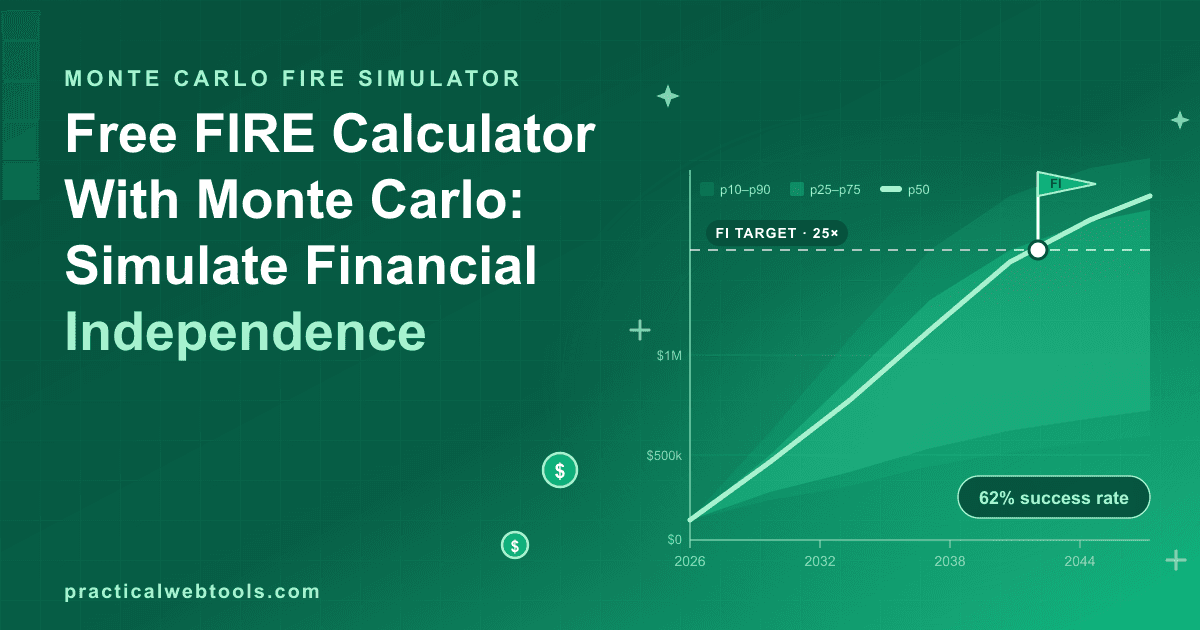
- Stress-test your full retirement timeline across market cycles in the Retirement Calculator and the Financial Independence Simulator (and read our Monte Carlo FIRE simulator guide for a walkthrough of sequence-of-returns risk).