Convert 7Z to ZIP: The Ultimate Guide for File Conversion

Have you ever tried to send a compressed file to a colleague, friend, or client, only to get a reply saying, "I can't open this .7z file"? Or perhaps you've been on the receiving end, staring at a file your computer doesn't natively understand. It's a common digital-age hiccup. While the 7z format is a marvel of compression technology, its Achilles' heel is compatibility. The ZIP format, on the other hand, is the universal language of file archives.
This comprehensive guide is your one-stop resource for everything 7z-to-zip. We'll explore why you'd want to make the switch, compare the formats head-to-head, and provide detailed, step-by-step instructions for converting your files using three distinct methods: online tools, desktop software, and the command line. Whether you're a casual user looking for a quick fix or a power user seeking to automate your workflow, you'll find the perfect solution here.
Understanding the Players: 7z vs. ZIP
Before we dive into the conversion process, it's helpful to understand what these file formats are and why they exist. Both are archive formats, meaning they act as containers to bundle multiple files and folders into a single file, often compressing them to save space.
What is a 7z File?
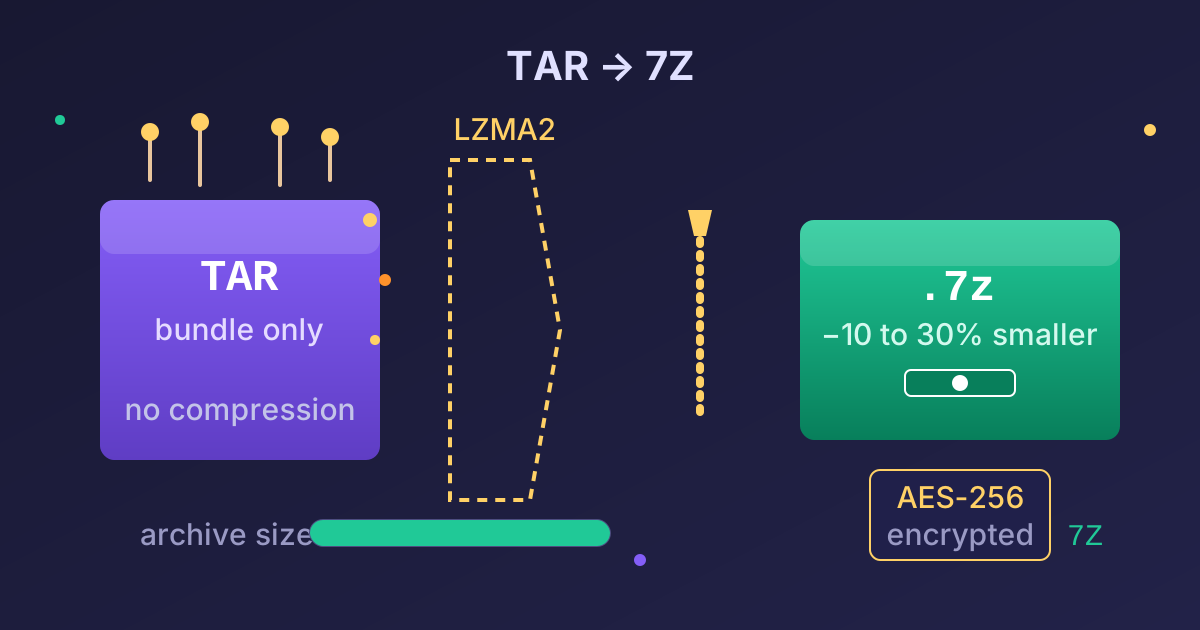
The .7z extension signifies an archive created using the 7-Zip archiver. Developed by Igor Pavlov, its primary claim to fame is its high compression ratio, thanks to the sophisticated LZMA and LZMA2 compression algorithms. This means that, in many cases, a 7z file will be significantly smaller than a ZIP file containing the exact same data. It also supports robust AES-256 encryption, making it a secure choice for sensitive information.
However, this power comes at a cost: it's not natively supported by most operating systems like Windows and macOS. To open a 7z file, you almost always need to install third-party software.
What is a ZIP File?
The ZIP format is the stalwart veteran of file compression, dating back to 1989. Its longevity is a testament to its greatest strength: ubiquity. Virtually every modern operating system—Windows, macOS, Linux, Android, and iOS—can create and extract ZIP files without any additional software. This makes it the de facto standard for sharing compressed files.
While its compression is generally less efficient than 7z (resulting in slightly larger files), the trade-off for universal compatibility is one that millions of users make every day.
Why Convert from 7z to ZIP?
The primary reason to convert 7z to ZIP is compatibility. If you're sending a file to someone and you're not sure what software they have, sending a ZIP file is the safest bet. It eliminates the friction of them needing to download and install a new program just to access your files.
Here's a breakdown of the key differences:
| Feature | 7z (7-Zip) | ZIP (PKZIP) |
|---|---|---|
| Compatibility | Low (Requires third-party software) | Very High (Natively supported by most OS) |
| Compression Ratio | High to Very High (Smaller file sizes) | Good (Larger files than 7z) |
| Encryption | Strong (AES-256) | Varies (Legacy ZipCrypto is weak, AES-256 is available) |
| Software Needed | 7-Zip, WinRAR, The Unarchiver, etc. | Built-in tools in Windows, macOS, Linux, etc. |
| Best For | Archiving for personal storage, maximum space saving. | Sharing files with others, ensuring accessibility. |
In short, you convert from 7z to ZIP when the priority shifts from personal storage efficiency to universal accessibility for sharing.
How to Convert 7z to ZIP: A Step-by-Step Guide
Now, let's get to the practical part. We'll cover three methods, ranging from the incredibly simple to the technically advanced.
Method 1: The Quick & Easy Way with Online Converters
For a one-off conversion without any software installation, online tools are unbeatable. They work directly in your web browser, making them platform-independent.
Our own 7Z to ZIP Converter is designed for exactly this purpose, with a strong focus on privacy and simplicity. Unlike many online tools that upload your files to a server, our tool processes them locally in your browser. Your files never leave your computer, ensuring complete privacy.
Here's how to use it:
- Navigate to the Tool: Open your web browser and go to the Practical Web Tools 7Z to ZIP converter.
- Select Your File: Click the "Choose File" button or drag and drop your
.7zfile directly onto the designated area on the page. - Wait for Processing: The tool will immediately begin decompressing the 7z archive and re-compressing its contents into a ZIP file. You'll see a progress indicator. Since this happens on your machine, it's fast and secure.
- Download the ZIP File: Once the process is complete, a download link for your new
.zipfile will appear. Click it to save the file to your computer.
That's it! In just a few clicks, you have a universally compatible ZIP file ready to be shared, all without installing a single piece of software.
Method 2: Powerful Desktop Software (Windows, macOS, Linux)
If you frequently work with compressed files or need to convert large archives, a desktop application is a more robust solution.
For Windows Users: 7-Zip
Ironically, the best tool to handle 7z files is also one of the best for creating ZIP files. 7-Zip is free, open-source, and incredibly powerful.
- Install 7-Zip: If you don't already have it, download and install 7-Zip from the official website (7-zip.org).
- Extract the 7z Archive: Right-click on your
.7zfile. In the context menu, hover over "7-Zip" and select "Extract Here" or "Extract to [folder name]/". This will create a folder containing all the files from the archive. - Create the ZIP Archive: Now, right-click on the folder you just extracted. Hover over "7-Zip" again, but this time select "Add to archive...".
- Configure ZIP Settings: A new window will pop up. Under "Archive format," select "zip". You can also set a password or change the compression level if needed. Click "OK".
7-Zip will create a new .zip file in the same location, containing all the files from your original 7z archive.
For macOS Users: The Unarchiver & Keka
macOS can natively create ZIP files but needs a third-party app to open 7z files. The Unarchiver is a popular, free choice for extraction.
- Install The Unarchiver: Download it for free from the Mac App Store.
- Extract the 7z File: Simply double-click your
.7zfile. The Unarchiver will automatically extract its contents into a new folder in the same location. - Create the ZIP File: Now, use macOS's built-in functionality. Right-click (or Control-click) the newly created folder and select "Compress '[folder name]'".
Your Mac will instantly create a standard .zip file, ready to go.
For Linux Users: Archive Manager & p7zip
Most Linux distributions come with a GUI tool like Archive Manager (also known as File Roller), which can often handle 7z files if the necessary backend package is installed.
- Install p7zip: Open your terminal and run
sudo apt-get install p7zip-full(for Debian/Ubuntu) or the equivalent for your distribution. This provides the backend support for the 7z format. - Extract via GUI: Open your
.7zfile with Archive Manager. Click the "Extract" button, choose a destination, and extract the files. - Create ZIP via GUI: Select all the extracted files, right-click, and choose "Compress...". In the dialog box, select the
.zipextension and click "Create".
Method 3: For the Power Users: Converting with the Command Line
For developers, system administrators, or anyone who loves the terminal, the command line offers a fast, scriptable way to convert archives.
On Linux and macOS (using p7zip)
After installing p7zip as described above, you can perform the conversion with a two-step command.
-
Open Terminal: Navigate to the directory containing your
.7zfile. -
Run the Conversion Command: Use this one-liner to extract from 7z and immediately zip the contents:
7z x yourfile.7z -oextracted_folder && zip -r yourfile.zip extracted_folder7z x yourfile.7z -oextracted_folderextracts the archive into a directory namedextracted_folder.&&ensures the second command only runs if the first is successful.zip -r yourfile.zip extracted_folderrecursively zips the contents ofextracted_folderintoyourfile.zip.
On Windows (using 7-Zip Command Line)
The 7-Zip installer includes a command-line executable (7z.exe). You may need to add its directory to your system's PATH or run the command from the installation folder (e.g., C:\Program Files\7-Zip).
- Open Command Prompt or PowerShell: Navigate to your file's location.
- Run the Extraction Command:
"C:\Program Files\7-Zip\7z.exe" x yourfile.7z -oextracted_folder - Run the Zipping Command: Windows has built-in compression capabilities via PowerShell, but using the 7-Zip command line again is consistent:
"C:\Program Files\7-Zip\7z.exe" a -tzip yourfile.zip .\extracted_folder\*
This tells 7-Zip to 'add' (a) files to a 'zip' type archive (-tzip) named yourfile.zip from the contents of the extracted_folder.
Best Practices for Archive Management
Converting is just one part of managing digital archives effectively. Often, your workflow involves more than a simple format swap.
Sometimes, you don't need to convert an entire archive, but rather just view its contents or pull out a single file. In these cases, a full conversion is overkill. You can simply use a tool to Decompress Files online, which allows you to unpack various formats like 7z, ZIP, RAR, and more, directly in your browser to access what you need.
After extracting files, you might want to create a new, reorganized archive. Perhaps you only need to share a subset of the original files, or you want to add new ones. For these tasks, a flexible tool to Compress Files is invaluable. You can drag and drop the exact files and folders you want, and it will package them into a clean, new ZIP archive for easy sharing.
Frequently Asked Questions (FAQ)
Does converting 7z to ZIP lose quality?
No. Both 7z and ZIP use lossless compression. This means that when you decompress the files, they are restored to their original state, bit-for-bit. Converting from one archive format to another does not alter the data inside; it only changes the container and the compression method used.
Is it safe to use online 7z to ZIP converters?
It depends on the converter. Many online tools upload your files to their servers, which can pose a privacy risk. This is why it's crucial to use a client-side tool like the one offered by Practical Web Tools, where the entire conversion process happens on your own computer, ensuring your data remains private.
What is the file size limit for conversion?
For desktop software, the limit is typically determined by your available disk space and system memory. For online converters, there are often limits. Server-side converters may have a limit of 100MB or a few gigabytes. Client-side tools are limited by the browser's capabilities and your computer's RAM, but can often handle very large files efficiently.
Can I convert 7z to ZIP on my phone (Android/iOS)?
Yes. You can use a browser-based online converter, like the Practical Web Tools converter, on any device with a modern web browser. Alternatively, you can find file manager apps on the Google Play Store or Apple App Store that support both extracting 7z and creating ZIP archives.
Conclusion: The Right Format for the Right Job
Understanding the strengths of 7z and ZIP formats allows you to make informed decisions. Use 7z when you need the utmost compression to save disk space for personal backups. But when it comes time to share, converting to the universally-accepted ZIP format is the professional and courteous choice.
Whether you prefer the instant convenience of an online tool, the power of desktop software, or the automation of the command line, converting your files is a straightforward process. You now have all the knowledge needed to handle any 7z file that comes your way.
Ready to get started? Give our secure, private, and easy-to-use online converter a try. Convert your first 7Z to ZIP file now!