Convert CSV to XLSX: The Ultimate Guide (3 Easy Methods)

From Plain Text to Powerful Spreadsheets: The Ultimate CSV to XLSX Guide
Have you ever downloaded a data report from a web service, a bank, or an analytics platform, only to receive a .csv file? It's a wall of text and numbers, separated by commas. While useful for data exchange, it's not ideal for analysis, visualization, or presentation. To truly unlock the power of that data, you need to convert it into a more robust format, and that's where XLSX, the native format for Microsoft Excel, shines.
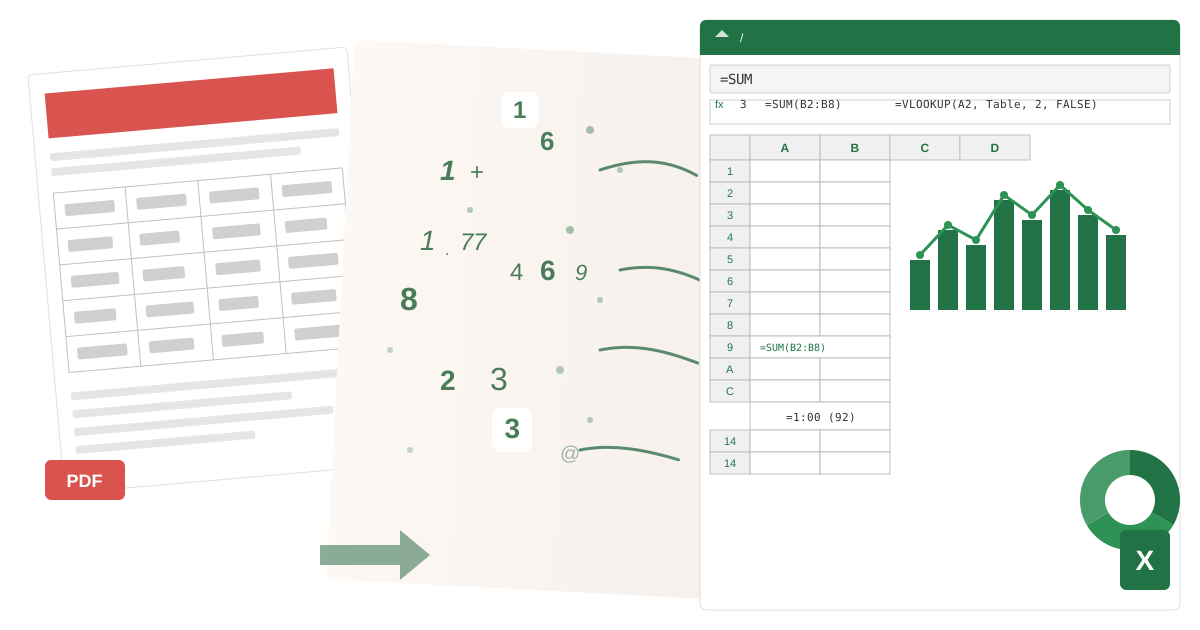
Converting a CSV (Comma-Separated Values) file to an XLSX (Excel Open XML Spreadsheet) file is a common task for anyone working with data, from marketing analysts to researchers and developers. This conversion transforms your simple, plain-text data into a dynamic spreadsheet capable of handling complex formulas, vibrant charts, and sophisticated formatting.
This comprehensive guide will walk you through everything you need to know. We'll explore why this conversion is so crucial and break down three distinct methods to accomplish it, from the simplest online tool to the powerful control of Excel's import wizard and even automated scripts for power users.
Understanding the Formats: CSV vs. XLSX
Before we dive into the 'how,' let's quickly understand the 'what' and 'why.' Knowing the fundamental differences between these two file types will clarify why you need to convert them in the first place.
What is a CSV File?
A CSV file is the epitome of simplicity. It's a plain text file where values are separated by a delimiter, most commonly a comma. Each line in the file represents a row of data, and each value separated by the comma represents a cell.
Pros:
- Universal: Nearly every data application, programming language, and spreadsheet program can open or generate a CSV file.
- Lightweight: Being plain text, CSV files are very small and easy to share.
- Human-Readable: You can open a CSV in a simple text editor and understand its structure.
Cons:
- No Formatting: It cannot store any styling like colors, font sizes, or cell widths.
- No Formulas: It only stores the raw data, not the formulas or functions used to calculate it.
- Single Sheet: A CSV file can only represent a single table of data; it does not support multiple sheets.
- Data Type Ambiguity: It doesn't store information about data types, which can lead to problems like leading zeros in ZIP codes being dropped.
What is an XLSX File?
An XLSX file is the default format for Microsoft Excel (since version 2007). It's a complex, XML-based archive (essentially a ZIP file containing multiple XML files and folders) that can store a vast amount of information beyond just the data.
Pros:
- Rich Features: Supports formatting, formulas, charts, images, macros, and more.
- Multiple Sheets: You can organize data across different worksheets within a single file.
- Strong Data Typing: It explicitly stores whether a cell contains a number, text, date, etc., preserving data integrity.
- Advanced Analysis: It's the foundation for features like PivotTables, slicers, and Power Query.
Cons:
- Larger File Size: All the extra features and formatting make XLSX files significantly larger than their CSV counterparts.
- Proprietary Roots: While widely supported, it's ultimately a Microsoft format.
Why Convert from CSV to XLSX?
The decision to convert is usually driven by the need to do more with your data. Here are the top reasons:
- Data Analysis and Formulas: To perform calculations, use functions like
VLOOKUP,SUMIF, or create complex financial models. - Data Visualization: To create charts, graphs, and conditional formatting rules to better understand and present your data.
- Formatting and Presentation: To create professional-looking reports with branded colors, fonts, and structured layouts.
- Data Integrity: To preserve specific data types, especially text values that look like numbers (e.g., ZIP codes, employee IDs with leading zeros).
- Organization: To consolidate multiple related datasets into a single workbook using different sheets.
Method 1: The Quickest Solution - Online Converters
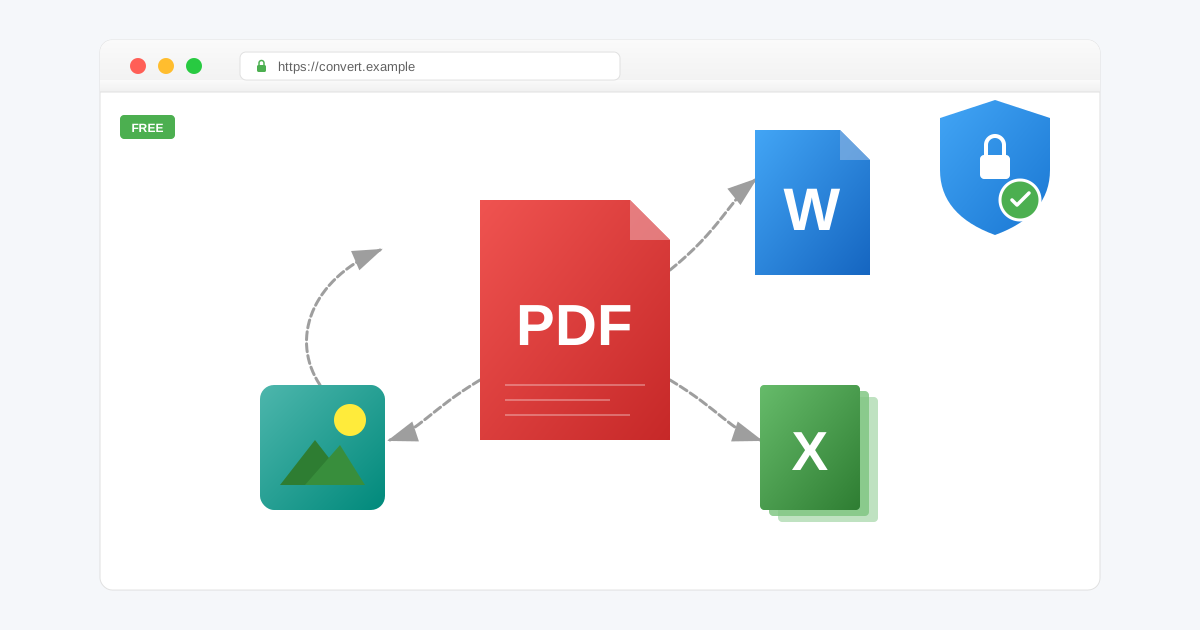
For a fast, one-off conversion without opening any heavy software, an online tool is your best friend. These web-based applications are perfect when you just need a quick transformation without any complex import settings.
However, a word of caution: when using online tools, always consider your data's privacy. Many sites upload your file to their servers, which could be a security risk for sensitive information. This is why choosing a privacy-focused tool is paramount.
At Practical Web Tools, our converters are designed with your privacy in mind, processing files directly in your browser whenever possible to ensure your data never leaves your computer.
How to Use a Secure Online Converter
Using an online tool is typically a simple three-step process:
- Upload: Select or drag-and-drop your
.csvfile onto the webpage. - Convert: Click the "Convert" button. The tool will process the file, structuring the comma-separated data into spreadsheet rows and columns.
- Download: Once complete, a download link for your new
.xlsxfile will appear. Click it to save the file to your device.
This method is incredibly efficient for simple datasets where you don't need to fine-tune import settings.
Method 2: The Standard Approach - Using Microsoft Excel
For more control over the import process, Microsoft Excel is the gold standard. However, there's a right way and a wrong way to do it. Simply double-clicking a CSV file can lead to frustrating formatting issues.
The correct approach is to use Excel's built-in import wizard, which gives you full control over how the data is interpreted.
The Wrong Way: Double-Clicking (And Its Pitfalls)
When you double-click a CSV file, Excel makes its best guess about the structure and data types. This often results in:
- Lost Leading Zeros: A value like
01234is interpreted as the number1234. - Incorrect Delimiters: If your CSV uses a semicolon (
;) instead of a comma, all the data might be crammed into the first column. - Date Misinterpretation: Values like
10-12might be automatically converted to a date (12-Oct).
The Right Way: The "From Text/CSV" Import Wizard
This method guarantees your data is imported correctly. Here’s a step-by-step guide:
- Open Excel: Start with a new, blank workbook.
- Navigate to the Data Tab: In the Excel ribbon at the top, click on the "Data" tab.
- Select "From Text/CSV": In the "Get & Transform Data" group on the left, click the "From Text/CSV" button.
- Choose Your File: A file explorer window will open. Locate and select your
.csvfile and click "Import." - Configure Import Settings: A preview window will now appear. This is the most crucial step. Excel gives you several options:
- File Origin: This is the character encoding.
UTF-8is the modern standard and usually the correct choice. - Delimiter: Excel will automatically detect the delimiter (like a comma). If it's wrong, you can select the correct one from the dropdown (e.g., Semicolon, Tab, Space).
- Data Type Detection: This is key. By default, Excel scans the first 200 rows to guess the data type for each column. For full control, select "Do not detect data types."
- File Origin: This is the character encoding.
- Load the Data: You have two options at the bottom:
- Load: This loads the data directly into a new worksheet as a table. This is the most common choice.
- Transform Data: This opens the Power Query Editor for more advanced transformations before loading the data. This is useful for cleaning or reshaping complex datasets.
Once the data is loaded into Excel, it will be perfectly structured. Now, all you have to do is save it.
Saving as an XLSX File
With your data correctly imported, simply go to File > Save As. In the "Save as type" dropdown menu, select "Excel Workbook (*.xlsx)" and give your file a name. Congratulations, you've successfully and accurately converted your CSV!
Method 3: Advanced Methods for Automation
If you regularly convert large numbers of CSV files, manual methods can become tedious. This is where scripting comes in, allowing you to automate the entire process.
Using Python with Pandas
For those comfortable with coding, Python's pandas library is an incredibly powerful tool for data manipulation. Converting a CSV to XLSX can be done in just a few lines of code.
First, make sure you have the necessary libraries installed:
pip install pandas openpyxl
Then, use the following Python script:
import pandas as pd

# Define the input and output file names
csv_file_path = 'input_data.csv'
xlsx_file_path = 'output_data.xlsx'

# Read the CSV file into a pandas DataFrame
# The dtype=str parameter ensures all data is read as text, preserving leading zeros
df = pd.read_csv(csv_file_path, dtype=str)

# Write the DataFrame to an Excel file
# index=False prevents pandas from writing the DataFrame index as a column
df.to_excel(xlsx_file_path, index=False)

print(f"Successfully converted {csv_file_path} to {xlsx_file_path}")
This script reads the CSV, ensuring all data is treated as text to prevent data type issues, and then writes it to a clean XLSX file. It's a highly efficient way to handle batch conversions.
Troubleshooting Common Conversion Problems
Sometimes, even with the best methods, you can run into issues. Here are some common problems and their solutions.
Problem: My leading zeros are disappearing!
- Cause: Excel is interpreting columns with values like
00789as numbers and stripping the non-significant zeros. - Solution: Use the Excel "From Text/CSV" import wizard. In the preview window, click "Transform Data." In the Power Query editor, right-click the header of the problematic column, select "Change Type," and choose "Text." This forces Excel to treat the values as literal text, preserving the zeros.
Problem: All my data is stuck in a single column!
- Cause: The delimiter in your CSV file is not a comma (it might be a semicolon, tab, or pipe
|), and your import method didn't detect it correctly. - Solution: Use the Excel import wizard. In the preview screen, look at the "Delimiter" dropdown and select the correct character that separates your data.
Problem: My converted XLSX file is huge!
- Cause: XLSX files inherently store more information than plain text CSVs, leading to larger file sizes. This is normal.
- Solution: If file size is a critical concern for storage or sharing, you can easily compress the file after conversion. Use a tool to Compress Files into a ZIP archive, which can significantly reduce its size. The recipient will then just need a way to Decompress Files to access the spreadsheet.
Managing Your Converted Files
Once you have your XLSX files, you might need to manage them as part of a larger workflow. Often, data is shared in various compressed formats. For example, if you receive a project's data as a .7z archive but your workflow is standardized on ZIP files, you might first need to convert the archive using a 7Z to ZIP converter before you can even get to the CSVs inside.
Being familiar with tools for managing different archive formats is a valuable skill for anyone who handles data regularly, ensuring you can access the files you need, regardless of how they are packaged.
Conclusion: Choosing the Right Method for You
Converting data from CSV to XLSX is a fundamental step in moving from raw data to actionable insights. As we've seen, the best method depends entirely on your needs:
- For speed and simplicity, a secure online converter is unbeatable.
- For control and accuracy, Microsoft Excel's "From Text/CSV" wizard is the most reliable choice.
- For automation and batch processing, a simple Python script is the most efficient solution.
By transforming your plain-text data into the feature-rich XLSX format, you open up a world of possibilities for analysis, visualization, and professional reporting. You can finally build those charts, apply those formulas, and present your data with the clarity it deserves.
Ready to get started? Explore the file management tools at Practical Web Tools to handle all your conversion and compression needs securely and efficiently.