XLSX to CSV: The Ultimate Guide to Converting Excel Files

You've just finished compiling a massive dataset in Microsoft Excel. It has multiple tabs, complex formulas, and beautiful charts. But the system you need to upload it to—be it a database, a CRM, or a data visualization tool—rejects your .xlsx file. It's asking for a .csv. What now?
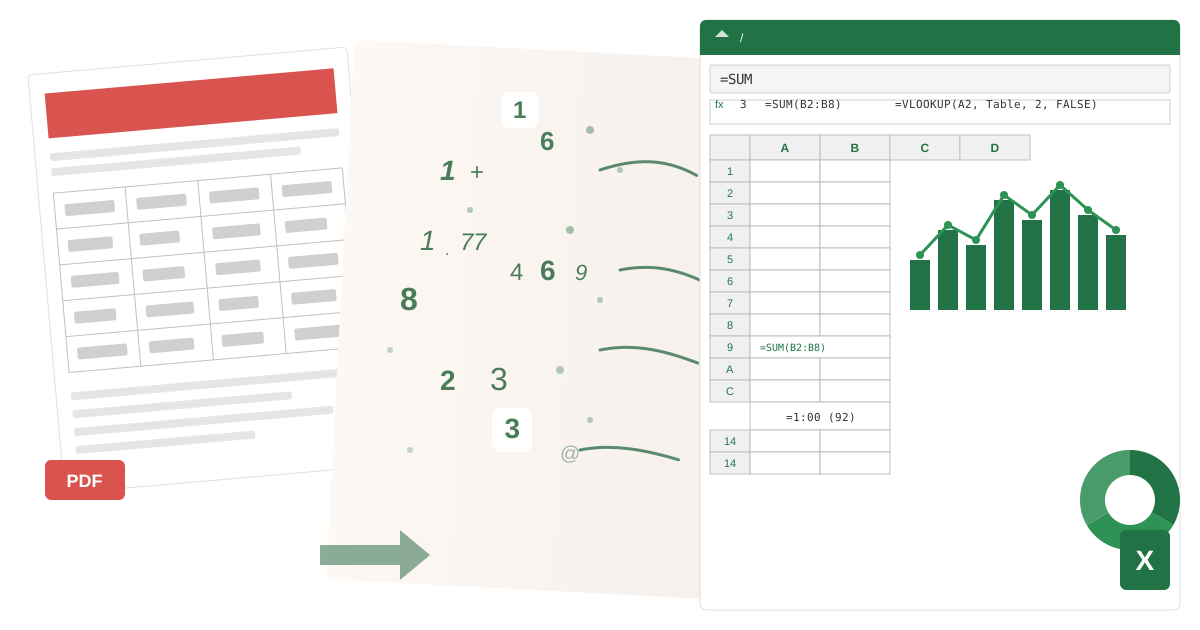
This scenario is incredibly common. While Excel's XLSX format is powerful for analysis and presentation, the simple, universal CSV format is the lingua franca of data exchange. Understanding how, when, and why to convert between these two formats is a crucial skill for anyone working with data.
This comprehensive guide will walk you through everything you need to know about converting XLSX to CSV. We'll cover the core differences between the formats, explore multiple conversion methods—from manual software clicks to automated scripts—and tackle common pitfalls like character encoding and multiple sheets. Let's unlock your data.
Understanding the Formats: XLSX vs. CSV
Before diving into the conversion methods, it's essential to understand what these file types are and why they are so different. Their fundamental structures dictate what they can and cannot do.
What is an XLSX File?
The .xlsx format, introduced with Microsoft Excel 2007, is the default format for modern Excel spreadsheets. It's an XML-based format, essentially a ZIP archive containing multiple XML files and folders that store all the different parts of your workbook.
Key Features of XLSX:
- Multiple Worksheets: An XLSX file can contain many individual sheets within a single workbook, allowing for organized and segmented data.
- Rich Formatting: It supports a vast range of formatting options, including cell colors, font styles (bold, italics), borders, number formats (currency, dates), and conditional formatting.
- Formulas and Functions: You can embed complex formulas and functions directly into cells to perform calculations.
- Charts and Graphics: It allows for the embedding of charts, graphs, images, and other objects to visualize data.
- Data Structures: Supports advanced features like PivotTables, cell comments, and data validation rules.
In short, XLSX is a complex container designed for human interaction, analysis, and presentation within the Excel ecosystem.
What is a CSV File?
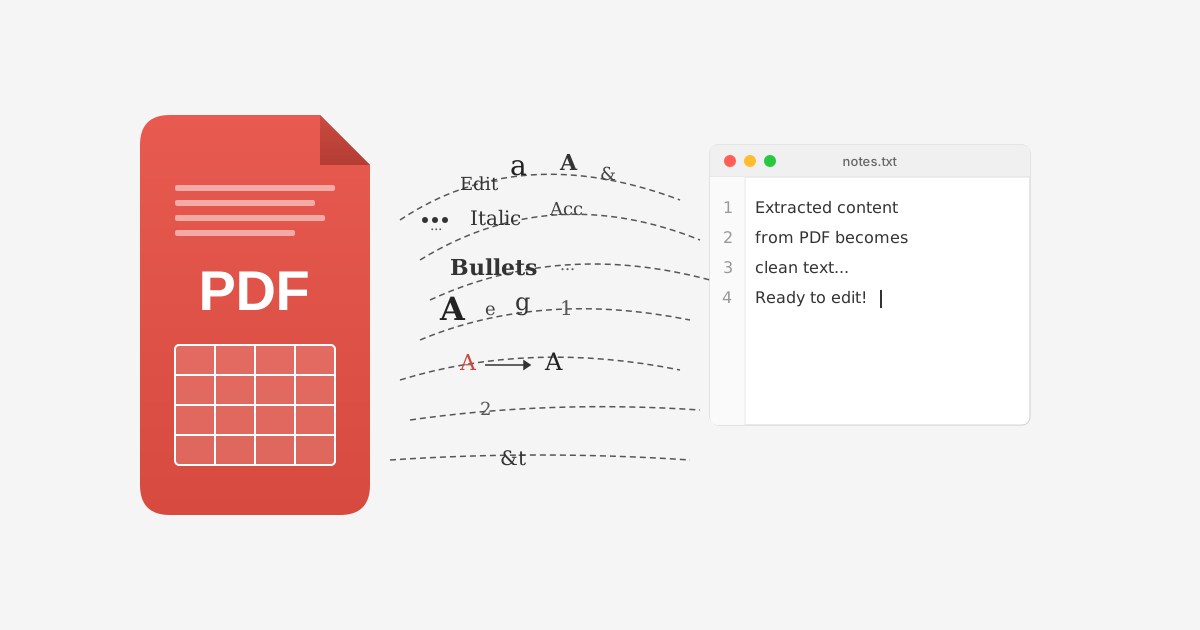
CSV stands for Comma-Separated Values. It is one of the simplest data storage formats in existence. A CSV file is a plain text file where data is organized in a tabular, grid-like structure.
Key Features of CSV:
- Plain Text: You can open and read a CSV file with any basic text editor (like Notepad or TextEdit).
- Single Sheet: A CSV file represents a single table of data. It has no concept of multiple sheets.
- Delimiter-Separated: Each value (or cell) within a row is separated by a delimiter, most commonly a comma. The rows themselves are separated by line breaks.
- No Formatting: It stores only the raw data. All formatting, formulas, charts, and images are lost.
CSV is the universal standard for data import/export because its simplicity guarantees compatibility across nearly every data-handling application, from programming languages to databases.
Comparison Table: XLSX vs. CSV
| Feature | XLSX (Excel Spreadsheet) | CSV (Comma-Separated Values) |
|---|---|---|
| Structure | Complex XML-based archive | Simple plain text |
| Formatting | Fully supported (colors, fonts, etc.) | Not supported |
| Formulas | Supported | Not supported (values are saved) |
| Multiple Sheets | Supported | Not supported |
| Charts/Images | Supported | Not supported |
| Compatibility | Primarily Microsoft Office suite | Universal |
| File Size | Generally larger | Very lightweight and smaller |
| Use Case | Data analysis, reporting, financial modeling | Data import/export, storage, scripting |
Method 1: Manual Conversion with Spreadsheet Software
This is the most straightforward method for one-off conversions. If you have spreadsheet software installed, you can convert your file in just a few clicks.
Using Microsoft Excel
If you have Microsoft Excel, this is the most direct route.
- Open Your File: Launch Microsoft Excel and open the
.xlsxfile you wish to convert. - Handle Multiple Sheets (If Applicable): If your workbook has multiple sheets, remember that a CSV can only store one. Click on the tab of the specific worksheet you want to export.
- Go to Save As: Navigate to the
Filemenu in the top-left corner and selectSave As. - Choose the Format: In the
Save Asdialog box, click on the dropdown menu labeled "Save as type". Scroll through the list and select CSV (Comma delimited) (*.csv). For better compatibility with special characters, it's often wise to choose CSV UTF-8 (Comma delimited) (*.csv) if available. - Save the File: Choose your destination, give the file a new name if desired, and click
Save. - Heed the Warnings: Excel will likely show one or two warning pop-ups.
- The first will warn you that only the active sheet will be saved. Click
OK. - The second will warn you that your file "may contain features that are not compatible with CSV." This is referring to the loss of formatting, formulas, etc. Click
Yesto proceed with saving in the CSV format.
- The first will warn you that only the active sheet will be saved. Click
Your new CSV file is now ready.
Using Google Sheets (Free Online Alternative)
If you don't have Excel, Google Sheets is a powerful and free cloud-based alternative.
- Upload to Google Drive: Go to your Google Drive and upload the
.xlsxfile. - Open with Google Sheets: Right-click the uploaded file and select
Open with > Google Sheets. The file will open in a new tab. - Navigate to Download: Click on
Filein the top menu, hover overDownload, and a sub-menu will appear. - Select CSV: From the sub-menu, choose Comma-separated values (.csv).
- Download Begins: Your browser will automatically download the converted file for the currently active sheet.
This method is excellent for its accessibility and because it doesn't require any software installation.
Using LibreOffice Calc (Free Desktop Alternative)
LibreOffice is a free, open-source office suite that provides a great alternative to Microsoft Office.
- Open in Calc: Launch LibreOffice Calc and open your
.xlsxfile. - Select Save As: Go to
File > Save As. - Choose File Type: In the "File type" dropdown menu, select Text CSV (.csv).
- Save: Click the
Savebutton. - Confirm Format: A pop-up will appear asking you to confirm the format. Click
Use Text CSV Format. - Export Settings: An "Export Text File" dialog will appear. Here you can configure advanced settings like the character set (UTF-8 is recommended) and the field delimiter (ensure it's a comma). Click
OKto finalize the save.
Method 2: Using a Secure Online Converter
Sometimes you need a quick conversion without opening a full-fledged application. This is where online tools shine. However, privacy is paramount. Many online tools upload your files to a server, which can be a security risk.
At Practical Web Tools, we champion privacy-focused, browser-based tools. A hypothetical XLSX to CSV converter on our site would process your file directly in your browser, meaning your data never leaves your computer. This provides the convenience of an online tool with the security of a desktop application.
A Step-by-Step Guide (Hypothetical PWT Tool):
- Navigate to the Tool: Open your web browser and go to the XLSX to CSV converter tool page on practicalwebtools.com.
- Select Your File: Drag and drop your
.xlsxfile onto the designated area, or click the "Upload" button to select it from your computer. - Instant Conversion: The tool would use browser-side JavaScript to read your XLSX file, extract the data from the first sheet, and convert it into the CSV format in real-time.
- Download the CSV: A "Download .csv" button would appear. Click it to save the newly created CSV file to your computer. No sign-ups, no uploads, just a quick and secure conversion.
Method 3: Programmatic Conversion for Power Users
For repetitive tasks, large batches of files, or integration into a larger workflow, automating the conversion process is the most efficient approach.
Using Python with Pandas
Python is a fantastic language for data manipulation, and the pandas library makes converting file formats trivial. This method requires some basic setup (installing Python and the pandas library), but it offers immense power and flexibility.
Steps:
- Install Libraries: If you don't have them, open your terminal or command prompt and run:
pip install pandas openpyxl - Create a Python Script: Create a simple Python file (e.g.,
convert.py) and add the following code:import pandas as pd # Define the input and output file names input_xlsx = 'your_file.xlsx' output_csv = 'converted_file.csv' # Read the Excel file into a pandas DataFrame # By default, it reads the first sheet. Use sheet_name='Sheet2' for others. df = pd.read_excel(input_xlsx) # Write the DataFrame to a CSV file # index=False prevents pandas from writing row indices into the CSV df.to_csv(output_csv, index=False, encoding='utf-8') print(f'Successfully converted {input_xlsx} to {output_csv}') - Run the Script: Place your
.xlsxfile in the same directory and run the script from your terminal:python convert.py
This approach is easily scalable to loop through hundreds of files in a folder, making it the preferred method for bulk conversions.
Common Pitfalls and Best Practices
Converting from a complex format to a simple one can sometimes lead to unexpected issues. Here are some best practices to ensure a smooth transition.
1. Handling Multiple Worksheets
Problem: A CSV file can only represent a single flat table, but your XLSX file might have 10 different sheets.
Solution: You must decide how to handle this. You can either:
- Manual Export: Manually save each sheet as a separate CSV file using one of the methods described above (e.g.,
report-jan.csv,report-feb.csv). - Automated Export: A simple modification to the Python script can loop through all sheets and save them automatically.
2. Character Encoding (The Dreaded )
Problem: You open your CSV and see strange characters like †or , especially around special symbols or accented letters.
Solution: This is an encoding mismatch. Always save your CSV using the UTF-8 encoding standard. It is the most widely supported standard and handles a vast range of characters from different languages. In Excel, choose the "CSV UTF-8" option when saving. In Python, specify encoding='utf-8'.
3. Delimiter Issues
Problem: You open your CSV in Excel, and all the data appears in a single column instead of being properly separated.
Solution: This usually means the delimiter in the CSV file (e.g., a comma) is different from what your program expects. Some European systems expect a semicolon (;) instead of a comma. When exporting, ensure you are using the correct delimiter for your target system. Most advanced export tools (like LibreOffice's or Python's) allow you to specify the delimiter.
4. Data Integrity and Cleaning
- Check Headers: Ensure your column headers are simple, descriptive, and do not contain special characters or line breaks.
- Remove Formulas: Before converting, consider copying your data and pasting it as values to remove all formulas, ensuring the raw output is what you export.
- Simplify Data: Remove charts, images, and merged cells before saving to avoid potential conversion errors.
- Manage File Size: After conversion, if your CSV is still very large, transferring it can be cumbersome. A great practice is to archive it. You can use a tool to Compress Files into a ZIP or 7Z package, making it much smaller and easier to email or upload. If you receive a compressed file, you'll similarly need a tool to Decompress Files before you can work with the data. For specific archive needs, you might even need to convert between formats, such as from 7Z to ZIP, to ensure compatibility.
Conclusion: Choosing the Right Method for the Job
Converting XLSX to CSV is a fundamental task in data management. As we've seen, there's a tool for every level of need, from a quick one-time conversion to a fully automated pipeline.
- For quick, single-file conversions, using the
Save Asfunction in Excel, Google Sheets, or LibreOffice is fast and effective. - For secure, software-free conversions, a privacy-focused online tool like those found on Practical Web Tools is the ideal choice.
- For bulk processing, automation, and complex workflows, scripting with a language like Python offers unparalleled power and flexibility.
By understanding the nature of both XLSX and CSV files and being aware of potential pitfalls like encoding and multiple sheets, you can ensure your data moves seamlessly between applications. The next time you're faced with an XLSX file that needs to be a CSV, you'll be equipped with the knowledge to handle it with confidence.
Explore our suite of free and secure file management tools at Practical Web Tools to handle all your conversion and editing needs right in your browser.