How to Convert TAR to ZIP: The Ultimate Guide for 2024
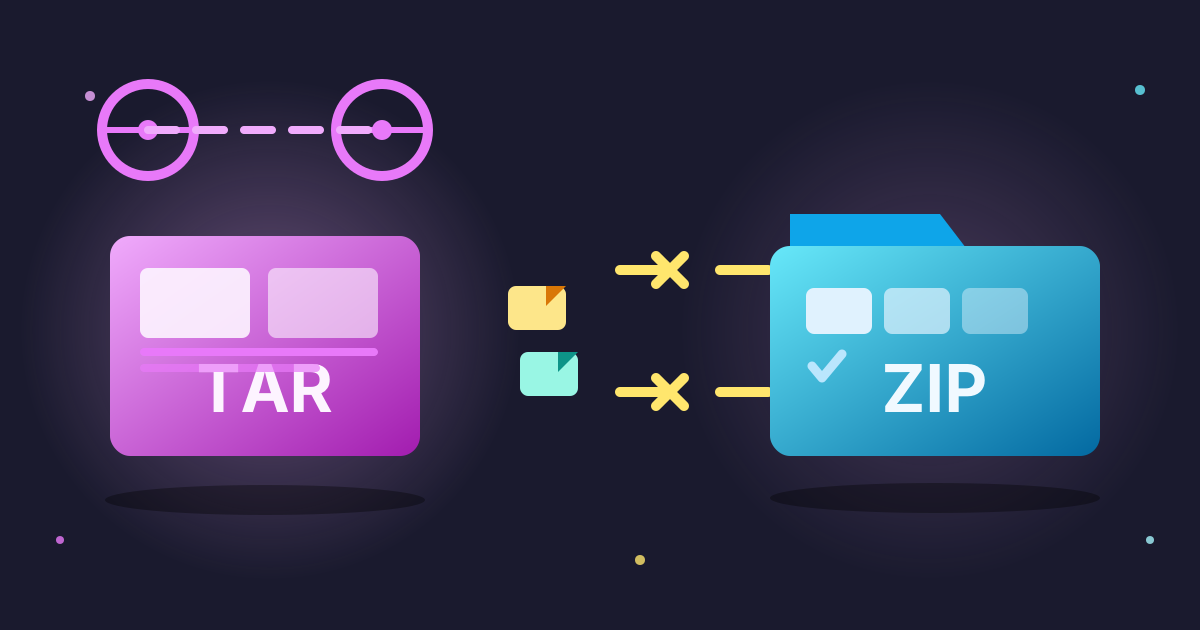
You've just downloaded a project from a server or a code repository, and there it is: a file ending in .tar. If you're on Windows, your first instinct might be confusion. Unlike the ubiquitous ZIP file, TAR archives aren't always natively understood. This situation is common for developers, system administrators, and anyone who interacts with Linux or Unix-based systems.
While TAR files are incredibly useful in their native environments, they can be a roadblock when you need to share files with colleagues who are less tech-savvy or use different operating systems. The solution? Converting them to the universally recognized ZIP format.
This comprehensive guide will walk you through everything you need to know about converting TAR to ZIP. We'll explore why you'd want to, compare the formats head-to-head, and provide step-by-step instructions for every major operating system, using both graphical tools and the command line.
Understanding the Formats: TAR vs. ZIP
Before we dive into the conversion process, it's essential to understand what these two file types are and how they differ. They might both be used for bundling files, but their core philosophies and functionalities are distinct.
What is a TAR File?
TAR stands for Tape Archive. Its name hints at its origins: it was created in the early days of Unix to write data to sequential storage devices, like magnetic tape drives, for backup purposes. Its primary function is to bundle multiple files and directories into a single file, preserving file system information like permissions and directory structure.
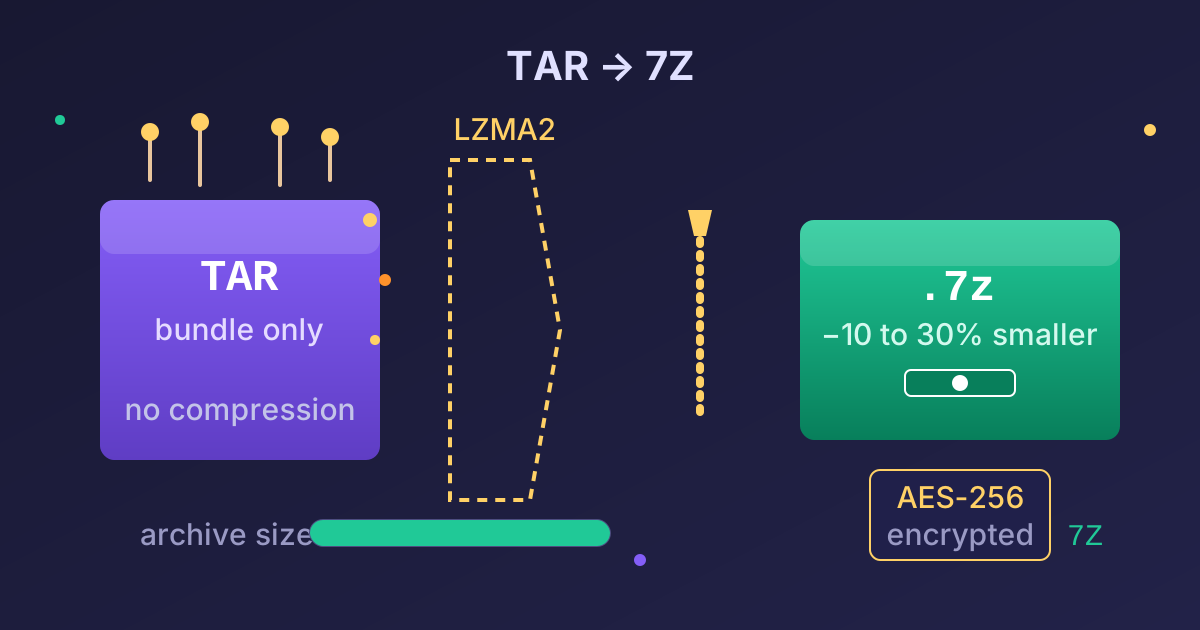
The most crucial thing to understand about TAR is that it's an archiver, not a compressor. A plain .tar file is simply a collection of files stitched together, with no reduction in size. This is why you so often see files with double extensions, like .tar.gz (or .tgz) and .tar.bz2. These files have first been bundled by TAR and then compressed by a separate algorithm like Gzip or Bzip2.
What is a ZIP File?
The ZIP format, on the other hand, was designed from the ground up to be both an archiver and a compressor. When you create a ZIP file, it bundles your files and applies a compression algorithm (typically DEFLATE) to each one, all in a single step.
Developed by Phil Katz in 1989, the ZIP format quickly became the standard for file archiving and compression on DOS and Windows platforms. Today, its native support is built into virtually every modern operating system, making it the most popular and compatible archive format in the world.
Key Differences: A Head-to-Head Comparison
To make it clearer, let's compare the two formats in a table. This is a great way to see their strengths and weaknesses at a glance.
| Feature | TAR (Tape Archive) | ZIP (Zipped File) |
|---|---|---|
| Primary Function | Archiving (bundling files) | Archiving and Compression |
| Compression | None by itself; relies on external tools like Gzip, Bzip2 | Built-in, applied to individual files within the archive |
| Native OS Support | Universal on Linux/Unix/macOS; requires third-party software on Windows | Universal on Windows, macOS, and most modern Linux distros |
| Metadata Preservation | Excellent; preserves Unix file permissions and ownership | Good, but less comprehensive than TAR for Unix-like systems |
| Common Use Cases | Software distribution, backups in Linux environments | General file sharing, email attachments, cross-platform distribution |
| Structure | A continuous stream of file data (a "tarball") | A container with a central directory of files at the end |
Why Convert TAR to ZIP?
Now that you know the difference, why would you go through the trouble of converting from one to the other? There are several practical reasons.
Universal Compatibility
This is the biggest driver. You can send a ZIP file to virtually anyone, regardless of their operating system or technical expertise, and be confident they can open it. Windows and macOS can both create and extract ZIP files without any additional software. While macOS can also handle TAR, Windows users would need to install a program like 7-Zip or WinRAR.
Ease of Use for Non-Technical Users
Double-clicking a ZIP file is a familiar action for most computer users. Explaining how to handle a TAR or TAR.GZ file can be an unnecessary complication when sharing files with clients, family, or colleagues who aren't in the IT field.
Integrated Compression
If you have a plain .tar file, it's uncompressed. Converting it to a ZIP file will apply compression and reduce the overall file size, making it faster to upload, download, and email. If you have a .tar.gz, the size difference after converting to ZIP will likely be minimal, but you still gain the compatibility benefits.
Granular Access
Because of its structure, ZIP archives allow for quick access to individual files without needing to read the entire archive. While modern software has made this less of an issue for TAR files, the design of ZIP is inherently more efficient for randomly accessing contents.
How to Convert TAR to ZIP: Step-by-Step Methods
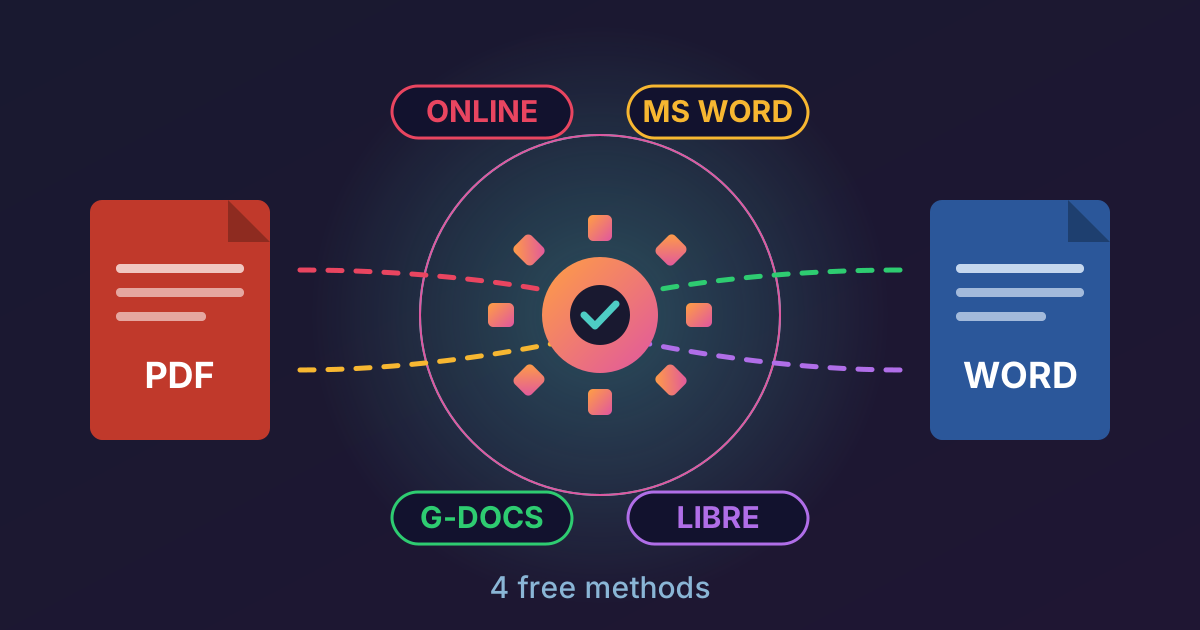
Let's get to the practical part. We'll cover four primary methods, suitable for different operating systems and comfort levels with the command line.
Method 1: Using Online Converters (The Easiest Way)
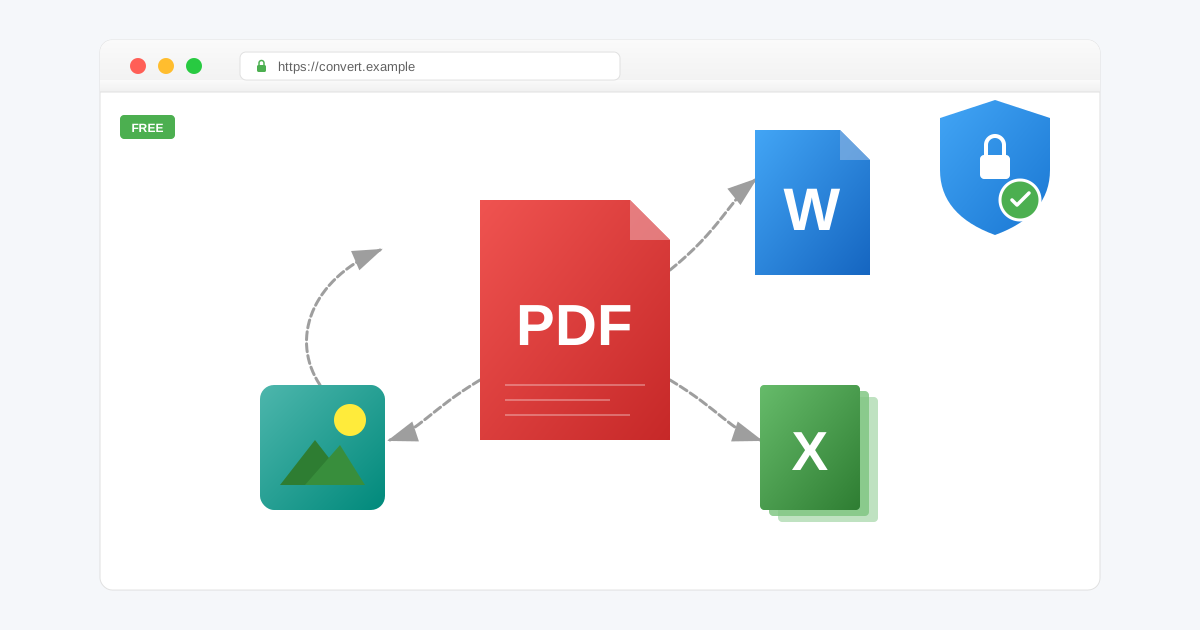
For a quick, one-off conversion without installing any software, online tools are a fantastic option. They work on any OS through your web browser.
However, it's crucial to consider privacy. You are uploading your data to a third-party server. For sensitive files, this might not be the best choice. At Practical Web Tools, all our utilities are privacy-focused and process your files directly in your browser or on the server only for the duration of the operation.
While we don't have a direct TAR-to-ZIP tool, you can achieve the same result with a simple two-step process using our tools:
- Extract the TAR Archive: Go to our versatile Decompress Files tool. Upload your
.tarfile, and it will extract all the contents, which you can then download. - Create a New ZIP Archive: Open our Compress Files tool. Drag and drop the files and folders you just extracted. The tool will bundle them into a new, clean ZIP archive for you to download.
Pros:
- Extremely easy and intuitive.
- No software installation required.
- Works on any operating system with a web browser.
Cons:
- Requires an internet connection.
- May have file size limitations.
- Not ideal for highly sensitive or confidential data (unless using trusted, privacy-focused tools).
Method 2: Converting on Windows
For Windows users, the best offline approach is to use a free, third-party utility. Our top recommendation is 7-Zip.
Using 7-Zip (Free and Powerful)
7-Zip is a free and open-source file archiver with a high compression ratio. It supports a vast array of formats, including TAR and ZIP.
- Install 7-Zip: If you don't have it, download it from the official website (7-zip.org) and install it.
- Extract the TAR file: Right-click on your
.tarfile. In the context menu, hover over "7-Zip" and select either "Extract Here" (to place contents in the current folder) or "Extract to "folder_name\"" (to create a new folder for the contents). - Select the Extracted Content: You will now have a folder containing all the files from the TAR archive. Select this folder.
- Create the ZIP Archive: Right-click on the selected folder. Hover over "7-Zip" again and choose "Add to archive...".
- Configure ZIP Settings: A new window will pop up. Under the "Archive format" dropdown menu, select zip. You can also change the compression level or add a password if you wish. Click "OK".
That's it! A new ZIP file containing all the contents of your original TAR archive will be created in the same directory.
Method 3: Converting on macOS
macOS users have it easy, as the operating system includes powerful, built-in tools for handling both formats.
Using the Finder (GUI Method)
This is the simplest method and requires no special software.
- Extract the TAR file: Simply find your
.tarfile in the Finder and double-click it. The built-in Archive Utility will automatically extract its contents into a new folder in the same location. - Compress to ZIP: Right-click (or Control-click) on the newly created folder.
- Select "Compress": From the context menu, choose the option that says "Compress '[folder_name]'".
macOS will instantly create a ZIP file of that folder. This is a quick, seamless process for converting from TAR to ZIP.
Using the Terminal
For those who prefer the command line, macOS's Terminal provides direct access to Unix utilities.
- Open Terminal: You can find it in
Applications/Utilities/or search for it with Spotlight. - Navigate to the File: Use the
cdcommand to move to the directory where your TAR file is located. For example:cd ~/Downloads. - Extract the Archive: Type the following command and press Enter:
Replacetar -xvf yourfile.taryourfile.tarwith the actual name of your file. - Create the ZIP Archive: This command will create a new ZIP file from the extracted folder. Assuming the TAR file extracted to a folder named
yourfile, the command would be:
Thezip -r yourfile.zip yourfile/-rflag stands for "recursive," ensuring that all files and subdirectories within the folder are included.
Method 4: Converting on Linux
As the native environment for TAR, Linux offers the most direct command-line tools for this task.
- Open a Terminal: Open your preferred terminal emulator.
- Navigate to the Directory: Use
cdto get to the location of your TAR file. - Extract the TAR: The command is identical to the one on macOS:
tar -xvf yourfile.tar - Install ZIP (if needed): Most desktop Linux distributions come with the
ziputility pre-installed. If not, you can easily install it. On Debian/Ubuntu-based systems, the command is:sudo apt update && sudo apt install zip - Create the ZIP: Again, this command is the same as on macOS. It creates a recursive ZIP archive of the extracted directory.
Replacezip -r newarchive.zip extracted_folder/newarchive.zipwith your desired output filename andextracted_folder/with the name of the folder created when you extracted the TAR.
Handling Compressed TAR Archives (.tar.gz, .tgz, .tar.bz2)
A common point of confusion is dealing with compressed TAR files. The good news is that the process is almost identical.
- GUI Tools (7-Zip, macOS Archive Utility): These tools are smart enough to handle the decompression and un-archiving in a single step. You just right-click and extract as usual, and they take care of the rest.
- Command Line: You only need to add one extra letter to the
tarcommand to tell it which decompression algorithm to use.- For
.tar.gzor.tgzfiles, use thezflag for gzip:tar -xzvf yourfile.tar.gz - For
.tar.bz2files, use thejflag for bzip2:tar -xjvf yourfile.tar.bz2
- For
After extracting, the process of creating a ZIP file from the resulting folder is exactly the same as described above.
Beyond TAR and ZIP: Exploring Other Formats
While TAR and ZIP are two of the most common archive formats, the world of file compression is vast. You might also encounter formats like 7Z, RAR, or GZ.
- 7Z (.7z): Known for its very high compression ratios, often better than ZIP.
- RAR (.rar): A proprietary format popular for its multi-volume archive feature.
- GZ (.gz): Not an archive format, but a compression format (Gzip) that works on a single file. You can compress a TAR file to get a
.tar.gz, but you can also compress a single document to get a.doc.gz.
Managing these different formats can be a hassle. Sometimes you need to convert a modern, high-compression archive into something more compatible. For example, if you receive a .7z file, you might need to convert it from 7Z to ZIP before sending it to someone who doesn't have the necessary software. Similarly, you might want to perform the reverse of our guide and convert a ZIP to TAR if you're preparing files for a Linux server.
Conclusion: Choosing the Right Method for the Job
Converting a TAR file to a ZIP file is a straightforward process once you understand the tools at your disposal. The key is to choose the method that best fits your workflow and technical comfort level.
- For quick, easy, and platform-independent conversions, online tools are your best friend.
- For Windows users, 7-Zip is an essential, free utility that handles nearly any archive format you can throw at it.
- For macOS and Linux users, powerful tools are already built into the operating system, accessible via both the graphical interface and the command line.
By converting your TAR archives to the universally compatible ZIP format, you ensure seamless file sharing and accessibility for everyone, regardless of their technical background.
Ready to manage your own archives? Try our easy-to-use Decompress Files and Compress Files tools today for a fast, free, and private experience right in your browser!