Compound Interest Calculator: Your Guide to Growing Wealth
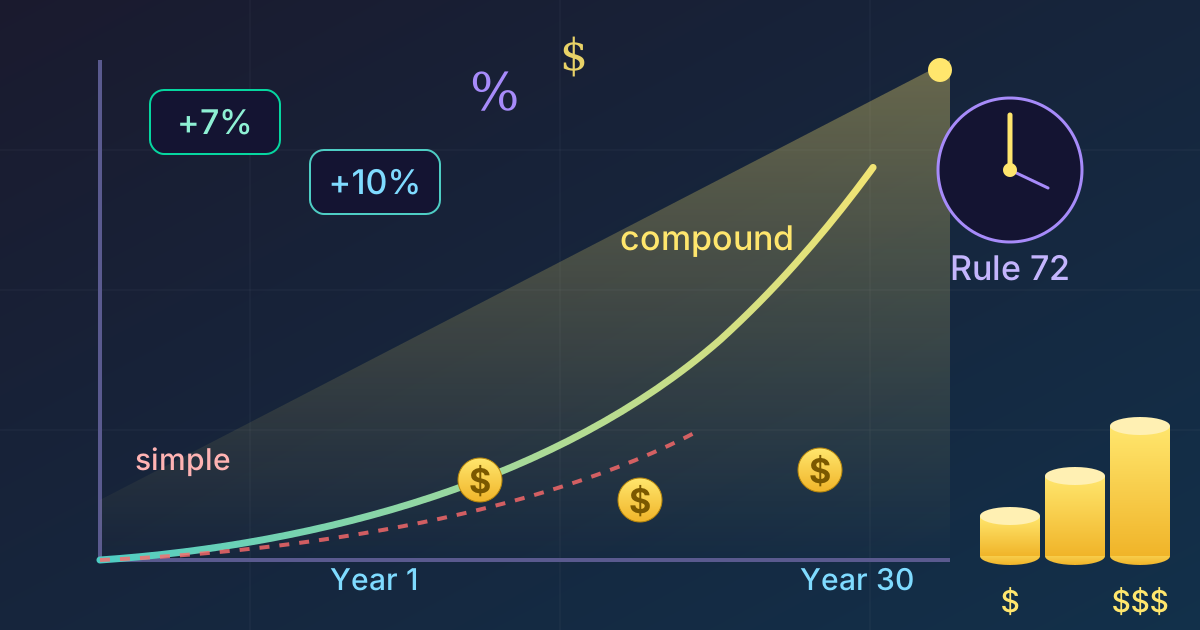
Albert Einstein famously called compound interest the eighth wonder of the world. "He who understands it, earns it... he who doesn't... pays it." It's a powerful concept, the financial equivalent of a snowball rolling downhill, gathering mass and momentum. Yet, for many, it remains an abstract idea. How do you translate this wonder into tangible wealth? The answer is simpler than you think: a compound interest calculator.
This comprehensive guide will demystify the process. We'll move beyond the theory and show you how to use this essential tool to model, plan, and accelerate your journey to financial independence. You'll learn how to manipulate different variables to see your potential future, turning abstract financial goals into a concrete, actionable plan.
Understanding the Core Engine: Simple vs. Compound Interest
Before we dive into the calculator, it's crucial to grasp what makes compounding so powerful. It all comes down to earning interest not just on your initial investment (the principal), but also on the accumulated interest from previous periods.
Simple Interest: You earn interest only on the principal amount. It's a linear, predictable growth.
Compound Interest: You earn interest on the principal and any interest you've already earned. It's exponential growth.
Let's see this in action. Imagine you invest $10,000 at a 7% annual interest rate for 5 years.
| Year | Simple Interest (End Balance) | Compound Interest (End Balance) | The Compounding Difference |
|---|---|---|---|
| 1 | $10,700 | $10,700 | $0 |
| 2 | $11,400 | $11,449 | $49 |
| 3 | $12,100 | $12,250 | $150 |
| 4 | $12,800 | $13,108 | $308 |
| 5 | $13,500 | $14,026 | $526 |
In just five years, compounding has already added an extra $526 to your investment. Now, imagine that effect over 20, 30, or 40 years. The difference becomes staggering. This is the magic we're going to harness.
Your Financial Crystal Ball: Using a Compound Interest Calculator
Manually calculating compound interest, especially with regular contributions, is tedious and complex. The formula, A = P(1 + r/n)^(nt), can be intimidating. A compound interest calculator does the heavy lifting, allowing you to focus on strategy instead of arithmetic.
Most calculators require the same key inputs. Let's break them down.
The Core Components of Your Financial Future
Understanding these levers is the first step to taking control of your financial destiny.
- Initial Principal (P): This is your starting amount. The more you start with, the bigger your initial snowball.
- Regular Contributions: This is the new money you add to your investment on a regular basis (e.g., monthly, annually). This is often the most powerful variable you can control.
- Interest Rate (r): The annual rate of return you expect on your investment. This is an estimate; historical market returns are often used as a benchmark (e.g., 7-10% for stock market index funds).
- Compounding Frequency (n): How often the interest is calculated and added to your principal. It can be daily, monthly, quarterly, or annually. More frequent compounding leads to slightly better results.
- Time (t): The duration, in years, that you plan to let your investment grow. Time is the most critical ingredient for compounding.
By adjusting these inputs, you can instantly see how small changes today can lead to massive differences in the future.
Strategic Wealth Planning: Running Scenarios for Success
Now for the fun part. Let's run some practical scenarios to see how you can use a calculator to make informed financial decisions.
Scenario 1: The Power of Time - Starting Early vs. Starting Late
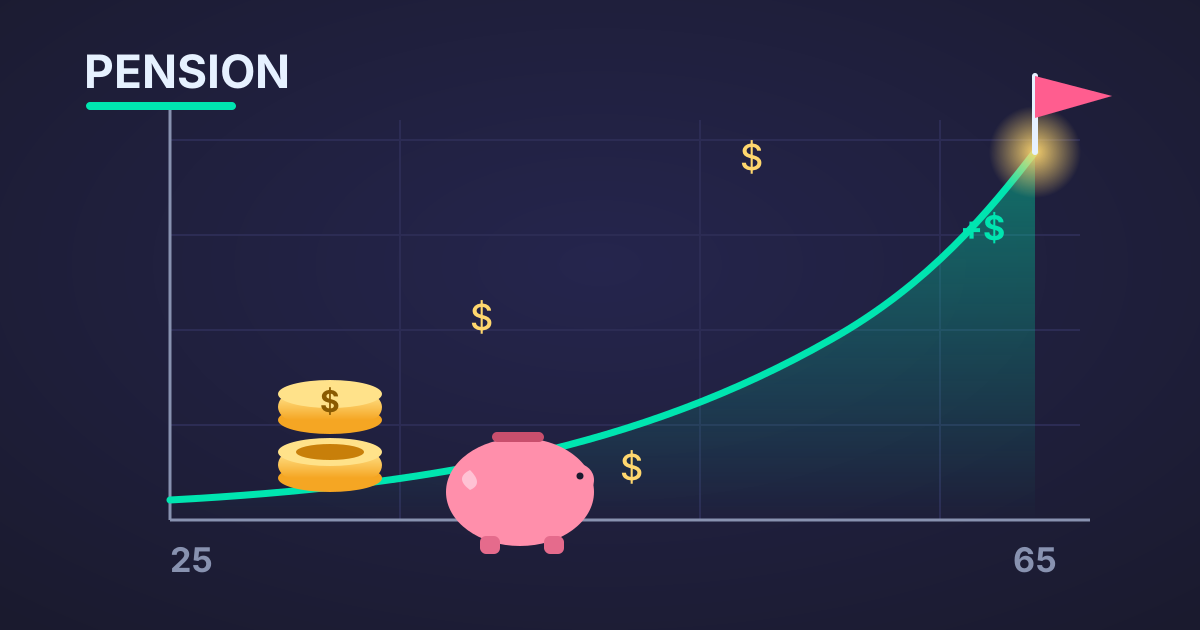
Let's compare two individuals, Alex and Ben. Both want to retire at 65. They both contribute $500 per month and earn an average annual return of 8%.
- Alex starts at age 25. He invests for 40 years.
- Ben starts at age 35. He invests for 30 years.
Here's what the calculator shows:
- Alex (starts at 25): Total Contributions: $240,000. Final Amount at 65: $1,745,505
- Ben (starts at 35): Total Contributions: $180,000. Final Amount at 65: $745,183
Alex invested just $60,000 more than Ben, but his final nest egg is over $1,000,000 larger. That extra decade of compounding more than doubled his outcome. This is the single most important lesson in wealth building: start as early as possible.
Scenario 2: The Impact of Contributions - Fueling the Fire
Let's say you're 30 and have a starting investment of $20,000. You plan to retire in 35 years at age 65, and you expect an 8% annual return. How much difference does an extra few hundred dollars a month make?
- With $300/month contribution: Your final amount would be $788,775.
- With $500/month contribution: Your final amount would be $1,234,233.
- With $800/month contribution: Your final amount would be $1,906,584.
Increasing your monthly contribution by $500 (from $300 to $800) results in over $1.1 million more at retirement. Use the calculator to find the sweet spot between your current budget and your future goals.
When you're running multiple scenarios like this, you might end up with several spreadsheets or documents outlining different potential futures. To keep your financial planning folder tidy, it's a great idea to Compress Files. This saves space and makes it easier to email your plans to a financial advisor or partner.
Scenario 3: The Effect of Interest Rates - Finding the Right Vehicle
Your expected rate of return has a monumental impact on your final outcome. Let's assume you start with $10,000, contribute $500/month for 30 years.
- At 5% return (conservative bonds/CDs): Final Amount: $499,398
- At 7% return (balanced portfolio): Final Amount: $691,411
- At 9% return (equity-heavy portfolio): Final Amount: $1,023,737
The difference between a 5% and 9% return is over half a million dollars. This illustrates why understanding investment vehicles and their potential returns is so critical. A calculator helps you quantify the potential reward for taking on different levels of risk.
Beyond the Basics: Advanced Factors and Common Mistakes
While a calculator is a powerful tool, it's important to consider real-world factors that can affect your results.
The Rule of 72: A Quick Mental Check
The Rule of 72 is a simple heuristic to estimate how long it will take for an investment to double. Simply divide 72 by your annual interest rate.
- At a 6% return, your money will double in approximately 72 / 6 = 12 years.
- At a 9% return, your money will double in approximately 72 / 9 = 8 years.
This is a great way to quickly grasp the power of different interest rates without needing a calculator.
Don't Forget Inflation and Taxes
- Inflation: The $1 million you calculate for your retirement won't have the same purchasing power as $1 million today. You should factor in an average inflation rate (historically 2-3%) to understand your real return. If you expect an 8% return and inflation is 3%, your real return is closer to 5%.
- Taxes: Investment gains are often taxed. Using tax-advantaged accounts like a 401(k) or an IRA can shield your investments from taxes and allow them to compound more efficiently.
Managing Your Financial Data Securely
As you progress on your financial journey, you'll accumulate a lot of important digital documents: brokerage statements, tax forms, performance reports, and saved calculator scenarios. Managing this data is crucial.
Often, you'll download archives of these documents from your financial institutions. Let's say you receive a ZIP file with your annual statements. For long-term archival, you might prefer a format with a higher compression ratio to save cloud storage space. With a simple online tool, you can convert that ZIP to 7Z in seconds. Keeping your digital financial life organized is just as important as organizing your finances.
Conclusion: Start Compounding Your Wealth Today
Compound interest is not a get-rich-quick scheme; it's a get-rich-surely strategy. The principles are simple: start early, contribute consistently, and let time work its magic. The compound interest calculator is your most valuable companion on this journey. It transforms abstract goals into a visible, achievable future.
Don't let another day pass. Your challenge today is to find a calculator and run your own numbers.
- Input your current savings.
- Determine a realistic monthly contribution.
- Play with the time horizon and see the incredible impact of a few extra years.
Visualize your goals, create a plan, and take the first step. Building wealth is a marathon, and the sooner you start, the easier the run. And as you manage the digital side of your financial life, from reports sent by your accountant to your own saved plans, remember that Practical Web Tools has a full suite of free tools to help you manage your files, whether you need to Decompress Files or convert them to a different format.