Mastering Discount Math: The Ultimate Sale Price Guide
Your Guide to Understanding Discount Calculator Sale Price Math
We've all been there. You're walking through a store or browsing online, and a bright red sign catches your eye: "40% OFF!" It's tempting, but what does that really mean for your wallet? How much are you actually saving, and what is the final price? For savvy shoppers, understanding this math is key to managing a budget. For business owners, it's the foundation of a successful sales strategy.
Many of us reach for a calculator, but what if you could understand the logic behind it? Knowing the formulas empowers you to quickly estimate costs, compare deals, and verify that the price you're being charged is correct. This comprehensive guide will demystify discount and sale price mathematics. We'll break down the core formulas, walk through practical examples, explore complex scenarios like stacking discounts, and even show you how to calculate backwards to find the original price.
Whether you're trying to score the best deal on a new laptop or pricing products for your own online store, mastering this simple math is a practical skill that pays dividends. Let's dive in and turn you into a discount calculation expert.
The Core Formulas You Need to Know
At its heart, discount math revolves around a few straightforward formulas. Once you understand these, every sale sign will be an open book. Let's break them down one by one.
Formula 1: Calculating the Discount Amount
This is the first piece of the puzzle: figuring out the exact dollar amount you're saving. It tells you how much money is being taken off the original price.
The Formula:
Discount Amount = Original Price × (Discount Percentage / 100)
To use this, you simply convert the percentage into a decimal by dividing it by 100, then multiply it by the original price.
Example: A jacket has an original price of $120 and is on sale for 25% off.
- Convert the percentage to a decimal:
25 / 100 = 0.25 - Multiply the original price by the decimal:
$120 × 0.25 = $30
The Discount Amount is $30. This is the amount you save.
Formula 2: Calculating the Sale Price (The Two-Step Method)
Once you know the discount amount, finding the final sale price is just a simple subtraction.
The Formula:
Sale Price = Original Price - Discount Amount
Example (Continuing from above): The jacket's original price is $120, and we calculated a discount amount of $30.
- Subtract the discount from the original price:
$120 - $30 = $90
The Sale Price is $90.
The All-in-One Formula for Sale Price (The-One Step Method)
Want to get to the final price faster? This combined formula lets you calculate the sale price in a single step. It works by calculating the percentage of the price you still have to pay.
If an item is 25% off, you are paying for 75% of its original price (100% - 25% = 75%).
The Formula:
Sale Price = Original Price × (1 - (Discount Percentage / 100))
Example (Using the same jacket): An original price of $120 with a 25% discount.
- Convert the percentage to a decimal:
25 / 100 = 0.25 - Subtract the decimal from 1:
1 - 0.25 = 0.75 - Multiply the original price by this new decimal:
$120 × 0.75 = $90
The Sale Price is $90. As you can see, you get the same result in one efficient calculation. This is the formula most online discount calculators use.
How to Calculate a Discount: A Step-by-Step Guide
Let's put it all together into a simple, repeatable process. This method is perfect for optimizing for featured snippets and for anyone who loves clear instructions.
To find the final sale price, follow these five steps:
- Identify the Original Price: Find the item's full, non-discounted price. Let's say it's a $350 tablet.
- Find the Discount Percentage: Locate the advertised discount. Let's say it's 30% off.
- Convert the Percentage to a Decimal: Divide the percentage by 100. In our case,
30 / 100 = 0.30. - Calculate the Savings: Multiply the original price by the decimal.
$350 × 0.30 = $105. This is your discount amount. - Determine the Final Price: Subtract the savings from the original price.
$350 - $105 = $245.
Alternatively, using the one-step method: Sale Price = $350 × (1 - 0.30) = $350 × 0.70 = $245.
Advanced Scenarios: Stacking Discounts and BOGO Deals
Sales aren't always a simple percentage off. Retailers often use more complex deals to attract customers. Here's how to handle them.
Calculating Stacked Discounts (e.g., 20% off + an extra 10% off)
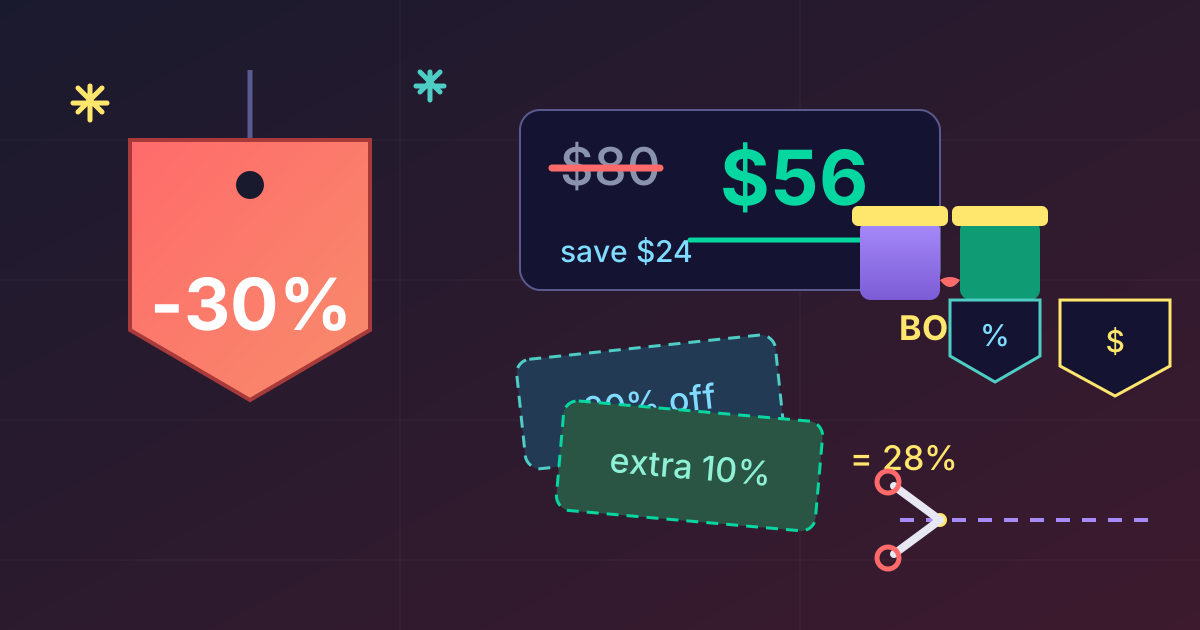
This is a common trap. It's tempting to add the percentages together (20% + 10% = 30%), but that's incorrect. Stacked discounts are applied sequentially.
The Rule: You take the first discount off the original price, and then you take the second discount off the new, discounted price.
Example: An item costs $200. It's on sale for 20% off, and you have a coupon for an additional 10% off.
- Apply the first discount (20%):
$200 × (1 - 0.20) = $200 × 0.80 = $160
- Apply the second discount (10%) to the new price:
$160 × (1 - 0.10) = $160 × 0.90 = $144
The final sale price is $144.
If you had incorrectly calculated a 30% discount, you would have thought the price was $200 × 0.70 = $140. The sequential method results in a slightly higher price, which is why it's crucial to calculate it correctly.
Understanding "Buy One, Get One" (BOGO) Deals
BOGO deals can be tricky. "Buy One, Get One Free" is simple—you get two items for the price of one, which is effectively a 50% discount on the total purchase of two items.
However, "Buy One, Get One 50% Off" is different. It's not a 50% discount on the total.
Example: You want to buy two shirts that are $40 each under a "BOGO 50% Off" deal.
- First Shirt: You pay the full price: $40.
- Second Shirt: You get 50% off:
$40 × 0.50 = $20. - Total Cost:
$40 + $20 = $60for two shirts.
The total original price would have been $40 + $40 = $80. You paid $60, saving $20. To find the true discount percentage, use the formula:
Discount Percentage = (Savings / Original Price) × 100
($20 / $80) × 100 = 0.25 × 100 = 25%
So, a "BOGO 50% Off" deal is actually a 25% discount on the total purchase of two items.
Reverse Calculations: Finding the Original Price or Discount
Sometimes you have different information. You might know the sale price and want to find the original price to see if the deal is as good as it sounds.
How to Find the Original Price
The Scenario: You bought an item for $75, and you know it was marked down by 25%. What was the original price?
The Formula:
Original Price = Sale Price / (1 - (Discount Percentage / 100))
Calculation:
1 - (25 / 100) = 1 - 0.25 = 0.75Original Price = $75 / 0.75 = $100
The original price was $100.
How to Find the Discount Percentage
The Scenario: An item was originally $50, but you bought it on sale for $35. What percentage discount did you get?
The Formula:
Discount Percentage = ((Original Price - Sale Price) / Original Price) × 100
Calculation:
$50 - $35 = $15(This is your savings amount)$15 / $50 = 0.300.30 × 100 = 30%
You received a 30% discount.
The Business Side: Managing Digital Sales and Assets
For entrepreneurs and small business owners, discount math is mission-critical. It impacts everything from revenue and profit margins to inventory management. But running a sale involves more than just numbers—it also involves managing the digital assets associated with your products and promotions.
Imagine you're a graphic designer selling a "Startup Branding Bundle." This bundle contains logos, font packages, and social media templates. To make it a great deal, you offer it for $199, a 35% discount off the combined value of the individual items. You've done the math, but now you need to deliver it to your customers efficiently.
Your bundle consists of dozens of individual files. Sending them one by one is impractical. The professional solution is to package them into a single, downloadable archive. This is where file management becomes crucial. By using a tool to Compress Files, you can bundle everything into a single ZIP or 7Z file. This not only keeps your product organized but also significantly reduces the file size, allowing your customers to download their purchase quickly.
On the other end, consider your customer's experience. Not everyone is tech-savvy. A customer might not know what to do with a .ZIP or .7Z file. To provide excellent service, you could include a link in your delivery email to a simple, free tool they can use. Pointing them to a page to Decompress Files removes a potential point of friction and ensures they can access their purchased assets without any trouble. This small touch shows you care about their experience from start to finish.
Thinking about file compatibility can also enhance the customer experience. While ZIP is nearly universal, some users might prefer other formats, or you may receive assets from collaborators in a different archive type. Understanding how to convert between them, for example using a 7Z to ZIP converter, can streamline your workflow and prevent compatibility headaches.
Conclusion: Empower Your Financial Decisions
Understanding discount calculator and sale price math is a superpower for both consumers and business owners. It allows you to see beyond the flashy signs and grasp the real value of a deal. By mastering the core formulas—calculating the discount, finding the sale price, and even working backwards—you can make smarter, more confident financial decisions.
For businesses, this mathematical precision goes hand-in-hand with practical digital management. Just as you carefully calculate your prices, you should also carefully manage the delivery of your digital goods. Efficiently handling files is a key part of providing a professional and seamless customer experience.
At Practical Web Tools, we're dedicated to providing the utilities you need to manage your digital world effectively. Whether you're calculating numbers or managing files, having the right tools makes all the difference. Explore our collection of free, privacy-focused tools to see how we can help you work smarter today.