Loan Calculator: Compare Rates & Payments Like a Pro
Your Comprehensive Guide to Comparing Loan Rates and Monthly Payments
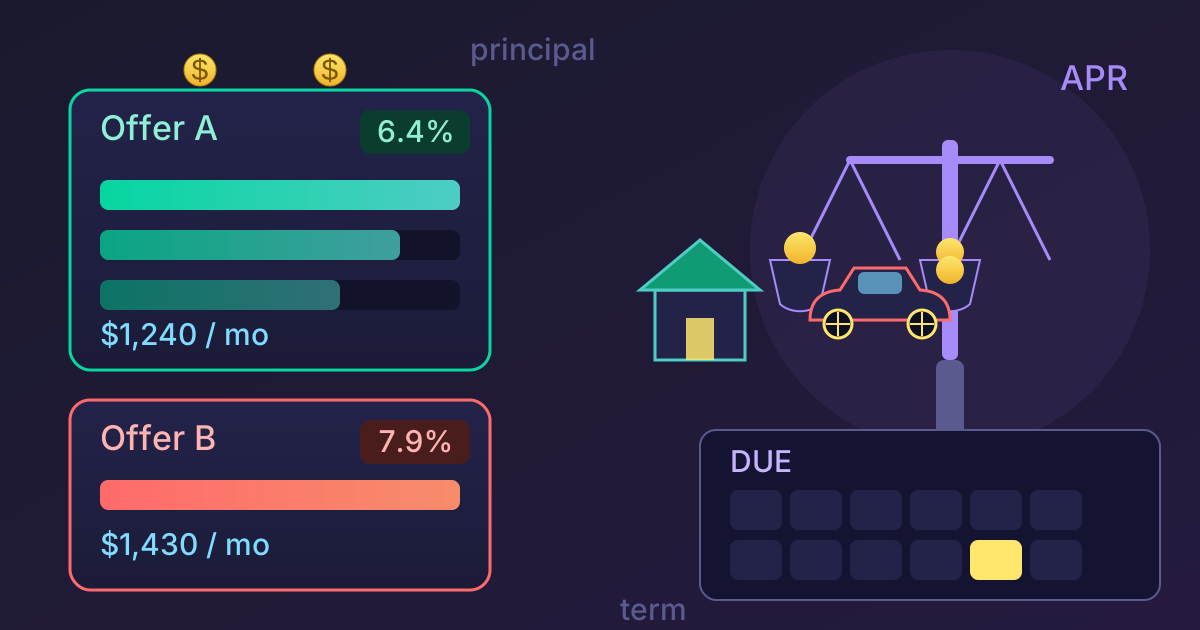
Taking on a loan, whether it's for a new car, a home, or consolidating debt, can feel like navigating a maze blindfolded. You're bombarded with terms like APR, loan term, and principal, and every lender claims to offer the best deal. How do you cut through the noise and make a decision that benefits your financial future, not just the lender's bottom line? The answer is simpler and more powerful than you might think: a loan calculator.
This isn't just another boring financial tool. A loan calculator is your personal financial compass, empowering you to see the true cost of borrowing, compare offers with confidence, and take control of your debt. In this comprehensive guide, we'll demystify the entire process. We'll break down every component of a loan, show you a step-by-step method for comparing rates like a seasoned professional, and highlight common pitfalls to avoid. Let's transform that feeling of uncertainty into one of confidence and clarity.
What is a Loan Calculator and Why is it Essential?
A loan calculator is a digital tool that helps you estimate the payments on a loan. By inputting a few key pieces of information—the loan amount, interest rate, and loan term—it instantly calculates your estimated monthly payment. But its true value goes far beyond that single number. It provides a complete picture of your financial commitment over the life of the loan.
Using a loan calculator isn't just a suggestion; it's an essential step in the borrowing process. Here’s why:
- Provides Total Clarity: It shows you exactly how much you'll pay each month, how much of that payment goes towards interest versus the principal, and, most importantly, the total amount of interest you'll pay over the entire loan term.
- Enables Effective Comparison Shopping: It allows you to create an apples-to-apples comparison between different loan offers. You can quickly see how a slightly lower interest rate from one bank could save you thousands of dollars over the years compared to another.
- Aids in Budgeting and Planning: By knowing your precise monthly payment, you can confidently determine if a loan fits within your budget before you ever sign on the dotted line. It prevents you from overextending yourself financially.
- Reveals the True Cost of Borrowing: Many people focus only on the monthly payment. A loan calculator forces you to look at the bigger picture, including the total interest paid, which is the real cost of borrowing money.
- Empowers Negotiation: When you understand the numbers inside and out, you can negotiate with lenders from a position of strength.
Breaking Down the Key Loan Components
To use a loan calculator effectively, you first need to understand the data you're putting into it. Let's break down the three core components of any loan.
Principal Loan Amount
This is the starting point. The principal is the total amount of money you are borrowing from the lender. If you're buying a $30,000 car and making a $5,000 down payment, your principal loan amount is $25,000. It's the initial sum on which all interest calculations are based.
Interest Rate (and APR)
The interest rate is the percentage of the principal that the lender charges you for the privilege of borrowing money. However, the more important number to look for is the Annual Percentage Rate (APR).
- Interest Rate: The base rate for borrowing.
- APR: A broader measure that includes the interest rate plus any additional lender fees, such as origination fees or closing costs, rolled into the loan. The APR gives you a more accurate representation of the yearly cost of your loan.
When comparing loans, always use the APR for the most accurate comparison.
Loan Term
The loan term is the duration of the loan—the amount of time you have to pay it back. This is typically expressed in months or years. For example, car loans often have terms of 36, 48, 60, 72, or even 84 months. Mortgages commonly have terms of 15 or 30 years.
The loan term presents a critical trade-off:
- Shorter Term (e.g., 36 months): Results in higher monthly payments but significantly less total interest paid. You own the asset sooner and save money in the long run.
- Longer Term (e.g., 72 months): Results in lower, more manageable monthly payments but substantially more total interest paid over the life of the loan. While easier on the monthly budget, it's the more expensive option overall.
How to Compare Loan Offers Like a Pro: A Step-by-Step Guide
Now that you understand the components, let's put them into practice. Here’s how to systematically compare different loan offers to find the absolute best deal for your situation.
Step 1: Gather Your Loan Offers
Before you can compare, you need options. Get pre-approved loan offers from multiple sources:
- Your primary bank or credit union
- Online lenders
- The dealership (for car loans) or a mortgage broker (for home loans)
Aim for at least three different offers. Each offer should clearly state the loan amount, the APR, and the available loan terms.
Step 2: Standardize Your Comparison
To compare offers accurately, you must compare them on a level playing field. Choose a fixed loan amount and a fixed loan term for your comparison. For example, let's say you're borrowing $25,000 for a car and want to compare offers for a 60-month (5-year) term.
Step 3: Analyze Each Offer with a Loan Calculator
Plug the numbers from each offer into a loan calculator. Your goal is to fill out a table like the one below to see the complete financial picture.
Loan Comparison Example (Principal: $25,000 | Term: 60 Months)
| Lender | APR | Est. Monthly Payment | Total Interest Paid | Total Loan Cost |
|---|---|---|---|---|
| Lender A | 5.0% | $471.78 | $3,306.80 | $28,306.80 |
| Lender B | 5.5% | $477.42 | $3,645.20 | $28,645.20 |
| Lender C | 6.0% | $483.32 | $3,999.20 | $28,999.20 |
Step 4: Look Beyond the Monthly Payment
Looking at the table, the difference in monthly payments seems small—only about $12 separates the best and worst offers. This is a trap many fall into. They pick Lender C because an extra $12 a month feels insignificant. However, the crucial column is "Total Interest Paid." By choosing Lender A over Lender C, you save nearly $700 over the life of the loan for the exact same car. The loan calculator makes this long-term impact crystal clear.
Managing Your Loan Documents Securely and Efficiently
Once you've used a loan calculator to pinpoint the best offer, the next step is the formal application. This process almost always involves submitting a significant amount of paperwork to the lender to verify your income, assets, and identity. This can include:
- Pay stubs
- Tax returns (W-2s, 1040s)
- Bank statements
- Proof of identity (driver's license, passport)
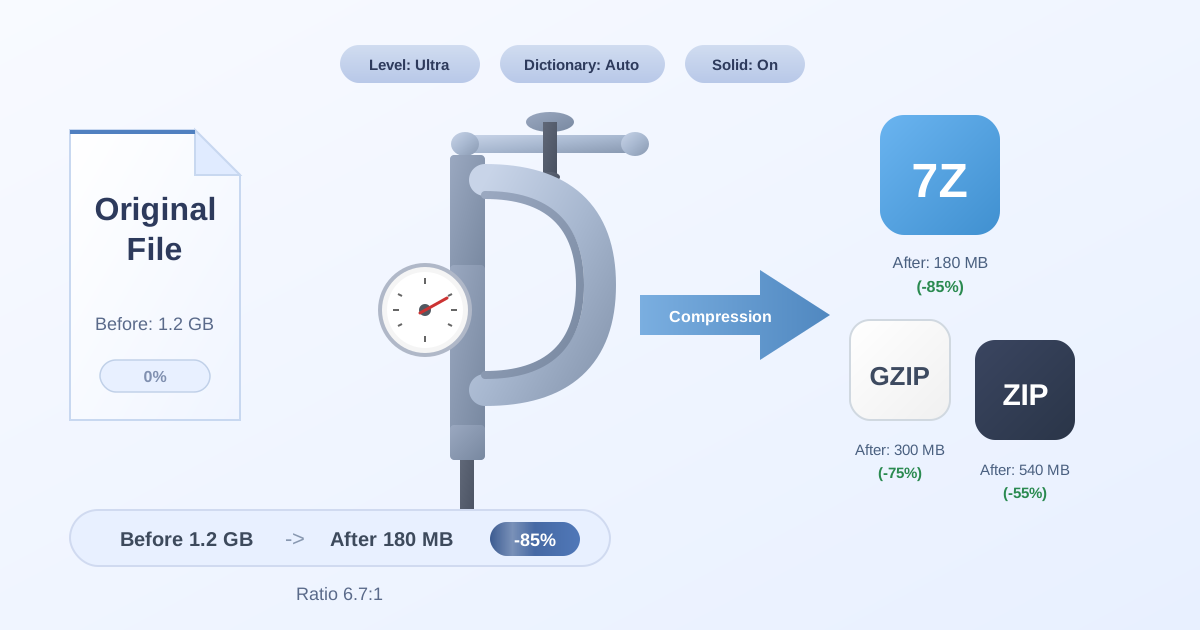
In today's digital world, these documents are usually submitted electronically. To keep everything organized, secure, and easy to send, it's a best practice to bundle them into a single, compressed archive file.
This is where a simple web tool can be incredibly helpful. To keep your private financial data off third-party servers, you can use our free and privacy-focused Compress Files tool. It lets you create a ZIP file from multiple documents right in your web browser. Your files are never uploaded, ensuring your information remains on your computer. This makes it easy to attach a single, organized file to an email or upload it to a lender's online portal.
On the flip side, you might receive important loan agreements or disclosure documents from your lender as a compressed file to save space. If you ever need to open an archive and don't have software installed, our simple Decompress Files tool can handle that instantly and securely in your browser.
While ZIP is the most common format, some systems might use others. Knowing how to convert between formats, like using a 7Z to ZIP converter, can be a handy skill for managing various digital documents you encounter.
Common Pitfalls to Avoid When Borrowing
Being armed with a loan calculator is your best defense against making a poor financial decision. Here are some common mistakes to watch out for:
- Ignoring Fees: Some loans come with origination fees or other charges. This is why comparing by APR, not just interest rate, is so critical, as the APR includes these fees.
- The Prepayment Penalty Trap: Ask if the loan has a prepayment penalty. This is a fee charged if you pay off the loan early. You always want the flexibility to pay off debt ahead of schedule without being penalized.
- Choosing a Variable Rate Without Understanding the Risk: A fixed-rate loan has an interest rate that stays the same for the entire term. A variable-rate loan can change over time. While it might start lower, it could increase significantly in the future, raising your monthly payment unexpectedly.
- Not Knowing Your Credit Score: Your credit score is one of the biggest factors determining the APR you'll be offered. Before you even start looking for loans, check your credit score and report to ensure there are no errors and to see where you stand.
Conclusion: Take Control of Your Financial Decisions
A loan is a powerful financial tool when used wisely, but it can become a burden when misunderstood. By leveraging a loan calculator, you move from being a passive consumer to an empowered, informed borrower. You can confidently analyze offers, understand the long-term costs, and choose the loan that aligns perfectly with your financial goals.
Remember the key takeaways: always compare loans using the APR, look at the total interest paid (not just the monthly payment), and understand the trade-offs of different loan terms. This knowledge, combined with the right tools, will help you save money and build a stronger financial future.
Now that you're equipped to make smarter loan decisions, explore our full suite of over 455+ free, privacy-focused tools at Practical Web Tools to simplify every aspect of your digital life!