Half-Life Calculator: The Ultimate Chemistry Guide
Ever wondered how archaeologists can confidently say a fossil is 30,000 years old? Or how doctors determine the precise timing for medication doses? The answer isn't magic; it's a fundamental scientific principle known as half-life. While it might sound like a complex term reserved for physicists in lab coats, the concept of half-life is surprisingly intuitive and incredibly powerful. It governs everything from nuclear energy to medical treatments.
This comprehensive guide will demystify the world of half-life. We'll break down the core formula, walk you through step-by-step calculations (just like a half-life calculator would), and explore its fascinating real-world applications. Whether you're a student tackling chemistry homework, a curious mind, or a professional needing a quick refresher, this guide will equip you with the knowledge to understand and calculate half-life with confidence.
What is Half-Life? The Core Concept Explained
At its heart, half-life is a measure of time. Specifically, it's the time required for a quantity of a substance to reduce to half of its initial value.
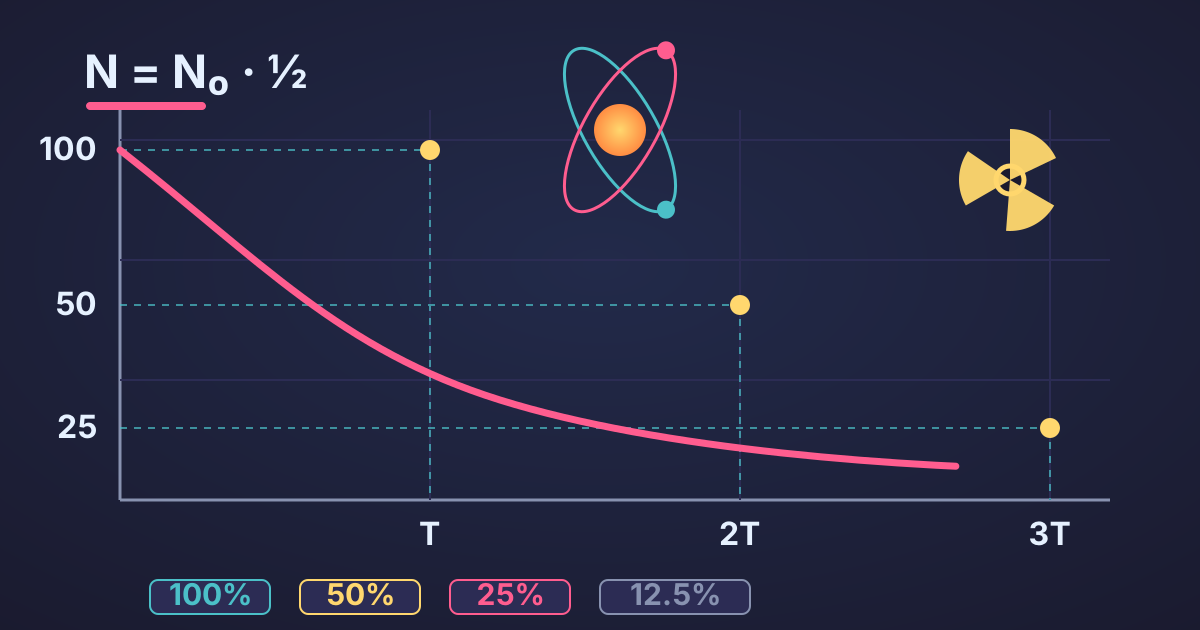
While this concept can apply to various processes, it's most famously associated with the radioactive decay of unstable atomic nuclei. Imagine you have a collection of 100 radioactive atoms. These atoms are unstable and will eventually transform, or "decay," into more stable atoms, releasing energy in the process. The half-life is the time it takes for 50 of those 100 atoms to decay.
After one half-life, you have 50 original atoms left. After a second half-life, half of the remaining 50 will decay, leaving you with 25. After a third half-life, you'll be left with about 12 or 13.
This process is called exponential decay. The amount of substance doesn't decrease by a fixed amount over time; it decreases by a fixed percentage (50%) of the remaining amount. This is why a radioactive substance never truly disappears completely—it just gets infinitely smaller.
It's crucial to understand that half-life is a probabilistic measure. You can't predict exactly when a single, specific atom will decay. However, for a large collection of atoms, the half-life provides a highly accurate average rate of decay.
The Half-Life Formula: Decoding the Math
To move from concept to calculation, we need a formula. The primary formula for half-life allows us to determine the amount of a substance remaining after a certain period.
The most common half-life formula is:
N(t) = N₀ * (1/2) ^ (t / T)
This might look intimidating, but let's break it down variable by variable. This is what any half-life calculator uses behind the scenes.
| Variable | Represents | Description |
|---|---|---|
| N(t) | Amount Remaining | The quantity of the substance that is left after a specific amount of time has passed. This is what you are often trying to find. |
| N₀ | Initial Amount | The starting quantity of the substance at time t=0. |
| t | Time Elapsed | The total duration over which the decay occurs. |
| T or t₁/₂ | Half-Life | The time it takes for half of the substance to decay. This is a constant for a given isotope. |
A Simple Example Calculation
Let's say you start with 200 grams of Carbon-14. The half-life of Carbon-14 is approximately 5,730 years. How much Carbon-14 will be left after 11,460 years?
-
Identify your variables:
- N₀ (Initial Amount) = 200 g
- t (Time Elapsed) = 11,460 years
- T (Half-Life) = 5,730 years
-
Plug them into the formula:
- N(t) = 200 * (1/2) ^ (11460 / 5730)
-
Solve the exponent:
- 11460 / 5730 = 2. This means two half-lives have passed.
-
Calculate the final amount:
- N(t) = 200 * (1/2) ^ 2
- N(t) = 200 * (1/4)
- N(t) = 50 g
So, after 11,460 years, 50 grams of Carbon-14 would remain.
The Decay Constant Formula
In more advanced physics and chemistry, you might encounter another formula involving the natural logarithm (e):
N(t) = N₀ * e^(-λt)
Here, the Greek letter lambda (λ) represents the decay constant. This constant is unique to each substance and is directly related to the half-life (T) by the formula:
T = ln(2) / λ (where ln(2) ≈ 0.693)
This version of the formula is particularly useful in calculus and for describing continuous decay processes.
How to Use a Half-Life Calculator: A Step-by-Step Guide
Whether you're using an online tool or solving problems by hand, the process follows a logical sequence. The key is to identify what you know and what you need to find.
Step 1: Identify Your Knowns
Look at the problem and list the values you have. You will typically have three of the four main variables: Initial Amount (N₀), Final Amount (N(t)), Time Elapsed (t), and Half-Life (T).
Step 2: Determine Your Unknown
What is the question asking you to find? Is it the remaining mass, the original mass, the age of the sample, or the half-life of the substance?
Step 3: Choose and Rearrange the Formula
Based on your unknown, you may need to rearrange the base formula. Here are the common scenarios:
- Finding the Remaining Amount: Use the standard formula:
N(t) = N₀ * (1/2) ^ (t / T) - Finding the Initial Amount: Rearrange to solve for N₀:
N₀ = N(t) / ((1/2) ^ (t / T)) - Finding the Time Elapsed (Age): This is common in carbon dating and requires logarithms to solve for
t. - Finding the Half-Life: This also requires logarithms to solve for
T.
Step 4: Plug in Values and Solve
Carefully substitute your known values into the correct formula and perform the calculation. Let's work through another example.
Example: Finding the Age of a Sample
A scientist discovers a fossilized bone that contains 25% of its original Carbon-14. Knowing the half-life of Carbon-14 is 5,730 years, how old is the bone?
-
Knowns:
- N(t) / N₀ = 0.25 (Since 25% remains, the ratio of final to initial is 0.25)
- T = 5,730 years
-
Unknown: Time elapsed (t)
-
Formula:
N(t) = N₀ * (1/2) ^ (t / T) -
Solve:
- Divide both sides by N₀:
N(t) / N₀ = (1/2) ^ (t / T) - Substitute the known ratio:
0.25 = (1/2) ^ (t / 5730) - Recognize that 0.25 is (1/2)². So,
(1/2)² = (1/2) ^ (t / 5730) - Now that the bases are equal, the exponents must be equal:
2 = t / 5730 - Solve for t:
t = 2 * 5730 = 11,460 years
- Divide both sides by N₀:
The fossil is approximately 11,460 years old. This demonstrates how two half-lives have passed.
Practical Applications of Half-Life in Chemistry and Beyond
Half-life isn't just a theoretical concept; it's a practical tool used across numerous scientific disciplines.
Radiocarbon Dating
This is the most famous application. Living organisms constantly absorb carbon from the atmosphere, including the radioactive isotope Carbon-14. When an organism dies, it stops absorbing carbon, and the Carbon-14 within it begins to decay at a predictable rate (half-life of ~5,730 years). By measuring the ratio of remaining Carbon-14 to stable Carbon-12, scientists can accurately determine the age of organic materials like bones, wood, and cloth up to about 50,000 years old.
Medical Imaging and Treatment
In medicine, radioactive isotopes (radioisotopes) with short half-lives are invaluable.
- Diagnostics: Technetium-99m has a half-life of about 6 hours and is the most commonly used medical radioisotope. It's attached to biological molecules and injected into the body. As it decays, it emits gamma rays that can be detected by a scanner, creating images of organs and blood flow (e.g., in PET scans). Its short half-life ensures it does its job and then quickly vanishes from the body, minimizing radiation exposure.
- Cancer Therapy: Cobalt-60 emits strong gamma rays that can be focused on tumors to destroy cancerous cells. Its longer half-life (5.27 years) makes it suitable for use in external beam radiotherapy machines.
Pharmacology
Every drug has a biological half-life, which is the time it takes for the concentration of the drug in the bloodstream to be reduced by half. This concept is critical for determining dosage schedules. A drug with a short half-life (e.g., 2-4 hours) may need to be taken multiple times a day to remain effective, while a drug with a long half-life (e.g., 24+ hours) might only require a once-daily dose.
Nuclear Power and Waste Management
The half-lives of nuclear fuels and their byproducts are a central concern in the energy sector. Uranium-235, the fuel for most nuclear reactors, has a half-life of over 700 million years. The waste products, like Plutonium-239, have half-lives of over 24,000 years. This incredibly long decay time is why the safe, long-term storage of nuclear waste is such a significant engineering and environmental challenge.
Managing and Sharing Your Chemistry Data
When you're working on complex half-life problems, lab reports, or extensive research projects, you'll inevitably accumulate a lot of data—spreadsheets with calculations, text documents with your findings, and maybe even simulation outputs. Over time, these files can become large and disorganized.
To make sharing this data with colleagues, submitting it for academic review, or simply archiving it for future reference, it's a great practice to Compress Files into a single, smaller archive like a ZIP file. This not only saves valuable disk space but also keeps all your related documents neatly bundled together.
On the receiving end, your professor or collaborator can easily use a tool to Decompress Files to access all the original data in one go. This streamlined workflow is essential for efficient scientific collaboration and data management.
For even better compression ratios, especially with very large datasets from scientific instruments, you might consider converting your archives. For instance, moving from a standard ZIP to a more efficient format is simple with an online ZIP to 7Z converter, helping you manage and transmit your research even more effectively.
Conclusion: Mastering the Concept of Half-Life
Half-life is more than just a formula in a chemistry textbook. It's a fundamental clock of the universe, ticking away in everything from ancient fossils to the medicine you take. By understanding its core principles—that it represents the time for 50% of a substance to decay through an exponential process—you unlock the ability to solve a vast range of practical problems.
We've broken down the formula, walked through clear examples, and explored its profound impact on science and technology. With this knowledge, you are no longer just looking at a problem; you are equipped to be the problem solver. You have the tools to calculate, analyze, and appreciate the elegant predictability of the natural world.
Now that you have a firm grasp on half-life calculations, explore our full suite of free, privacy-focused online tools at Practical Web Tools to help with your other projects, from data management and file conversions to text analysis and more!