Master Circle Calculations: Radius, Area, Circumference Guide

Your Complete Guide to Circle Calculations: From Radius to Area and Beyond
Circles are everywhere. From the wheels on your car to the pupils in your eyes, this fundamental geometric shape is an integral part of our world. Whether you're a student tackling a geometry problem, a designer mapping out a user interface, a DIY enthusiast planning a new garden, or an engineer designing a new part, understanding how to calculate a circle's properties is an essential skill. It might seem daunting at first, with terms like radius, circumference, and the mysterious number Pi (π), but the concepts are surprisingly straightforward.
This comprehensive guide will demystify the world of circle calculations. We'll break down each component, provide clear, easy-to-use formulas, walk through practical examples, and show you how to apply this knowledge to real-world problems. By the end, you'll be able to calculate the radius, diameter, circumference, and area of any circle with confidence.
Understanding the Core Components of a Circle
Before we can start calculating, we need to speak the language of circles. Let's define the key terms you'll encounter.
What is a Radius? (r)
The radius is the distance from the exact center of the circle to any point on its outer edge. It's the foundational measurement from which most other calculations are derived. Think of it as a single spoke on a bicycle wheel.
What is a Diameter? (d)
The diameter is the distance across the circle, passing through its center. It's essentially two radii placed end-to-end in a straight line. The relationship is simple: the diameter is always twice the length of the radius (d = 2r).
What is Circumference? (C)
The circumference is the distance around the circle. If you were to take a piece of string, wrap it perfectly around the edge of a circle, and then straighten it out, its length would be the circumference. It's the perimeter of a circle.
What is Area? (A)
The area of a circle is the total space enclosed within its boundary (the circumference). It tells you how much surface the circle covers, measured in square units (like square inches or square meters).
The Magic of Pi (π)
Pi (π) is a special mathematical constant. It is the ratio of a circle's circumference to its diameter. No matter how big or small a circle is, this ratio is always the same. Pi is an irrational number, meaning its decimal representation never ends and never repeats. For most calculations, Pi is commonly approximated as 3.14159 or the fraction 22/7.
The Essential Circle Formulas
Memorizing these core formulas is the key to mastering circle calculations. Here’s a quick reference table, followed by a detailed breakdown of each.
| To Find | Given | Formula |
|---|---|---|
| Radius (r) | Diameter (d) | r = d / 2 |
| Circumference (C) | r = C / (2π) |
|
| Area (A) | r = √(A / π) |
|
| Diameter (d) | Radius (r) | d = 2r |
| Circumference (C) | d = C / π |
|
| Circumference (C) | Radius (r) | C = 2πr |
| Diameter (d) | C = πd |
|
| Area (A) | Radius (r) | A = πr² |
How to Calculate Circumference
Calculating the distance around a circle is useful for finding the length of fencing needed for a circular garden or the distance a wheel travels in one rotation.
Using the Radius: The formula is C = 2πr.
- Measure the radius (r). Let's say you have a circle with a radius of 5 cm.
- Multiply the radius by 2.
5 cm * 2 = 10 cm. - Multiply the result by Pi (π).
10 cm * 3.14159 = 31.4159 cm. The circumference is approximately 31.42 cm.
Using the Diameter: The formula is C = πd.
- Measure the diameter (d). Let's use a circle with a diameter of 12 inches.
- Multiply the diameter by Pi (π).
12 in * 3.14159 = 37.69908 in. The circumference is approximately 37.7 inches.
How to Calculate Area
Calculating the area tells you how much space a circle occupies. This is crucial for determining the amount of paint needed for a circular mural or the size of a round pizza.
Using the Radius: The formula is A = πr².
- Measure the radius (r). Let's take a circle with a radius of 8 meters.
- Square the radius. This means multiplying the radius by itself:
8 m * 8 m = 64 m². - Multiply the result by Pi (π).
64 m² * 3.14159 = 201.06176 m². The area is approximately 201.06 square meters.
A common mistake is to multiply the radius by 2 instead of squaring it. Always remember: Area uses the radius squared (r²).
How to Calculate Radius and Diameter
Sometimes, you have the area or circumference and need to work backward to find the radius or diameter.
Finding Radius from Circumference:
- Formula:
r = C / (2π) - Example: If C = 50 feet, then
r = 50 / (2 * 3.14159) = 50 / 6.28318 = 7.957 ft.
Finding Radius from Area:
- Formula:
r = √(A / π) - Example: If A = 100 sq. inches, then
r = √(100 / 3.14159) = √31.83 = 5.64 in.
Once you have the radius, finding the diameter is easy: just multiply the radius by 2.
Practical Applications: Where Circle Calculations Matter
The ability to calculate the properties of a circle is not just an academic exercise. It has countless applications in various fields.
Engineering and Construction
Engineers constantly use circle formulas to design pipes, tunnels, gears, and wires. They need to calculate the cross-sectional area to determine flow rates, stress tolerance, and capacity. When building a circular structure like a silo or a water tank, calculating the circumference and area is fundamental to determining the materials needed.
Design and Art
Graphic designers and UI/UX designers use circles for logos, buttons, icons, and data visualizations like pie charts. Accurately calculating the area and circumference helps ensure proper scaling, alignment, and visual balance. Architects use these formulas to design curved walls, arches, and domes.
Everyday Life
Even in daily tasks, circle calculations are useful. Comparing pizza deals? Calculate the area of a 16-inch pizza versus two 10-inch pizzas to see which is a better value. (Hint: the single 16-inch pizza has more area!). Planning a garden? Calculate the area to determine how much soil and fertilizer you need. Cyclist? Calculate your wheel's circumference to know how far you travel with each rotation.
Managing Your Design and Data Files
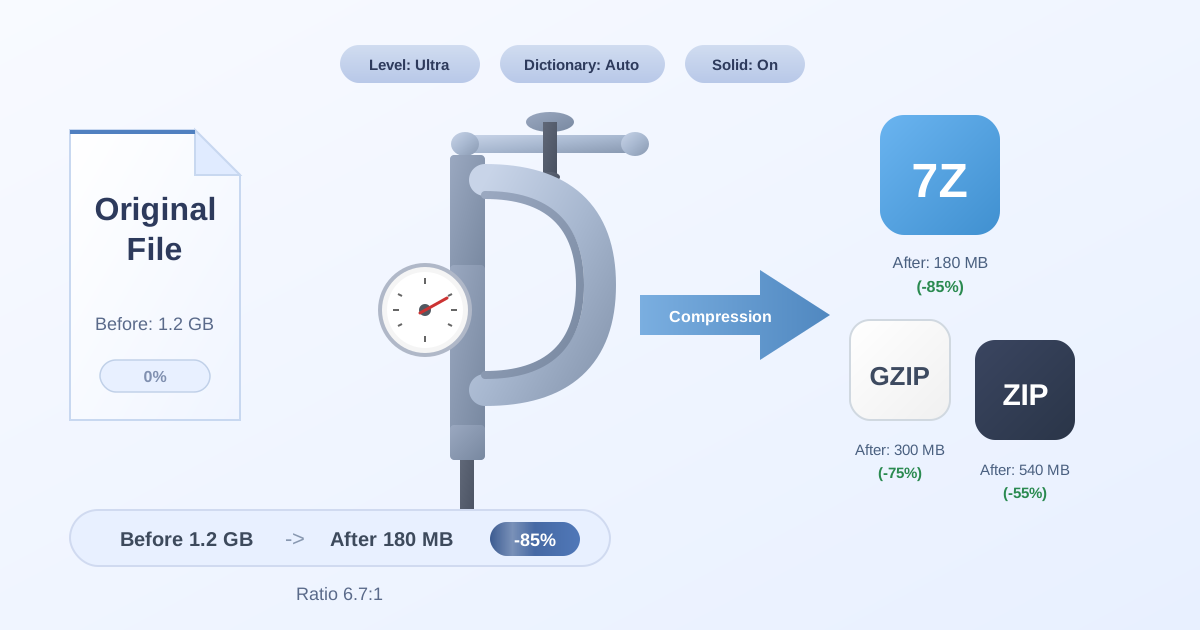
When you work on projects involving these calculations—be it a CAD drawing for an engineering part, a vector-based logo, or a spreadsheet with scientific data—you're creating digital files. These project files, especially high-resolution designs or large datasets, can quickly become bulky.
Managing these files efficiently is crucial for a smooth workflow, especially when collaborating with a team or sending deliverables to a client. Large files consume storage space and can be slow to upload or email. This is where file compression comes in.
Before sharing your project folder, which might contain blueprints, design mockups, and calculation sheets, it’s a great practice to Compress Files into a single ZIP archive. This not only reduces the total file size, making it easier to transfer, but also keeps all related documents neatly packaged together. Our free online tool handles this in seconds, right in your browser.
Similarly, when you receive a project archive from a colleague, you'll need an easy way to access its contents. Instead of relying on built-in operating system tools that can sometimes be clunky, you can use a dedicated utility to Decompress Files and extract everything you need to get started.
Step-by-Step Example: Planning a Circular Patio
Let's put everything together with a practical, real-world example. Imagine you want to build a circular stone patio in your backyard. You've decided the patio should have a diameter of 12 feet.
Goal: Calculate the radius, circumference (for the edging material), and area (for the paver stones).
-
Find the Radius (r):
- We know the diameter (d) is 12 feet.
- The formula is
r = d / 2. r = 12 ft / 2 = 6 ft.- The radius of your patio is 6 feet.
-
Find the Circumference (C):
- We need to know the total length for the flexible edging that will go around the patio.
- The formula is
C = πd. C = 3.14159 * 12 ft = 37.69908 ft.- You will need to buy approximately 37.7 feet of edging material.
-
Find the Area (A):
- We need to know the total square footage to buy the right amount of paver stones and sand.
- The formula is
A = πr². - First, square the radius:
6 ft * 6 ft = 36 sq ft. - Now, multiply by Pi:
A = 3.14159 * 36 sq ft = 113.09724 sq ft. - You will need to cover approximately 113.1 square feet with pavers.
With these three simple calculations, you now have all the critical measurements needed to start your patio project.
Frequently Asked Questions (FAQ) for Circle Calculations
Q1: What is the exact value of Pi (π)?
Pi is an irrational number, so it cannot be expressed as a simple fraction and its decimal representation is infinite. For most practical purposes, using 3.14159 is more than accurate enough. For quick mental estimates, 3.14 is often sufficient.
Q2: What's the main difference between circumference and area? Circumference is a one-dimensional measurement of length—the distance around the circle. It's measured in units like inches, feet, or meters. Area is a two-dimensional measurement of space—the surface inside the circle. It's measured in square units like square inches, square feet, or square meters.
Q3: Can I find the area if I only know the circumference?
Yes! You can work backward. First, use the circumference to find the radius with the formula r = C / (2π). Once you have the radius, you can use it to find the area with the formula A = πr². It's a two-step process, but perfectly achievable.
Q4: Why is the area formula πr²?
An intuitive way to understand this is to imagine cutting a circle into many tiny pizza-like slices and rearranging them into a shape that looks like a rectangle. The height of this "rectangle" would be the circle's radius (r), and its width would be half of the circumference (because half the slices are on top and half are on the bottom). Since C = 2πr, half the circumference is πr. The area of a rectangle is height × width, which in this case is r * πr, giving us πr².
Conclusion: You've Mastered the Circle
From the radius that defines its size to the circumference that encloses it and the area it contains, the properties of a circle are governed by a few elegant and powerful formulas. By understanding the relationships between radius, diameter, Pi, circumference, and area, you've equipped yourself with a versatile problem-solving tool applicable in countless scenarios.
Now that you can confidently calculate a circle's dimensions, you're ready to tackle any project that comes your way. And as you manage the digital side of those projects, remember that having the right tools for every task is key. Explore the wide range of free, privacy-focused utilities at Practical Web Tools to help you convert, edit, and manage your files with ease.