Mastering Molarity: Your Ultimate Chemistry Solutions Guide

Your Guide to Molarity Calculator and Chemistry Solutions
Chemistry can often feel like a world of abstract concepts and complex calculations. For students and lab professionals alike, one of the most fundamental and frequently used concepts is molarity. Whether you're preparing a solution for a titration experiment, conducting biochemical assays, or simply trying to ace your chemistry exam, understanding molarity is non-negotiable. But let's be honest: manual calculations can be tedious and prone to error. A simple slip of a decimal point can throw off an entire experiment.
This is where a molarity calculator comes in. It’s a powerful digital tool that streamlines the process, ensuring accuracy and saving precious time. But a tool is only as good as the person using it. This comprehensive guide will not only show you how to use a molarity calculator effectively but will also dive deep into the core concepts behind it. We'll break down the molarity formula, walk through step-by-step examples, and explore common pitfalls to avoid. By the end, you'll be able to calculate solution concentrations with confidence, whether you're using a calculator or doing it by hand.
What is Molarity? The Core Concept Explained
Before we can master the calculations, we must first understand the concept. In the simplest terms, molarity is a measure of the concentration of a solution. It tells you how much of a substance (called the solute) is dissolved in a certain amount of liquid (called the solvent).
Here’s the official definition:
Molarity (M) is defined as the number of moles of solute per liter of solution.
Let's break down those key terms:
- Solute: The substance that is being dissolved. For example, if you're making saltwater, the salt (sodium chloride, NaCl) is the solute.
- Solvent: The liquid that is doing the dissolving. In the saltwater example, the water (H₂O) is the solvent.
- Solution: The uniform mixture that results from dissolving the solute in the solvent. The saltwater itself is the solution.
Think of it like making coffee. The coffee grounds are the solute, the hot water is the solvent, and the final brewed coffee is the solution. Molarity would be a way to describe how strong that coffee is.
The Molarity Formula: Breaking It Down
The entire concept of molarity is captured in a single, elegant formula. Understanding this formula is the key to all molarity-related calculations.
The Molarity Formula:
Molarity (M) = Moles of Solute / Liters of Solution
Let's look at each component:
- Molarity (M): This is what you are often trying to find. Its units are moles per liter (mol/L). The unit is often abbreviated with a capital 'M'. So, a 6 M HCl solution means there are 6 moles of hydrochloric acid for every 1 liter of solution.
- Moles of Solute: This represents the amount of the substance being dissolved. A mole is a specific quantity in chemistry, like how a 'dozen' means 12. One mole is equal to approximately 6.022 x 10²³ particles (Avogadro's number). You rarely measure moles directly; instead, you calculate them from the mass of the substance.
- Liters of Solution: This is the total volume of the final solution, not just the volume of the solvent you started with. This is a critical distinction because adding a solute can sometimes change the volume slightly.
How to Calculate Moles from Grams
A common prerequisite for finding molarity is converting the mass of your solute (which you can measure on a scale) into moles. To do this, you need another simple formula and a piece of information called the molar mass.
Moles = Mass of Substance (g) / Molar Mass (g/mol)
- Molar Mass (or Molecular Weight): This is the mass of one mole of a substance. You calculate it by adding up the atomic masses of each atom in the molecule, which you can find on the periodic table.
Example: Finding the Molar Mass of Sodium Chloride (NaCl)
- Find the atomic mass of Sodium (Na) on the periodic table: ~22.99 g/mol.
- Find the atomic mass of Chlorine (Cl) on the periodic table: ~35.45 g/mol.
- Add them together: 22.99 + 35.45 = 58.44 g/mol.
So, the molar mass of NaCl is 58.44 g/mol.
Step-by-Step Manual Calculation (A Practical Example)
Let's put it all together. Imagine you need to prepare a solution by dissolving 29.22 grams of NaCl in enough water to make a final solution volume of 500 mL. What is the molarity?
Step 1: List Your Knowns
- Mass of solute (NaCl): 29.22 g
- Volume of solution: 500 mL
- Identity of solute: NaCl
Step 2: Calculate the Molar Mass of the Solute
- As we calculated above, the molar mass of NaCl is 58.44 g/mol.
Step 3: Convert the Mass of Solute to Moles
- Use the formula:
Moles = Mass / Molar Mass - Moles = 29.22 g / 58.44 g/mol = 0.5 moles
Step 4: Convert the Solution Volume to Liters
- The molarity formula requires liters, but we have milliliters. Remember that 1 L = 1000 mL.
- Volume in Liters = 500 mL / 1000 mL/L = 0.5 L
Step 5: Calculate the Molarity
- Now, plug your values into the main formula:
Molarity = Moles / Liters - Molarity = 0.5 moles / 0.5 L = 1.0 mol/L
Answer: The molarity of the solution is 1.0 M.
Why Use a Molarity Calculator? Speed, Accuracy, and Efficiency
While the manual calculation above is straightforward, it involves multiple steps where errors can occur—a misplaced decimal, a calculator typo, or a forgotten unit conversion.
An online molarity calculator automates this entire process, offering several key advantages:
- Speed: It provides instant answers, which is invaluable when you need to perform many different calculations quickly.
- Accuracy: By eliminating manual steps, it significantly reduces the risk of human error.
- Convenience: Most calculators handle unit conversions for you. You can input volume in mL and mass in mg, and the tool will convert them correctly behind the scenes.
- Flexibility: You can use it to solve for any variable. If you know the desired molarity and volume, a good calculator can tell you exactly how many grams of solute you need to weigh out.
Managing Your Chemistry Data and Lab Reports
In any scientific endeavor, from academic labs to industrial research, data management is crucial. Your calculations, experimental procedures, raw data, and final reports constitute a significant body of work. Keeping this information organized and accessible is key to successful project completion and collaboration.
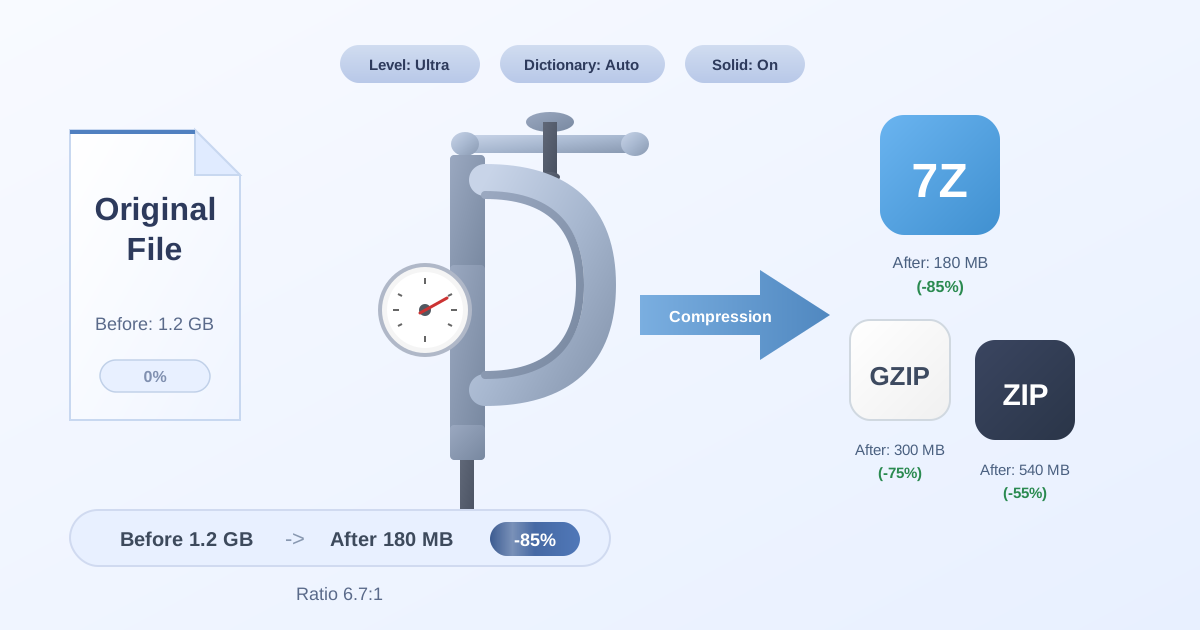
When you're working with a team or submitting your findings, you often have multiple files—spreadsheets with your molarity calculations, documents with your analysis, and images of your results. Emailing these one by one is inefficient. A better approach is to bundle them together. To keep your project files tidy and reduce their size for easier emailing, you can use a tool to Compress Files into a single ZIP archive. This not only saves space but also ensures all related documents stay together.
Furthermore, scientific collaboration is global. You might receive data from a colleague in a different archive format, like 7Z or TAR. If you need to share it with someone whose system only easily handles ZIP files, you can use an online converter. For instance, a 7Z to ZIP converter allows you to quickly change the format without needing to install special software. These privacy-focused web tools are perfect for handling sensitive research data, as they process your files without storing them long-term.
Common Pitfalls in Molarity Calculations (and How to Avoid Them)
Whether using a calculator or working by hand, certain mistakes pop up frequently. Being aware of them is the first step to avoiding them.
1. Unit Conversion Errors
This is by far the most common mistake. The molarity formula is strict: it requires moles and liters.
- Volume: Always convert milliliters (mL), cubic centimeters (cm³), or other volume units to liters (L) before calculating. (1 L = 1000 mL).
- Mass: Ensure your mass is in grams (g) before converting to moles, as molar mass is almost always expressed in g/mol. Convert milligrams (mg) or kilograms (kg) accordingly.
2. Incorrect Molar Mass
An incorrect molar mass will make every subsequent calculation wrong. Always double-check your atomic masses from a reliable periodic table and be careful with your addition, especially for complex molecules with many atoms.
3. Confusing Solvent Volume with Solution Volume
Molarity is based on the final volume of the entire solution. When you dissolve a solid in a liquid, the final volume may be slightly different from the initial volume of the solvent. For precise work, chemists prepare solutions by dissolving the solute in a portion of the solvent and then adding more solvent until the desired final volume is reached in a volumetric flask.
Beyond Basic Molarity: Other Important Calculations
Once you've mastered molarity, you can tackle other common chemistry calculations.
Dilution Calculations
Often in a lab, you start with a highly concentrated 'stock' solution and dilute it to create less concentrated solutions for use in experiments. The formula for this is:
M₁V₁ = M₂V₂
Where:
- M₁ = Molarity of the stock solution
- V₁ = Volume of the stock solution
- M₂ = Molarity of the diluted solution
- V₂ = Volume of the diluted solution
You can use this formula to find any of the four variables if you know the other three. For example, it can tell you how much of a stock solution you need to use to create a specific volume and concentration of a diluted solution.
Calculating Mass Needed for a Target Molarity
This is a very practical skill. Let's say you need to prepare 250 mL of a 0.75 M KCl solution. How many grams of potassium chloride (KCl) do you need?
You can rearrange the molarity formula to solve for mass:
- Start with
Molarity = Moles / Liters - Rearrange to find moles:
Moles = Molarity * Liters - We also know
Moles = Mass / Molar Mass - Combine them:
Mass / Molar Mass = Molarity * Liters - Solve for Mass:
Mass (g) = Molarity (mol/L) * Volume (L) * Molar Mass (g/mol)
Example Calculation:
- Molarity: 0.75 M
- Volume: 250 mL = 0.250 L
- Molar Mass of KCl: 39.10 (K) + 35.45 (Cl) = 74.55 g/mol
- Calculate Mass: Mass = 0.75 * 0.250 * 74.55 = 13.98 grams
You would need to weigh out 13.98 grams of KCl.
Conclusion: From Calculation to Comprehension
Molarity is more than just a formula; it's a fundamental language of chemistry that allows scientists to precisely control the composition of solutions. While an online molarity calculator is an indispensable tool for ensuring speed and accuracy, a true understanding of the underlying principles is what empowers you to solve complex problems, design experiments, and interpret results with confidence.
By mastering the concepts of moles, molar mass, and unit conversions, you transform a calculator from a magic box into a powerful assistant. You can now confidently tackle any solution concentration problem that comes your way.
We encourage you to explore the wide range of practical, privacy-focused tools available on Practical Web Tools. From data management tools that let you Decompress Files to other converters and editors, our goal is to make your digital tasks simpler and more secure. Bookmark our site and make it your go-to resource for all your practical web tool needs.