Annuity Calculator: Your Ultimate Guide to Retirement Income

Your Roadmap to a Secure Retirement Starts Here
Planning for retirement can feel like navigating a complex map without a compass. You have a destination in mind—a comfortable, stress-free future—but the paths to get there are numerous and often confusing. One of the most powerful yet misunderstood vehicles for this journey is the annuity. What if you could turn a portion of your savings into a guaranteed income stream that lasts for the rest of your life? That's the promise of an annuity.
But how much income can you actually expect? How do different interest rates, investment amounts, and timelines affect your future payments? The guesswork can be paralyzing. This is where an annuity calculator becomes your most trusted navigational tool. This comprehensive guide will not only demystify annuities but also provide a step-by-step walkthrough of using a calculator to chart a clear course toward your financial goals.
Understanding Annuities: Your Personal Pension Plan
At its core, an annuity is a contract between you and an insurance company. You make a payment or a series of payments (the principal), and in return, the insurer agrees to make periodic payments back to you, either immediately or at some point in the future. Think of it as creating your own personal pension.
The world of annuities can be complex, but they generally fall into a few key categories. Understanding these distinctions is the first step in making an informed decision.
Key Types of Annuities
| Annuity Type | Description | Best For... |
|---|---|---|
| Fixed Annuity | The insurance company guarantees a fixed interest rate on your investment and, consequently, a fixed payout amount. | Individuals seeking predictable, guaranteed income with low risk. |
| Variable Annuity | Your principal is invested in sub-accounts (similar to mutual funds). Payouts fluctuate based on the performance of these investments. | Individuals with a higher risk tolerance who are seeking greater potential returns. |
| Indexed Annuity | A hybrid option. Returns are tied to the performance of a market index (like the S&P 500), but with a cap on gains and a floor on losses. | Those who want the potential for market growth with downside protection. |
| Immediate Annuity | Payouts begin almost immediately after you make a lump-sum payment (typically within one year). | Retirees who need to convert savings into an immediate and steady income stream. |
| Deferred Annuity | Payouts are delayed until a future date that you choose. During the deferral period (the accumulation phase), your money grows tax-deferred. | Individuals still in their working years who are building their retirement nest egg. |
The Power of Precision: Why an Annuity Calculator is Essential
An annuity calculator is a digital tool that models the future performance of an annuity. By inputting a few key variables, you can eliminate speculation and gain a clear picture of your potential financial future. Here’s why it’s an indispensable part of your retirement planning toolkit:
- Eliminates Guesswork: See concrete numbers for your future monthly or annual income.
- Compares Scenarios: Easily model how changing your principal, timeline, or interest rate impacts your returns. What if you invested $50,000 more? What if you retired five years later? A calculator gives you instant answers.
- Sets Realistic Goals: Understand what it will take to reach your desired retirement income level.
- Aids in Product Selection: Compare potential payouts from different types of annuities and products offered by various companies.
- Empowers Decision-Making: Armed with data, you can have more productive conversations with a financial advisor and make choices that align with your personal goals.
How to Use an Annuity Calculator: A Practical Walkthrough
Let's walk through a hypothetical scenario to see the calculator in action. Meet Alex, who is 55 years old and planning to retire at 65. Alex has saved $250,000 to purchase a deferred fixed annuity.
Here are the steps and inputs Alex would use:
Step 1: Determine the Annuity Type
Alex wants guaranteed income in retirement, so he's looking at a deferred fixed annuity. His payments won't start for 10 years.
Step 2: Enter the Principal Amount
This is the initial investment. In a calculator, this field might be labeled "Starting Principal" or "Annuity Amount."
- Alex's Input: $250,000
Step 3: Input the Interest Rate
For a fixed annuity, this is the guaranteed annual growth rate during the accumulation phase. For variable or indexed annuities, this would be an estimated average rate of return.
- Alex's Input: 4.5% (the guaranteed rate offered on his chosen product)
Step 4: Define the Accumulation Period
This is the time between when you fund the annuity and when you start receiving payments. Alex is waiting 10 years.
- Alex's Input: 10 years
Step 5: Specify the Payout Period
How long do you want to receive payments? This could be a fixed term (e.g., 20 years) or for your lifetime. Let's assume Alex chooses a 20-year payout period.
- Alex's Input: 20 years
Step 6: Review the Results
The calculator will process these inputs and provide a detailed summary.
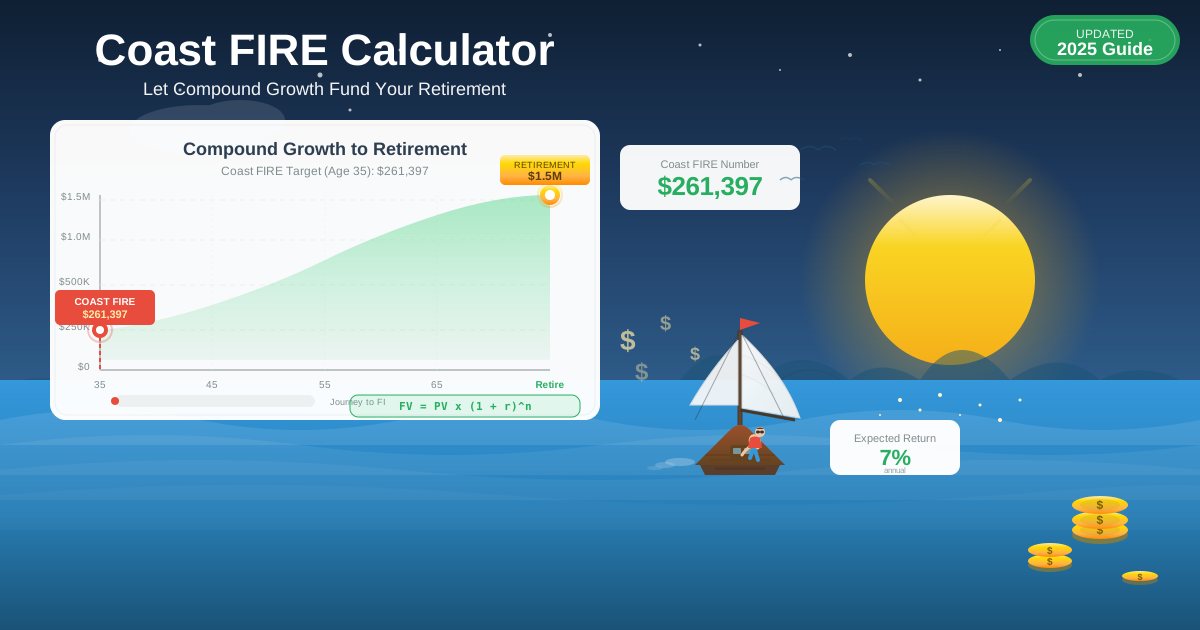
- Future Value at Payout: The calculator first determines how much Alex's $250,000 will grow to in 10 years at 4.5%. The result is approximately $388,275.
- Periodic Payout: The calculator then uses this future value to determine the monthly payout over a 20-year period. The result is approximately $2,455 per month.
- Total Payouts: $2,455/month x 12 months/year x 20 years = $589,200
- Total Interest Earned: $589,200 (Total Payouts) - $250,000 (Initial Principal) = $339,200
This simple exercise transforms an abstract goal into a tangible plan. Alex now knows that his $250,000 investment can generate a reliable $2,455 per month to supplement his other retirement income.
Organizing Your Financial Future: Managing Annuity Documents
As you research annuities and run calculations, you'll accumulate a significant amount of digital paperwork. Financial advisors will send you prospectuses, product comparisons, illustrations, and application forms. Keeping these documents organized and secure is a critical, but often overlooked, part of the process.
Often, to save space and keep related documents together, advisors will send a package of files in a single compressed folder. Before you can review the contents, you’ll need a simple way to access them. Our free Decompress Files tool allows you to quickly and safely extract files from ZIP, 7Z, TAR, and other archive formats right in your browser, without needing to install any software.
Once you've made a decision and purchased an annuity, you'll receive a contract and regular statements. These documents can be large, especially high-resolution PDF files. To save storage space on your computer or to email them securely to a family member or estate planner, it's wise to shrink them down. You can easily Compress Files with our tool, which reduces file size while maintaining document quality.
Occasionally, you might encounter compatibility issues. For instance, an advisor might send a .7z file, which your computer can't open by default. Instead of searching for complex software, you can use a simple online converter. A quick 7Z to ZIP conversion makes the files universally accessible.
Navigating the Nuances: What Calculators Don't Always Tell You
Annuity calculators are fantastic for providing a baseline understanding, but they are simplified models. To get a complete picture, you must also consider the following factors:
Fees and Charges
Annuities are not free. Be aware of potential costs that can impact your returns:
- Surrender Charges: Significant penalties if you withdraw money before a specified term (often 7-10 years).
- Administrative Fees: Flat fees or a percentage of your account value to cover record-keeping.
- Mortality & Expense (M&E) Risk Charges: Specific to variable annuities, these fees compensate the insurance company for the risks it assumes.
- Investment Management Fees: Fees for the underlying sub-accounts in a variable annuity.
The Impact of Inflation
A fixed payment of $2,500 per month sounds great today, but what will its purchasing power be in 20 years? Inflation erodes the value of fixed income streams over time. Some annuities offer a Cost-of-Living Adjustment (COLA) rider, which increases your payments over time to help counteract inflation, but this will result in lower initial payments.
Tax Implications
Growth within a deferred annuity is tax-deferred, which is a major benefit. However, when you start receiving payments, the earnings portion is taxed as ordinary income, not at the lower capital gains rate. The tax rules depend on whether the annuity is qualified (funded with pre-tax dollars, like in an IRA) or non-qualified (funded with after-tax dollars).
Frequently Asked Questions (FAQs) About Annuities
1. Are annuities a safe investment?
Fixed annuities are generally considered very safe, as they are backed by the financial strength and claims-paying ability of the issuing insurance company. They are not FDIC-insured like bank CDs, but they are protected by state-level guaranty associations up to certain limits. Variable annuities involve market risk and can lose value.
2. What's the difference between an annuity and a 401(k)?
A 401(k) is a retirement savings plan designed for wealth accumulation. An annuity is an insurance product designed for wealth distribution, providing a guaranteed income stream. You can, and many people do, use funds from a 401(k) to purchase an annuity upon retirement.
3. How much does a $100,000 annuity pay per month?
There is no single answer. The monthly payout from a $100,000 annuity depends heavily on your age, gender, the type of annuity, the payout period, and the interest rates at the time of purchase. An immediate fixed annuity for a 65-year-old male might pay a different amount than one for a 70-year-old female. The only way to know for sure is to get quotes and use an annuity calculator with specific inputs.
Take Control of Your Retirement Planning Today
An annuity can be a cornerstone of a stable and secure retirement, providing the peace of mind that comes with a predictable income stream. By leveraging an annuity calculator, you move from abstract hopes to a data-driven strategy. You can model different outcomes, understand the impact of your decisions, and build a plan that truly works for you.
Planning for the future is an ongoing process of learning and adapting. As you continue to organize your financial life, remember that having the right tools makes all the difference. Explore the wide range of free and privacy-focused utilities at Practical Web Tools to manage your documents, convert files, and streamline your digital life.