Master Your Debt: A Guide to Credit Card Payoff Calculators

Your Path to Financial Freedom Starts Here
Credit card debt can feel like a heavy weight, an endless cycle of monthly payments where the balance barely seems to budge. You make payments diligently, but the high interest rates keep you tethered, making financial progress feel slow or even impossible. It's a frustrating position, but what if you had a tool that could cut through the confusion, provide a clear roadmap, and show you the exact date you could be debt-free?
That tool is the credit card payoff calculator.
Often overlooked as a simple number-cruncher, a payoff calculator is one of the most powerful resources in your financial arsenal. It transforms abstract debt into a concrete plan with a finish line. This guide will demystify these calculators, showing you not just how to use one, but how to leverage it to create powerful strategies, save thousands in interest, and accelerate your journey to becoming debt-free.
What Exactly is a Credit Card Payoff Calculator?
A credit card payoff calculator is a digital tool designed to give you a clear, data-driven picture of your debt repayment journey. At its core, it answers two fundamental questions: "When will I be debt-free?" and "How much will I pay in interest?"
To do this, it uses a straightforward amortization formula based on three key pieces of information that you provide:
- Current Credit Card Balance: This is the total amount you currently owe. You can find this on your most recent credit card statement or by logging into your online account.
- Annual Percentage Rate (APR): This is the interest rate your credit card company charges on your balance over a year. It's crucial to use the exact APR for an accurate calculation, as even a small difference can have a big impact over time.
- Monthly Payment: This is the amount you plan to pay each month. You can input your current payment, the minimum payment, or an aspirational amount you'd like to pay.
Once you enter this data, the calculator instantly processes it and provides several critical outputs:
- Your Payoff Date: It will give you the month and year you will make your final payment.
- Total Interest Paid: This is often the most eye-opening number. It shows you the total cost of your debt beyond the original amount you borrowed.
- Total Payments Made: The sum of your original balance plus all the interest paid.
- Amortization Schedule (in advanced calculators): A detailed, month-by-month breakdown showing how each payment is split between principal and interest, and how your balance decreases over time.
This isn't just about numbers; it's about clarity. Seeing that you could be debt-free by a specific date, or that paying an extra $50 a month could save you $2,000 in interest, transforms a vague goal into an achievable mission.
How Credit Card Interest Really Works (A Quick Primer)
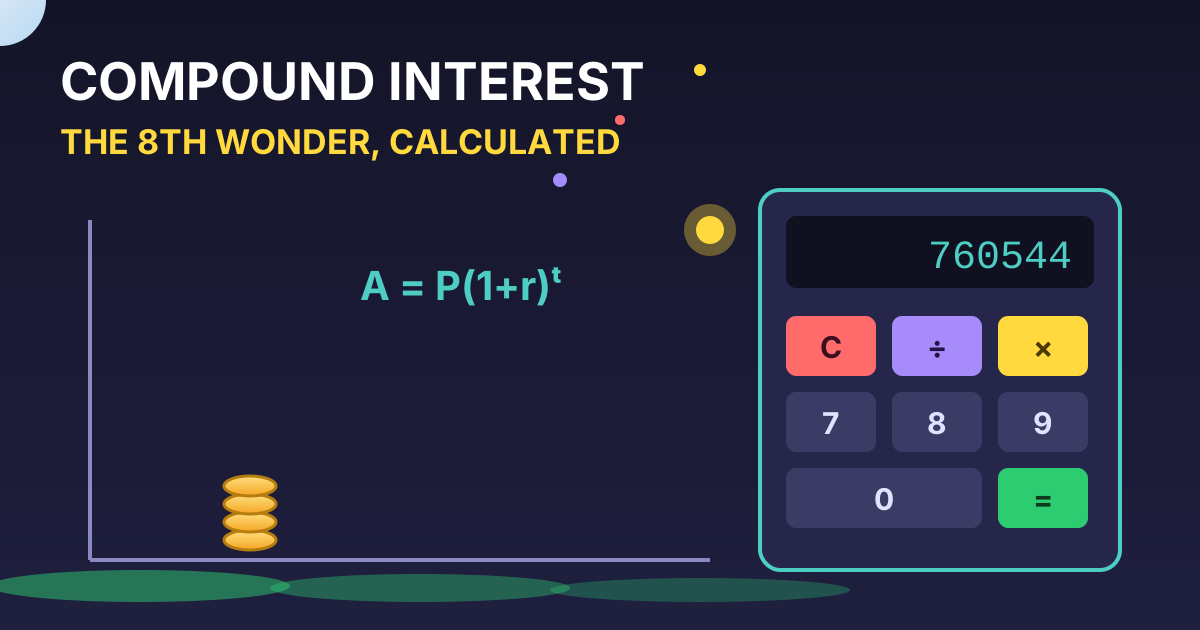
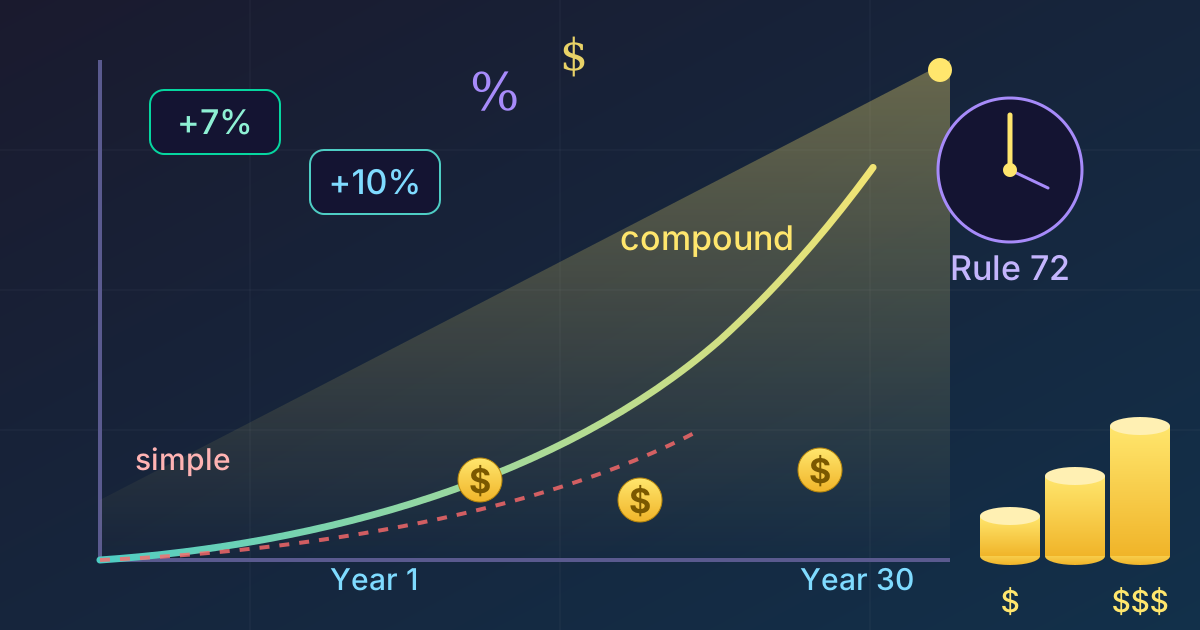
To truly appreciate why a payoff calculator is so essential, you need to understand the force it's helping you fight: compound interest. When it comes to debt, compound interest works against you, causing your balance to grow if you're not paying it down aggressively.
Your APR, or Annual Percentage Rate, isn't just applied once a year. It's typically broken down into a daily or monthly rate. Let's say your APR is 21.99%. The credit card company might divide this by 365 to get a daily periodic rate of about 0.06%. Every day, they calculate the interest on your current balance and add it to the total. The next day, they calculate the interest on the new, slightly larger balance. This is compounding.
This is why making only the minimum payment is such a dangerous financial trap. Minimum payments are often calculated as a small percentage of your balance (e.g., 1-2%) plus interest and fees. This means the vast majority of your payment goes toward interest, with very little reducing the principal you actually owe.
Let's see the stark difference a fixed payment makes compared to the minimum.
Minimum Payment vs. Fixed Payment Example
Imagine a $5,000 balance with a 19.99% APR.
| Metric | Paying Minimum Only (~2%) | Paying a Fixed $200/month |
|---|---|---|
| Payoff Time | Over 20 years | 2 years, 11 months |
| Total Interest Paid | Over $7,500 | $1,555 |
| Total Paid | Over $12,500 | $6,555 |
As the table clearly shows, sticking to the minimum payment would cost you more in interest than the original amount you borrowed and keep you in debt for decades. By committing to a fixed payment of $200, you save nearly $6,000 and free yourself from that debt 17 years sooner. This is the kind of powerful insight a payoff calculator delivers instantly.
Step-by-Step Guide: Using a Payoff Calculator Effectively
A calculator is only as good as the data you put in and the strategies you build from its results. Follow these steps to use it as a strategic planning tool.
Step 1: Gather Your Financial Documents
Before you start, collect your most recent credit card statements for all the cards you have a balance on. For each card, you need to identify:
- The exact current balance.
- The precise Purchase APR. (Note: Cash advance or penalty APRs can be different and much higher).
Step 2: Input Your Baseline Data
Enter the balance, APR, and your current monthly payment into the calculator. This will give you your baseline—a snapshot of your current trajectory. Take note of the payoff date and the total interest you're on track to pay.
Step 3: Analyze the Results (The Reality Check)
This first result can be sobering. Seeing that you'll be paying for a purchase for 10 more years and will spend $4,000 in interest can be a powerful motivator. Don't be discouraged; this is your starting point. The goal now is to improve these numbers.
Step 4: Experiment with Scenarios
This is where the magic happens. A payoff calculator is a risk-free sandbox for your financial future. Start asking "what if?" and plugging in different numbers to see the impact.
- The "Extra Payment" Scenario: What if you increased your monthly payment by $25, $50, or $100? Enter the new amount and watch how dramatically the payoff date moves up and the total interest paid plummets. This helps you quantify the real value of cutting a small expense elsewhere to put toward your debt.
- The "Windfall" Scenario: Did you get a tax refund or a bonus? Many calculators have a feature to add a one-time lump sum payment. See how applying that money directly to your principal can shave months or even years off your repayment.
- The "Lower APR" Scenario: Have you considered a balance transfer card with a 0% introductory APR? Model this scenario by changing the APR to 0% and see how much faster you can pay down the principal during the introductory period. This can help you decide if pursuing a balance transfer is worth it.
By playing with these scenarios, you can build a realistic and aggressive payment plan that fits your budget and your goals.
Beyond the Calculator: Proven Debt Payoff Strategies
Once you have a handle on the numbers, you can apply proven strategies to tackle your debt, especially if you have multiple credit cards. The two most popular methods are the Debt Snowball and the Debt Avalanche. You can use your calculator to model both and see which is right for you.
The Debt Snowball Method
This method focuses on motivation and behavioral psychology. The idea is to build momentum by scoring quick wins.
- List Your Debts: Arrange all your debts (credit cards, personal loans, etc.) from the smallest balance to the largest.
- Pay the Minimums: Make the minimum required payment on all debts except the one with the smallest balance.
- Attack the Smallest: Throw every extra dollar you have at the smallest debt until it's paid off completely.
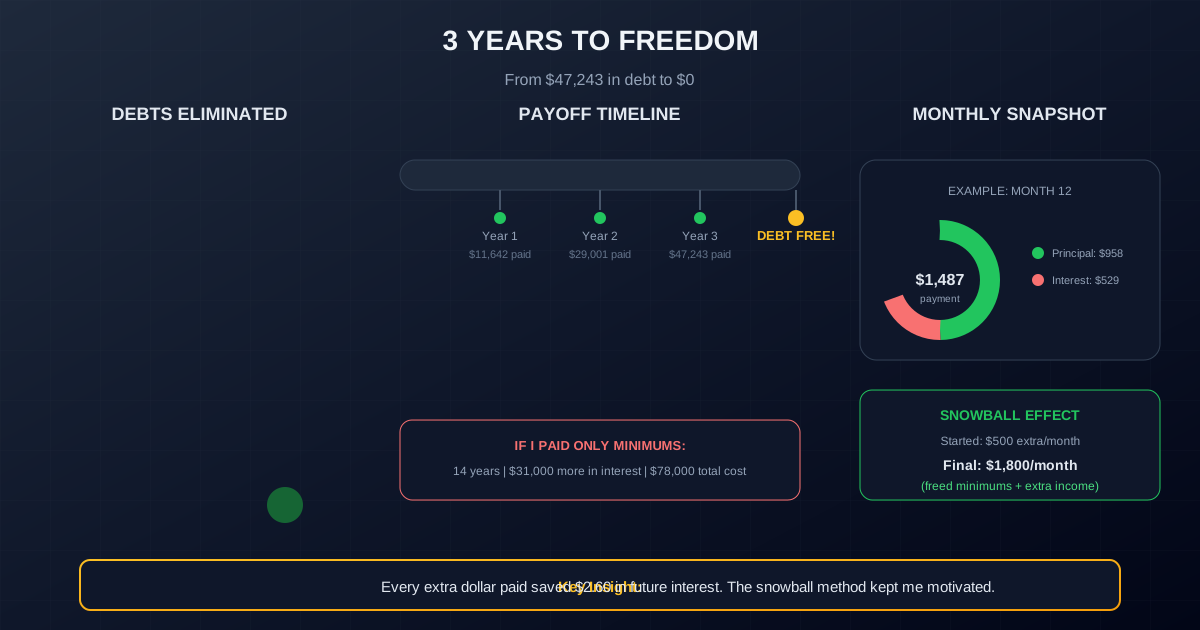
- Roll It Over: Once the smallest debt is gone, take the entire payment you were making on it (the minimum plus the extra) and add it to the minimum payment for the next smallest debt. Repeat this process, creating a larger and larger "snowball" of a payment until all debts are gone.
The Debt Avalanche Method
This method is purely mathematical. The goal is to save the maximum amount of money on interest over the life of your loans.
- List Your Debts: Arrange all your debts from the highest APR to the lowest APR.
- Pay the Minimums: Make the minimum required payment on all debts except the one with the highest APR.
- Attack the Highest Interest: Throw every extra dollar you have at the debt with the highest interest rate until it's eliminated.
- Roll It Over: Once that debt is gone, take its entire payment and roll it into the payment for the debt with the next highest APR. Continue until you're debt-free.
Which Method is Right for You?
| Feature | Debt Snowball | Debt Avalanche |
|---|---|---|
| Focus | Smallest balance first | Highest APR first |
| Advantage | Quick psychological wins, builds momentum | Saves the most money in interest |
| Best For | People who need motivation and quick results | People who are disciplined and mathematically driven |
There's no single right answer. The best plan is the one you can stick with. The Debt Snowball's early victories can provide powerful motivation, while the Debt Avalanche is the most efficient on paper. Use your calculator to run the numbers for both strategies and see what the difference in total interest paid looks like for your specific situation.
Managing Your Financial Data Securely
As you embark on your debt-free plan, you'll be gathering and tracking a lot of sensitive financial documents—monthly statements, budgeting spreadsheets, and personal notes on your strategy. Keeping this information organized and secure is a crucial part of the process.
One best practice is to download your credit card and bank statements each month as PDFs or CSV files. Over time, however, these can clutter up your computer. To keep everything tidy and secure, consider bundling a year's worth of statements into a single, encrypted archive file. Our free Compress Files tool is perfect for this. It can create a compact ZIP or 7Z archive, which you can then password-protect for an extra layer of security. This makes storage and backup much simpler.
Sometimes, you might receive financial documents from different sources in various archive formats. To maintain a uniform system, you might need to convert them. For example, if you prefer the universally compatible ZIP format, you can use our 7Z to ZIP converter to quickly switch formats without needing to install any software. Keeping your digital records organized helps you stay on top of your financial journey.
Conclusion: From Calculation to Action
A credit card payoff calculator is more than a simple online utility. It is a tool of empowerment. It demystifies debt, exposes the true cost of interest, and provides a clear, actionable path toward financial wellness. By moving beyond a single calculation and using it to model different scenarios and strategies, you transform it from a passive estimator into an active planner.
The journey to becoming debt-free begins with a single step: understanding exactly where you stand and where you're going. A calculator gives you that knowledge. The rest is about turning that knowledge into a consistent, disciplined plan of action.
Ready to take control of your finances? Start by building your payoff plan, and explore our full suite of practical, privacy-focused online tools to help you manage your digital life while you focus on achieving your financial goals.