Master Your Money: The Ultimate Compound Interest Calculator Guide
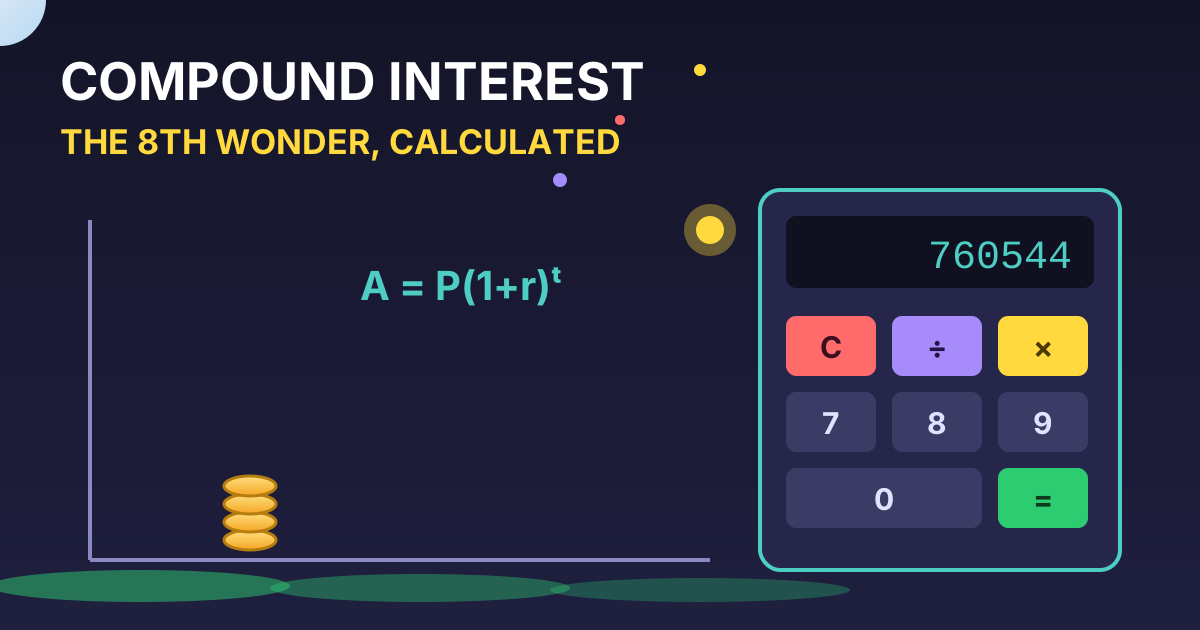
They say Albert Einstein once called compound interest the eighth wonder of the world, adding, "He who understands it, earns it; he who doesn't, pays it." This powerful concept is the secret engine behind almost all significant wealth creation. It’s the difference between a savings account that barely grows and an investment portfolio that expands exponentially over time. But how do you harness this financial magic?
The answer lies in understanding and visualizing its potential. That's where a compound interest calculator comes in. This guide will demystify compound interest and show you how to use a calculator to map out your financial future, turning abstract goals into a concrete, achievable plan.
What Exactly is Compound Interest?
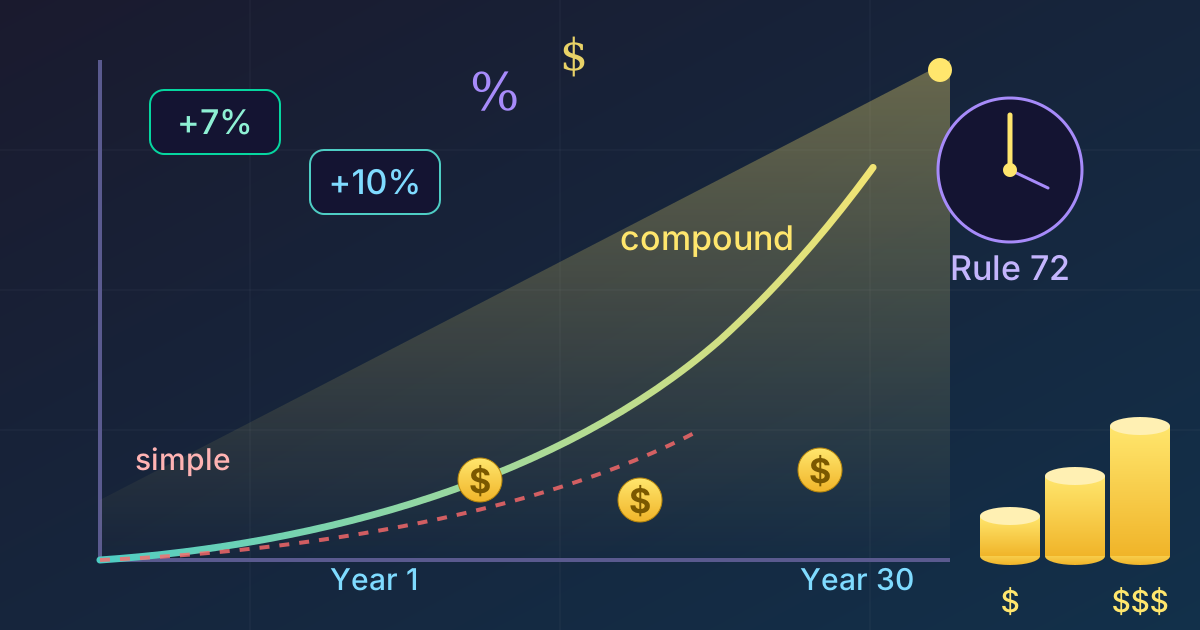
At its core, compound interest is simply interest on interest. When you save or invest money, you earn a return (interest). With simple interest, you only earn interest on your initial investment (the principal). With compound interest, you earn interest on your principal and on the accumulated interest from previous periods.
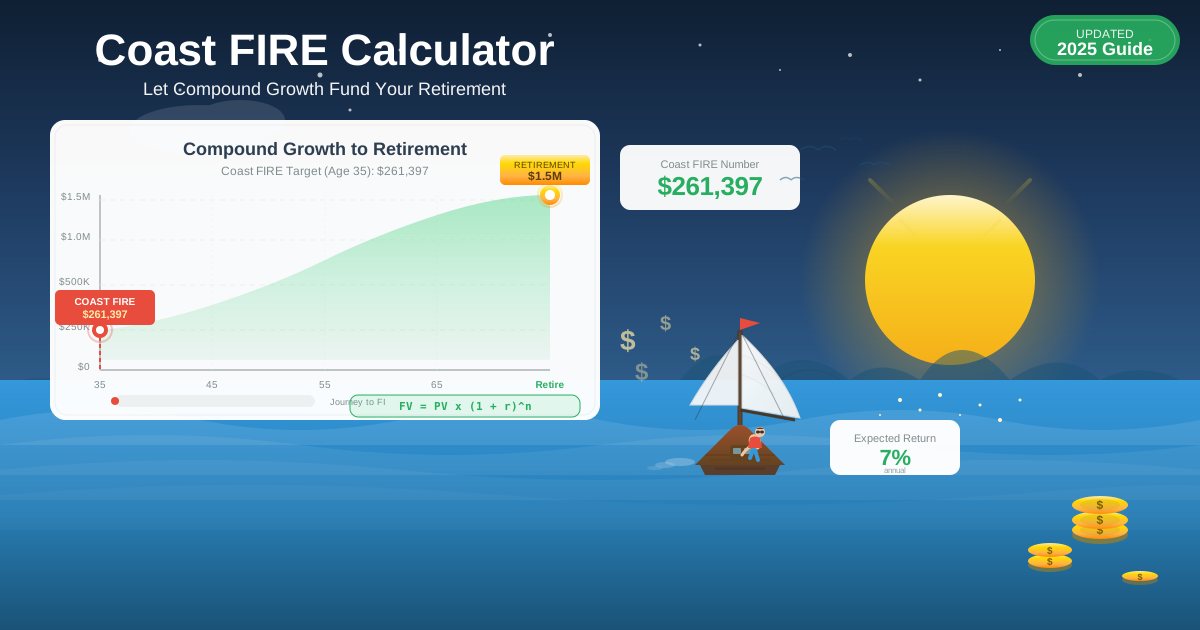
Think of it like a snowball rolling down a hill. It starts small, but as it rolls, it picks up more snow, getting bigger and bigger at an ever-increasing rate. Your money works the same way. The interest earned in the first year gets added to your principal, and in the second year, you earn interest on that new, larger amount. This cycle repeats, creating an exponential growth curve.
Simple vs. Compound Interest: A Clear Comparison
Let's see how this plays out with a simple example. Imagine you invest $10,000 at a 7% annual interest rate for 10 years.
| Year | Simple Interest Balance | Compound Interest Balance (Compounded Annually) | The Compounding Difference |
|---|---|---|---|
| 1 | $10,700 | $10,700 | $0 |
| 2 | $11,400 | $11,449 | +$49 |
| 3 | $12,100 | $12,250 | +$150 |
| 5 | $13,500 | $14,026 | +$526 |
| 10 | $17,000 | $19,672 | +$2,672 |
As you can see, the difference is small at first, but over time, the gap widens significantly. The compound interest portfolio earned an extra $2,672 without you lifting a finger. Now, imagine this effect over 30 or 40 years—the results are staggering.
The Formula Behind the Magic
While a calculator does the heavy lifting for you, it's helpful to understand the engine running under the hood. The formula for compound interest is:
A = P (1 + r/n)^(nt)
Don't let the math intimidate you. Let's break down each component:
- A = Future Value of the Investment/Loan: This is the final amount you'll have after the specified time period. It's the number you're trying to find.
- P = Principal Amount: The initial amount of money you are starting with.
- r = Annual Interest Rate: The annual rate of return, expressed as a decimal (e.g., 7% becomes 0.07).
- n = Compounding Frequency: The number of times that interest is compounded per year. For example:
- Annually: n = 1
- Semiannually: n = 2
- Quarterly: n = 4
- Monthly: n = 12
- Daily: n = 365
- t = Time in Years: The number of years the money is invested or borrowed for.
Understanding these variables is key to using a compound interest calculator effectively.
How to Use a Compound Interest Calculator: A Step-by-Step Guide
A good compound interest calculator, like the one offered by Practical Web Tools, simplifies this formula into a user-friendly interface. Here’s how to use it to project your financial growth.
Let’s follow a fictional example: Alex, age 25, wants to start saving for retirement.
Step 1: Determine Your Initial Principal (P)
This is your starting amount. It could be money from a savings account, an inheritance, or your first contribution to a new investment account. A larger principal gives you a head start, but even a small amount can grow into a fortune over time.
- Alex's Plan: Alex has saved up $5,000 to open a retirement account.
Step 2: Set the Annual Interest Rate (r)
This is your expected annual return. For savings accounts, this is the APY. For investments like stocks or mutual funds, this is an estimated average return. Historically, the S&P 500 has averaged around 10% annually, but a more conservative estimate of 7-8% is often used for planning.
- Alex's Plan: Alex plans to invest in a low-cost index fund and estimates a conservative average annual return of 7%.
Step 3: Choose the Compounding Frequency (n)
How often is your interest calculated and added to the principal? Most savings accounts compound daily or monthly. Many investment dividends are paid quarterly. The more frequently interest is compounded, the faster your money grows, although the effect is most pronounced over very long periods.
- Alex's Plan: Alex's investment account compounds annually.
Step 4: Define the Time Horizon (t)
This is the most powerful variable. The longer you let your money grow, the more work compounding can do. This is why financial advisors stress starting to save for retirement as early as possible.
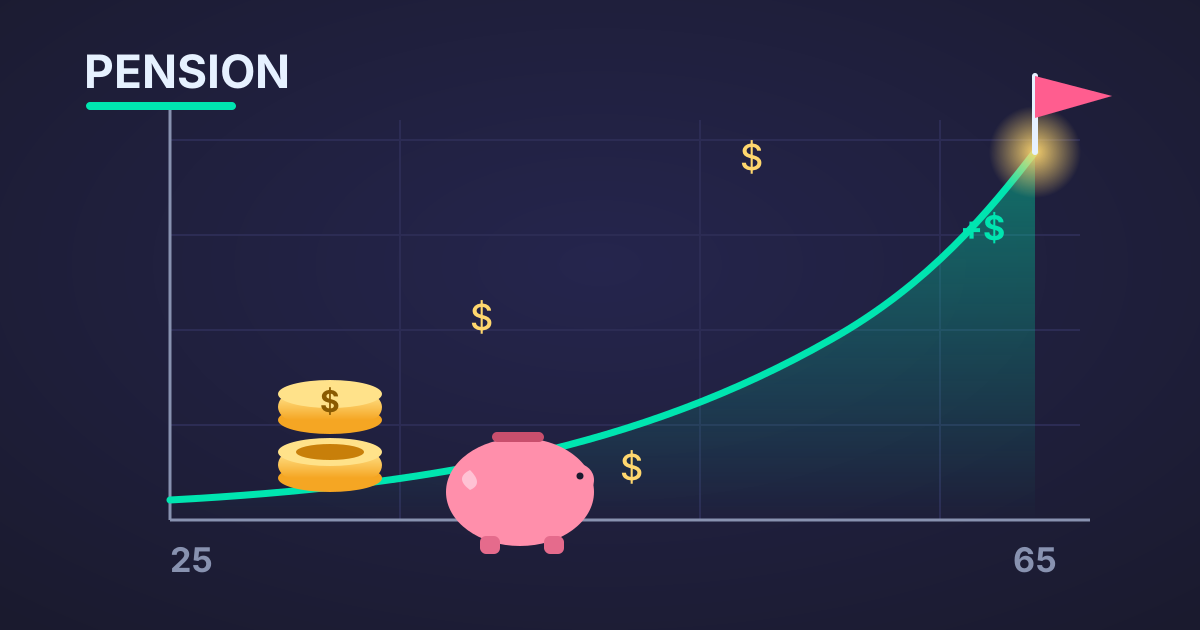
- Alex's Plan: Alex is 25 and wants to retire at 65, giving the investment 40 years to grow.
Step 5: Add Regular Contributions (Optional but Recommended)
This is the secret weapon for wealth building. Most calculators have a field for monthly or annual contributions. Consistently adding money to your principal dramatically accelerates the compounding process.
- Alex's Plan: Alex decides to contribute $300 per month ($3,600 per year) to the account.
Putting It All Together: Alex's Results
After plugging these numbers into the calculator, here's what Alex's financial future looks like:
- Total Contributions: $5,000 (initial) + ($3,600/year * 40 years) = $149,000
- Total Interest Earned: $611,544
- Future Value: $760,544
By consistently saving, Alex turned $149,000 of their own money into over three-quarters of a million dollars. The vast majority of that final balance—over $600,000—is pure profit from compound interest. That's the eighth wonder of the world in action.
Key Factors That Supercharge Your Growth
Playing with a compound interest calculator reveals four key levers you can pull to maximize your results:
- Time (Start Early): As seen with Alex, a long time horizon is your greatest asset. An investment made in your 20s has decades more to compound than one made in your 40s. The best time to start was yesterday; the second-best time is today.
- Contribution Amount (Be Consistent): Making regular, automatic contributions is a powerful habit. Even small amounts add up significantly over time and create a much larger principal for interest to grow on.
- Interest Rate (Invest Wisely): The difference between a 5% return and an 8% return over 40 years is enormous. This highlights the importance of choosing investments that align with your risk tolerance and have a solid potential for growth.
- Compounding Frequency (The Small Details): While not as impactful as the other three, more frequent compounding (e.g., monthly vs. annually) does give your money a slight edge, adding a little extra to the final amount.
Practical Applications: More Than Just Retirement
A compound interest calculator is a versatile tool for planning any long-term financial goal:
- Saving for a House Down Payment: Calculate how much you need to save each month to reach your target down payment in 5 or 10 years.
- Funding a Child's Education: Project the future cost of college and determine the monthly savings needed in a 529 or other educational account.
- Evaluating Investment Choices: Compare two potential investments with different expected returns to see how the outcomes differ over time.
- Understanding Debt: The same principle works in reverse for loans and credit card debt. Use the calculator to see how quickly debt can grow if left unpaid, motivating you to pay it down faster.
Managing Your Financial Documents
Once you use a calculator to create a financial plan, you'll start accumulating important digital documents: spreadsheets with projections, PDF statements from investment accounts, and detailed strategy documents. Managing these files effectively is a crucial, though often overlooked, part of financial discipline.
Your financial projections, complete with charts and multi-year data, can become large files. When sharing your plan with a spouse or a financial advisor, you'll want to ensure it's easy to send. Using a tool to Compress Files can shrink your spreadsheets and reports into a smaller ZIP archive, making them simple to attach to an email without hitting size limits.
Over the years, you will also download and archive countless statements from various institutions. Sometimes these come in less common archive formats like .7z or .tar.gz. If you receive a compressed file with your historical investment data in a .7z format, our free and privacy-focused 7Z to ZIP converter lets you quickly change it to a more universally accessible format, right in your browser. No software installation is needed. Proper file management ensures that you can always access and review your financial history when you need it.
Conclusion: Take Control of Your Financial Future
Compound interest is not a get-rich-quick scheme; it's a get-rich-slowly-but-surely blueprint. It rewards patience, consistency, and foresight. By understanding how it works and using a compound interest calculator, you transform from a passive saver into an active architect of your financial destiny.
You can visualize goals, test different scenarios, and build a concrete plan to achieve your dreams. The power isn't just in the math; it's in the clarity and motivation that seeing your potential future wealth provides.
Ready to see what the eighth wonder of the world can do for you? Use our free, simple, and privacy-focused Compound Interest Calculator today to start mapping your journey to financial independence.