Retirement Savings by Age: How Much You Really Need

Your Future Self is Counting on You
"Am I saving enough for retirement?" It's a question that keeps many of us up at night. We see headlines proclaiming we need a million, two million, or even more to live comfortably in our golden years. This flood of information, often contradictory, can lead to financial paralysis. We know we should be saving, but the target seems so immense and abstract that it's hard to know where to even begin.
The truth is, there is no single magic number that works for everyone. The amount you need to save for retirement isn't a generic figure plucked from a news article; it's a deeply personal number that depends on your unique circumstances. Your income, your desired lifestyle, the age you plan to retire, and your personal goals all play a crucial role.
This guide will cut through the noise. We'll break down the popular rules of thumb, provide a step-by-step process to calculate your personal retirement number, and offer actionable strategies to help you reach your goals, no matter your age or income level. It's time to replace anxiety with a clear, confident plan.
Why a One-Size-Fits-All Number Fails
Generic advice like "you need $1 million to retire" is a decent starting point for a conversation, but it's a terrible endpoint for personal planning. Relying on such a simple figure ignores the critical factors that make your financial life unique.
Here’s why it doesn't work:
- Lifestyle Variation: The person who plans to travel the world in retirement needs a vastly different nest egg than someone who wants to stay home, garden, and spend time with family. Your desired lifestyle is the single biggest factor in determining your retirement expenses.
- Location, Location, Location: Retiring in a high-cost-of-living area like San Francisco is exponentially more expensive than retiring in a small town in the Midwest. Your $1 million will stretch much further in one place than the other.
- Health and Longevity: We're living longer than ever before, which is great news! But it also means our retirement savings need to last longer. Unexpected healthcare costs can also be a significant expense that generic numbers don't account for.
- Retirement Age: Retiring at 55 versus 67 creates a massive difference in your financial needs. Retiring early means you have fewer years to save and more years of retirement to fund.
Instead of chasing an arbitrary number, your goal should be to build a plan that funds your specific vision for the future.
Popular Rules of Thumb (And How to Use Them Wisely)
While we've established that one-size-fits-all isn't ideal, popular rules of thumb can be excellent benchmarks. They help you gauge if you're generally on the right track. Think of them as guideposts, not gospel.
The 15% Rule
This is perhaps the simplest guideline. The 15% rule suggests you should aim to save 15% of your pre-tax income for retirement each year, starting in your 20s. This includes any contributions your employer makes to your 401(k) or other workplace retirement plan.
- Pros: It's incredibly simple to understand and automate. Setting up automatic contributions makes it a "set it and forget it" strategy.
- Cons: If you start saving later in life (in your 30s or 40s), 15% may not be enough to catch up. It also doesn't specify a final goal, just a savings rate.
The 4% Rule
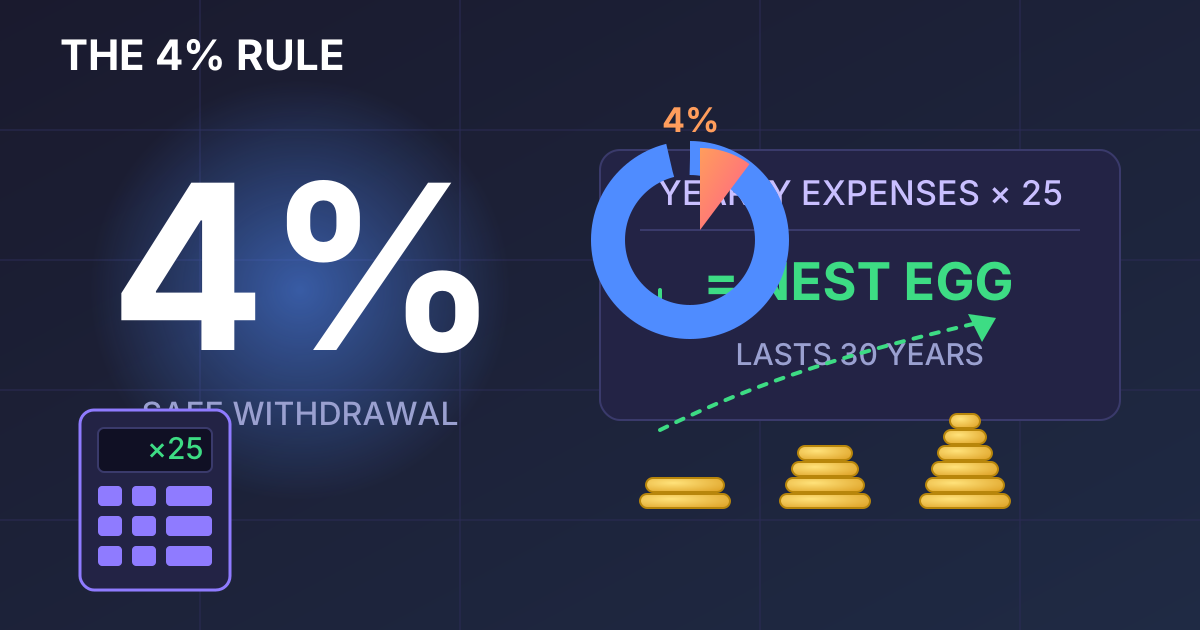
The 4% rule is actually a withdrawal guideline, but you can work backward to determine your total savings goal. The rule states that you can safely withdraw 4% of your investment portfolio in your first year of retirement, and then adjust that amount for inflation each subsequent year, without a high risk of running out of money.
To find your target number, simply multiply your desired annual retirement income by 25 (or divide it by 0.04).
- Formula:
Desired Annual Income / 0.04 = Your Retirement Savings Goal - Example: If you want $60,000 per year from your savings, you would need:
$60,000 / 0.04 = $1,500,000.
Age-Based Salary Multiples
Financial institutions like Fidelity have developed helpful milestones based on a multiple of your annual salary. These provide a quick check-up on your progress over time.
Here’s a commonly cited framework:
| Age | Target Savings (Multiple of Salary) |
|---|---|
| 30 | 1x your annual salary |
| 35 | 2x your annual salary |
| 40 | 3x your annual salary |
| 45 | 4x your annual salary |
| 50 | 6x your annual salary |
| 55 | 7x your annual salary |
| 60 | 8x your annual salary |
| 67 | 10x your annual salary |
So, if you are 40 years old and earn $80,000 per year, this guideline suggests you should have about $240,000 saved for retirement.
A Step-by-Step Guide to Calculating Your Personal Retirement Number
Ready to move beyond rules of thumb and find your number? Follow these four steps.
Step 1: Envision Your Retirement Lifestyle
First, dream a little. What do you want your life to look like when you stop working? Grab a notebook and answer these questions:
- Will you still have a mortgage or will it be paid off?
- Do you plan to travel extensively or take up new hobbies?
- Will you downsize your home or move to a different city/state?
- Do you want to work part-time or volunteer?
- How will you handle healthcare?
This vision is the foundation of your plan. It dictates how much income you'll actually need.
Step 2: Estimate Your Annual Retirement Expenses
Using your vision from Step 1, create a mock retirement budget. A common approach is to assume you'll need about 80% of your pre-retirement income. However, a more detailed budget is always better.
- Start with your current take-home pay.
- Subtract expenses you'll no longer have: Commuting costs, work clothes, and most importantly, retirement savings contributions themselves!
- Add expenses you anticipate: Increased travel, higher healthcare premiums, and hobby-related costs.
Let's say you currently earn $90,000 per year. You might estimate needing about $72,000 (80%) annually in retirement.
Step 3: Account for Other Income Sources
Your personal savings don't have to cover 100% of your expenses. You will likely have other sources of income.
- Social Security: You can get an estimate of your future benefits from the Social Security Administration (SSA) website.
- Pensions: If you are one of the lucky few with a pension, factor in that guaranteed income.
- Rental Income or Part-Time Work: Include any other income you realistically expect to have.
Continuing our example, if you need $72,000 per year and expect to receive $24,000 from Social Security, the gap your savings need to fill is $72,000 - $24,000 = $48,000 per year.
Step 4: Calculate Your Total Nest Egg Goal
Now we use the 4% rule on the income gap we just calculated. This is the total amount you need to have invested by the time you retire.
- Formula:
Annual Income Gap / 0.04 = Your Retirement Savings Goal - Example:
$48,000 / 0.04 = $1,200,000.
So, for this person, the personalized retirement savings goal is $1.2 million. This number is far more meaningful and actionable than a generic $1 million target.
Strategies to Boost Your Savings at Any Age
Knowing your number is one thing; reaching it is another. Here are strategies tailored to different stages of your life.
In Your 20s and 30s: Harness the Power of Compounding
Time is your greatest asset. Even small amounts invested early can grow into massive sums thanks to compound interest.
- Get the Full Employer Match: If your employer offers a 401(k) match, contribute at least enough to get the full amount. It's free money!
- Automate Your Savings: Set up automatic contributions to your 401(k) and/or an IRA. Pay your future self first.
- Embrace Growth: At this age, you can afford to take on more risk for higher potential returns. A portfolio heavy in broad-market index funds is a common strategy.
In Your 40s and 50s: The Catch-Up Phase
If you're behind, now is the time to get serious. Your income is likely at its peak, giving you more firepower to save.
- Maximize Contributions: Aim to max out your 401(k) ($23,000 in 2024) and IRA ($7,000 in 2024) contributions.
- Use Catch-Up Contributions: If you are age 50 or older, you can contribute an extra $7,500 to your 401(k) and an extra $1,000 to your IRA.
- Review Your Plan: Re-evaluate your budget, cut unnecessary expenses, and look for ways to increase your income to free up more cash for saving.
Creative & Advanced Retirement Strategies
For those looking to accelerate their journey to financial freedom, consider these powerful strategies:
-
Explore Coast FIRE: The concept of Coast FIRE (Financial Independence, Retire Early) is about saving enough early on that you can later "coast" to retirement without any further contributions. Your existing investments will do the heavy lifting through compound growth. Curious where you stand? Our free Coast FIRE Calculator can help you determine your target number and timeline.
-
Reduce Your Biggest Expense with House Hacking: Housing is the largest monthly expense for most people. House hacking involves purchasing a multi-unit property, living in one unit, and renting out the others. The rental income can cover your mortgage, allowing you to live for free and drastically increase your savings rate. See how the numbers could work for your area with our House Hacking Calculator.
-
Leverage Self-Employment: Starting a side hustle or your own business can supercharge your income. If you're self-employed, you unlock powerful retirement accounts like the SEP IRA or Solo 401(k), which allow for much higher contribution limits than traditional accounts. Just remember that you're responsible for your own taxes. Our Self-Employment Tax Calculator can help you estimate what you'll owe.
Common Pitfalls to Avoid on Your Retirement Journey
Building a solid nest egg also means avoiding common mistakes that can derail your progress.
- Ignoring Inflation: The $1.2 million we calculated earlier won't have the same purchasing power in 30 years. Always use inflation-adjusted return estimates in your calculations (a real return of 4-5% is a common, conservative estimate for long-term planning).
- Being Too Conservative with Investments: While you don't want to be reckless, keeping all your money in cash or low-yield bonds is a surefire way to lose purchasing power to inflation over time.
- Forgetting About Healthcare: Medicare isn't free and doesn't cover everything. Plan for premiums, co-pays, and potential long-term care costs. A Health Savings Account (HSA), if available to you, is a fantastic triple-tax-advantaged tool for this.
- Cashing Out Your 401(k) When Changing Jobs: It can be tempting to take the cash when you leave an employer, but you'll be hit with taxes and penalties, and you'll irrevocably damage your long-term growth. Always roll your old 401(k) over to an IRA or your new employer's plan.
Conclusion: It's a Marathon, Not a Sprint
Figuring out how much to save for retirement can feel overwhelming, but it doesn't have to be. By moving past generic advice and calculating a number based on your own life and goals, you transform a vague fear into an actionable plan.
Remember that this is a long-term journey. Your plan may change as your life does, and that's okay. The most important step is the one you take today—whether that's increasing your 401(k) contribution by 1%, opening an IRA, or simply sitting down to calculate your number for the first time.
Don't just guess at your financial future. Use the steps and tools in this guide to build a concrete plan for the retirement you deserve. Start by exploring our Coast FIRE Calculator to see how powerful your early investments can be on your path to financial freedom.