When Can You Retire? Calculate Your Number & Make It Happen

The question, "When can I retire?" floats in the back of nearly everyone's mind. For some, it feels like a distant, hazy dream. For others, it's a concrete goal they're sprinting towards. The difference between the dreamers and the achievers often comes down to one thing: a number. Not just any number, but your personal retirement number—the amount of money that unlocks the door to financial independence.
But how do you find this magic number? Is it a million dollars? Five million? The truth is, it's deeply personal and has less to do with a generic milestone and more to do with your specific lifestyle and goals. This comprehensive guide will demystify the process. We'll walk you through exactly how to calculate your retirement number, explore powerful strategies to reach it faster, and empower you to turn the abstract concept of retirement into an actionable plan.
Understanding Your Retirement Number
Before you can hit a target, you have to know what you're aiming for. Your retirement number, often called your Financial Independence (FI) number, is the total amount of invested assets you need to accumulate so you can live off the investment returns indefinitely without ever having to work for money again.
The most common guideline for calculating this number is the 4% Rule.
The 4% Rule Explained
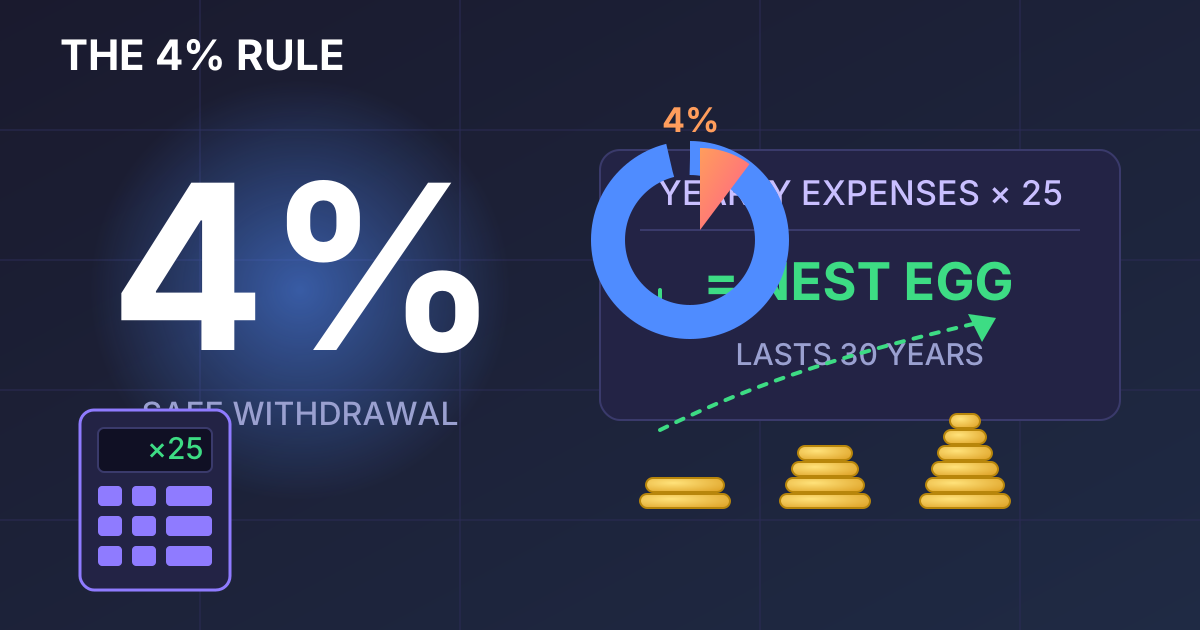
The 4% Rule is based on a famous 1998 study called the "Trinity Study." It concluded that with a portfolio of 50-75% stocks, you could safely withdraw 4% of your initial portfolio value each year (adjusted for inflation) with a very high probability of your money lasting for at least 30 years.
To reverse-engineer this, you simply flip the math:
- Your Retirement Number = Your Desired Annual Expenses ÷ 4%
An even simpler way to think about it is the 25x Rule:
- Your Retirement Number = Your Desired Annual Expenses x 25
These two formulas produce the exact same result. If you need $50,000 per year to live comfortably in retirement, you would need $50,000 x 25, which equals $1,250,000 invested.
How to Calculate Your Retirement Number: A Step-by-Step Guide
Ready to find your number? Grab a notebook or open a spreadsheet. Let's break it down.
Step 1: Calculate Your Annual Expenses
This is the most critical step. Your retirement number is entirely dependent on how much you spend. Many people make the mistake of using their current income, but expenses are what truly matter.
- Track Your Spending: For at least 3-6 months, track every dollar you spend. Use an app, a spreadsheet, or a simple notebook. This will give you a realistic picture of where your money goes.
- Categorize Your Expenses: Group your spending into categories like housing, transportation, food, healthcare, entertainment, and travel.
- Envision Your Retirement Lifestyle: Will your expenses go up or down?
- Decrease: Your mortgage might be paid off, you won't have commuting costs, and you won't be saving for retirement anymore.
- Increase: You might want to travel more, spend more on hobbies, or face higher healthcare costs.
- Find Your Baseline: Start with your current annual expenses and adjust them based on your anticipated retirement lifestyle. Let's say your current take-home pay is $80,000, but you discover you live comfortably on $60,000 and save the rest. Your starting point for calculations should be $60,000.
Step 2: Apply the 25x Rule
Once you have your target annual expenses, the math is simple.
- Annual Retirement Expenses x 25 = Your Retirement Number
Example: If your projected annual expenses in retirement are $70,000: $70,000 x 25 = $1,750,000
This $1.75 million is your target. This is the amount you need invested to generate the $70,000 per year you plan to live on.
Step 3: Account for Other Income Sources
Your investments don't have to do all the heavy lifting. You may have other sources of income in retirement that can reduce the amount you need to withdraw from your portfolio.
- Social Security: While it shouldn't be your only plan, it's a factor. You can get an estimate of your future benefits from the Social Security Administration's website.
- Pensions: If you are lucky enough to have a pension from an employer, factor in that guaranteed annual income.
- Rental Income: Income from investment properties can provide a steady cash flow.
- Part-Time Work: Some people plan to work part-time in a job they enjoy.
To adjust your number, subtract this expected annual income from your annual expenses before applying the 25x rule.
Example:
- Annual Expenses: $70,000
- Expected Social Security & Pension: $25,000
- Income Needed from Investments: $70,000 - $25,000 = $45,000
- New Retirement Number: $45,000 x 25 = $1,125,000
Step 4: Consider Taxes and Inflation
The 4% rule's model generally accounts for inflation by assuming you'll adjust your withdrawal amount upwards each year. However, taxes are a separate consideration. Withdrawals from a traditional 401(k) or IRA are taxed as regular income. Capital gains taxes may apply to withdrawals from a standard brokerage account. Building a portion of your savings in tax-advantaged accounts like a Roth IRA (which offers tax-free withdrawals) can be a powerful part of your strategy.
Beyond Traditional Retirement: Exploring the FIRE Movement
The Financial Independence, Retire Early (FIRE) movement has gained popularity by challenging the idea of working until age 65. It's about aggressively saving and investing to reach financial independence much sooner. There are several flavors of FIRE:
- Lean FIRE: Living a minimalist, frugal lifestyle on a smaller nest egg (e.g., $25,000-$40,000 per year).
- Fat FIRE: Maintaining a high-spending lifestyle in retirement, requiring a much larger nest egg (e.g., $100,000+ per year).
- Barista FIRE: Leaving a traditional high-stress career to work a part-time job, often for benefits like health insurance, while letting your investments cover the rest.
- Coast FIRE: This is a particularly powerful and less stressful approach. Coast FIRE is the point at which you have enough money in your retirement accounts that, without any further contributions, it will grow to support a traditional retirement. Once you hit your Coast FIRE number, you only need to earn enough to cover your current living expenses. The pressure to save aggressively is gone. Curious what your Coast FIRE number is? Use our free Coast FIRE Calculator to find out exactly how much you need to invest to coast to retirement.
4 Actionable Strategies to Reach Your Number Faster
Calculating your number is the first step. The next is building a plan to get there. Here are the most effective strategies to accelerate your journey to financial independence.
1. Radically Increase Your Savings Rate
Your savings rate—the percentage of your income you save and invest—is the single most important lever you can pull. The higher your rate, the faster you'll reach your goal.
| Savings Rate | Years to Retirement |
|---|---|
| 10% | 51 years |
| 20% | 37 years |
| 30% | 28 years |
| 40% | 22 years |
| 50% | 17 years |
| 60% | 12.5 years |
(Table assumes a 0 starting balance and 7% average annual investment return after inflation)
To increase your savings rate:
- Create a detailed budget: Know where every dollar is going.
- Cut the big expenses: Focus on the big three: housing, transportation, and food. Small changes here have a massive impact.
- Automate your savings: Set up automatic transfers to your investment accounts on payday.
2. Aggressively Boost Your Income
There's a limit to how much you can cut, but there's no limit to how much you can earn. Boosting your income allows you to turbocharge your savings rate without sacrificing your quality of life.
- Negotiate a Raise: Consistently prove your value at work and ask for the compensation you deserve.
- Develop New Skills: Certifications and new skills can open doors to higher-paying jobs or promotions.
- Start a Side Hustle: Freelancing, consulting, or starting a small business can bring in significant extra income. If you're self-employed, managing your finances and taxes is crucial. Our Self-Employment Tax Calculator can help you estimate your tax burden and plan accordingly.
3. Optimize Your Investments
Make your money work as hard as you do. While saving is essential, you can't reach your goals with money sitting in a low-yield savings account. You need to invest.
- Prioritize Tax-Advantaged Accounts: Max out your 401(k) (especially if there's an employer match), Roth IRA, and HSA if available.
- Embrace Low-Cost Index Funds: For most people, investing in broad-market, low-cost index funds or ETFs (like those tracking the S&P 500) is a simple and effective long-term strategy.
- Stay the Course: The market goes up and down. Avoid emotional decisions and stick to your long-term plan. Time in the market beats timing the market.
4. Reduce Your Biggest Expense with House Hacking
For most people, housing is their single largest monthly expense. Slashing or eliminating it can be a financial game-changer. This is the core idea behind "house hacking."
House hacking involves renting out portions of your primary residence to generate income that offsets your mortgage and living costs. This could mean:
- Renting out spare bedrooms to roommates.
- Buying a duplex, triplex, or fourplex, living in one unit, and renting out the others.
- Renting out an accessory dwelling unit (ADU) or basement apartment.
The money you save on housing—potentially thousands of dollars per month—can be funneled directly into your investments. This strategy can supercharge your savings rate. See how much you could save by exploring different scenarios with our House Hacking Calculator.
Conclusion: Your Journey Starts Now
Retirement isn't an age; it's a financial state. Understanding and calculating your retirement number transforms it from a vague hope into a tangible, achievable goal. By understanding your expenses, applying the 25x rule, and implementing powerful strategies to save more, earn more, and invest wisely, you can take control of your financial future.
The path to financial independence is a marathon, not a sprint. But every step you take today brings you closer to the finish line. Don't just dream about retirement. Start planning for it today. Use our suite of free financial calculators to take the first step, find your numbers, and build your own roadmap to freedom.