Retirement Savings: The 4% Rule Explained Simply (2024 Guide)
Your Guide to Retiring Confidently
The dream of retirement is a powerful one. It’s a vision of freedom—freedom from the daily grind, freedom to travel, to pursue hobbies, or to simply spend more time with loved ones. But standing between that dream and reality is one daunting question: How much money do you actually need to retire?
For decades, financial planners and aspiring retirees have wrestled with this question, often getting lost in complex formulas and market predictions. But what if there was a simple, straightforward guideline that could give you a powerful starting point?
Enter the 4 Percent Rule.
This popular rule of thumb has helped millions of people frame their retirement goals. In this comprehensive guide, we'll break down exactly what the 4% Rule is, how to use it to calculate your own retirement number, and explore its pros, cons, and modern-day relevance. Let’s demystify retirement planning and turn your financial goals into an actionable plan.
What is the 4 Percent Rule?
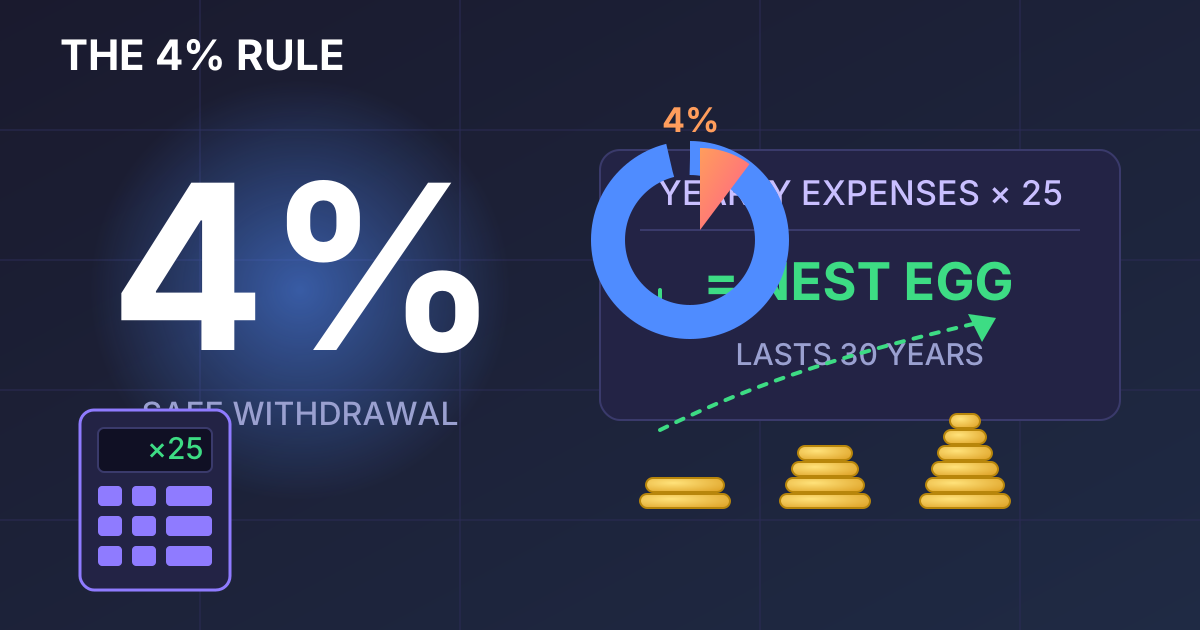
The 4 Percent Rule is a guideline that states you can safely withdraw 4% of your investment portfolio in your first year of retirement. In subsequent years, you adjust that initial withdrawal amount for inflation. The goal is to provide a steady stream of income throughout retirement without depleting your principal too quickly.
Essentially, if you follow this rule, your portfolio has a very high probability of lasting for at least 30 years.
The Origin: The Trinity Study
The rule isn't just a random number. It's based on extensive historical research, most famously the 1998 paper "Retirement Spending: Choosing a Sustainable Withdrawal Rate," conducted by three finance professors at Trinity University.
The study analyzed historical stock and bond market returns from 1926 to 1995. They ran simulations on various portfolio allocations (e.g., 50% stocks/50% bonds, 75% stocks/25% bonds) and withdrawal rates. Their findings showed that a 4% initial withdrawal rate, adjusted for inflation annually, was highly successful in sustaining a portfolio for a 30-year retirement period in nearly all historical scenarios.
How to Calculate Your Retirement Number Using the 4 Percent Rule
One of the best things about the 4% Rule is its simplicity. You don't need complex software or a degree in finance to get a solid estimate of your target retirement savings. It boils down to a two-step process.
Step 1: Estimate Your Annual Retirement Expenses
This is the most crucial—and often most difficult—step. You need to realistically estimate how much money you'll spend each year in retirement. This isn't just about survival; it's about funding the lifestyle you envision.
Here are common expense categories to consider:
- Housing: Mortgage (if not paid off), property taxes, insurance, maintenance, utilities.
- Transportation: Car payments, gas, insurance, maintenance, public transport.
- Healthcare: Insurance premiums, deductibles, co-pays, prescription drugs, long-term care.
- Food: Groceries, dining out.
- Personal Care: Clothing, toiletries, haircuts.
- Entertainment & Travel: Hobbies, vacations, subscriptions (Netflix, etc.), gifts.
- Taxes: Income tax on withdrawals, property tax.
- Debt: Any remaining student loans, credit card debt, etc.
Actionable Tip: Track your current spending for a few months. This will give you a realistic baseline. Then, adjust it for retirement. Some expenses might go down (like commuting costs), while others might go up (like travel and healthcare).
Let’s say after careful consideration, you estimate you'll need $50,000 per year to live comfortably in retirement.
Step 2: Multiply Your Annual Expenses by 25
This is the magic part. To find your target retirement nest egg, simply multiply your estimated annual expenses by 25.
Why 25? It's the inverse of 4 percent (1 / 0.04 = 25).
Formula:
Your Annual Retirement Expenses x 25 = Your Target Retirement Savings
Using our example:
$50,000 (Annual Expenses) x 25 = $1,250,000
So, according to the 4% Rule, you would need a nest egg of $1.25 million to retire and sustainably fund a $50,000 per year lifestyle.
Retirement Savings Target Examples
To make it even clearer, here’s a table showing the required nest egg for various annual spending levels:
| Desired Annual Income | Required Nest Egg (Income x 25) |
|---|---|
| $40,000 | $1,000,000 |
| $50,000 | $1,250,000 |
| $60,000 | $1,500,000 |
| $75,000 | $1,875,000 |
| $100,000 | $2,500,000 |
| $120,000 | $3,000,000 |
This simple calculation gives you a tangible goal to work toward during your saving years.
The Pros of the 4 Percent Rule
There's a reason this rule has remained popular for over two decades. It offers several key advantages:
- Simplicity: It provides a clear, easy-to-understand calculation that anyone can do. This clarity helps transform the vague idea of "saving for retirement" into a concrete, numerical target.
- Historical Backing: It’s not just a guess. The rule is grounded in decades of historical market data, giving it a strong foundation of credibility.
- Provides a Clear Goal: Knowing you need to reach a specific number ($1M, $1.5M, etc.) is a powerful motivator for saving and investing consistently.
- Inflation-Adjusted: The rule accounts for inflation by adjusting the withdrawal amount each year, which helps maintain your purchasing power over a long retirement.
The Cons and Criticisms of the 4 Percent Rule
Despite its popularity, the 4% Rule is not foolproof. Critics point out several potential flaws that are important to understand:
- Based on Past Performance: The rule is based on historical data from the 20th century. There is no guarantee that future market returns, inflation rates, and interest rates will behave similarly.
- Sequence of Returns Risk: This is a major risk. If you retire right before a significant market downturn, withdrawing 4% of a now-depleted portfolio can severely damage its long-term viability. The first few years of retirement are critical.
- Assumes a 30-Year Retirement: The original study was based on a 30-year timeframe. If you plan to retire early (say, at 50) and may live for 40+ years in retirement, a 4% withdrawal rate might be too aggressive.
- Inflexible by Design: The rule suggests a rigid withdrawal strategy. In reality, your spending might not be a straight line. You might spend more in the early, active years of retirement and less later on (excluding potential healthcare spikes).
- Doesn't Account for Fees: The 4% is a pre-fee figure. High investment management fees can significantly eat into your returns and impact the sustainability of your withdrawals.
Organizing Your Financial Future: A Practical Step
Effective retirement planning involves more than just calculations; it requires meticulous organization. Over the years, you will accumulate countless digital documents: bank statements, investment reports, tax returns, insurance policies, and estate planning documents. Keeping these organized is critical for tracking your progress and for easy access when you need them.
As you gather these important files, you might find they take up a lot of digital space, especially scanned documents or detailed PDF reports. A simple, privacy-focused way to manage this is to Compress Files into a single, smaller ZIP archive. This makes your financial records easier to store on a backup drive, manage in the cloud, and share securely with a financial planner or family member.
When you need to review those organized archives, our simple Decompress Files tool is just a click away, with no software to install. This streamlined process ensures your financial life stays tidy and accessible as you work toward your retirement goals.
Adjusting the 4 Percent Rule for Your Situation
Given the limitations, it's wise to view the 4% Rule as a starting framework, not an unbreakable law. Here’s how you can adapt it to better fit your personal circumstances:
Consider a More Conservative Rate
For those planning a longer retirement or who are more risk-averse, a lower withdrawal rate might be more appropriate. Many financial experts now suggest a 3.3% or 3.5% rule, especially in today's low-interest-rate environment. This provides an extra buffer against market volatility.
Use a Dynamic Withdrawal Strategy
Instead of a fixed percentage, consider a flexible approach. This could mean:
- Guardrails: Set an upper and lower limit for your portfolio's value. If the market soars and your portfolio value goes above the upper guardrail, you can take out more money. If it drops below the lower guardrail, you tighten your belt and withdraw less for that year.
- Percentage of Current Portfolio: Instead of adjusting the initial amount for inflation, you withdraw a fixed percentage (e.g., 4%) of your portfolio's current value each year. This means you'll have more income in good years and less in bad years, which naturally protects your principal during downturns.
Factor in Other Income Sources
The 4% Rule assumes your investment portfolio is your only source of income. But most retirees have other streams of revenue. Make sure to account for:
- Social Security
- Pensions
- Rental Property Income
- Part-time Work or a Side Hustle
Subtract these reliable income sources from your annual expenses first. The remaining amount is what your portfolio needs to cover. This can significantly reduce the size of the nest egg you need.
Example:
- Annual Expenses: $60,000
- Annual Social Security & Pension: $25,000
- Income needed from portfolio: $60,000 - $25,000 = $35,000
- New Target Nest Egg: $35,000 x 25 = $875,000 (much lower than the initial $1.5M target!)
Conclusion: A Guideline, Not Gospel
So, is the 4% Rule still relevant today? The answer is a resounding yes, but with a crucial caveat: it should be used as a powerful starting point, not a rigid, set-it-and-forget-it command.
It brilliantly simplifies a complex problem, giving you a tangible number to anchor your savings strategy. By calculating your target nest egg (annual expenses x 25), you replace vague anxiety with a clear goal.
However, the wisest approach is to use this number as your foundation and then build upon it with flexibility and common sense. Consider your personal risk tolerance, your planned retirement length, and potential alternative income streams. Be prepared to adjust your spending, especially in response to market conditions.
The journey to a secure retirement is a marathon, not a sprint. The 4% Rule is your map, but you are still the driver. Use it to navigate, but don't be afraid to take a different route when the terrain gets tricky. Start by calculating your number today—what's your first step towards that goal?