How to Retire at 55: The FIRE Math Most People Get Wrong

The dream of leaving the 9-to-5 grind behind at 55 isn't just a fantasy; it's a tangible goal for millions inspired by the FIRE (Financial Independence, Retire Early) movement. Online forums are filled with success stories of people hitting their "magic number" and sailing off into a life of leisure. But behind these inspiring tales lies a simple mathematical framework that is dangerously easy to misinterpret.
Many aspiring early retirees fixate on a target portfolio value without truly understanding the assumptions baked into that number. They overlook critical variables like inflation, taxes, and the very real risk of a 40-year retirement. This is where the dream can turn into a financial nightmare.
This comprehensive guide will pull back the curtain on the math behind retiring at 55. We'll demystify the core principles, expose the common pitfalls and miscalculations that trip people up, and provide a realistic, actionable roadmap to help you achieve financial independence on your own terms.
Understanding the FIRE Movement Beyond the Hype
At its heart, FIRE isn't about being lazy or hating work. It's about achieving Financial Independence—the point at which your passive income from investments is enough to cover your living expenses indefinitely. The "Retire Early" part is simply the incredible option that FI provides. It's about having the freedom to choose how you spend your time, whether that's traveling, starting a passion project, volunteering, or, yes, never working again.
Because personal finance is personal, the movement has evolved into several different styles:
- Lean FIRE: Living a minimalist lifestyle on a smaller budget (e.g., under $40,000 per year). This requires a smaller nest egg, making it faster to achieve.
- Fat FIRE: Maintaining a lavish or upper-middle-class lifestyle in retirement (e.g., $100,000+ per year). This requires a significantly larger portfolio and a high income during the accumulation phase.
- Barista FIRE: A hybrid approach where you've saved enough to cover most expenses but take on a part-time job (like a barista) for benefits like health insurance and some extra spending money.
- Coast FIRE: This involves saving aggressively early in your career to a point where your existing investments will grow (or "coast") to your full retirement number by a traditional retirement age without any further contributions. This frees you up to take lower-stress, lower-paying jobs to simply cover current living expenses.
Understanding these variations is key. Retiring at 55 doesn't have to be an all-or-nothing proposition. The goal is to design a life of freedom that works for you.
The Bedrock of FIRE: The 4% Rule and Your "FIRE Number"
So, how much money do you actually need? The core of FIRE math is built on two simple but powerful concepts: the 4% Safe Withdrawal Rate (SWR) and the 25x Rule.
The 4% Rule
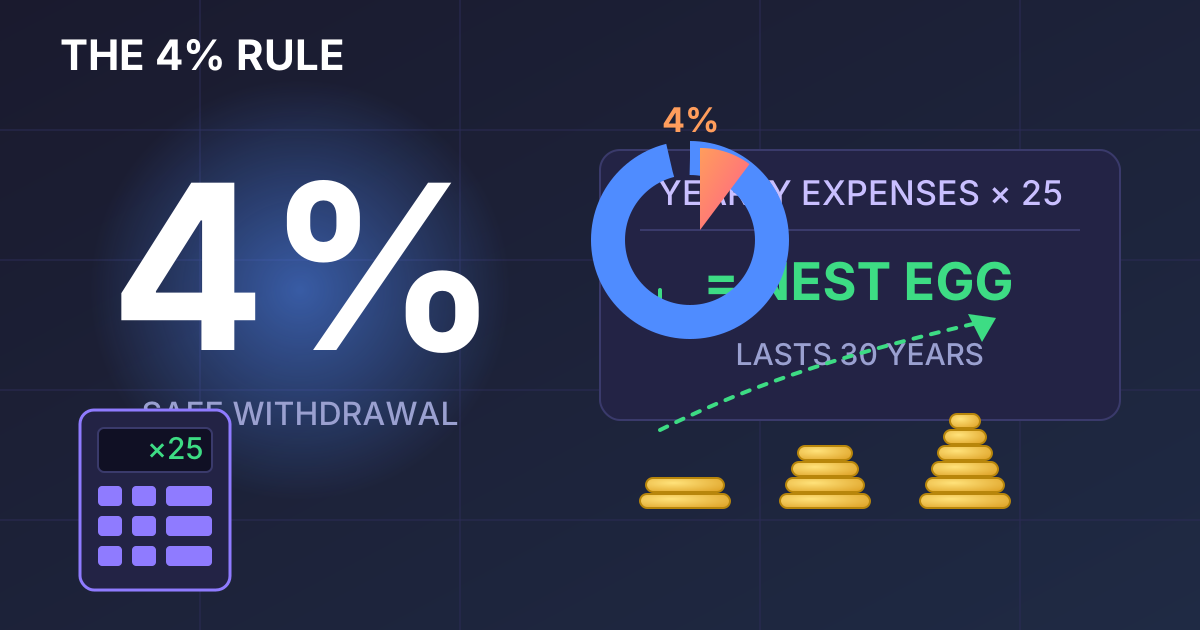
This rule of thumb originates from a 1998 study called the "Trinity Study." The researchers found that, based on historical market data, a retiree could withdraw 4% of their initial portfolio value, adjust that amount for inflation each subsequent year, and have a very high probability of their money lasting for at least 30 years.
The 25x Rule
This is simply the 4% Rule flipped on its head. If you can withdraw 4% of your portfolio each year, it means you need a portfolio that is 25 times your annual expenses (since 1 / 0.04 = 25). This gives you your target retirement nest egg, often called your "FIRE Number."
Here's how it works in practice:
- Calculate Your Annual Expenses: Track your spending and determine exactly how much you spend in a year.
- Multiply by 25: Take your annual expenses and multiply by 25 to find your FIRE Number.
Let's see some examples:
| Desired Annual Retirement Income | Your FIRE Number (Income x 25) | Safe Annual Withdrawal (4%) |
|---|---|---|
| $50,000 | $1,250,000 | $50,000 |
| $70,000 | $1,750,000 | $70,000 |
| $90,000 | $2,250,000 | $90,000 |
This simple calculation is empowering, but it's also where the first mistakes are often made.
The Most Important Metric: Your Savings Rate
While your FIRE number is the destination, your savings rate is the engine that determines how fast you get there. Your savings rate—the percentage of your after-tax income that you save and invest—is far more important than your raw income. Someone earning $60,000 and saving 50% will reach FI much faster than someone earning $150,000 and saving only 15%.
Why? Because a high savings rate does two things simultaneously:
- It drastically increases the amount you invest, accelerating the power of compound growth.
- It trains you to live on less, which directly lowers your target FIRE number.
The relationship between savings rate and your working timeline is staggering:
| Savings Rate | Approximate Years to Financial Independence |
|---|---|
| 10% | ~51 years |
| 20% | ~37 years |
| 30% | ~28 years |
| 40% | ~22 years |
| 50% | ~17 years |
| 60% | ~12.5 years |
| 70% | ~8.5 years |
(Note: This assumes starting from zero and an average 5% real return on investments after inflation.)
Looking at this chart, it becomes clear that to retire at 55, you need to be consistently saving a significant portion of your income, likely 30% or more, starting from your 20s or 30s.
Where the Math Breaks Down: Common FIRE Miscalculations
The 25x Rule is a fantastic starting point, but it's not the finish line. Relying on it blindly without adjusting for your personal situation is the biggest mistake you can make. Here's where the simple math gets complicated.
Mistake 1: Underestimating Future Expenses
Your expenses today are not your expenses in retirement. Many people calculate their FIRE number based on their current, frugal, pre-retirement lifestyle.
- Healthcare: This is the elephant in the room for U.S.-based early retirees. Before you're eligible for Medicare at 65, you're on your own for health insurance. Premiums, deductibles, and out-of-pocket costs can easily add $10,000-$20,000 or more to your annual expenses.
- Inflation: The 4% rule accounts for inflation adjustments after you retire, but people often forget to account for it while saving. The $1.5 million you're targeting today will have significantly less purchasing power in 20 years.
- Lifestyle Changes: Will you want to travel more? Pick up expensive hobbies? Help your adult children? Building in a buffer for an enjoyable retirement is crucial.
Mistake 2: Ignoring the Taxman
Your FIRE number should be based on your net withdrawals. How your money is taxed in retirement depends entirely on where you saved it.
- Traditional 401(k)/IRA: Withdrawals are taxed as ordinary income.
- Roth 401(k)/IRA: Qualified withdrawals are completely tax-free.
- Taxable Brokerage Account: You pay capital gains tax on the profits when you sell investments.
A smart retirement plan involves a mix of these accounts to give you flexibility in managing your tax burden. Forgetting to factor in a 15-25% reduction in your withdrawal due to taxes can derail your plan.
Mistake 3: Over-relying on the 4% Rule
The Trinity Study was groundbreaking, but it has limitations, especially for someone retiring at 55.
- Retirement Length: The study was based on a 30-year retirement. If you retire at 55, you could easily live another 40 or even 50 years. This longer time horizon increases the risk of running out of money.
- Sequence of Returns Risk: This is the danger of experiencing poor market returns in the first few years of retirement. Withdrawing money from a portfolio during a downturn can permanently cripple its long-term growth potential. To combat this, many in the FIRE community now advocate for a more conservative SWR of 3.0% to 3.5%, which translates to a larger FIRE number (33x to 28.5x your annual expenses).
A Practical Plan to Retire at 55
Feeling overwhelmed? Don't be. Armed with a more realistic understanding of the math, you can build a robust plan. Here’s a step-by-step guide.
Step 1: Calculate Your Real Future Expenses
Forget simple budgeting. Diligently track every dollar you spend for at least six months to get an accurate baseline. Then, project forward. Research health insurance marketplace plans. Add a line item for travel, hobbies, and unforeseen major expenses (new roof, car replacement). Be conservative and add a 10-15% buffer to your final number.
Step 2: Redefine Your FIRE Number
Instead of blindly using the 25x rule, consider a more conservative multiplier based on a lower withdrawal rate. A 3.5% SWR requires a 28.5x multiple, while a 3% SWR requires a 33x multiple. This builds a crucial safety margin into your plan for a longer retirement.
Step 3: Engineer a High Savings Rate
You can't reach a 40%+ savings rate by cutting lattes. You need to focus on the big wins: housing, transportation, and food. Lowering your costs in these three areas will do 80% of the work.
One of the most powerful strategies to slash your biggest expense is house hacking. By purchasing a multi-unit property and living in one unit while renting out the others, you can dramatically reduce or even eliminate your housing costs. The extra income can be channeled directly into your investments. You can use a free tool like the Practical Web Tools House Hacking Calculator to run the numbers and see how much this strategy could accelerate your journey.
Step 4: Automate and Optimize Your Investments
Make saving effortless. Set up automatic transfers to your investment accounts every payday.
- Get Your 401(k) Match: If your employer offers a match, contribute enough to get 100% of it. It's free money.
- Max Out Roth IRAs: Contribute the maximum allowed to a Roth IRA for tax-free growth and withdrawals.
- Max Out Your 401(k): Go back to your 401(k) and contribute up to the legal maximum.
- Invest in a Taxable Brokerage: Any money left over can go into a low-cost index fund (like VTSAX or FZROX) in a standard brokerage account.
Step 5: Explore Alternative FIRE Paths
If the path to a 50% savings rate feels impossible, don't give up. Consider a more flexible approach like Coast FIRE. The goal here is to save aggressively in your 20s and 30s to hit a specific number—your "Coast FI" number. Once you hit that, you can stop saving. Your investments will then have decades to compound, growing into your full retirement nest egg by age 65. This frees you up to take a less demanding job, work part-time, or start a business to simply cover your current living expenses.
Curious what your number would be? A tool like our Coast FIRE Calculator can help you determine the exact target you'd need to hit based on your age and desired retirement income. It's a powerful way to visualize a different, less stressful path to financial freedom.
It's Not Just Math, It's a Mindset
Retiring at 55 is an ambitious goal that requires discipline, planning, and a clear understanding of the numbers. The simple math of the FIRE movement is a great motivator, but the real work lies in challenging its assumptions and building a personalized plan that can withstand the tests of time, inflation, and market volatility.
Remember the key takeaways:
- Your savings rate is the single most important factor in your timeline.
- Your FIRE number should be based on a conservative withdrawal rate (3.0-3.5%) and a realistic projection of your future expenses, including healthcare.
- A tax-efficient withdrawal strategy using a mix of account types is crucial.
Don't let the complexity deter you. The journey to financial independence is a marathon, not a sprint. Start by tracking your expenses, calculating your savings rate, and using the right tools to build a robust and realistic plan. What's the first step you'll take today to design your future?