Social Security COLA 2026: How Much Will Your Benefits Grow?

For the millions of Americans who rely on Social Security, the annual Cost-of-Living Adjustment (COLA) is more than just a number—it's a critical lifeline that helps their benefits keep pace with rising prices. As we look ahead, the question on everyone's mind is: what will the Social Security COLA be for 2026, and how much will my check actually increase?
While the official announcement is a long way off, understanding the factors that influence the COLA can empower you to plan your finances with greater confidence. This comprehensive guide will break down how the COLA is calculated, explore the economic trends shaping the 2026 projections, and reveal the hidden factors that determine the real dollar amount that lands in your bank account.
What Exactly is the Social Security COLA?
The Cost-of-Living Adjustment, or COLA, is an annual increase in Social Security and Supplemental Security Income (SSI) benefits. Its sole purpose is to counteract the effects of inflation, ensuring that the purchasing power of your benefits doesn't erode over time. When the cost of goods and services goes up, the COLA is designed to give your benefits a corresponding boost.
This automatic annual adjustment has been a feature of Social Security since 1975, a legislative response to a period of high inflation where ad-hoc benefit increases passed by Congress weren't sufficient to protect seniors' financial stability. Without the COLA, a fixed monthly benefit would buy less and less each year, placing an immense strain on retirees.
How the Government Calculates the COLA
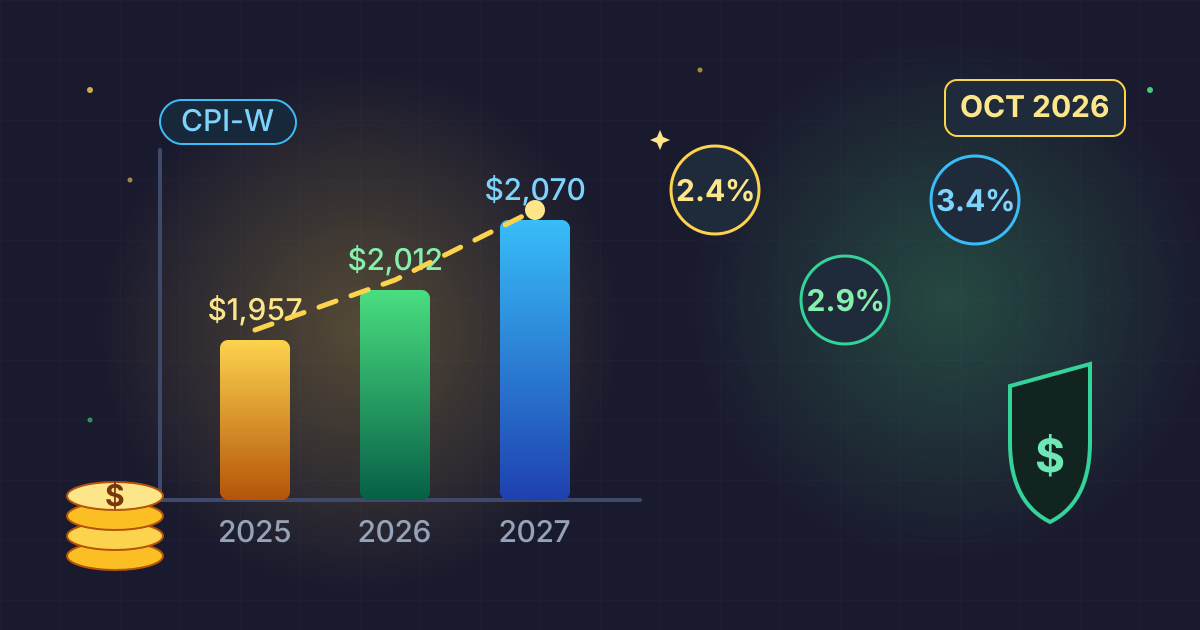
The Social Security Administration (SSA) doesn't just pick a number out of thin air. The COLA is tied directly to inflation data from the Bureau of Labor Statistics (BLS). Specifically, it's based on the Consumer Price Index for Urban Wage Earners and Clerical Workers, more commonly known as the CPI-W.
Here’s a step-by-step breakdown of the official process:
- Data Collection Period: The SSA only looks at data from the third quarter of the year. They calculate the average CPI-W for July, August, and September.
- Comparison Year: This third-quarter average is then compared to the average CPI-W from the third quarter of the last year a COLA was enacted. For the 2026 COLA, this will be the Q3 2024 data (which determines the 2025 COLA).
- Calculate the Percentage Increase: The percentage difference between these two averages becomes the COLA for the following year. For example, if the Q3 2025 average CPI-W is 3% higher than the Q3 2024 average, the COLA for 2026 will be 3.0%.
- No Increase, No Decrease: If there is no increase in the CPI-W (or if it decreases), there is no COLA. By law, Social Security benefits cannot be reduced even if there is deflation.
The final COLA is typically announced in October, after the September inflation data is released by the BLS. The adjustment then takes effect for benefits paid out starting in January of the following year.
Predicting the 2026 Social Security COLA: Key Economic Factors
Predicting the 2026 COLA this far out is an exercise in economic forecasting, but we can analyze the key drivers that will influence the outcome. These are the main factors economists and advocacy groups are watching:
Inflation Trajectory
This is the single most important factor. After a period of historically high inflation, the Federal Reserve has been working to bring it back down to its target rate of around 2%. The success of these efforts will directly impact the CPI-W. If inflation remains stubborn and stays above 3%, the COLA will be higher. If it cools down and settles in the 2-2.5% range, the COLA will be more modest.
Energy Prices
Gasoline and energy costs are a significant and volatile component of the CPI-W. Geopolitical events, supply chain issues, and domestic production levels can cause sharp swings in energy prices, which can either drive the COLA up or pull it down.
Housing Costs
Shelter is the largest component of the consumer price index. Rising rents and homeownership costs have been a major driver of recent inflation. While these costs tend to be "stickier" and slower to decline, their direction in late 2024 and 2025 will heavily influence the final COLA calculation.
Food Prices
Like energy, the cost of groceries can fluctuate due to weather events, supply chain disruptions, and global demand. This is a key expense for most households and a significant part of the CPI-W basket of goods.
2026 COLA Projections: A Range of Possibilities
Given the factors above, experts are considering several potential scenarios for the 2026 COLA. It's important to remember these are educated guesses, not guarantees. The table below illustrates how different inflation environments could translate into a COLA and impact an average benefit.
| Scenario | Projected COLA Range | Economic Conditions | Impact on Average $1,900 Benefit (Gross Monthly Increase) |
|---|---|---|---|
| Low Inflation | 1.8% - 2.5% | The economy cools significantly, and inflation settles near the Fed's target. | +$34.20 to +$47.50 |
| Moderate Inflation | 2.6% - 3.4% | Inflation remains persistent but controlled, hovering slightly above the Fed's target. | +$49.40 to +$64.60 |
| High Inflation | 3.5% or higher | Unexpected economic shocks, a resurgence in energy prices, or renewed supply issues. | +$66.50 or more |
Most current long-range forecasts anticipate an inflation environment that would produce a COLA in the moderate range (2.6% to 3.4%) for 2026. However, retirees should be prepared for any of these possibilities.
Beyond the Headline Number: The Real Impact on Your Wallet
A 3% COLA doesn't always mean your net check will be 3% larger. Several crucial factors can reduce the actual cash you receive. This is where the headline number can be misleading.
The Medicare Part B Premium Bite
For most Social Security beneficiaries, Medicare Part B premiums are deducted directly from their monthly benefit checks. Each year, the Centers for Medicare & Medicaid Services (CMS) announces the new Part B premium, which often increases.
Example:
- Your current gross benefit: $2,000
- Projected 2026 COLA: 3.0% (a $60 increase)
- Your new gross benefit: $2,060
However, let's say the Medicare Part B premium increases by $12 per month. That $12 comes directly out of your $60 raise, leaving you with a net increase of only $48. In years with small COLAs and large Medicare premium hikes, the net gain can be minimal.
The "hold harmless" provision protects some beneficiaries from having their Social Security check decrease due to a Part B premium increase, but it doesn't apply to everyone, particularly new enrollees or high-income earners.
Income Taxes on Your Benefits
A larger COLA can have unintended tax consequences. Your Social Security benefits can become taxable if your "combined income" (Adjusted Gross Income + nontaxable interest + half of your Social Security benefits) exceeds certain thresholds.
- For Individuals: You may pay tax on up to 50% of your benefits if your combined income is between $25,000 and $34,000. You may pay tax on up to 85% of your benefits if it's over $34,000.
- For Married Couples Filing Jointly: You may pay tax on up to 50% of benefits for combined income between $32,000 and $44,000, and up to 85% for income over $44,000.
These income thresholds are not indexed for inflation. Therefore, each annual COLA pushes more retirees past these fixed thresholds, causing their benefits to become taxable for the first time or increasing the taxable portion for existing taxpayers.
The CPI-W vs. Senior Spending
A long-standing criticism of the COLA calculation is that the CPI-W does not accurately reflect the spending habits of seniors. The CPI-W is based on the expenses of urban workers, who typically spend more on transportation and education. Retirees, on the other hand, allocate a much larger portion of their budget to healthcare and housing—two areas where inflation has often been highest.
Advocacy groups have long pushed for the use of an experimental index called the CPI-E (Consumer Price Index for the Elderly), which would likely result in higher COLAs over time. However, a legislative change is not expected in the near future.
Planning Your Finances Around the 2026 COLA
While you can't control the COLA, you can control how you prepare for it. A proactive approach can help you maintain financial stability regardless of the final percentage.
Create a Flexible Retirement Budget
Don't base your annual budget on a best-case-scenario COLA. Build a baseline budget with your current income and then create models for low, medium, and high COLA increases. Account for potential increases in Medicare premiums, taxes, and other essential living costs.
Explore Additional Income Streams
For many, Social Security is just one piece of the retirement puzzle. If you're able, supplementing your benefits can provide a powerful buffer against inflation. This could include part-time work, consulting, or turning a hobby into a small business. If you're considering self-employment, it's crucial to understand your tax obligations. You can use our free Self-Employment Tax Calculator to estimate what you'll owe, helping you price your services and plan your finances accordingly.
Stress-Test Your Long-Term Plan
It's always a good idea to review your overall retirement strategy. Are your savings and investments positioned to provide the long-term growth you need to supplement Social Security? Understanding concepts from the Financial Independence, Retire Early (FIRE) movement can be insightful, even if you're already retired. For instance, our Coast FIRE Calculator can help you visualize how your existing investments can grow over time, giving you a clearer picture of your long-term financial health.
Leverage Your Existing Assets
Your home is often your largest asset. For some retirees, finding ways to generate income from their property can be a game-changer. Renting out a spare room or a basement apartment can provide a significant and steady income stream to supplement your Social Security check. While it's a big decision, our House Hacking Calculator is a useful tool to run the numbers and see if an arrangement like this could work for your financial situation.
Conclusion: Stay Informed and Be Proactive
The 2026 Social Security COLA will be a direct reflection of the economic conditions over the coming year. While current indicators point toward a moderate increase, the final number remains uncertain.
What is certain is that the most empowered retirees are those who stay informed and plan proactively. By understanding how the COLA is calculated, recognizing its real-world limitations, and taking steps to strengthen your overall financial plan, you can navigate the future with confidence.
We encourage you to bookmark this page, as we will update it as new data and projections become available. In the meantime, take control of your financial future by exploring the suite of free, privacy-focused financial tools here on Practical Web Tools.