Retire Comfortably: A Guide to the 4% Rule and Beyond

The dream of a comfortable retirement is universal. It’s a vision of financial freedom, where your days are your own—free from the daily grind, filled with travel, hobbies, and time with loved ones. But between that dream and reality lies one of the most daunting financial questions a person can ask: How much money do I actually need?
For many, this question feels so massive it’s paralyzing. We hear staggering figures in the millions, see complex charts, and are told conflicting advice. The result? We push the thought aside for another day. But it doesn’t have to be this way.
Retirement planning isn’t about finding a magical, one-size-fits-all number. It’s a process of understanding your unique needs, creating a realistic target, and building a strategy to get there. One of the most famous tools for this is the 4% Rule, a simple yet powerful guideline that has helped millions create a tangible goal. In this comprehensive guide, we'll demystify the 4% rule, explore its limitations, and go beyond it to discuss modern strategies that can help you build a resilient and confident retirement plan.
The Foundation: What Does 'Comfortable Retirement' Mean to You?
Before you can calculate how much, you need to define what. A "comfortable" retirement for one person might be a quiet life in a small town, while for another, it's globetrotting adventures. Your personal definition is the most critical variable in the entire equation.
Here are the key factors to consider:
- Lifestyle: Do you envision traveling extensively? Picking up expensive hobbies like sailing or golf? Dining out frequently? Or do you see a quieter life focused on community, gardening, and family? Be honest and specific about your desired lifestyle.
- Location: Where you live has a massive impact on your expenses. Retiring in a high-cost-of-living city like New York or San Francisco requires a much larger nest egg than settling in a more affordable region. Consider if you plan to stay in your current home, downsize, or move to a new state or country.
- Healthcare: This is one of the biggest and most unpredictable expenses in retirement. While Medicare helps, it doesn't cover everything. You'll need to budget for supplemental insurance, co-pays, dental, vision, and potential long-term care needs.
How to Estimate Your Annual Retirement Expenses
Once you have a vision, you can start putting numbers to it. A common rule of thumb is that you'll need about 70-85% of your pre-retirement annual income to maintain your lifestyle. This is because some expenses will disappear (like saving for retirement itself and payroll taxes), while others may decrease (like commuting costs).
For a more accurate picture, follow these steps:
- Track Your Current Spending: For a few months, track every dollar you spend. Categorize your expenses into housing, food, transportation, healthcare, entertainment, etc.
- Create a Mock Retirement Budget: Go through your current budget line by line and adjust it for your retired life.
- Add New Retirement Expenses: Don't forget to add costs specific to retirement, such as increased travel, new hobbies, and higher out-of-pocket medical expenses.
Here's a simplified example of how expenses might change:
| Expense Category | Pre-Retirement (Annual) | Post-Retirement (Annual) | Notes |
|---|---|---|---|
| Mortgage/Rent | $24,000 | $6,000 | Mortgage paid off; only taxes/insurance remain. |
| Commuting & Work | $5,000 | $500 | No daily commute; occasional travel. |
| Food | $12,000 | $10,000 | Less dining out for lunch, more cooking at home. |
| Healthcare | $6,000 | $12,000 | Higher premiums and out-of-pocket costs. |
| Travel & Hobbies | $4,000 | $15,000 | More free time for planned vacations and hobbies. |
| Retirement Savings | $15,000 | $0 | No longer contributing to savings. |
| Total | $66,000 | $43,500 | The target number for retirement income. |
Once you have your target annual expense number, you can use it to calculate your total nest egg goal.
The Famous 4 Percent Rule Explained
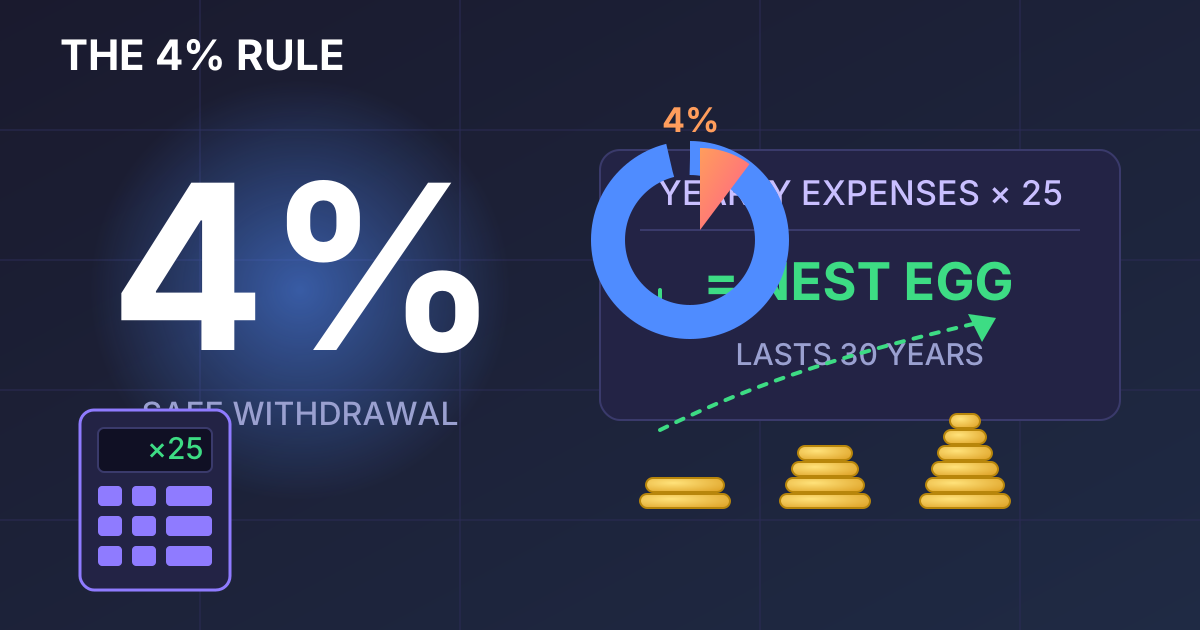
The 4% Rule is a guideline that states you can safely withdraw 4% of your retirement portfolio in your first year of retirement. In subsequent years, you adjust that dollar amount for inflation. If you follow this rule, historical data suggests a very high probability that your money will last for at least 30 years.
How It Works: The Simple Math
The rule provides a beautifully simple way to determine your target retirement savings goal. You just flip the equation:
Your Target Nest Egg = Your Annual Retirement Expenses × 25
(This is the same as dividing your annual expenses by 4%, or 0.04).
A Practical Example: Let's use the estimated expenses from our table above. If you need $43,500 per year to live comfortably in retirement:
$43,500 × 25 = $1,087,500
Suddenly, that big, scary question has a concrete answer. Your target is approximately $1.1 million. This number gives you a clear goal to work toward.
Pros and Cons of the 4% Rule
The rule was born from a 1994 study by financial advisor William Bengen, who analyzed historical stock and bond returns. While revolutionary for its simplicity, it's essential to understand its strengths and weaknesses.
| Pros | Cons |
|---|---|
| Simplicity: Easy to understand and calculate. | Based on Historical Data: Past performance is not a guarantee of future results. |
| Provides a Clear Goal: Gives you a tangible savings target. | Inflexible: Doesn't account for market downturns, especially early in retirement (Sequence of Returns Risk). |
| Historically Reliable: Has held up well over most 30-year periods in the past. | Assumes a 30-Year Retirement: If you retire early or live longer, it may not be sufficient. |
| Accounts for Inflation: The rule adjusts withdrawals to maintain purchasing power. | Can Be Too Conservative: In good market years, it might lead you to underspend and leave a large inheritance unintentionally. |
Beyond the 4% Rule: Modern and Dynamic Strategies
The biggest critique of the 4% Rule is its rigidity. Your life isn't static, and neither is the stock market. Modern retirement strategies often incorporate more flexibility to adapt to changing circumstances.
The Dynamic Withdrawal Strategy
Instead of taking out the same inflation-adjusted amount every year, dynamic strategies adjust your withdrawals based on portfolio performance.
- The Guardrail Method: You set a target withdrawal rate (e.g., 5%) but create upper and lower "guardrails" (e.g., 4% and 6%). If a great market year pushes your withdrawal rate below 4% of your new portfolio balance, you give yourself a raise. If a bad market year pushes it above 6%, you take a small pay cut until things recover. This helps you preserve capital during downturns and enjoy the fruits of bull markets.
- The Bucket Strategy: This popular method involves segmenting your portfolio into different "buckets" based on time horizon:
- Bucket 1 (Short-Term): 1-3 years of living expenses in cash or cash equivalents (like high-yield savings accounts). This is your safety net. You draw your income from here, so you never have to sell stocks during a market crash.
- Bucket 2 (Mid-Term): 3-10 years of expenses in stable, income-producing assets like bonds. This bucket is used to refill Bucket 1.
- Bucket 3 (Long-Term): The rest of your money in growth-oriented assets like stocks (e.g., index funds). This is your engine for long-term growth to outpace inflation.
Factoring in Other Income Streams
The 4% rule assumes your portfolio is your only source of income. But most people have other resources. Make sure to subtract any guaranteed income from your annual expense needs before doing your calculation.
Annual Expenses - (Social Security + Pensions + Other Income) = Annual Portfolio Withdrawal Need
If your annual need is $50,000, but you'll receive $25,000 from Social Security, you only need your portfolio to generate $25,000.
Your new target nest egg would be: $25,000 x 25 = $625,000. This makes the goal significantly more attainable.
The Practical Steps: Organizing Your Financial Life
Calculating your number is just one part of the equation. A successful retirement plan relies on meticulous organization. You need a clear and accessible record of your financial life, not just for your own planning, but for your spouse or heirs who may one day need to manage it.
Building Your Retirement Dossier
Think of this as creating a central hub for all your important financial information. This digital dossier should include:
- Bank and investment account statements
- Tax returns from the last 7 years
- Insurance policies (life, health, property)
- Wills, trusts, and power of attorney documents
- Deeds to property
- A list of all digital accounts and passwords
Gathering these documents is the first step. The next is to digitize and organize them securely.
Digitizing and Securing Your Documents
Having a digital archive of your most important documents is crucial for both security and accessibility. As you scan and download decades of financial statements, tax forms, and legal papers, you'll find the total file size can become quite large. To save space and make your archive easier to manage, you can Compress Files into a single, manageable ZIP archive. This not only saves space on your cloud storage or external hard drive but also makes the entire collection easier to encrypt and share securely with a trusted financial advisor or family member.
Over time, you might receive documents in various formats. A brokerage firm might send an annual report as a RAR file, while an accountant might use 7Z for security. To maintain a standardized and easily accessible archive, using a converter is a smart move. For instance, a tool like our free 7Z to ZIP converter lets you quickly standardize these files into the universally accepted ZIP format without installing any software.
And when you need to quickly access a specific document from a large compressed folder without unpacking the whole thing, our browser-based tool to Decompress Files is invaluable. It lets you extract what you need privately and securely, as no files are ever uploaded to our servers, respecting your financial privacy.
Your Path to a Confident Retirement
Figuring out how much money you need to retire can feel like an insurmountable challenge, but it's a solvable problem. By breaking it down, you can transform anxiety into action.
Here’s a recap of your path forward:
- Define Your Dream: Get specific about the lifestyle you want in retirement.
- Estimate Your Expenses: Create a detailed mock budget to understand your annual spending needs.
- Use the 4% Rule as a Starting Point: Calculate your initial savings goal by multiplying your annual expenses by 25.
- Refine Your Strategy: Consider dynamic withdrawal methods and factor in other income sources like Social Security to create a more resilient plan.
- Get Organized: Build a comprehensive and secure digital dossier of your financial life.
The journey to a comfortable retirement is a marathon, not a sprint. The most important step is the one you take today. Start by calculating your number, organizing your documents, and creating a plan. Your future self will thank you.