Pay Off Student Loans Fast: Your Realistic 2026 Guide
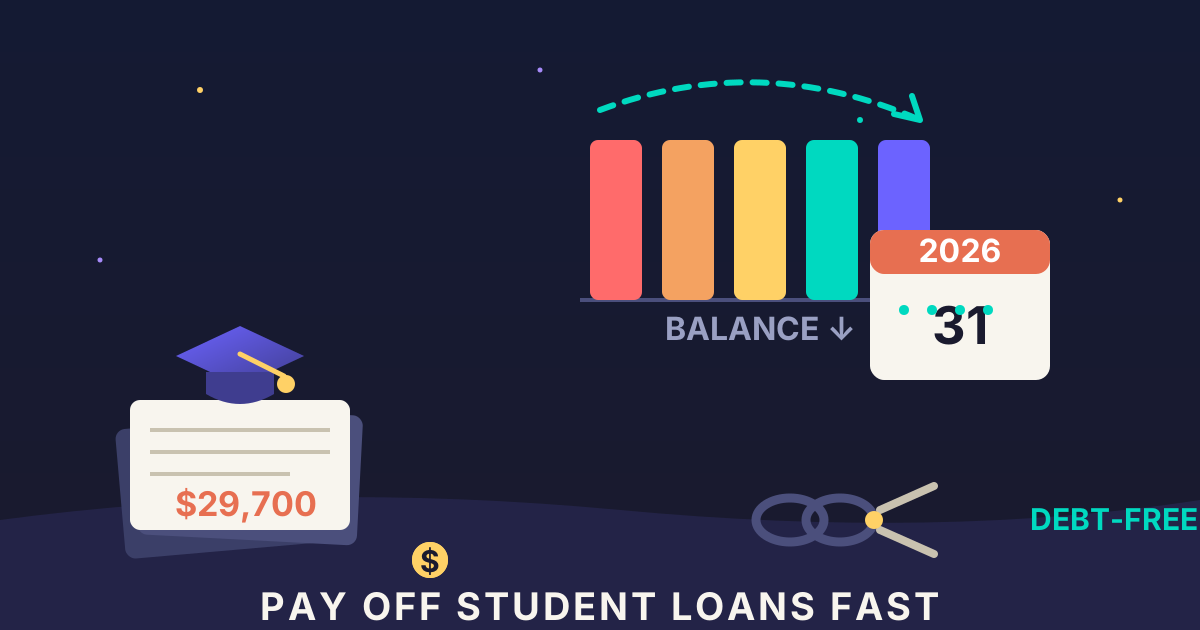
The weight of student loan debt can feel overwhelming. It's a constant presence, influencing major life decisions from buying a home to starting a family. With the economic landscape constantly shifting, creating a plan to tackle this debt can feel like trying to hit a moving target. But what if you could have a clear, actionable strategy designed for right now? A realistic plan for 2026 that doesn't rely on lottery winnings or extreme deprivation, but on smart, consistent steps that lead to real freedom.
This isn't another article telling you to just "stop buying lattes." This is a comprehensive guide to understanding your debt, choosing the right strategy, and systematically dismantling your student loan balance. We'll break down the exact steps you need to take to make 2026 the year you take back control of your finances and accelerate your journey to becoming debt-free.
Step 1: Get a Crystal-Clear Picture of Your Debt
You can't fight an enemy you don't understand. The first and most critical step is to get a complete, unflinching look at your total student loan situation. This means gathering every piece of information about every single loan you have. It might feel intimidating, but this clarity is the foundation of your entire plan.
How to Find All Your Student Loans
Your loans are likely split between federal and private lenders. Here’s how to track them all down:
- Federal Loans: The definitive source for all your federal student loans is the official National Student Loan Data System (NSLDS), accessible through your Federal Student Aid account at StudentAid.gov. Log in to see a full dashboard of your federal loans, including the original amount, current balance, interest rate, and loan servicer.
- Private Loans: These won't appear on the federal site. The easiest way to find them is to pull your free annual credit report from AnnualCreditReport.com. All your private student loan accounts will be listed there, along with the lenders.
Create a Master Loan Spreadsheet
Once you've located all your loans, it's time to organize the information. Create a simple spreadsheet with the following columns for each loan:
- Loan Name/Identifier (e.g., "FedLoan Subsidized 1")
- Lender/Servicer (e.g., Nelnet, MOHELA, SoFi)
- Loan Type (Federal or Private)
- Current Principal Balance
- Interest Rate (%)
- Minimum Monthly Payment
- Loan Term (in years)
This spreadsheet is now your command center. It allows you to see everything in one place, sort by interest rate or balance, and track your progress as you start paying down the debt. As you download statements and documents from various lender websites, you may end up with a lot of files. To keep your financial records tidy, it’s helpful to Compress Files into a single, password-protected ZIP archive for safekeeping.
Step 2: Choose the Right Repayment Strategy
With a clear view of your debt, you can now choose a strategy. The goal is to pay more than the minimum, but how you direct that extra money matters. The two most popular methods are the Debt Avalanche and the Debt Snowball.
The Debt Avalanche Method
How it works: You continue to make minimum payments on all your loans. Then, you throw every extra dollar you have at the loan with the highest interest rate. Once that loan is paid off, you roll its payment amount (the minimum plus the extra you were paying) onto the loan with the next-highest interest rate. You repeat this until all loans are gone.
- Pros: This is the most mathematically sound method. It saves you the most money in interest over the life of your loans because you're eliminating the most expensive debt first.
- Cons: It might take a while to pay off that first loan, especially if it has a large balance. This can make it feel like you're not making progress, which can be demotivating for some.
The Debt Snowball Method
How it works: You make minimum payments on all loans. Then, you focus all your extra money on the loan with the smallest balance, regardless of the interest rate. Once that loan is paid off, you roll its entire payment amount into the next-smallest loan, creating a "snowball" of payment that grows over time.
- Pros: You get quick psychological wins. Paying off that first loan, even if it's small, provides a huge boost of motivation and makes you feel like you're succeeding. This momentum can be powerful.
- Cons: You will pay more in total interest compared to the avalanche method because you're leaving high-interest loans to accrue interest for longer.
Which is right for you? If you're motivated by pure numbers and want to save the most money, choose the Avalanche. If you need early wins to stay motivated and build good habits, choose the Snowball.
Step 3: Find Extra Money to Accelerate Repayment
Paying the minimum will keep you in debt for decades. To pay off loans fast, you need to pay more. This extra money has to come from somewhere, and it's usually a combination of increasing your income and decreasing your expenses.
Create a Realistic Budget
Before you can find extra money, you need to know where your money is currently going. Track your spending for a month using an app or a simple notebook. Then, categorize your spending. A popular framework is the 50/30/20 rule:
- 50% on Needs: Housing, utilities, transportation, groceries.
- 30% on Wants: Dining out, entertainment, hobbies, shopping.
- 20% on Savings & Debt Repayment: This is the category you want to maximize.
Look at your "Wants" category first. Where can you trim without feeling completely deprived? Could you cancel a streaming service you barely use? Cook at home one more night a week? The goal is to consciously redirect money from your "Wants" to your student loan payments.
Strategies to Increase Your Income
Cutting expenses has a limit, but your earning potential is theoretically unlimited. Consider these options:
- Negotiate a Raise: Research your market value and schedule a meeting with your boss to discuss your contributions and compensation.
- Find a Side Hustle: The gig economy offers endless options. Drive for a rideshare service, deliver food, become a virtual assistant, or freelance in your area of expertise (writing, design, coding).
- Sell Unused Items: Go through your home and sell clothes, electronics, and furniture you no longer need on platforms like Facebook Marketplace or Poshmark.
Treat any extra income as "debt-destroying" money. Apply it directly to your loans before you have a chance to spend it elsewhere.
Step 4: Automate and Optimize Your Payments
Making your repayment plan as seamless as possible is key to long-term success. This involves setting up systems that work for you, not against you.
Set Up Autopay for a Discount
Most federal and many private lenders offer a 0.25% interest rate reduction for enrolling in automatic payments. It's a small but effortless win. It also ensures you never miss a payment, which is crucial for your credit score.
Make Extra Payments the Right Way
When you send extra money to your loan servicer, you must be specific. If you don't, they might apply it as a pre-payment for future months, which doesn't help you pay down the principal faster. When making an extra payment online or by phone, explicitly state: "Please apply this extra payment to the principal balance of Loan ID [insert loan number]. Do not advance my due date."
Consider Student Loan Refinancing
Refinancing is the process of taking out a new private loan with a lower interest rate to pay off your existing student loans. This can be a powerful tool, but it's not for everyone.
- Pros: A lower interest rate means more of your payment goes to principal, helping you get out of debt faster and cheaper. It also consolidates multiple loans into one simple monthly payment.
- Cons: When you refinance federal loans into a private loan, you permanently lose all federal protections. This includes access to Income-Driven Repayment (IDR) plans, loan forgiveness programs like Public Service Loan Forgiveness (PSLF), and generous deferment and forbearance options.
Who should consider it? Refinancing is often a good option if you have a stable job, a good credit score (typically 650+), and high-interest private loans. It's riskier if you have federal loans and work in a volatile industry or the public sector.
When you apply for refinancing, lenders require a lot of documentation like tax returns, pay stubs, and account statements. Gathering these can be a hassle. If you have documents in various compressed formats, a simple online tool can help. For instance, you can use a RAR to ZIP converter to standardize your files before uploading them to an application portal. If a lender has a specific or unusual format requirement, a tool that converts ZIP to TAR can be a lifesaver.
Your 2026 Action Plan: A Month-by-Month Guide
Here’s how to put it all together. Use this timeline to guide your efforts throughout the year.
| Quarter | Months | Key Actions |
|---|---|---|
| Q1 | Jan-Mar | Assess & Organize: Gather all loan documents. Build your master spreadsheet. Track your spending for 30 days and create your first budget. Identify at least 3-5 expenses to cut. |
| Q2 | Apr-Jun | Strategize & Act: Choose your repayment method (Avalanche or Snowball). Set up autopay for the 0.25% discount. Make your first targeted extra payment. Research refinancing options if they fit your profile. |
| Q3 | Jul-Sep | Accelerate: Start one income-boosting activity (ask for a raise, start a side hustle). Review your budget and find another $50 to cut. Apply any "found money" (like a birthday gift or bonus) directly to your target loan. |
| Q4 | Oct-Dec | Review & Refine: Update your master spreadsheet with a full year of progress. Celebrate how much principal you've paid down! Analyze what worked and what didn't, and set your aggressive repayment goal for 2027. |
Conclusion: Your Debt-Free Future Awaits
Paying off student loans fast is a marathon, not a sprint. The key to success in 2026 and beyond isn't a secret trick; it's the consistent application of a solid plan. By getting organized, choosing a smart strategy, finding ways to pay more than the minimum, and optimizing your payments, you can make incredible progress.
Remember the steps: Assess, Strategize, Accelerate, and Automate. Each small decision to put an extra $20 toward your loans, to say no to an unnecessary purchase, or to work an extra hour is a vote for your future financial freedom. The journey starts with a single step, and your first one is to get organized.
Ready to take control? Start by gathering your financial records. If you need help managing your documents, check out Practical Web Tools' suite of free, privacy-focused file management tools to help you on your way.