Amortization Calculator Explained: Master Your Loan Repayments

Your Ultimate Guide to Using an Amortization Calculator
Taking on a significant loan—whether it's for a house, a car, or your education—is a major financial step. You see the big number, the interest rate, and the monthly payment, but the path from start to finish can feel like a dense fog. How much are you really paying in interest? What would happen if you paid a little extra each month? How much of your payment is actually reducing your debt?
These questions can be overwhelming, leaving you feeling like a passenger on your own financial journey. But what if you could have a detailed roadmap, one that shows you every turn, every milestone, and the final destination of being debt-free? That's precisely what an amortization calculator provides. It's a powerful tool that demystifies the loan repayment process, transforming confusion into clarity and empowering you to take control of your financial future.
In this comprehensive guide, we'll break down everything you need to know about amortization calculators. We'll explore what amortization is, how these calculators work their magic, and how you can leverage them to make smarter financial decisions, potentially saving you thousands of dollars over the life of your loan.
What Exactly Is Amortization?
Before diving into the calculator itself, it's crucial to understand the concept it's built upon: amortization.
In simple terms, amortization is the process of paying off a debt over time through regular, scheduled installments. Each payment you make is split into two parts: one part covers the interest accrued for that period, and the other part goes toward reducing the principal (the original amount you borrowed).
Think of it like chipping away at a large block of ice with a pickaxe. Your loan's principal is the block of ice. Each swing of the pickaxe is your monthly payment. In the beginning, the block is massive, and a large portion of your effort (payment) is spent just clearing away the frost that has formed on the surface (interest). As the block gets smaller, less frost forms, and more of your effort goes into breaking off chunks of the actual ice (principal). Over time, your consistent effort pays off, and the entire block disappears.
This is the core principle of an amortized loan. The payment amount stays the same each month, but the allocation of that payment between interest and principal changes dramatically over the loan's term.
- Early Payments: A larger portion of your payment goes toward interest.
- Later Payments: A larger portion of your payment goes toward the principal.
This is why making extra payments, especially early on, can be so impactful. You're reducing the principal balance faster, which in turn reduces the amount of interest that can accrue in the future.
How an Amortization Calculator Works
An amortization calculator is a simple yet powerful digital tool that does all the complex math for you. It uses a standard amortization formula to determine how your loan will be paid off over its term. While you don't need to know the formula to use the calculator, understanding the inputs and outputs is key.
The Inputs: What You Need to Provide
To get an accurate picture of your loan, you'll need three key pieces of information:
- Loan Amount (Principal): This is the total amount of money you are borrowing. For a mortgage, this would be the price of the home minus your down payment.
- Annual Interest Rate: This is the percentage the lender charges you for borrowing the money. Be sure to use the annual rate (e.g., 6.5%, not the monthly rate).
- Loan Term: This is the length of time you have to repay the loan, typically expressed in years (e.g., 30 years for a mortgage, 5 years for a car loan).
The Outputs: The Financial Clarity You Receive
Once you enter the inputs, the calculator instantly generates a wealth of information:
- Monthly Payment: The fixed amount you will pay each month.
- Total Principal Paid: This will be equal to your original loan amount.
- Total Interest Paid: The total cost of borrowing the money over the entire loan term. This number can often be an eye-opener!
- Amortization Schedule: This is the most valuable output—a detailed, payment-by-payment breakdown of your entire loan.
Decoding Your Amortization Schedule
An amortization schedule is the roadmap we talked about earlier. It's typically presented in a table format and shows you exactly where your money is going with every single payment. Let's look at an example for a $300,000 loan at a 6% interest rate over 30 years.
Your calculated monthly payment would be approximately $1,798.65.
Here’s what the first few months and the last few months of the schedule would look like:
| Payment # | Payment Amount | Principal Paid | Interest Paid | Remaining Balance |
|---|---|---|---|---|
| 1 | $1,798.65 | $298.65 | $1,500.00 | $299,701.35 |
| 2 | $1,798.65 | $300.15 | $1,498.50 | $299,401.20 |
| 3 | $1,798.65 | $301.65 | $1,497.00 | $299,099.55 |
| ... | ... | ... | ... | ... |
| 358 | $1,798.65 | $1,772.33 | $26.32 | $3,546.99 |
| 359 | $1,798.65 | $1,781.19 | $17.46 | $1,765.80 |
| 360 | $1,798.65 | $1,789.83 | $8.82 | $0.00 |
Key Observations from the Schedule:
- Payment 1: Out of your nearly $1,800 payment, a staggering $1,500 goes to interest, and only about $300 reduces your actual debt.
- The Shift: Notice how with each payment, the amount going to principal slowly increases, while the interest portion decreases.
- Payment 360 (Final Payment): By the end of the loan, almost the entire payment ($1,790) goes toward the principal, with less than $9 paid in interest.
- Total Cost: For this $300,000 loan, the total interest paid over 30 years would be a whopping $347,514.40—more than the original loan amount!
This detailed breakdown is invaluable for financial planning and motivates strategies to reduce that total interest figure.
Advanced Strategies: Using the Calculator for Smarter Decisions
An amortization calculator isn't just for seeing your payment schedule; it's a sandbox for financial strategy. Here’s how you can use it to your advantage:
1. The Power of Extra Payments
What if you paid just a little extra each month? Let's use our same $300,000 loan example. What happens if you add just $100 extra to your principal each month?
- Original Loan: Paid off in 30 years. Total interest: $347,514.
- With $100 Extra/Month: Paid off in 25 years and 4 months (4 years and 8 months sooner!). Total interest: $288,582. You would save over $58,900 in interest!
Use the calculator to experiment. Try different extra payment amounts—the cost of one less dinner out per month, for example—and see the long-term impact.
2. Comparing Loan Terms
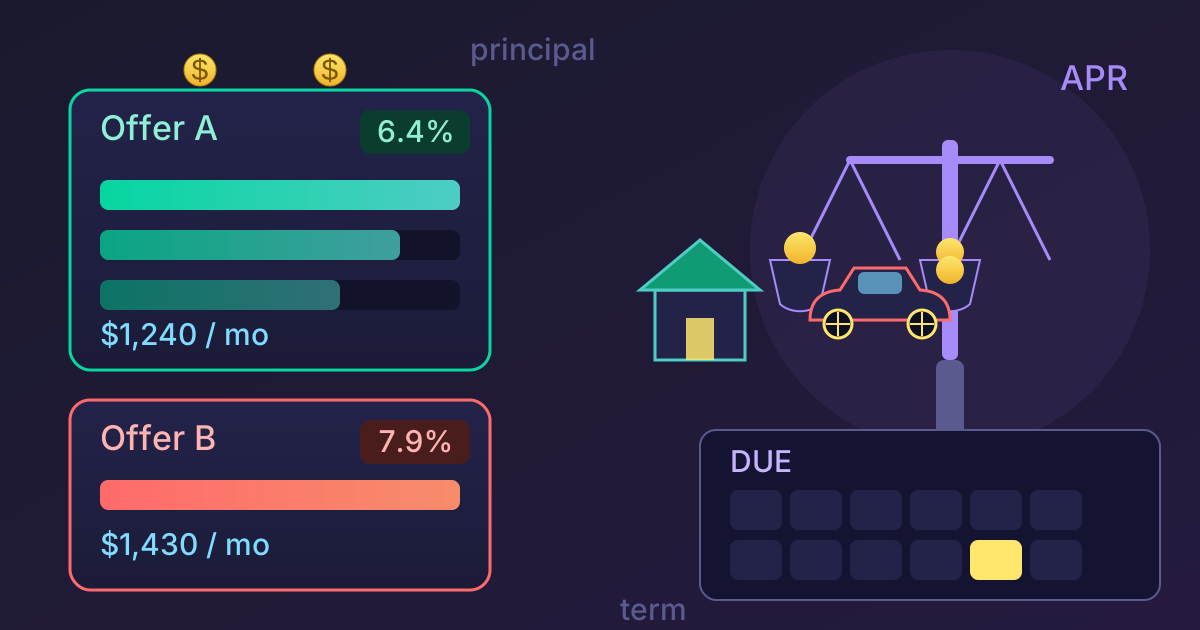
Should you take a 15-year mortgage or a 30-year mortgage? A 15-year loan has higher monthly payments but a lower interest rate and significantly less total interest.
- 30-Year Loan @ 6%: $1,798.65/month. Total interest: $347,514.
- 15-Year Loan @ 5.5%: $2,450.04/month. Total interest: $141,007.
The monthly payment is about $650 higher, but you save over $206,000 in interest and own your home free and clear 15 years sooner. An amortization calculator lets you compare these scenarios side-by-side to see what fits your budget and long-term goals.
3. Analyzing Refinancing Opportunities
If interest rates have dropped since you took out your loan, refinancing might be a good option. Use an amortization calculator to model the new loan. Enter your current remaining balance, the new (lower) interest rate, and the new term. This will show you your potential new monthly payment and total interest savings, helping you decide if the closing costs of a refinance are worth it.
Managing Your Financial Documents
Once you've used an amortization calculator to map out your loan strategy, you'll likely want to save or download the schedule. These schedules, often saved as PDF or CSV files, are important financial documents. For a 30-year mortgage, you'll be referring to this plan for decades!
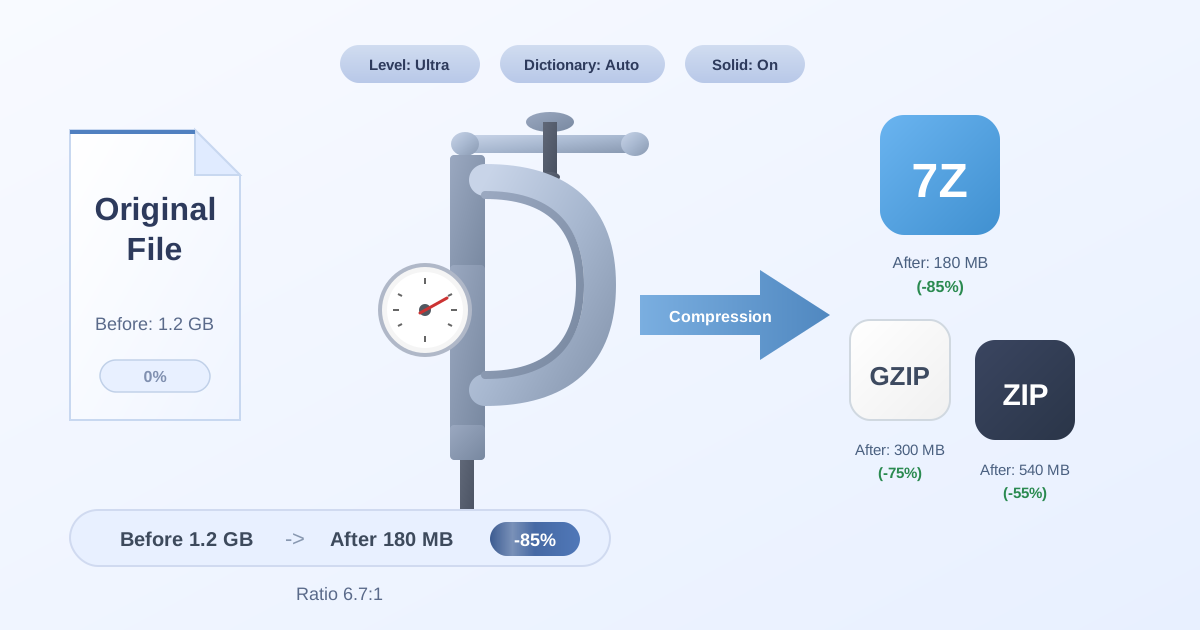
It's good practice to keep all your loan-related documents—the original agreement, your amortization schedule, and records of extra payments—organized together. Over the years, this can become a lot of data. To keep things tidy and secure, consider bundling them into a single, organized archive. Using a free online tool to Compress Files is an excellent way to save storage space and make your financial records easier to manage or email to a co-borrower or financial advisor.
Sometimes you might receive financial documents from an institution in a less common format, like a .7z file. If you need to make it more universally accessible, a quick 7Z to ZIP conversion can ensure you can open it on any device without special software. Staying organized with your digital files is a small step that supports your larger financial goals.
Conclusion: Take Command of Your Debt
An amortization calculator is more than just a number cruncher. It's a tool of financial empowerment. It pulls back the curtain on the complex world of loans, providing you with the clarity needed to understand exactly how your debt works and how you can conquer it more efficiently.
By understanding your amortization schedule, you can move from being a passive debtor to an active strategist. You can see the direct impact of your decisions, whether it's making small extra payments or choosing a shorter loan term. This knowledge transforms debt from a source of stress into a manageable challenge with a clear finish line.
Don't let your loans manage you. Take the first step today by finding a reliable amortization calculator and plugging in your own numbers. Experiment with different scenarios and build a payment plan that aligns with your financial aspirations. And as you organize your digital life, from financial plans to personal files, explore Practical Web Tools for a full suite of free, private, and easy-to-use utilities to help you along the way.